The Swedish Startup Making Home Energy as Simple as a Netflix Subscription
STOCKHOLM — May 2026 – Sweden is facing an electricity crisis. The country's nuclear fleet, which once provided the backbone of its famously clean energy grid, is aging. New nuclear plants are over a decade away. Transmission bottlenecks between the hydro-rich north and the power-hungry south have turned what was once Europe's most stable electricity market into a source of anxiety for millions of households. In December 2025, a fierce storm knocked out power to tens of thousands of homes, some of which waited days for reconnection. The Swedish energy system, long a model of reliability, is showing cracks.
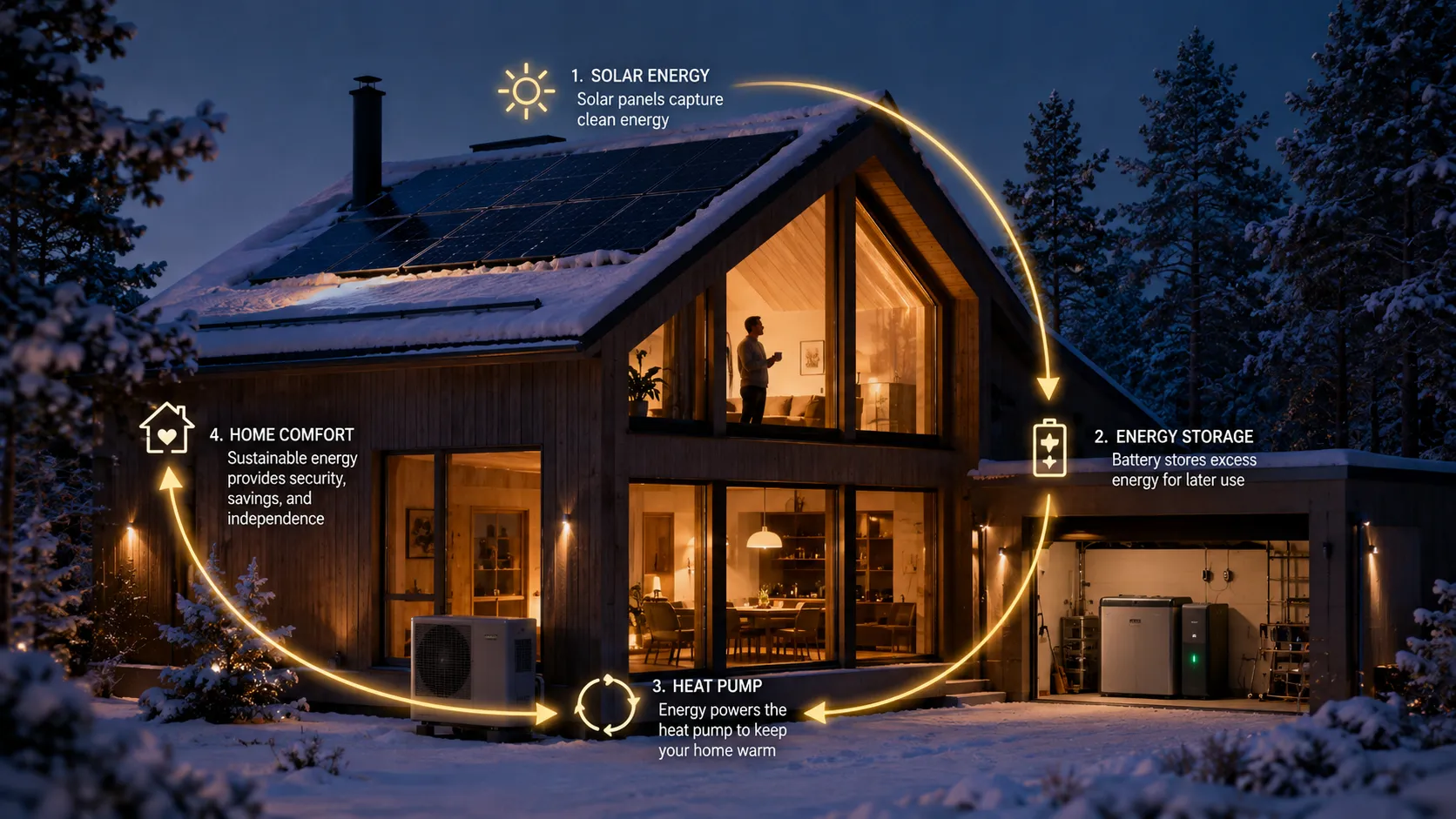
Into this breach has stepped a startup with a proposition so simple it sounds like a consumer internet pitch rather than an energy infrastructure play: pay a fixed monthly fee, and we will install solar panels, a battery, and a heat pump on your house. We will own the hardware. We will handle the maintenance. You will get electricity, heat, and the quiet satisfaction of knowing your home is no longer dependent on a strained grid. No upfront cost. No installation stress. No repair bills. Just a subscription.
The startup is Elvy. In mid-May 2026, it closed a €5.9 million ($7 million) equity round led by Daft Capital and Essential Capital, with participation from Mathias Kamprad—a member of the IKEA founding family—and other angel investors. The round was announced alongside news that Elvy had secured a €480 million credit facility from Scayl, a Swedish debt-funding platform, giving the company the financial firepower to deploy hardware at scale. Former Klarna executive Knut Frängsmyr joined as Chairman of the Board. The message was unmistakable: this is not a science project. This is a capital-mobilization machine designed to build a distributed energy utility, one Swedish home at a time.
The Subscription Model Meets the Energy Transition
Elvy was founded in 2023 by Johan Outinen and David Wedar, two entrepreneurs who understood that the energy transition had a structural problem that had nothing to do with technology. Solar panels work. Batteries work. Heat pumps work. The problem was not the hardware. It was the business model. Homeowners were being asked to make five-figure upfront investments in systems they did not fully understand, from vendors they did not fully trust, with payback periods measured in decades. The result was predictable: slow adoption, market friction, and a gap between the technology's potential and its real-world deployment.
Elvy's subscription model removes the upfront capital barrier entirely. The company installs and owns the solar panels, batteries, and heat pumps. The homeowner pays a fixed monthly fee that covers hardware, installation, maintenance, repairs, and the household's electricity needs. The contract runs for 15 years. Elvy takes full operational responsibility, using a proprietary AI engine to control and optimize energy generation and consumption across its distributed network. The homeowner gets a warm house, hot water, and a predictable energy bill. Elvy gets a recurring revenue stream that, aggregated across thousands of homes, begins to look like a utility.
The model is resonating. Elvy's subscription base grew tenfold in 2025. In just over 18 months, the company has built 23 megawatts of distributed energy capacity across Sweden—a virtual power plant distributed across hundreds of rooftops, batteries, and heat pumps, all orchestrated by AI. The company plans to invest over €1 billion alongside partners to reach 600 megawatts of capacity within three years. That is enough to power a small city.
The IKEA Connection and the Klarna Playbook
The involvement of Mathias Kamprad and Knut Frängsmyr is not incidental. It signals the convergence of two powerful Swedish business traditions: affordable design for the masses and frictionless fintech for the consumer.
Kamprad, whose family built IKEA into the world's largest furniture retailer by making well-designed products accessible to ordinary people, clearly sees a parallel. Elvy is applying the same logic to home energy: design a great system, standardize the components, and remove the cost barriers that prevent adoption. The €480 million credit facility from Scayl provides the capital to manufacture and install hardware at scale—the energy equivalent of IKEA's flat-pack supply chain.
Frängsmyr, who spent years at Klarna during its transformation from a Swedish startup into a global payments giant, brings expertise in consumer credit, regulatory navigation, and the operational discipline required to scale a subscription business across borders. His appointment as Chairman signals that Elvy is thinking about expansion well beyond Sweden. The company has already indicated plans to scale across Europe, and the credit facility provides the firepower to finance hardware deployment in multiple markets.
The Swedish context matters. Sweden has one of the highest rates of homeownership in Europe, a population that is technologically literate and environmentally conscious, and an electricity market that is increasingly volatile. It is, in many ways, the perfect testbed for a home energy subscription model. If Elvy can prove the model at scale in Sweden, the addressable market expands to every European country with high electricity prices, aging grid infrastructure, and a growing appetite for energy independence.
What Every Entrepreneur Can Learn
Elvy's story offers a masterclass in business model innovation applied to a legacy industry.
First, the barrier to adoption is often the payment structure, not the product. Solar panels and heat pumps are mature, reliable technologies. What has held back mass adoption is not technological risk but financial friction. Elvy did not invent a better solar panel. It invented a better way to pay for the solar panel. Entrepreneurs in any capital-intensive industry should ask: is the problem the product, or is it the purchase?
Second, subscriptions can transform hardware businesses. The subscription model is not just for software. When applied to physical assets, it aligns incentives in powerful ways. The company that owns the hardware has every incentive to maintain it well, because downtime means lost revenue. The customer who pays a flat fee has every incentive to let the company manage the system optimally, because the energy savings accrue to the company, not the customer. The result is a long-term relationship rather than a one-time transaction, with all the compounding benefits that recurring revenue brings to enterprise value.
Third, the energy transition is a capital-mobilization problem. The technology to decarbonize residential energy exists. What is missing is the financial infrastructure to deploy it at scale. Elvy's €480 million credit facility is as important as its solar panel technology. The entrepreneurs who solve the financing problem will capture as much value as those who solve the engineering problem.
The Road Ahead
Elvy's path will not be without obstacles. The subscription model for home energy requires enormous upfront capital, and the company is betting that the €480 million credit facility will be sufficient to reach scale before competitors erode its early lead. The European home energy market is attracting well-funded entrants—Norway's Otovo, Germany's 1KOMMA5°, and a growing number of solar-as-a-service startups—and the competitive landscape will intensify. Regulatory frameworks for virtual power plants and distributed energy resources vary across European markets, and navigating that patchwork will require patience and localization.
But the tailwinds are powerful. European electricity prices remain elevated by historical standards. Governments across the continent are offering incentives for residential solar and heat pump adoption. And the psychological shift triggered by energy insecurity—first by the Russia-Ukraine war, then by storm-driven blackouts—has permanently altered consumer attitudes toward grid dependence. Elvy is selling not just electricity, but autonomy. In a world where the grid is no longer a guarantee, that is a compelling offer.
Johan Outinen has said that Elvy's ambition is to make home energy "as easy as a Netflix subscription." It is a deceptively simple phrase that contains a profound business insight. Netflix did not invent television. It changed the way people pay for it. Elvy is attempting the same move for the home, and the early returns suggest that the market is ready.


