The Superstar, The Chief Minister, and The ₹10,000 Crore Mirage: Inside Salman Khan's Audacious Township Bet—And the Clarification That Followed
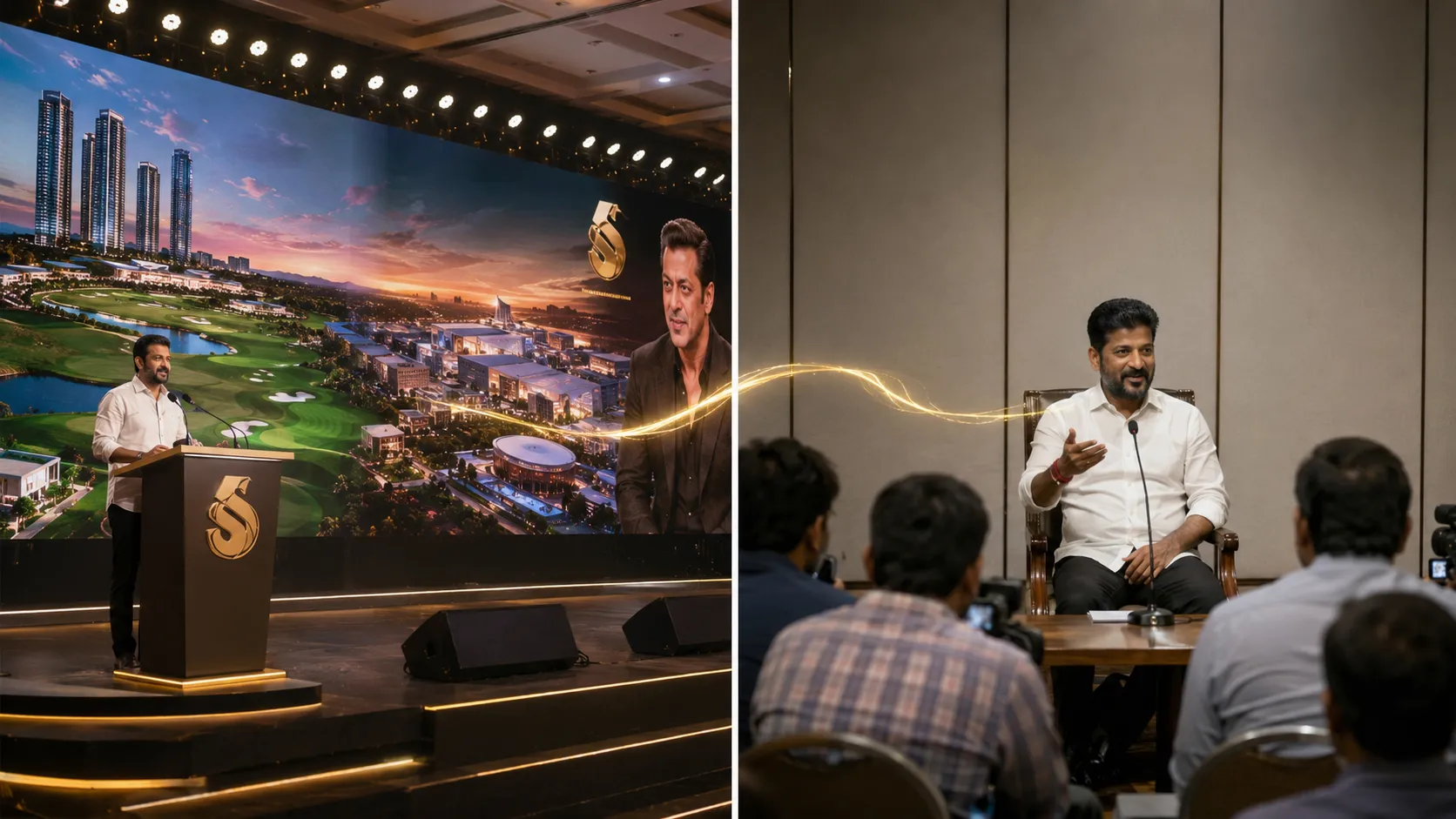
HYDERABAD — May 27, 2026 — On December 8, 2025, the first day of the Telangana Rising Global Summit, a press release landed in the inboxes of journalists across the country that momentarily rewrote the ceiling of what a Bollywood star could build. Salman Khan Ventures Private Limited—the business arm of the actor whose films have grossed over ₹5,000 crore at the Indian box office and whose net worth is estimated at ₹3,225 crore—had signed a Memorandum of Understanding with the Telangana government. The announcement was staggering in its scale: a ₹10,000 crore integrated township and world-class film studio, spread across 500 acres in the proposed Bharat Future City on the outskirts of Hyderabad. It was, by a factor of roughly ten, the largest single real estate bet ever announced by an Indian film personality, and it promised to transform not just the actor's business empire but the geography of India's creative economy.
The township, as described in the MoU, would be a self-contained world: premium residential developments, luxury hotels, mixed-use commercial zones, high-street retail, a championship golf course, a race course, curated nature trails, shooting ranges, and at its heart, a state-of-the-art film production ecosystem capable of hosting global cinema and OTT projects. Chief Minister A. Revanth Reddy welcomed the investment, calling it a "milestone for Telangana's creative sector" and assuring "full government support in terms of approvals, land structuring and infrastructure connectivity." The announcement was made alongside investment pledges from Reliance Vantara, Trump Media and Technology Group, Brookfield, and the GMR Group—a combined ₹5.39 lakh crore in commitments that were designed to signal Telangana's arrival as India's most investor-friendly state.
Eleven days later, on December 19, the Chief Minister held an informal press briefing and walked the entire thing back. "The proposed Rs 10,000 crore integrated township and film studio project announced by Salman Khan Ventures during the Global Summit was only an expression of interest, and not a finalised investment," he said. "No agreement had been formalised so far." He added that the project, if it ever materialised, would be awarded through a global competitive bidding process—not on a nomination basis—and that Salman Khan Ventures would have to compete with other bidders, including Middle East-based firms that had also expressed interest. The superstar's ₹10,000 crore headline had been, in effect, a handshake, not a contract. The difference between the two was the difference between a dream and a deal—and the dream was still waiting to be funded.
The MoU Economy
The Salman Khan township episode is, in one sense, a story about a single celebrity and a single project. But it is also a story about a broader phenomenon that has defined Indian business for decades: the MoU economy. Every Indian state government hosts investment summits—the Vibrant Gujarat Global Summit, the Make in India Week, the Telangana Rising Global Summit—at which corporate leaders, celebrities, and government officials pose for photographs in front of LED screens displaying eight-figure investment numbers. The MoUs are signed with great fanfare. The press releases are issued. The headlines are written. And then, in the months and years that follow, a significant percentage of those MoUs quietly expire, unfulfilled, their promised investments never materialising.
The Telangana Rising Global Summit of December 2025 was, by any measure, a spectacular success as a signalling exercise. The state government announced that it had secured investment commitments worth ₹5.39 lakh crore—a figure that represented roughly 25 percent of Telangana's entire annual GDP. The commitments came from some of the largest companies in the world: Reliance Vantara, Trump Media and Technology Group, Brookfield Axis Ventures, GMR Group. And then there was Salman Khan, the Bollywood superstar whose presence at the summit generated more headlines than any of the corporate commitments combined. The actor was not present in person, but his company's announcement—₹10,000 crore, 500 acres, a film studio, a golf course, a race course—was the most visually arresting and emotionally resonant pledge of the entire summit. It was a promise that Telangana could be more than a technology hub. It could be a creative capital, a luxury destination, a city of the future.
The Chief Minister's subsequent clarification was not a repudiation of the MoU model. It was a refinement of it. The MoU, he explained, was a signal of intent—a way of telling the world that a particular company was interested in a particular project. But it was not a contract, and it did not confer any exclusive rights. The actual project would be awarded through a competitive process, and the winning bidder would receive the land on a freehold basis—because, as the CM noted, "no company will take interest if the land is not transferred in their name." The clarification was factually accurate and legally precise. It was also a reminder that the distance between an MoU and a completed project is measured in years, not weeks, and that most of the MoUs signed at Indian investment summits never cross that distance.
The controversy that followed the summit—over land transfers, forest land disputes, and the legacy of the shelved Pharma City project—added a layer of complexity to the Salman Khan Ventures proposal. The land identified for the Future City had originally been acquired for Pharma City, a project that the previous BRS government had championed and that the current Congress government had promised to shelve. Farmers who had been displaced by the original land acquisition were protesting. The Supreme Court had intervened over the destruction of forest land near the University of Hyderabad. The movement against Pharma City had urged global investors to stay away. Into this volatile environment stepped Salman Khan Ventures with a ₹10,000 crore MoU that was, in the Chief Minister's own words, "only an expression of interest." The politics of the project were as complex as the economics, and the economics were still being written.
The Superstar's Second Act
To understand why Salman Khan would venture into real estate development—a sector that has consumed the fortunes of far wealthier and more experienced businesspeople—one must understand the architecture of his business empire.
As of 2026, Salman Khan's net worth is estimated at approximately ₹3,225 crore, making him one of the wealthiest actors in the world. His income streams are diversified across film fees (reportedly over ₹100 crore per film plus profit-sharing), television (he has hosted 15 seasons of Bigg Boss, earning approximately ₹250 crore over the franchise's lifetime), brand endorsements (he is the face of over 20 major brands), and his production house, Salman Khan Films, which has produced several commercially successful films. He owns a luxurious apartment at The Address Downtown in Dubai, a farmhouse in Panvel, and a portfolio of real estate holdings in Mumbai. His charitable foundation, Being Human, operates a clothing line whose proceeds fund education and healthcare for underprivileged children.
But for all his wealth and influence, Salman Khan has never built a township. He has never developed a golf course, never managed a hospitality chain, and never operated a film studio at the scale he is proposing. The ₹10,000 crore township is not just a financial bet. It is a bet on his ability to transition from the business of being Salman Khan—an enterprise built on his charisma, his fan following, and his box-office draw—to the business of building physical infrastructure that will outlast his film career. The transition is not unprecedented. Other Indian celebrities have diversified into real estate: Shah Rukh Khan has invested in luxury developments in Dubai and owns a production studio in Mumbai; Amitabh Bachchan has bought and sold premium properties across the country; Ranbir Kapoor recently purchased a land parcel in Ayodhya for ₹3.31 crore. But none of them has attempted anything at the scale of a 500-acre integrated township.
The film studio component of the project is, in some ways, the more credible piece. Hyderabad is already India's second-largest film production hub after Mumbai, home to Ramoji Film City—the world's largest integrated film studio complex—and a growing ecosystem of VFX, animation, and post-production companies. A new, state-of-the-art studio facility, equipped for large-format productions and OTT content, would be a logical addition to that ecosystem. The Telangana government has been actively courting the film industry with incentive-driven policy reforms, international production facilitation, and AVGC-XR (animation, visual effects, gaming, comics, extended reality) innovation centres. Salman Khan's brand, combined with a world-class production facility, could attract film projects that currently go to Mumbai, Chennai, or overseas. The studio, unlike the township, has a clear business case and a clear path to revenue.
But the studio is only one component of the ₹10,000 crore plan. The rest—the residences, the hotels, the golf course, the race course—is a real estate play of a scale that requires a completely different set of competencies: land acquisition, construction management, regulatory navigation, hospitality operations, and the patience to wait years for a return on capital that has been deployed upfront. The question that hangs over the project is whether Salman Khan Ventures possesses those competencies—or whether it will need to partner with established developers who do. The CM's clarification that the project would be awarded through competitive bidding suggests that the government, at least, believes that partnerships will be necessary.
The Ajay Devgn Parallel
The Salman Khan Ventures announcement was not the only Bollywood-related pledge made at the Telangana Rising Global Summit. Actor-producer Ajay Devgn also unveiled plans to establish an international-standard film studio equipped with advanced animation, VFX, and AI-powered smart studio technologies. Like the Salman Khan project, the Ajay Devgn studio was announced as part of the state's broader push to attract creative-economy investments to the Bharat Future City.
The Devgn announcement, however, was more modest in scale and more specific in scope. It was a film studio—not a township, not a golf course, not a race course. It was a production facility, designed to serve the growing demand for high-quality studio infrastructure in a city that already hosts one of the world's largest film production complexes. The veteran producer D. Suresh Babu, who owns Ramanaidu Studios in Hyderabad, publicly welcomed the announcement. "We welcome Ajay Devgn, along with other Bollywood and Kollywood stars, to Hyderabad to set up film studios," he said. "They will bring their establishments and teams, creating more job opportunities for local workers and technicians."
The contrast between the two announcements—Devgn's focused studio investment versus Khan's sprawling township-plus-studio vision—illustrates the spectrum of celebrity-driven development in India. On one end, a film star leverages their industry expertise to build a production facility that extends their existing business. On the other, a film star leverages their brand to build an entire city—a vision that requires not just capital and brand, but a set of development capabilities that no film star, however wealthy, has ever demonstrated at scale. The fact that both announcements were welcomed by the state government, and that both remain, as of May 2026, in the early stages of development, reflects the same fundamental dynamic: the MoU economy thrives on optimism, but it is built on contingencies.
The Devgn studio, with its narrower scope and its clearer alignment with the actor's core business, is more likely to materialise in something close to the form it was announced. The Khan township, with its vast scale and its dependence on land that is still contested, is more likely to evolve—in scope, in partnership structure, or in timeline—before it becomes a reality. The difference between the two is not a reflection of the actors' respective business acumen. It is a reflection of the vastly different challenges involved in building a film studio versus building a city.
The Future City Context
The Salman Khan township is not being proposed in a vacuum. It is being proposed as part of the Bharat Future City—a 30,000-acre, net-zero, smart-city development on the outskirts of Hyderabad that is the signature urban initiative of the Revanth Reddy government. The Future City is envisioned as a global-scale development with 11 to 12 verticals: an AI city, a health zone, an education zone, a sports arena, and a creative and entertainment district that would house the film studios and townships proposed by Bollywood investors.
The Future City is a project of extraordinary ambition—and extraordinary complexity. The land identified for it was originally acquired for the Pharma City project, which has been the subject of intense controversy, farmer protests, and legal challenges. The Congress government has maintained in the High Court that Pharma City continues, even as it has assured farmers that the project has been shelved. The contradiction has created an environment of legal uncertainty that complicates every investment commitment made at the summit. The movement against Pharma City has urged global investors to stay away. The Supreme Court has intervened over the destruction of forest land. Farmers who were displaced by the original land acquisition are demanding the return of their property. Into this maelstrom walks Salman Khan Ventures with an MoU that, even in the best-case scenario, will take years to translate into a completed project.
The Chief Minister's clarification—that the Salman Khan project was "only an expression of interest"—was, in part, a response to this complexity. The state government cannot simply hand 500 acres of contested land to a Bollywood actor, no matter how famous he is. The land must be legally transferred. The title must be clear. The compensation to farmers must be resolved. The environmental clearances must be obtained. The infrastructure—roads, water, electricity, sewage—must be built. The global tenders must be floated and evaluated. The winning bidder must demonstrate the financial capacity and the technical expertise to execute a project of this scale. Each of these steps is a potential point of failure, and the cumulative probability of all of them succeeding is considerably lower than the MoU signing ceremony would suggest.
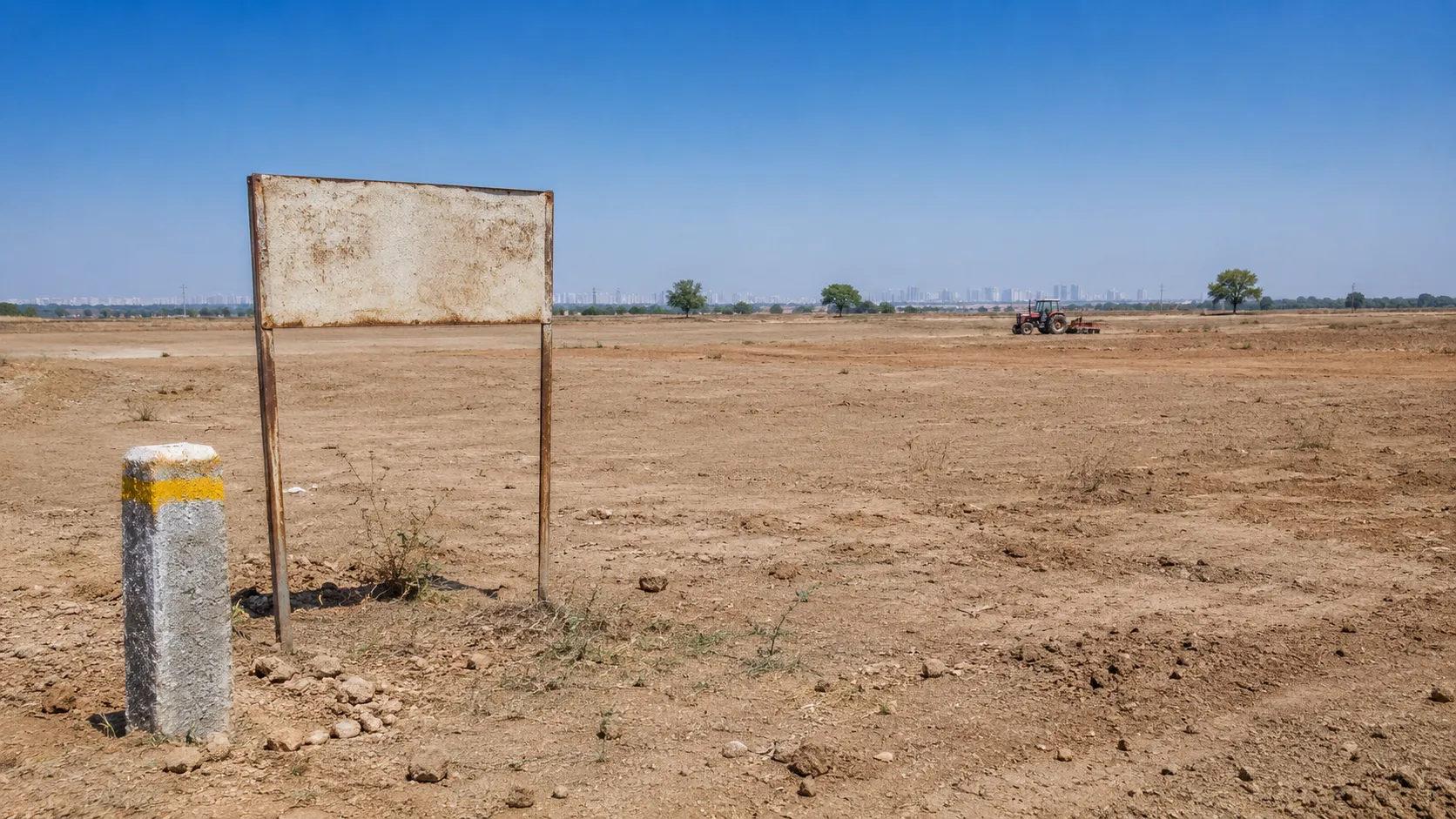
The Future City Development Corporation office is scheduled to be inaugurated on June 2, 2026—a milestone that the government hopes will signal the transition from planning to execution. From that point onward, the government plans to host global investment reviews directly from the new city site, bypassing traditional bureaucratic hurdles to invite international capital. Whether the Salman Khan project will be among the first to break ground is an open question. The MoU is signed. The expression of interest is filed. The global bidding process has not yet begun. The land has not yet been transferred. The township, for now, exists only in renderings—a vision of luxury, leisure, and creative ambition that has been announced to the world but not yet anchored to the earth.
What This Signals
The Salman Khan township story is not primarily about a real estate project. It is about the intersection of celebrity, state power, and the Indian investment summit economy—a world in which the gap between an MoU and a completed project is vast, and in which the headlines generated at the signing ceremony are often more valuable than the investments themselves.
For the Telangana government, the Salman Khan announcement was a public-relations coup. The superstar's name, attached to a ₹10,000 crore figure, generated coverage that no corporate announcement could match. It signalled that Telangana was open for business, that Bollywood was paying attention, that the Future City was attracting the kind of marquee investors who could put it on the global map. The fact that the announcement was later clarified as an expression of interest does not diminish its value as a signalling device. The MoU has already done its work. The headlines have been written. The world knows that Salman Khan is interested in Telangana. Whether he ultimately builds a township there is, from the government's perspective, almost secondary to the fact that he said he might.
For Salman Khan Ventures, the MoU is a different kind of asset. It is an option—a low-cost way of establishing a claim on a potential opportunity, without committing the capital that would be required to execute it. The expression of interest allows the company to participate in the global bidding process when it begins, to assess the terms on which the land is offered, and to decide—based on the economics at that time—whether to proceed. The MoU costs almost nothing to sign. The township would cost ₹10,000 crore to build. The asymmetry between those two numbers is the asymmetry at the heart of the MoU economy. The announcements are cheap. The execution is expensive. The former happens at summits. The latter happens—if it happens at all—over decades.
The Salman Khan township, as of May 2026, is still an idea. It has not been cancelled. It has not been confirmed. It exists in a liminal space between a press release and a ground-breaking ceremony, between a celebrity's ambition and a government's need for investment, between the headlines of December 2025 and the reality of a project that, even under the most optimistic assumptions, will not be completed for a decade. The superstar has expressed his interest. The Chief Minister has clarified its limits. The land is waiting. The global tender has not yet been issued. The most expensive real estate bet ever announced by an Indian film star is still, for now, a bet that has not been placed.


