The Submarine That Thinks for Itself: How a Chennai Startup Is Building Autonomous Underwater Drones for the Indian Navy—And the Global Market Is Watching
CHENNAI — May 31, 2026 — Sometime in the spring of 2023, a small, unmanned underwater vehicle slipped beneath the surface of the Bay of Bengal, approximately 12 nautical miles off the coast of Chennai. It was a test, and the observers—a handful of engineers from a Chennai‑based startup called Sequent Robotics, a few officers from the Indian Navy’s Directorate of Indigenisation, and a representative from the Defence Research and Development Organisation—watched the telemetry on a ruggedised tablet as the vehicle descended to a depth of 300 metres, navigated a pre‑programmed course, identified a simulated mine using its onboard sonar, and returned to the surface. The test lasted approximately four hours. The vehicle performed flawlessly. The Navy officers, who had been sceptical of the startup’s claims, were impressed. The test was a proof of concept—a demonstration that an Indian startup, operating on a budget that was a rounding error by the standards of the global defence industry, could build an autonomous underwater vehicle that was capable of performing missions that the Navy had historically reserved for its most advanced manned submarines.
Three years later, Sequent Robotics has delivered its first 12 operational AUVs to the Indian Navy, under a ₹480 crore contract that was signed in March 2026 after a competitive tender that included bids from two major international defence contractors. The AUVs—which the company has named the "Guardian‑X" series—are designed for a range of missions: mine detection and neutralisation, anti‑submarine warfare, harbour surveillance, and underwater reconnaissance. They are autonomous, which means they can be launched from a ship or a shore station, execute a mission without human intervention, and return to their launch point when the mission is complete. They are modular, which means their sensor packages and mission software can be reconfigured in the field to suit different operational requirements. And they are significantly cheaper—by a factor of approximately five—than the comparable underwater drones that the Navy had been procuring from foreign suppliers. The Sequent Robotics contract is the largest ever awarded to an Indian defence‑tech startup, and it represents the leading edge of a structural shift in how the Indian military procures advanced technology: from a handful of giant, state‑owned defence enterprises to a new generation of agile, venture‑backed, commercially oriented startups.
"The Navy does not want to buy submarines. It wants to buy capabilities—the capability to find mines, to track enemy submarines, to protect its harbours. If a startup can deliver that capability in a package that is faster, cheaper, and more adaptable than the traditional alternatives, the Navy will buy it. The procurement system is changing. The startups are ready." — Defence‑industry analyst, speaking anonymously to TIGI
The Autonomy Stack
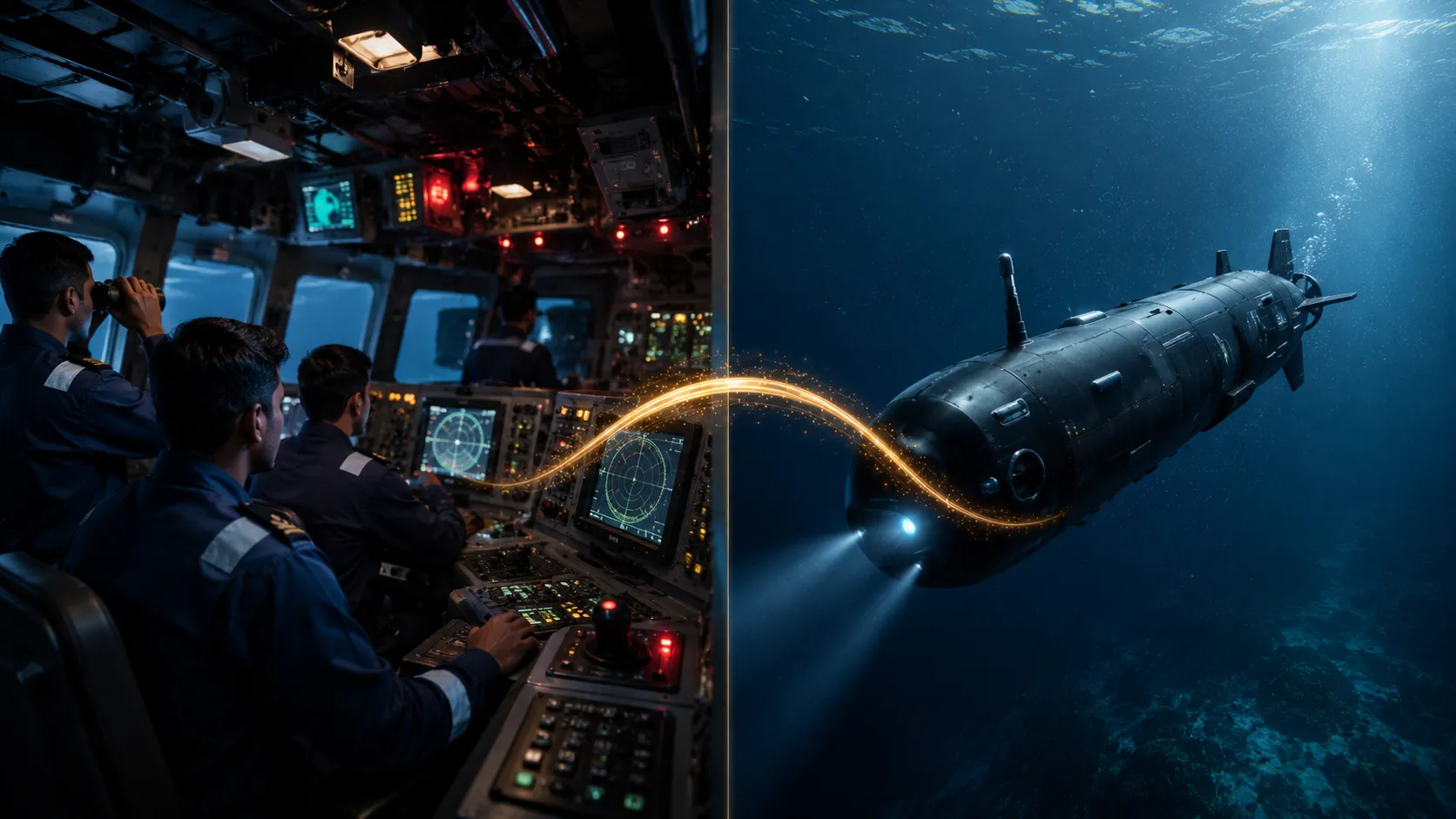
The single most significant technological asset that Sequent Robotics has built is its autonomy stack—the software, the sensors, and the AI models that allow the Guardian‑X to navigate, to sense, and to decide without human intervention. The autonomy challenge in the underwater environment is fundamentally different—and fundamentally harder—than the autonomy challenge on land or in the air. GPS signals do not penetrate water, which means the vehicle cannot rely on satellite navigation. Radio waves do not propagate, which means the vehicle cannot communicate with its operators while it is submerged. The underwater environment is dynamic, unpredictable, and sensor‑hostile—currents shift, visibility varies, and the sonar signals that the vehicle uses to navigate and to detect objects are distorted by temperature gradients, salinity variations, and the presence of marine life. The autonomous underwater vehicle must be able to build its own map of its environment, to locate itself within that map, to identify and classify the objects it encounters, and to make decisions about how to execute its mission—all without any external input, and all while operating in an environment that is, in effect, a sensory deprivation chamber.
The Sequent Robotics autonomy stack is built on a combination of sensor‑fusion algorithms, simultaneous‑localisation‑and‑mapping (SLAM) techniques, and deep‑learning models that have been trained on thousands of hours of underwater sensor data—data that the company has collected, painstakingly, over years of testing in the Bay of Bengal and in the test tanks of the National Institute of Ocean Technology. The sensor suite includes a side‑scan sonar for mine detection, a forward‑looking sonar for obstacle avoidance, a Doppler velocity log for speed measurement, an inertial navigation system for dead‑reckoning, and a suite of optical cameras for visual inspection. The data from all of these sensors is fused in real time by the vehicle’s onboard computer, which builds a three‑dimensional model of the underwater environment and uses that model to plan the vehicle’s path, to detect anomalies, and to adjust its behaviour in response to changing conditions. The autonomy stack is the heart of the Guardian‑X, and it is the reason that the vehicle can perform missions that the Navy had previously considered impossible for an unmanned system.
The autonomy stack also has a significant advantage over the human operators it replaces. The manned submarine that is searching for mines must operate slowly, cautiously, and with a large crew whose fatigue, stress, and attention span are limitations on the mission’s duration and effectiveness. The autonomous vehicle can operate continuously for up to 72 hours on a single charge, at a speed and a precision that no human crew can match, and it can do so without putting a single sailor at risk. The Navy’s interest in the Guardian‑X is not primarily about cost—although the cost advantage is substantial—but about capability: the ability to perform missions that the manned fleet cannot perform, in environments that the manned fleet cannot enter, at a tempo that the manned fleet cannot sustain.
The Manufacturing Model
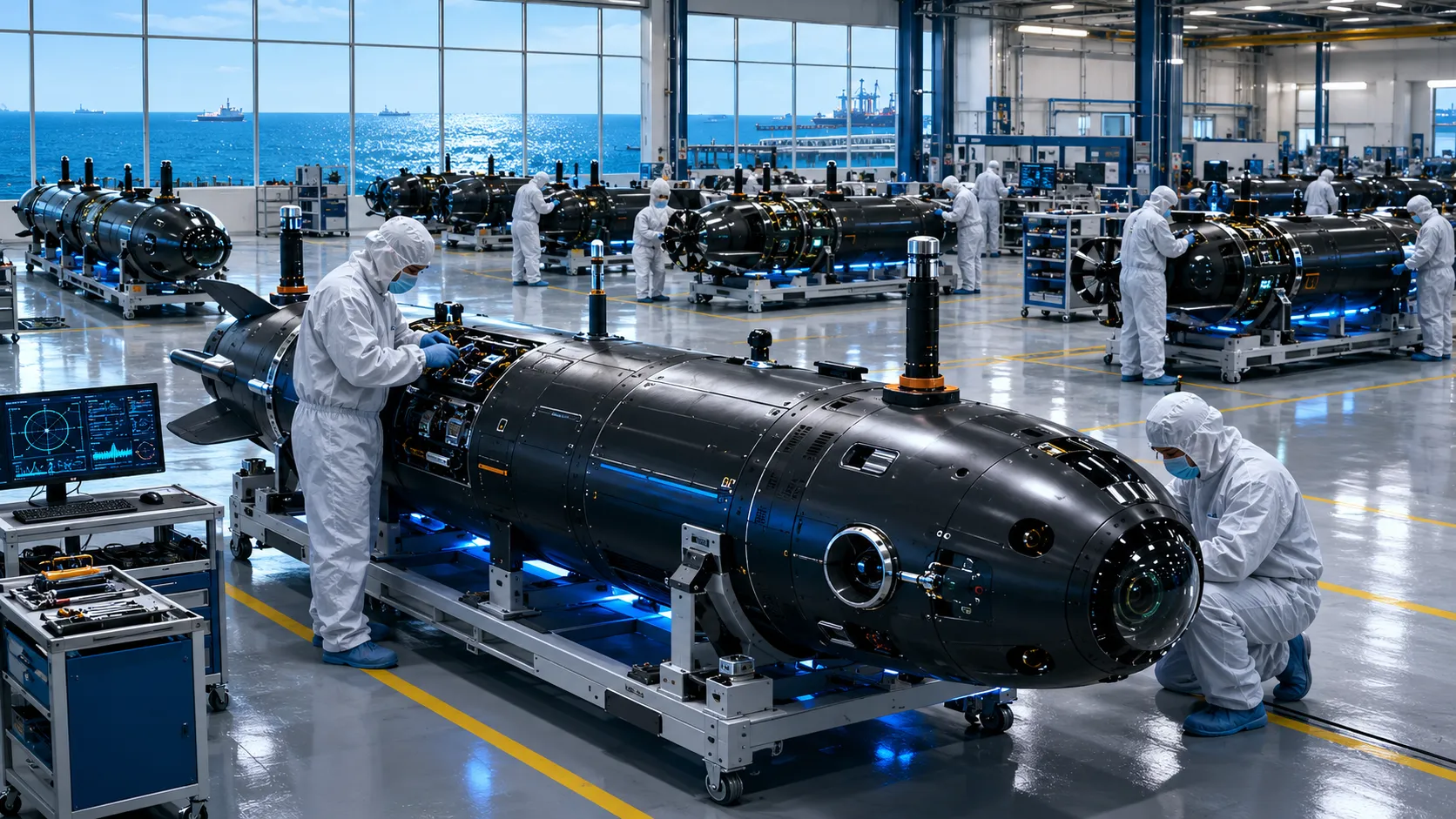
The second most significant asset that Sequent Robotics has built is its manufacturing model, which is fundamentally different from the traditional defence‑industry model. The traditional defence contractor builds products in small volumes, to bespoke specifications, on long timelines, at high cost—a model that is suited to the production of manned submarines, which are enormously complex and which are produced in single‑digit quantities, but that is hopelessly inefficient for the production of unmanned vehicles, which are far simpler and which need to be produced in larger numbers. The Sequent Robotics manufacturing model is borrowed, deliberately and unapologetically, from the commercial electronics and automotive industries: the Guardian‑X is designed for manufacture, with a modular architecture that allows the vehicle to be assembled from a relatively small number of standardised components, most of which are sourced from commercial suppliers rather than from the specialised defence‑industrial supply chain. The manufacturing process is designed to be scalable—the company can currently produce approximately three Guardian‑X vehicles per month, and it is investing in the tooling, the processes, and the workforce to increase that rate to approximately ten per month by the end of 2027.
The manufacturing model also allows for rapid iteration. The traditional defence contractor, which produces a product over a development cycle of a decade or more, is locked into the technology that was available at the start of the cycle; by the time the product is fielded, it is often obsolete. The Sequent Robotics model, which is based on commercial‑off‑the‑shelf components and a modular software architecture, allows the company to upgrade the Guardian‑X’s sensors, its processors, and its autonomy algorithms on a cycle of months rather than years—and to deploy those upgrades to the vehicles that are already in the field, through software updates, without requiring the vehicles to be returned to the factory. The rapid‑iteration model is the most important competitive advantage that the defence‑tech startups have over the traditional incumbents, and the Navy’s willingness to embrace it—to accept that the vehicle it buys today will not be the same vehicle it operates in two years—is one of the most significant cultural shifts in the history of Indian defence procurement.
The Export Opportunity
The most strategically significant dimension of the Sequent Robotics story is not the Indian Navy contract. It is the export opportunity. The global market for autonomous underwater vehicles is projected to exceed $15 billion by 2030, driven by the same forces that are driving the AUV market in India: the growing threat of naval mines, the increasing difficulty of anti‑submarine warfare in the contested littoral waters of the Indo‑Pacific, and the structural shift from manned to unmanned platforms across every navy in the world. The Guardian‑X, with its advanced autonomy stack, its competitive pricing, and its proven operational performance, is positioned to compete for a share of that market—and the company has already begun the process of pursuing export opportunities.
The export strategy is being supported by the Indian government, which has been actively promoting the export of indigenous defence technology through the Defence Exports Steering Committee and through the network of defence‑attaché offices that the Ministry of Defence maintains in Indian embassies around the world. The government has also been using the export of defence technology as an instrument of strategic partnership—a way of deepening defence relationships with friendly countries in Southeast Asia, the Middle East, and Africa—and the Guardian‑X, which is a non‑lethal, defensive system, is an ideal platform for that purpose. The company has received expressions of interest from several foreign navies, including those of Vietnam, the Philippines, and the United Arab Emirates, and it is in active negotiations for its first export contract.
The export opportunity also has a geopolitical dimension that extends beyond the commercial. The Indo‑Pacific region, which is the most strategically contested maritime theatre in the world, is also the region where the demand for autonomous underwater systems is growing fastest—and the countries that are building their naval capabilities are looking for suppliers that are not subject to the export controls, the political constraints, or the alliance obligations of the major Western defence exporters. The Indian AUV, which is built by an Indian company, using Indian technology, and supported by the Indian government, is a product that can be sold to customers that the Western defence industry cannot, or will not, serve—and the strategic advantage that this confers, for both the company and the country, is substantial.
What This Signals
The Sequent Robotics story is not primarily about a single startup or a single Navy contract. It is a story about the structural transformation of the Indian defence‑industrial base—a shift from a model that was defined by the dominance of a handful of large, state‑owned defence enterprises to a model that is increasingly defined by the participation of a new generation of agile, venture‑backed, commercially oriented startups, and from a procurement system that was designed for the 20th‑century military to a procurement system that is being redesigned for the 21st‑century one. The autonomous submarine that the Chennai startup is building is not merely a product. It is a proof of concept—evidence that an Indian startup can build a world‑class defence system, that the Indian military can procure it, and that the global market will buy it. The proof is now in the water, and the market is watching.


