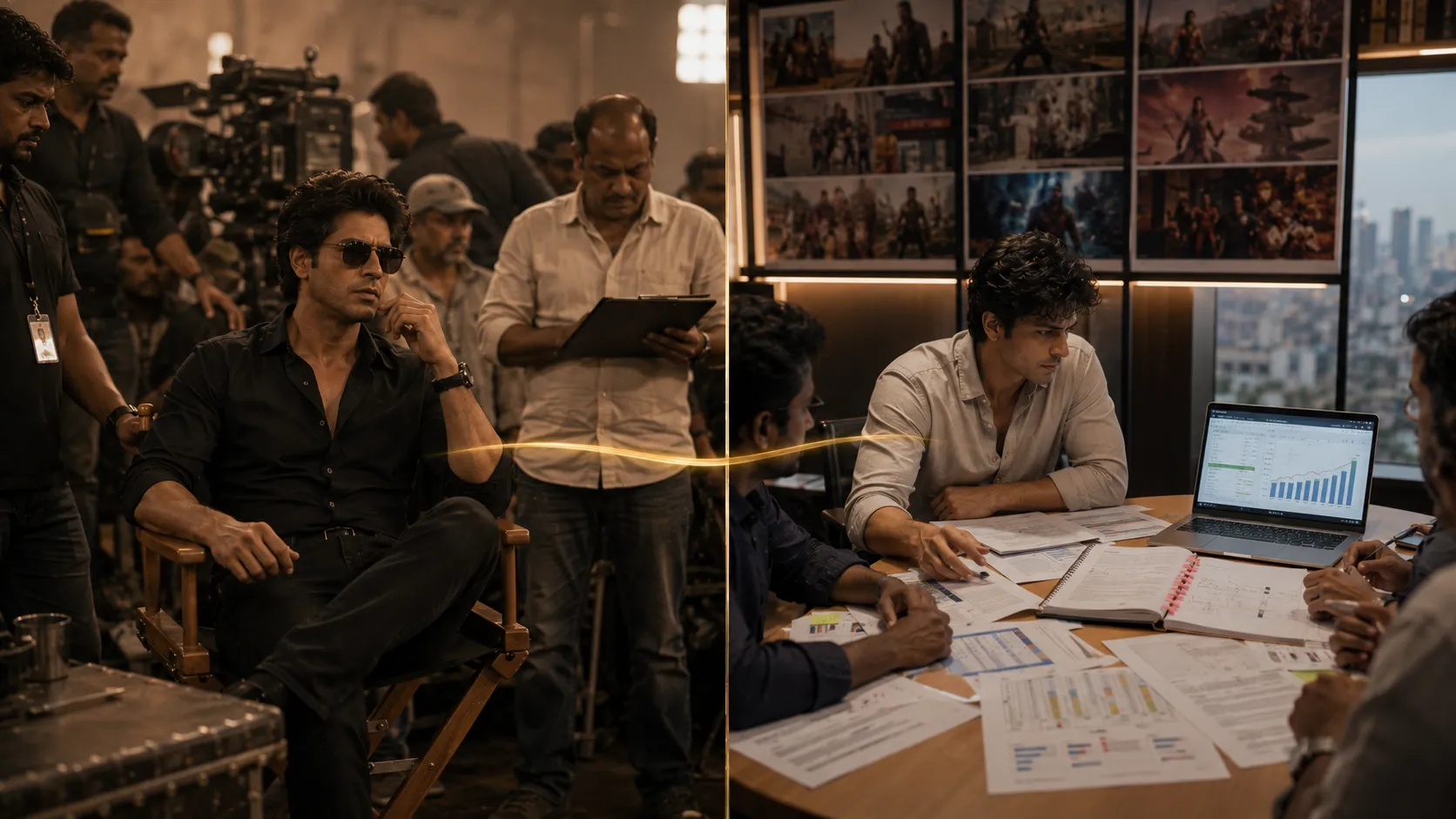
The Star Who Writes the Cheque: How Ranveer Singh, Allu Arjun, and a New Generation of Actor‑Producers Are Rewriting the Risk‑Reward Equation of Indian Cinema
MUMBAI — May 29, 2026 — In the winter of 2025, as Dhurandhar completed its record‑breaking rampage through the global box office, Ranveer Singh sat down with his financial team and made a decision that would, in retrospect, mark the moment the Indian film industry's oldest hierarchy was formally inverted. He would no longer be merely the star of his films. He would be their primary financier. His production company, Ma Kasam Films—launched quietly during the pandemic and previously limited to smaller, experimental projects—would now co‑finance every film he starred in, committing tens of crores of his own capital to each production, assuming a share of the risk in exchange for a larger share of the upside. The actor who had spent his career as the highest‑paid employee on every set he worked on was now becoming the employer. The distinction was not merely financial. It was structural. And it represented the culmination of a shift that has been building for years and that is now, unmistakably, reshaping the power dynamics of the Indian film industry.
The actor‑producer is not a new phenomenon. Aamir Khan has been structuring his compensation around profit‑sharing rather than upfront fees for more than a decade. Shah Rukh Khan's Red Chillies Entertainment has co‑produced many of his films, including Jawan and Dunki. Akshay Kumar's Cape of Good Films has backed a slate of mid‑budget projects. The model has existed for years, but it was the exception, not the rule—a strategy employed by a handful of stars at the very top of the commercial pyramid, and treated with suspicion by the rest of the industry. What has changed is the velocity of its adoption. In the first five months of 2026, at least six major Indian stars have announced films that they are co‑financing through their own production banners—a rate of adoption that suggests the actor‑producer model is crossing a threshold, and that the industry's traditional division of labour between the star and the studio is beginning to collapse.
The Ranveer Model
The most instructive case study in the actor‑producer model is Ranveer Singh, whose transformation from a star who commands fees into a star who writes cheques has been both rapid and deliberate. Ma Kasam Films, the production company he founded with a small team of financiers and creative executives, has co‑produced his last two films—Dhurandhar and Dhurandhar 2—and is now developing a slate of projects that includes Pralay, the ₹300 crore zombie epic that is currently in pre‑production, and several smaller, director‑driven films that do not feature Ranveer as an actor. The company's structure reflects a deliberate strategy: Ranveer invests his own capital in the films he stars in, aligning his financial interests with the film's commercial performance, while simultaneously using the profits from those star‑vehicles to fund a broader portfolio of projects that diversify his risk and extend his influence beyond his own acting career.
The Ranveer model is significant because it represents a departure from the traditional Bollywood producer‑actor relationship. The star who merely co‑produces his own film—taking a producer credit in exchange for a share of the profits, but contributing no capital and bearing no risk—is not an actor‑producer in any meaningful sense. They are a profit participant, and the distinction is important. The star who invests their own capital in a film is fundamentally altering the risk‑reward equation of the project. They are betting on themselves—on their ability to deliver a performance, to draw an audience, to generate a return. The bet is not symbolic. It is financial, and its consequences are real. The star who invests ₹50 crore in a film and watches it fail loses not just their fee, but their capital. The star who invests ₹50 crore in a film and watches it succeed earns not just their fee, but a share of the profits that can substantially exceed what any studio would pay. The incentives are aligned, the risk is shared, and the model—for the stars who can afford it—is increasingly attractive.
The Pralay project is the most ambitious expression of the Ranveer model to date. The film's ₹300 crore budget is being financed through a combination of Ranveer's own capital, a contribution from his co‑producers (Hansal Mehta's True Story Films and Sameer Nair's Applause Entertainment), and a significant co‑investment from the studio backing the project. The film's financial structure means that Ranveer's personal exposure to the project's success or failure is substantial—far greater than it would be under a conventional upfront‑fee arrangement. The risk is commensurate with the potential reward: if Pralay succeeds at the level of Dhurandhar 2, Ranveer's return on his investment will be many times what he could have earned from an upfront fee. If it fails, the loss will be similarly personal. The star who once walked away from Don 3 over a compensation dispute is now the star who is betting his own money on his own projects. The transformation is not merely financial. It is psychological, and it reflects a confidence—in his own commercial power, in his creative judgment, and in his ability to build an enterprise that outlasts his acting career—that the previous generation of stars rarely possessed.
The Allu Arjun Calculus
If Ranveer Singh represents the Bollywood version of the actor‑producer model, Allu Arjun represents the South Indian version—and the differences between the two are instructive. Allu Arjun, whose Pushpa franchise has made him one of the most bankable stars in the country, has been co‑financing his films through his family's production company, Geetha Arts, for years. The model is not new to the Telugu film industry, where the lines between star, producer, and financier have always been more porous than in Bollywood. What is new is the scale. The Pushpa franchise, which is produced by Mythri Movie Makers in partnership with Allu Arjun's family interests, is one of the most valuable intellectual properties in Indian cinema. The star's financial stake in the franchise's success—through a combination of profit‑sharing, co‑production credits, and equity ownership—is substantial, and it is structured to compound with each successive instalment.
The Allu Arjun calculus is different from the Ranveer model in one crucial respect: the South Indian star's production infrastructure is more mature, more vertically integrated, and more deeply embedded in the regional film economy. Geetha Arts is not merely a vehicle for Allu Arjun's own films. It is a full‑fledged production company with a slate of projects that spans multiple stars, multiple directors, and multiple languages. The star who co‑produces his own films through a family‑owned studio is not merely an actor who happens to invest in his own projects. He is an institution‑builder—someone who is constructing a production infrastructure that will survive his own acting career and that will continue to generate returns for his family long after he has stopped appearing on screen. The model is closer to the Hollywood tradition of the star‑owned production company—Tom Cruise's Cruise/Wagner Productions, Brad Pitt's Plan B, Margot Robbie's LuckyChap—than to the traditional Bollywood model of the star as hired gun.
The South Indian advantage is structural, not personal. The Telugu and Tamil film industries have historically been more family‑run, more vertically integrated, and more comfortable with the star‑as‑owner model than Bollywood, which has been dominated by a handful of large, professionally managed studios and a freelance labour market for talent. The shift toward the actor‑producer model in Bollywood is, in this sense, a catch‑up exercise—an attempt by the Hindi film industry's stars to replicate the ownership structures that their South Indian counterparts have been building for decades. The catch‑up is happening fast, but the gap is still substantial, and the stars who are closing it most effectively—Ranveer, Akshay, SRK—are the ones who have recognised that the old model, in which the star is merely the highest‑paid employee, is becoming obsolete.
The Risk‑Reward Asymmetry
The most important dimension of the actor‑producer model is not the upside. It is the downside. The star who invests their own capital in a film is assuming a risk that the star who takes an upfront fee does not bear—and the risk is not theoretical. The Indian film industry's failure rate is high, and the star who commits a substantial portion of their personal wealth to a series of projects that underperform will suffer consequences that no endorsement contract or appearance fee can offset.
The risk‑reward asymmetry is the reason that the actor‑producer model has been adopted unevenly, and why it will remain the preserve of the wealthiest and most commercially secure stars for the foreseeable future. The actor who has built a substantial personal fortune—through film fees, endorsements, and investments—can afford to lose money on a film. The actor who has not cannot. The model is self‑reinforcing: the stars who are already the most commercially successful are the ones who can most afford to adopt it, and their adoption of the model further increases their commercial advantage over their less‑wealthy peers. The concentration of power in the hands of a small number of star‑producers is not an unintended consequence of the model. It is the model's logical endpoint.
The Pralay standoff—the dispute between Ranveer Singh and Excel Entertainment over the actor's exit from Don 3—is, in this context, a revealing episode. The dispute was, at one level, a disagreement over compensation and contractual obligations. At a deeper level, it was a conflict between two different models of the star‑studio relationship: the old model, in which the star is a hired gun who can walk away from a project with limited financial consequences, and the new model, in which the star is an owner who bears the cost of their own decisions. The resolution of that dispute—which remains unresolved as of this writing—will shape the terms on which stars and studios negotiate for years to come. The FWICE non‑cooperation directive against Ranveer, which has frozen Pralay's pre‑production, is the most dramatic expression of the tensions that the actor‑producer model has created. The star who is also the producer is answerable not just to the studio, but to the workers whose livelihoods depend on the film proceeding. The accountability is double‑edged, and the star who wields the power of the producer must also bear the responsibility.
The Studio Response
The studios are not passive observers of the actor‑producer shift. They are active participants in it, and their response has been shaped by the same structural forces that are driving the stars toward ownership: the rising cost of star fees, the declining reliability of star‑driven box‑office openings, and the growing availability of alternative talent from the streaming‑fed pipeline of newcomers.
The studios have, in many cases, welcomed the actor‑producer model because it aligns the star's interests with the film's commercial performance in a way that the upfront‑fee model never did. The star who invests their own capital in a film is less likely to walk away from the project mid‑production, less likely to demand creative changes that inflate the budget, and more likely to participate actively in the film's marketing and promotion—because their own money is at stake. The studio that partners with an actor‑producer is, in effect, acquiring a co‑investor whose incentives are aligned with its own. The alignment is not perfect—the star and the studio may still disagree on creative decisions, budget allocations, or distribution strategies—but it is substantially better than the adversarial relationship that the upfront‑fee model produced.
The studios are also adapting their deal structures to accommodate the actor‑producer model. The traditional contract—a fixed upfront fee, with no profit participation—is being replaced, in an increasing number of cases, by a hybrid structure that combines a reduced upfront fee with a share of the film's profits and, in some cases, an equity stake in the film's intellectual property. The hybrid structure is more complex to negotiate, more difficult to value, and more legally demanding than the traditional contract, but it is also more aligned with the interests of both parties, and the studios that are embracing it are the ones that are attracting the most commercially powerful stars.
The YRF model is particularly instructive. The studio, which has historically been the most star‑dependent of the major Bollywood production houses, has begun to diversify its slate toward mid‑budget, newcomer‑led films that do not require star participation at all. The shift is partly a response to the rising cost of star fees, and partly a recognition that the star‑driven event film is becoming an increasingly risky proposition. The studio that can produce a ₹50 crore film with a newcomer and earn ₹200 crore at the box office is generating a return on investment that no star‑driven blockbuster can match. The actor‑producer model, which requires the studio to share a larger portion of the film's upside with the star, makes that arithmetic even more challenging for the largest productions. The studios that are building slates that balance star‑driven event films with newcomer‑led mid‑budget projects are the ones that are best positioned to survive the transition to the actor‑producer era.

The IP Horizon
The most strategically significant dimension of the actor‑producer model is not the immediate financial returns. It is the intellectual property. The star who co‑produces a film and retains a share of its IP is building an asset that can generate revenue for decades—through sequels, spin‑offs, streaming rights, merchandise, and format adaptations. The star who takes an upfront fee owns nothing. The distinction is the difference between a career and an enterprise.
The Dhurandhar franchise is the most visible example of the IP value that the actor‑producer model can create. Ranveer Singh's participation in the franchise's profits, through his co‑production arrangement with YRF, has already generated returns that substantially exceed what he would have earned from upfront fees. But the more significant asset is the franchise itself—the characters, the world, the narrative infrastructure that can sustain multiple films, multiple formats, and multiple revenue streams for years. The star who owns a piece of that franchise is not merely an actor. They are a stakeholder in an intellectual‑property enterprise that is among the most valuable in the Indian entertainment economy. The value of that stake will compound with each successive instalment, and the star who retains it—who does not sell their participation for a one‑time payment—will reap the benefits for the rest of their career.
The Pushpa franchise is the South Indian parallel. Allu Arjun's financial stake in the franchise, through his family's Geetha Arts, is not merely a profit‑sharing arrangement. It is an equity position in one of the most commercially potent intellectual properties in Indian cinema. The franchise's third instalment, Pushpa 3: The Rampage, which is expected to release in 2027, will be one of the most expensive Indian films ever made—and one of the most lucrative for the stakeholders who own a piece of it. The star who is also an owner of the franchise's IP is a fundamentally different economic actor from the star who is merely its lead performer. The former is building wealth. The latter is earning income. The difference is structural, and it is the reason that the actor‑producer model is being adopted with such urgency by the stars who understand its implications.
The broader context is an Indian entertainment industry that is consolidating around intellectual property—franchises, universes, characters, and stories that can be exploited across multiple media and over multiple decades. The studios that own the most valuable IP will dominate the industry. The stars who own a share of that IP will share in that dominance. The actor‑producer model is the mechanism through which the stars are securing their stake in the IP economy, and the negotiations over that stake—the profit‑sharing percentages, the equity arrangements, the sequel rights—are the negotiations that will determine the distribution of wealth in the Indian film industry for the next generation.
What This Signals
The rise of the actor‑producer is not primarily a story about individual stars. It is a story about the structural transformation of the Indian film industry's power dynamics—a shift from a system in which the star is the highest‑paid employee to a system in which the star is a co‑owner of the enterprise, from a model based on fees to a model based on equity, and from a career that ends when the audience stops buying tickets to an enterprise that continues to generate returns long after the star has left the screen.
The shift is not complete, and it will never be universal. The vast majority of Indian actors will never have the financial resources, the commercial leverage, or the institutional infrastructure to become actor‑producers. The model will remain concentrated among the wealthiest and most commercially secure stars—the Ranveer Singhs, the Allu Arjuns, the Shah Rukh Khans. But the concentration of the model among the elite does not diminish its significance. The elite stars are the ones who command the largest fees, who attract the largest audiences, and who determine the commercial viability of the industry's most expensive productions. The shift in their compensation structure—from fees to equity—is a shift in the distribution of the industry's wealth, and it will have consequences that ripple through every level of the film economy.
The actor‑producer who puts their own capital at risk is betting on themselves. The bet is not new—stars have been betting on themselves for as long as there have been stars—but the terms of the bet have changed. The star of the previous generation bet on their ability to deliver a performance. The star of this generation is betting on their ability to build an enterprise. The distinction is the difference between a career and a legacy, and the stars who understand it are the ones who are building the latter. The Pralay zombie epic may or may not rise. The Dhurandhar franchise may or may not sustain its momentum. The bets themselves are uncertain, as all bets are. But the model that enables them—the actor‑producer model, the star who writes the cheque—is here to stay, and it will define the Indian film industry for the next generation.


