The Spotify of Home Energy: How a Swedish Startup Is Making Solar as Simple as a Netflix Subscription — and Just Landed €480 Million to Prove It
STOCKHOLM — May 18, 2026 — Johan Outinen wants to be very clear about what his company is not selling. "The customer doesn't know the energy market," he says. "We tell them: this isn't sexy, but it's a long-term cost-saving measure. We're not going to promise you'll get rich from it." The line is quintessentially Swedish — understated, honest to the point of bluntness, almost suspicious of its own ambition. It is also the core of a business model that has, in under three years, attracted €480 million in credit financing, €5.9 million in fresh equity, a tenfold growth in subscribers in 2025 alone, and the quiet conviction from some of Europe's most discerning investors that the future of home energy looks less like a hardware purchase and more like a Spotify subscription.
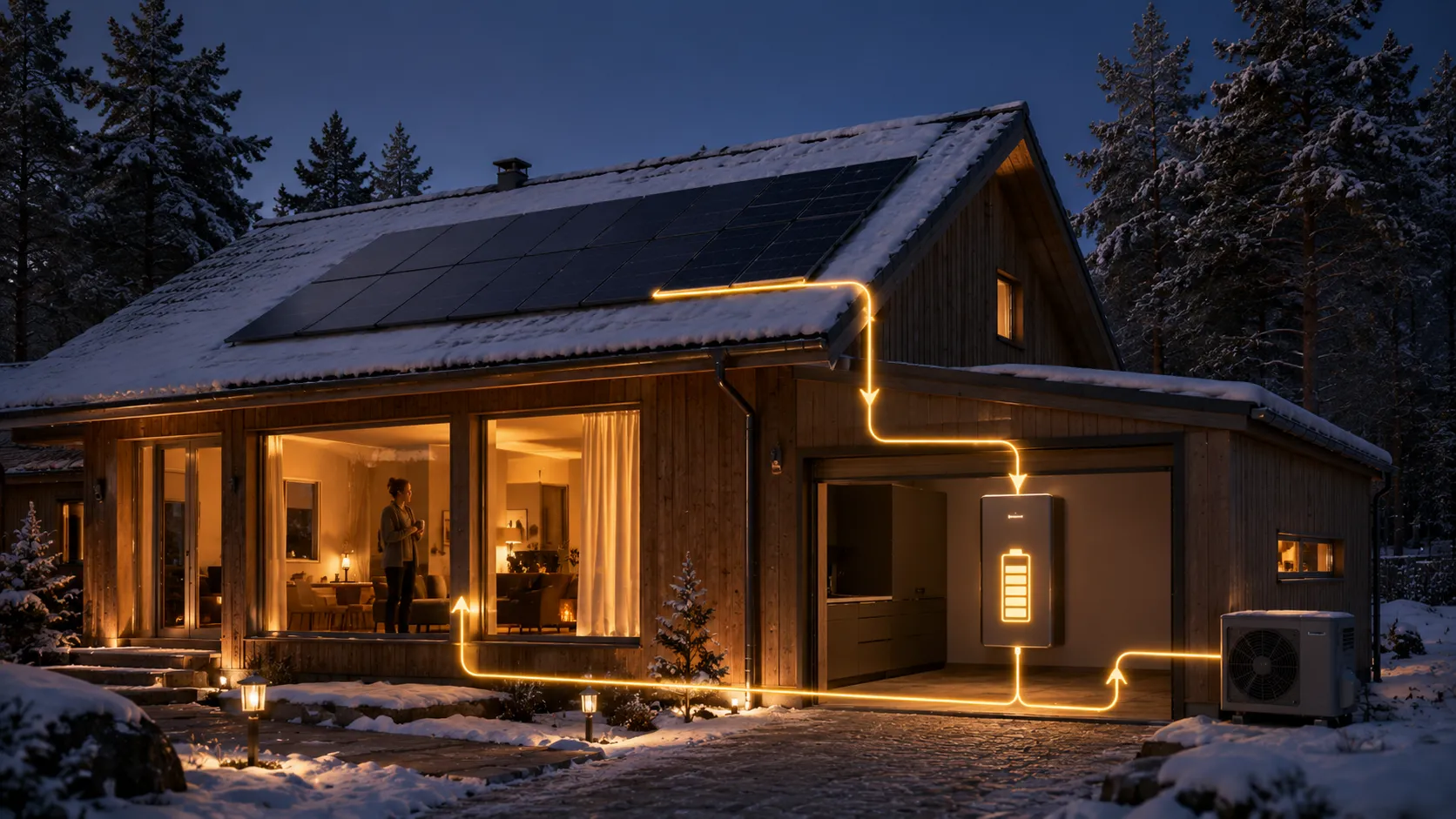
Elvy, the Stockholm-based cleantech startup Outinen co-founded in 2023 with David Wedar, has built its entire thesis around a single, almost absurdly simple proposition: homeowners should not have to become energy experts. They should not have to evaluate competing solar panel specifications, compare heat pump efficiency ratings, or calculate battery payback periods over 15-year horizons. They should not have to gamble five-figure upfront investments on technologies they do not fully understand, sold by vendors they do not fully trust, with savings projections that are often, in Outinen's diplomatic phrasing, "overly optimistic." Instead, they should pay a fixed monthly fee — approximately SEK 2,500 (€230) — and receive solar panels, a battery, a heat pump, installation, maintenance, AI-powered energy optimization, and a predictable electricity bill. For 15 years. No upfront cost. No maintenance stress. No repair bills. Just a subscription.
The model grew tenfold in 2025. Elvy's subscriber base — which stood at roughly 150 households when Sifted last profiled the company in February 2025 — had more than doubled to 350 within three months, and has since grown tenfold from that baseline. In under two years, the company has built 23 megawatts of distributed energy capacity across Sweden — a virtual power plant distributed across hundreds of rooftops, batteries, and heat pumps, all orchestrated by the company's proprietary AI engine. The target: 600 megawatts within three years, enough to power a small city.
The Crisis That Created the Market
To understand why Elvy exists, one must first understand what is happening to the Swedish electricity grid — and why a country that has long been a model of clean, reliable energy is suddenly in the market for radical alternatives.
Sweden's electricity system is under structural strain from multiple directions simultaneously. The country phased out nuclear reactors in the south, creating a persistent power deficit in the region where most of the population lives. Transmission bottlenecks between the hydro-rich north and the power-hungry south have turned what was once Europe's most stable electricity market into a source of anxiety for millions of households. In December 2025, a fierce storm knocked out power to tens of thousands of homes, some of which waited days for reconnection. New nuclear capacity is not expected to come online for over a decade. The Swedish AI boom is adding unprecedented demand to a grid that was already stretched: data center buildout is consuming electricity in quantities the IT sector has never before required, and southern and central Sweden's grid is now "severely strained," according to AI infrastructure analysts at Aixia.
Meanwhile, electricity prices have become volatile in ways Swedish households never experienced during the era of abundant nuclear baseload. In January 2026, average prices in northern Sweden climbed to over 90 öre per kilowatt-hour — a stark jump from roughly 30 öre in December 2025. System prices for the second quarter of 2026 are projected to land around 60 öre per kWh, roughly double the 29 öre seen in the same period a year earlier. The conflict with Iran has added geopolitical risk to European energy markets, pushing up coal power costs across the continent. And the underlying architecture of the grid — more wind, more solar, less baseload — has made prices more sensitive to weather and more prone to sudden swings, even as average prices have declined.
Into this breach, Elvy has stepped with a model that treats household energy not as a product to be purchased but as a service to be managed. The company installs and owns the solar panels, batteries, and heat pumps. The homeowner pays a fixed monthly fee that covers hardware, installation, maintenance, repairs, and the household's electricity needs. The contract runs for 15 years, after which the system belongs to the customer. If the customer moves house, they can transfer the contract to the new owners or buy out the hardware. Elvy takes full operational responsibility, using its AI engine to control and optimize energy generation and consumption — storing electricity when it is cheap, selling it back to the grid when it is expensive, and managing the household's energy profile as a continuous, automated function rather than a series of discrete purchasing decisions.
"It's less about the technology and more about what the homeowners actually want: peace of mind," Outinen told ArcticStartup. "Our customers want heating, warm water, and reasonable electricity costs. It shouldn't require big investments or that they become energy experts in their free time to optimise energy consumption."

The IKEA Connection and the Klarna Playbook
The financial architecture supporting Elvy's growth is as instructive as the product itself. In December 2025, the company secured a €480 million credit facility from Scayl, a Swedish fintech platform specializing in structured debt financing that enables non-bank lenders to access capital through bank partnerships. The facility funds the hardware that Elvy owns and installs at homes — the solar panels, the heat pumps, the batteries — and is structured so that the recurring subscription revenue services the debt over time. It is, in effect, a capital-mobilization machine designed to build a distributed energy utility one Swedish home at a time.
Then, in May 2026, Elvy closed a €5.9 million equity round co-led by Daft Capital and Essential Capital, with participation from Mathias Kamprad — a member of the IKEA founding family — and other angel investors including former Klarna executives Knut Frängsmyr and Jesper Wigardt. Frängsmyr, who spent over a decade as Klarna's deputy CEO and chief operating officer, joined Elvy's board as Chairman. The appointment was not ceremonial. It signaled that Elvy is thinking about expansion well beyond Sweden, and that the operational discipline required to scale a subscription business across borders — the discipline Frängsmyr helped build at Klarna during its transformation from a Swedish startup into a global payments giant — is being embedded into the company's leadership.
The Kamprad connection is similarly freighted with meaning. IKEA, the furniture empire built by Mathias Kamprad's family, became the world's largest furniture retailer by making well-designed products accessible to ordinary people through standardized components, flat-pack logistics, and relentless cost reduction. Elvy is applying the same logic to home energy: design a great system, standardize the components, and remove the cost barriers that prevent adoption. The €480 million credit facility provides the capital to manufacture and install hardware at scale — the energy equivalent of IKEA's flat-pack supply chain.
Medjit Yalmaz, CEO and co-founder of Scayl, articulated why the model attracted his firm: "Elvy's approach to home energy immediately stood out to us. Solar financing has existed for decades, but Elvy has created something fundamentally different: a product where customers see a net-positive economic effect from day one, rather than waiting years to break even."
The AI Engine and the Virtual Power Plant
Beneath the consumer-friendly subscription interface — the fixed monthly fee, the predictable bill, the absence of upfront cost — is a more complex technological reality. Elvy is not merely a financing company that happens to install solar panels. It is building a distributed, AI-managed virtual power plant.
The company's proprietary software monitors and optimizes energy production and consumption at the household level, using machine learning to predict electricity demand, solar generation, and grid pricing, then automatically dispatching stored energy — charging batteries when prices are low, discharging them when prices spike, and selling surplus power back to the grid. Each household becomes a node in a distributed energy network. Aggregated across thousands of homes, the network begins to behave like a utility-scale power plant — capable of providing frequency regulation, peak shaving, and demand response services to the grid operator.
The economics of this arbitrage model are what make the subscription sustainable. Elvy earns revenue not only from the monthly fees paid by homeowners, but also from the energy arbitrage — capturing the spread between low wholesale prices when batteries charge and high wholesale prices when they discharge. The homeowner benefits from a predictable, lower-than-retail electricity cost. Elvy benefits from the arbitrage margin and the recurring subscription revenue. The grid benefits from a distributed source of flexibility that reduces peak strain. It is, in theory, a three-sided value proposition in which every party wins.
The model has attracted imitation and competition. Norway's Otovo and Germany's 1KOMMA5° offer similar solar-as-a-service propositions. The competitive landscape is intensifying across Europe. But Elvy's integration of solar, battery, heat pump, and AI optimization into a single subscription — and its access to the €480 million credit facility that funds hardware deployment — gives it a structural advantage that pure-financing competitors cannot easily replicate.
What This Signals
Elvy's trajectory is best understood not as a single startup's growth story but as a signal of a structural shift in how residential energy infrastructure will be financed, deployed, and managed across Europe in the coming decade.
The subscription model for home energy is not, in itself, a technological breakthrough. Solar panels, heat pumps, and batteries are mature, commercially available products. What Elvy has done is solve the financial and operational friction that has kept those products from reaching mass adoption. By removing the upfront capital barrier — the five-figure investment that terrifies most homeowners — and replacing it with a predictable monthly fee, Elvy has reclassified home energy from a capital purchase to an operating expense. The household budget does not need to absorb a €20,000 solar installation. It needs to absorb a €230 monthly payment that is offset, partially or entirely, by reduced electricity costs.
The Klarna analogy is instructive. Klarna did not invent installment payments. It made them frictionless. Elvy is attempting the same move for home energy: not inventing new hardware, but making existing hardware accessible through a business model that aligns the incentives of the provider and the customer over a 15-year horizon. The company that owns the hardware has every incentive to maintain it well, because downtime means lost revenue. The customer who pays a flat fee has every incentive to let the company manage the system optimally, because the energy savings accrue to the company, not the customer. The result is a long-term relationship rather than a one-time transaction, with all the compounding benefits that recurring revenue brings to enterprise value.
The risks are real. Elvy operates in a competitive market against established players like Otovo and 1KOMMA5°. Long-term customer retention and the scalability of hardware deployment and maintenance across diverse housing stock present operational challenges. The reliance on a substantial credit facility introduces financial leverage risks — if interest rates rise or subscription growth slows, the debt service on €480 million becomes a weight rather than a springboard. And the 15-year contract, while providing revenue visibility, also locks the company into hardware maintenance obligations that will span changes in technology, regulation, and consumer behavior that are impossible to predict.
But the tailwinds are powerful. European electricity prices remain elevated by historical standards. Governments across the continent are offering incentives for residential solar and heat pump adoption. The psychological shift triggered by energy insecurity — first by the Russia-Ukraine war, then by storm-driven blackouts — has permanently altered consumer attitudes toward grid dependence. And the Swedish market, with its high rate of homeownership, technologically literate population, and increasingly volatile electricity prices, is in many respects the perfect testbed for a home energy subscription model. If Elvy can prove the model at scale in Sweden — and the tenfold subscriber growth in 2025 suggests it is on that path — the addressable market expands to every European country with high electricity prices, aging grid infrastructure, and a growing appetite for energy independence.
Johan Outinen has said that his ambition is to make home energy "as easy as a Netflix subscription." It is a deceptively simple phrase that contains a profound business insight. Netflix did not invent television. It changed the way people pay for it. Spotify did not invent music. It changed the way people access it. Elvy is attempting the same move for the home — not inventing new energy technology, but changing the business model through which households consume it. The €480 million credit facility, the €5.9 million equity round, the Klarna veterans on the board, and the IKEA family money on the cap table all suggest that serious people believe the model can work at scale.
The Swedish energy system, long a model of reliability, is showing cracks. New nuclear plants are over a decade away. Transmission bottlenecks between north and south are chronic. Electricity prices are volatile in ways Swedish households have never experienced. Into this uncertainty, Elvy is selling not just electricity but autonomy — the quiet promise that a home can generate, store, and manage its own energy, for a fixed monthly fee, without the homeowner ever needing to understand how any of it works. Whether that promise can be fulfilled at scale across Europe is the question the next three years will answer.


