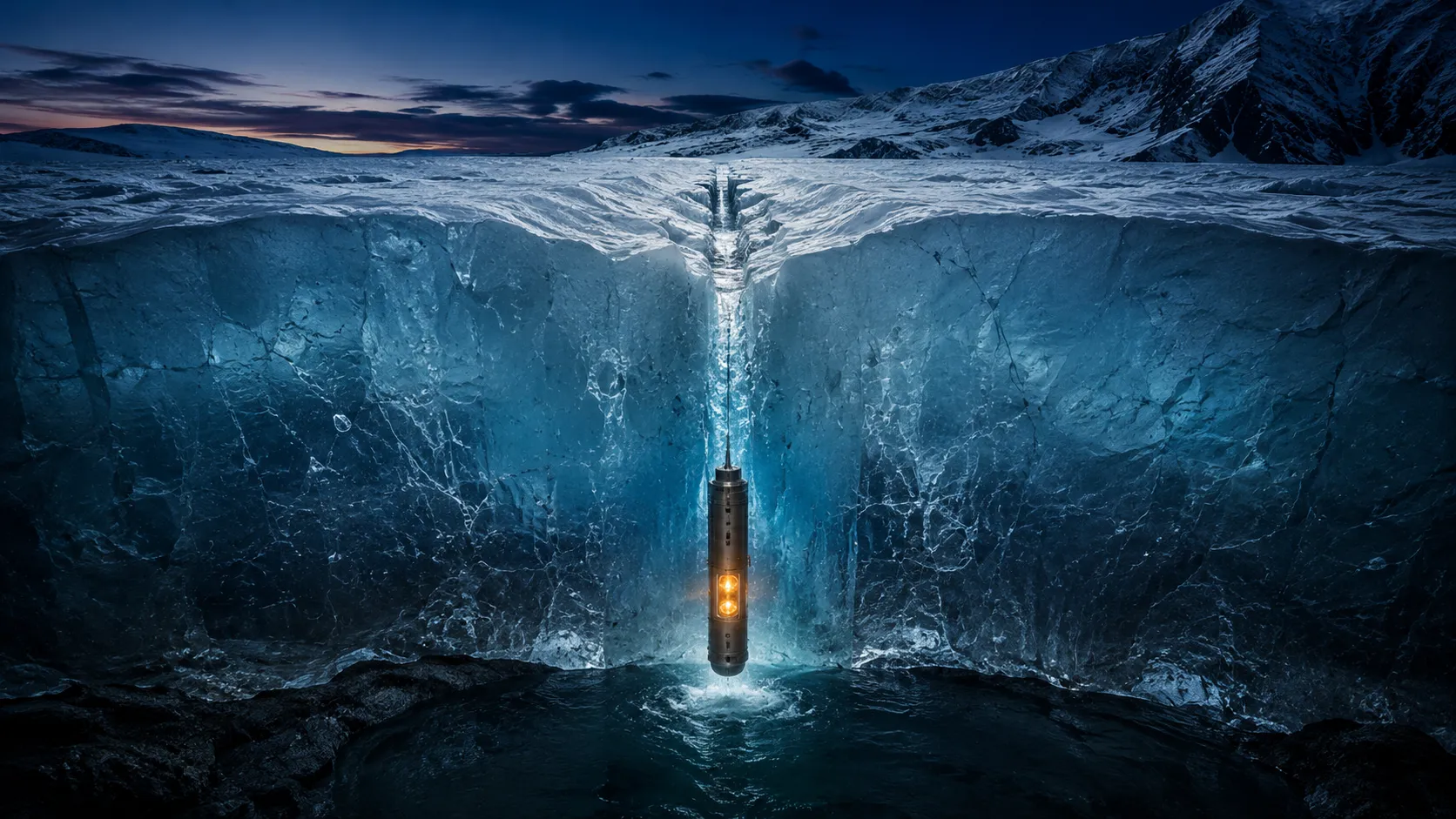
The Space Submarine: How a Nuclear-Powered Cryobot Melted Through 800 Meters of Ice—and Set Its Sights on Alien Oceans
JUNEAU, ALASKA — May 21, 2026 — Deep inside the Matanuska Glacier, where the ice has been frozen for ten thousand years and the pressure is enough to crush a steel hull, a machine the size of a telephone pole has been quietly making history. It has no wheels, no drill bit, no mechanical arms to scrape away the frozen walls around it. It moves by melting. A nuclear heat source, encased in a sterile, torpedo-shaped shell, warms the ice just enough to turn it into a thin film of water, and the probe sinks downward, inch by inch, hour by hour, for eighteen months. When it finally stopped, it had traveled 800 meters straight down, through the full thickness of the glacier, and emerged into the subglacial lake below.
The machine is called a cryobot, and the test conducted by NASA's Jet Propulsion Laboratory in collaboration with the University of Alaska Fairbanks represents the most advanced demonstration yet of a technology that has been dreamed of for decades: a probe that can melt its way through the ice shells of alien moons, reach their hidden oceans, and search for life in the most inaccessible environments in the solar system. The target, if the mission gets its final approval, is Europa—Jupiter's fourth-largest moon, whose icy crust conceals a global ocean containing more liquid water than all of Earth's oceans combined. The Matanuska test proved the cryobot can survive the journey. The next stop is another world.

The Ice Ceiling
Europa is, by any measure, the most promising place in the solar system to search for extraterrestrial life. Its surface is a cracked, frozen desert, blasted by Jupiter's intense radiation, but beneath the ice—estimated to be 10 to 30 kilometers thick—lies an ocean that has been liquid for billions of years, kept warm by the tidal flexing of the moon's interior as it orbits its giant parent planet. That ocean contains salts, organic molecules, and almost certainly hydrothermal vents on its rocky seafloor—the same conditions that, on Earth, gave rise to life around deep-ocean volcanic systems.
But the ice ceiling presents a formidable barrier. For decades, the only way to explore Europa's ocean was to imagine a lander that would touch down on the surface, deploy some kind of drill, and bore its way through kilometers of ice. The engineering challenges were staggering. A mechanical drill would require an enormous amount of power, generate friction that could destroy delicate scientific instruments, and risk contaminating the ocean with Earth microbes. Even if the drill worked, the borehole would tend to refreeze behind it, severing any communication link with the surface. Europa's ice seemed impenetrable.
The cryobot solves these problems by turning the ice into a pathway rather than an obstacle. The probe carries a radioisotope thermoelectric generator—a nuclear power source similar to those used on deep-space missions like Cassini and New Horizons—that produces both electricity and heat. The heat melts the ice immediately in front of the probe, allowing it to sink downward by gravity. The meltwater flows around the probe's hull and refreezes behind it, sealing the borehole and preventing contamination from the surface. The probe carries its own communications tether, unreeling a thin fiber-optic cable as it descends, maintaining contact with a surface lander that relays data back to Earth.
The Matanuska test was designed to prove that this elegant concept could survive the brutal reality of a real glacier. The cryobot, a prototype designated "IceMole-3," was inserted into a borehole near the top of the glacier and began its descent in November 2024. Eighteen months later, it had melted through 800 meters of ice—the full thickness of the glacier at that point—and reached a subglacial lake that had been sealed beneath the ice for millennia. Throughout the descent, the probe maintained a sterile internal environment, collected samples of the ice it melted through, and transmitted data on temperature, pressure, and chemical composition back to the surface. When it reached the lake, it deployed a small sampling tube, drew in water, and ran it through an onboard microfluidic life-detection instrument. The results are still being analyzed, but the engineering case is closed. The cryobot works.
The Sterility Imperative
The most difficult engineering challenge of the cryobot project was not the melting, or the power, or the communications tether. It was sterility. Planetary protection—the international obligation to avoid contaminating other worlds with Earth life—requires that any probe that enters a potentially habitable environment must be sterilized to the most stringent standard in existence: fewer than 30 bacterial spores per square meter, a level known as "Viking-level" sterility after the 1976 Mars landers.
Achieving that standard on a nuclear-powered probe with complex moving parts, scientific instruments, and a tether that must unspool through 20 kilometers of ice was a challenge that took the JPL team more than five years to solve. The solution was a combination of dry-heat sterilization, hydrogen peroxide vapor, and a novel technique called "sterile assembly under cleanroom conditions with end-of-line sterilization of the fully integrated probe." The probe was baked, gassed, and sealed in a way that ensured no viable microorganisms could survive on its surface or in its interior. When it entered the Matanuska Glacier, it was cleaner than a surgical instrument. When it reached the subglacial lake, the water it sampled was tested for contamination and found to be pristine.
The significance of this achievement is difficult to overstate. If life exists in Europa's ocean—and many astrobiologists believe the odds are good—the last thing humanity wants to do is discover it by accidentally infecting it with Earth bacteria that have hitchhiked across the solar system on a NASA probe. The cryobot test proved that a nuclear-powered melting probe can be sterilized to the required level and maintain that sterility through an 800-meter descent. The next step is to prove it can do so through 20 kilometers.
The Road to Europa
The Europa Lander mission, which would deliver the cryobot to the Jovian moon, is currently in the "Phase A" concept study at NASA, with a launch target in the 2037 timeframe. It would ride to space on a Space Launch System rocket or a commercial heavy lifter, cruise to Jupiter for five to seven years, and land on Europa's surface using a sky-crane system similar to the one that delivered the Perseverance rover to Mars.
The cryobot would then begin its descent, melting through the ice at a rate of roughly one meter per day—a journey that would take between one and three years, depending on the ice thickness at the landing site. During the descent, the probe would sample the ice at various depths, searching for biomarkers and analyzing the chemical environment. When it reached the ocean, it would release a small autonomous underwater vehicle—a "hydrobot"—that would swim free, exploring the ocean, searching for hydrothermal vents, and looking for the direct evidence of life that would answer one of the oldest questions in human history.
The Matanuska test was not the end of the development process. The cryobot must still be tested in Antarctic conditions—colder, deeper, and more analogous to Europa's surface than Alaska. The tether must be proven over distances of tens of kilometers rather than hundreds of meters. The life-detection instruments, which are still in development, must be integrated and tested. And the entire system must be hardened to survive the intense radiation environment of Jupiter's magnetosphere, which delivers a lethal dose to unshielded electronics in a matter of hours.
But the fundamental question—can a nuclear-powered probe melt through a kilometer of ice, remain sterile, and sample the water on the other side?—has been answered. The cryobot has done it. In Alaska, in a glacier that has been frozen since the last ice age, a machine built by human hands melted its way to the bottom, took a sip of ancient water, and phoned home. The next time it happens, the ice will be on another world, and the water may contain the answer to the question of whether we are alone.
What This Signals
The cryobot test in Alaska is not a mission to Europa. It is a rehearsal—a proof of concept that the most audacious astrobiology mission ever conceived is physically possible. The probe that melted through the Matanuska Glacier was not looking for alien life. It was looking for the limits of its own engineering, and it found them farther down than anyone expected.
The larger significance of the test is that it marks a transition in the search for extraterrestrial life—from the era of remote sensing and orbital reconnaissance to the era of direct exploration. The Mars rovers, for all their achievements, have only scratched the surface of the Red Planet. The Europa cryobot would go where no robot has gone before: into an alien ocean, beneath kilometers of ice, into the darkness where life may have been waiting for four billion years.
The question of whether we are alone in the universe is not a scientific question in the abstract. It is a question that will be answered, if it is ever answered, by a machine. The cryobot that melted through a glacier in Alaska is the prototype of that machine. It is not ready to fly to Jupiter. But it has proven, in the most convincing way possible, that the ice is not a barrier. It is a door. And we now have the key.


