The South Indian Studios That Out‑Hollywood Hollywood: How Hombale, Mythri, and Vyjayanthi Built Vertically Integrated Franchise Machines That Bollywood Cannot Copy
BENGALURU — May 29, 2026 — The most important film studio in India today does not have an office in Mumbai. It operates from a modest building in the Bengaluru suburb of Peenya, surrounded by automobile workshops and logistics warehouses. Its logo—a silhouetted lion framed by a rising sun—has become, in the space of half a decade, one of the most valuable intellectual-property markers in the Indian entertainment economy. The studio has produced four films. Together, they have grossed over ₹3,500 crore worldwide. Its most recent release, Kantara: Chapter 1, crossed ₹500 crore globally without a single Bollywood star in the cast. Its next project, Salaar 2, is expected to be one of the largest openings in Indian cinema history. And it has achieved all of this by doing something that no Bollywood studio has ever managed to do at scale: owning every link in the value chain.
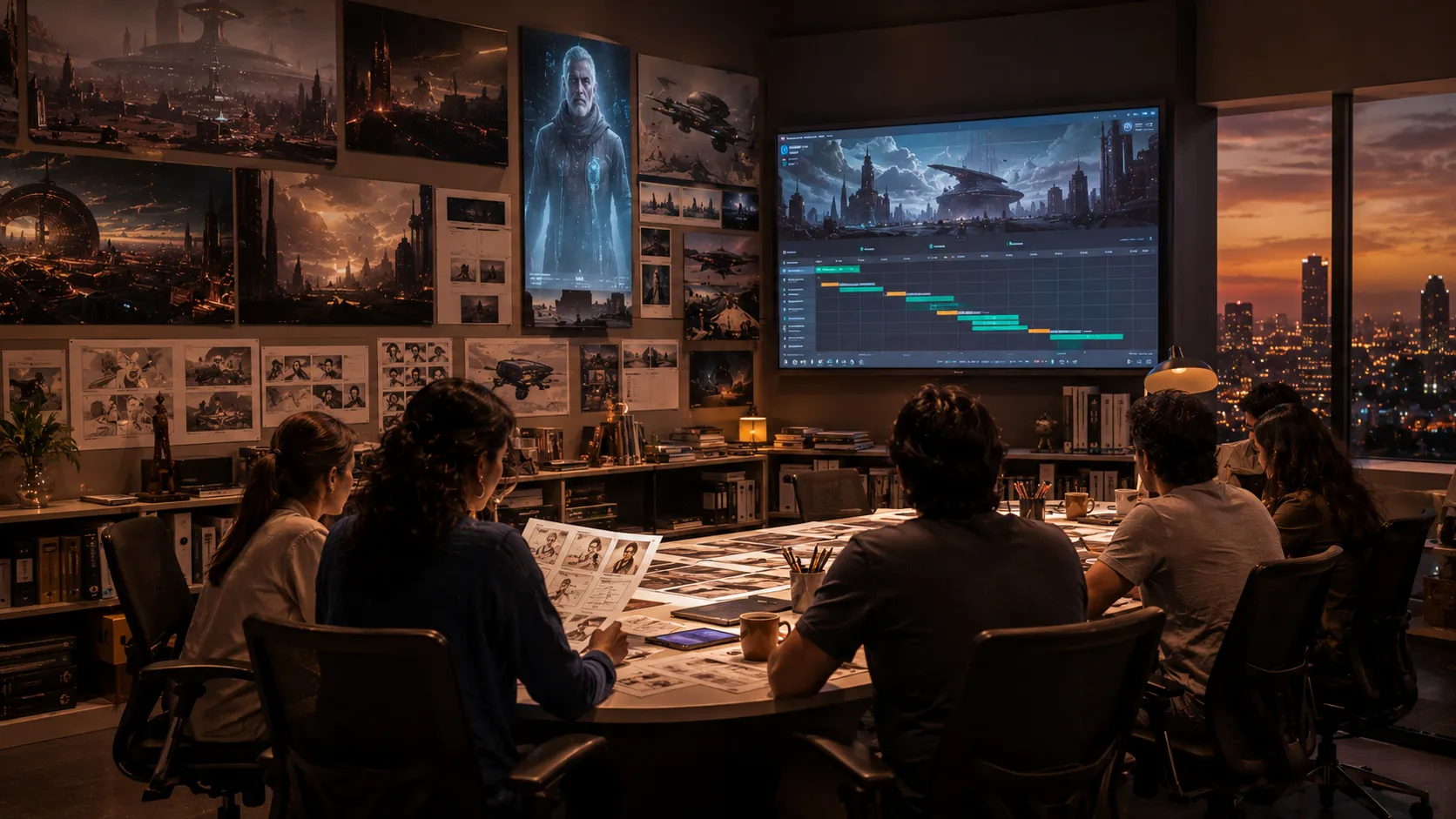
The studio is Hombale Films. It is not an outlier. It is the most visible example of a structural shift that is reshaping the Indian film industry from the south—a shift that has seen a small number of Kannada and Telugu production houses build vertically integrated studio models that would be recognisable to any Hollywood executive. These studios do not merely finance films. They develop intellectual property in-house. They own their visual-effects divisions rather than outsourcing to third-party vendors. They manage their own distribution, increasingly cutting out the territorial middlemen who have historically captured a significant share of a film's revenue. They build franchises that span multiple films, multiple languages, and multiple formats. And they are doing all of this with a discipline that stands in stark contrast to the star-driven, fee-for-service model that still dominates the Hindi-language film industry.
"Bollywood studios are essentially financiers," a senior executive at one of the largest Mumbai-based production houses told us, speaking on condition of anonymity. "They write a cheque, hire a star, hire a director, and hope the film works. The South Indian studios are building institutions. They own the IP. They own the VFX. They own the distribution. They are not making films. They are building franchise machines. And the difference is starting to show in the box-office numbers."
The Hombale Model
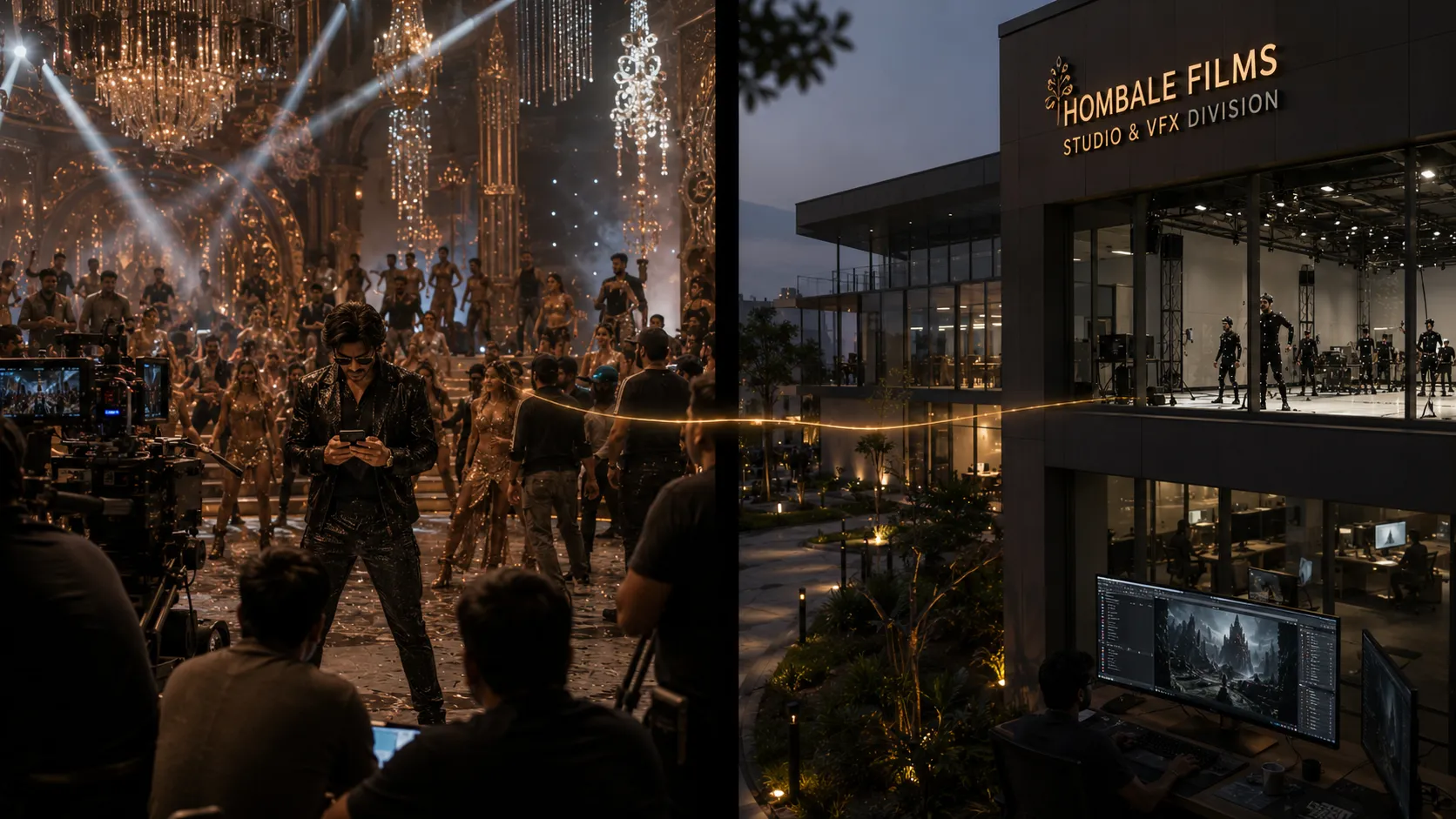
Hombale Films was founded in 2012 by Vijay Kiragandur, a former software entrepreneur who had spent years in the United States before returning to Bengaluru with a conviction that the Kannada film industry was capable of producing films that could compete on a global scale. The studio's first major success was K.G.F: Chapter 1 (2018), a period action film set in the gold mines of Kolar, which became the highest-grossing Kannada film in history at the time of its release. Its sequel, K.G.F: Chapter 2 (2022), was one of the first Kannada films to achieve pan-Indian success, grossing over ₹1,200 crore worldwide and establishing Yash as one of the most bankable stars in the country.
But the K.G.F franchise was not merely a box-office phenomenon. It was a proof of concept for a different way of making films. Hombale did not simply finance K.G.F. It developed the story in-house, working with director Prashanth Neel over several years to build a narrative world that could sustain multiple instalments. It built the visual-effects pipeline internally, investing in a dedicated VFX division that could handle the complex CGI required for the film's mining sequences and action set-pieces. It managed the distribution directly, negotiating with territorial buyers across India rather than selling the rights to a single national distributor. And it retained ownership of the intellectual property, which meant that the revenue from sequels, spin-offs, merchandise, and streaming rights flowed back to the studio rather than being dispersed among external partners.
The model was, in retrospect, revolutionary—but it was not unprecedented. It was exactly the model that Marvel Studios had used to build the Marvel Cinematic Universe, and that Lucasfilm had used to build Star Wars. The difference was that Hombale was building its franchise in Kannada, a language with approximately 45 million speakers, roughly the population of Spain. The studio's ability to achieve pan-Indian and global scale from such a narrow linguistic base is a testament to the power of the franchise model—and to the discipline with which Kiragandur and his team have executed it.
The Kantara franchise is Hombale's second major IP, and it is arguably more valuable than K.G.F because it is built around a filmmaker rather than a star. Rishab Shetty, who directs and stars in both Kantara (2022) and Kantara: Chapter 1 (2026), is not a conventional celebrity. He is a creator—a writer, director, and actor whose films are driven by his singular vision rather than by the commercial imperatives of a star vehicle. Hombale's decision to back Shetty—and to build an entire franchise around his vision of coastal Karnataka's folk mythology—is a bet on intellectual property over star power, and it is a bet that has paid off handsomely. Kantara: Chapter 1 has grossed approximately ₹538 crore globally on a budget of approximately ₹170 crore, and the franchise's third instalment is already in pre-production. The studio that owns Kantara owns a mythological universe that can sustain films, series, merchandise, and theme-park attractions for years. No Bollywood studio has built anything comparable.
The third pillar of Hombale's slate is the Salaar franchise, a collaboration with director Prashanth Neel and star Prabhas. The first Salaar film (2023) grossed over ₹700 crore worldwide. The sequel, Salaar 2: The Final Conflict, is scheduled for release in 2027 and is expected to be one of the largest openings in Indian cinema history. The franchise model is self-reinforcing: each successful instalment increases the value of the IP, which increases the studio's negotiating power with distributors and streaming platforms, which increases the budget available for the next instalment, which increases the likelihood of its success. The flywheel is not theoretical. It is measurable, and Hombale is the studio that has demonstrated it most convincingly.
Mythri Movie Makers: The Telugu Franchise Factory
If Hombale is the Kannada industry's answer to Marvel, Mythri Movie Makers is the Telugu industry's answer to Blumhouse—a studio that has built its business on a high-volume, high-efficiency model that treats films as an asset class rather than a creative indulgence.
Mythri was founded in 2015 by Naveen Yerneni, Y. Ravi Shankar, and Mohan Cherukuri, three first-generation entrepreneurs with backgrounds in finance and real estate who approached the film business with a discipline that was unusual in an industry defined by creative egos and star-driven economics. The studio's early hits—Srimanthudu (2015), Janatha Garage (2016), Rangasthalam (2018)—established a template that has become Mythri's signature: a star vehicle, mounted on a reasonable budget, with a strong commercial hook, released during a holiday window, and sold to distributors at a price that virtually guaranteed profitability even before the first ticket was sold.
The Pushpa franchise, which Mythri produces in partnership with director Sukumar and star Allu Arjun, is the studio's most valuable asset. Pushpa: The Rise (2021) grossed over ₹350 crore worldwide despite being released during the pandemic. Pushpa 2: The Rule (2024) more than doubled that figure, crossing ₹800 crore globally and establishing Allu Arjun as a pan-Indian star on the level of Prabhas and Yash. The franchise's third instalment, Pushpa 3: The Rampage, is expected to release in 2027 and is projected to be one of the largest Indian films ever made. Mythri's ownership of the Pushpa IP—developed in-house, with Sukumar as the creative anchor and Allu Arjun as the commercial engine—is the foundation of the studio's financial model. The franchise generates revenue not just from theatrical releases, but from streaming rights, satellite rights, music rights, and a growing merchandise business that is still in its early stages.
Mythri's approach to distribution is particularly instructive. The studio has been one of the most aggressive advocates for the rental system in the Telugu states—a position that put it at odds with the single-screen exhibitors whose revolt Chiranjeevi mediated this month. The Jetlee boycott, in which exhibitors allegedly refused to screen a Mythri release during the standoff, was a direct challenge to the studio's distribution model. The resolution of the standoff—the rental system ends on July 3, and percentage-sharing begins—represents a significant defeat for Mythri's preferred approach. But the defeat is limited to the Telangana market, and Mythri's broader distribution strategy, which relies on pre-selling territorial rights to buyers who assume the risk of exhibition, remains intact. The studio that has built its business on financial discipline is unlikely to be undone by a single regulatory change in a single state.
The Jetlee incident also revealed something about Mythri's operating philosophy that is worth noting. The studio, which had built its reputation on careful financial management, was willing to risk a boycott—and the associated box-office losses—rather than concede the principle of the rental system. The decision was not about greed. It was about control. The studio that pre-sells its distribution rights at a fixed price can forecast its revenue with a precision that a percentage-sharing model does not permit. The transition to percentage-sharing reduces the predictability of the studio's cash flows and increases its exposure to the volatility of the box office. The studios that have built their businesses on fixed-price distribution—Mythri prominent among them—are now being forced to adapt to a world in which that model is no longer available. The adaptation will be painful, but the studios that survive it will be stronger for the experience.
Vyjayanthi Movies: The Legacy Studio That Built India's Most Expensive Film
Vyjayanthi Movies is the oldest of the three studios, and its history is a microcosm of the structural shift that is reshaping the Indian film industry. The studio was founded in 1974 by C. Aswani Dutt, a legendary producer who built his reputation on the star-driven blockbusters of the 1980s and 1990s. For decades, Vyjayanthi operated on the traditional Bollywood model: finance a film, hire a star, hire a director, and hope for the best. The studio produced some of the most iconic films in Telugu cinema history—Jagadeka Veerudu Athiloka Sundari, Indra, Tagore—but it remained, at its core, a financier rather than an institution.
The transformation began with Aswani Dutt's daughters, Priyanka Dutt and Swapna Dutt, who took over the studio's operations in the 2010s and began the slow, difficult process of modernising its approach. The turning point was Mahanati (2018), a biopic of the legendary actress Savitri that was directed by Nag Ashwin and that earned both critical acclaim and commercial success. The film was not a star vehicle. It was a director-driven project, built around a script that had been in development for years, and its success demonstrated that the studio could produce films that were both creatively ambitious and commercially viable.
The Kalki project—the two-part science-fiction epic that began with Kalki 2898 AD (2024) and that will continue with Kalki 2 (2027)—is the culmination of Vyjayanthi's transformation. The first Kalki film, directed by Nag Ashwin and starring Prabhas, Amitabh Bachchan, and Deepika Padukone, was the most expensive Indian film ever made at the time of its release, with a budget estimated at over ₹600 crore. It grossed approximately ₹1,100 crore worldwide—a substantial return, but not a spectacular one by the standards of the investment. The film's real value, however, lies not in its theatrical box office but in the intellectual property it established. Kalki is the first original Indian science-fiction universe built from scratch, with its own mythology, its own visual language, and its own cast of characters that can sustain spin-offs, series, and merchandise for years. The studio that owns that universe—and Vyjayanthi owns it, having developed it in-house with Nag Ashwin—owns an asset that no other Indian studio can replicate.
The Kalki model is, in some ways, the most ambitious of the three. Hombale built its franchise around a mythological past. Vyjayanthi is building its franchise around a science-fictional future. Both approaches require substantial investment in visual effects, world-building, and narrative infrastructure. Both require a patience that the traditional Bollywood studio—which operates on a project-by-project basis, with freelancers who move from one film to the next—cannot sustain. And both require a willingness to bet on intellectual property over star power, even when the stars involved are among the most famous in the country. The Kalki films are, in this sense, a test case for whether the franchise model can work at the very highest level of Indian cinema—whether a studio that builds its own universe can compete with the studios that rent their stars and hope for the best.
The VFX Moat
The single most important competitive advantage that the South Indian studios have built over the past decade is not their IP libraries or their distribution networks. It is their visual-effects infrastructure. Hombale, Mythri, and Vyjayanthi have each invested substantially in building in-house VFX capabilities—not because they wanted to own the means of production, but because they had no choice. The international VFX houses that service Hollywood productions are expensive, difficult to schedule, and culturally distant from the specific demands of Indian mythological and period storytelling. The Indian VFX industry, which has historically been dominated by outsourcing shops that service Hollywood clients, was not equipped to handle the scale and complexity of the films that these studios were beginning to make. The only solution was to build the capability themselves.
Hombale's in-house VFX division, which employs over 200 artists and technicians, was built specifically to handle the demands of the K.G.F and Kantara franchises—the complex mining environments of the former, the lush, primordial forests of the latter. Mythri's VFX pipeline was developed for Pushpa and refined for Salaar, and the studio has announced plans to invest a further ₹100 crore in expanding its visual-effects capacity over the next three years. Vyjayanthi's Kalki franchise required a VFX infrastructure that could render entire science-fictional worlds—sprawling futuristic cityscapes, interstellar spacecraft, alien creatures—and the studio built that infrastructure from scratch, in partnership with international vendors but with a core team of Indian artists who understood the specific aesthetic and cultural demands of the project.
The VFX moat is not merely a technical advantage. It is a financial one. The studio that owns its VFX pipeline controls its costs and its timelines—two variables that are notoriously difficult to manage when the work is outsourced to third-party vendors. The studio that outsources its VFX to a vendor in Los Angeles or London is subject to that vendor's pricing, that vendor's availability, and that vendor's creative interpretation of the film's vision. The studio that owns its VFX pipeline controls all three. The difference shows up in the final product—not just in the quality of the visual effects, but in the coherence of the film's visual language. The Kantara films look different from every other Indian mythological epic because the visual effects were designed by the same team that designed the production design, the cinematography, and the colour grading. The integration is not a luxury. It is a competitive advantage, and it is one that the South Indian studios are exploiting with a discipline that Bollywood has not yet matched.
The Talent Moat
The second major competitive advantage that the South Indian studios have built is their relationship with talent. Not stars—the studios can rent stars when they need them, as they have done with Prabhas, Yash, and Allu Arjun—but directors, writers, and creative visionaries. The franchise model depends on a stable of creators who can build narrative worlds over multiple instalments, and the South Indian studios have been more successful than their Bollywood counterparts at identifying, developing, and retaining those creators.
Prashanth Neel, the director of K.G.F and Salaar, has worked almost exclusively with Hombale for nearly a decade. Sukumar, the director of Pushpa, has a long-standing relationship with Mythri that predates the franchise. Nag Ashwin, the director of Kalki, developed the project with Vyjayanthi over several years and is now deeply embedded in the studio's creative infrastructure. Rishab Shetty, the director and star of Kantara, has a relationship with Hombale that extends beyond a single project and is structured as a long-term creative partnership rather than a transactional arrangement. These relationships are not accidental. They are the product of a deliberate strategy by the studios to treat their creators as partners rather than employees—to give them the time, the resources, and the creative freedom to build worlds, and to share the financial upside of those worlds when they succeed.
The contrast with Bollywood is instructive. The Hindi-language film industry is, with a few exceptions, a freelance economy. Directors, writers, and actors move from project to project, working for whichever studio is willing to meet their fee. The studios do not develop talent; they rent it. The result is a creative ecosystem in which the incentives are misaligned: the director who builds a franchise for a Bollywood studio does not own any of the IP they create, and they have no financial stake in the franchise's long-term success. The director who builds a franchise for Hombale or Mythri or Vyjayanthi is, increasingly, a partner in the enterprise—a co-owner of the IP, with a share of the revenue that the IP generates. The difference in incentives is the difference between a creative culture that produces one-off blockbusters and a creative culture that produces enduring franchises. The South Indian studios have, for the moment, the latter. Bollywood is still struggling to build the former.
What This Signals
The rise of the South Indian studios is not primarily a geographical story. It is a structural one. The studios that are building the most valuable intellectual property in the Indian entertainment economy are doing so by adopting the same vertically integrated model that has powered the most successful studios in Hollywood history. They own the IP. They own the VFX. They own the distribution. They develop talent in-house, on long-term contracts, with incentives that align the interests of the creator and the studio. And they treat the franchise—not the star, not the director, not the individual film—as the fundamental unit of economic value.
The Bollywood studios that are watching this transformation from the sidelines are not blind to its significance. They are simply constrained by a legacy model that is difficult to dismantle. The star-driven, project-based, fee-for-service model that has defined the Hindi-language film industry for half a century is deeply embedded in the industry's culture, its economics, and its power structure. The stars who command the largest fees have no incentive to cede their power to the studios. The studios that depend on those stars for their commercial viability have no leverage to demand a different arrangement. And the creative talent that could build the franchises of the future—the writers, the directors, the world-builders—is, in many cases, working for the South Indian studios that are willing to offer them the partnerships that Bollywood cannot.
The box-office numbers tell the story of a market that is beginning to vote with its wallet. The South Indian studios are producing the films that audiences want to watch—the K.G.Fs, the Pushpas, the Kalkis, the Kantaras—and those films are earning a disproportionate share of the Indian box office. The Bollywood studios are still producing hits, but they are hits of a different kind: the star-driven spectacle, the nostalgia-driven franchise extension, the event film that opens big and fades fast. The difference between the two models is not yet a crisis for Bollywood, but it is becoming one. And the studios in the south that have spent the past decade building the infrastructure to own their own success are now reaping the rewards of a bet that no one in Mumbai was willing to make.
Hombale, Mythri, and Vyjayanthi are not the only studios in the south that are building franchise machines, and they are not the last. The model they have pioneered is being replicated by a growing number of production houses across the Tamil, Telugu, Kannada, and Malayalam industries—studios that have recognised, earlier than their Bollywood counterparts, that the future of the film business belongs to the companies that own the stories, not the companies that rent the stars. The shift is structural, and it is irreversible. The only question is how long it will take for the rest of the industry to catch up.


