The Solar Panel That Works at Night: How Thermoradiative Diodes Are Breaking the Limits of Solar Power
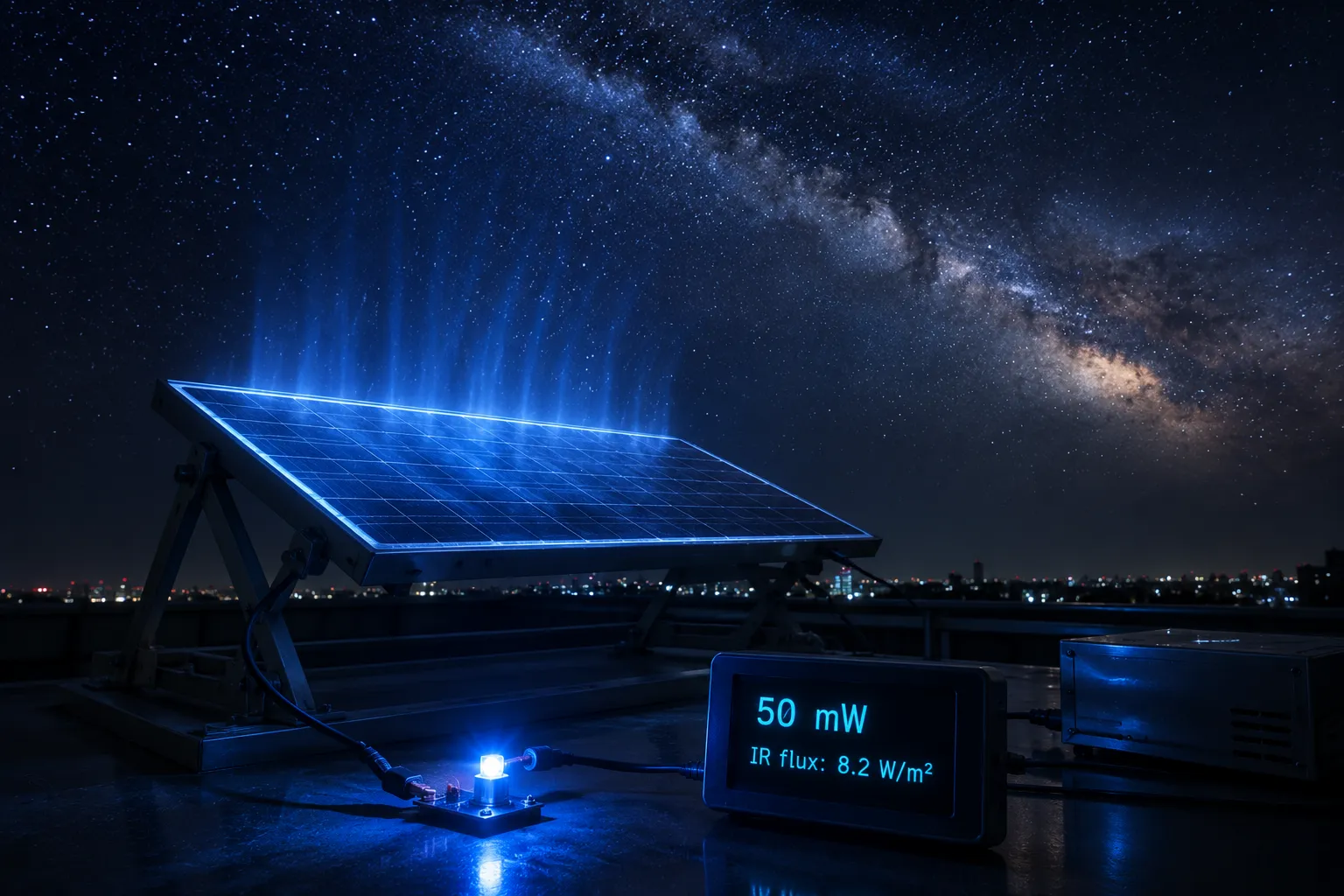
STANFORD, Calif. — May 26, 2026 — The panel on the rooftop of the Spilker Building at Stanford University looks like any other photovoltaic array. Its dark blue surface tilts toward the sky, absorbing sunlight during the day and converting it into electricity. But when the sun sets and the other panels in the test field go dark, this one keeps producing. Not much—a trickle, really, about 50 milliwatts per square meter—but the trickle is enough to power an LED or a small sensor. And it never stops. Through the night, through overcast days, through the dead of winter, the panel generates electricity from something that was long considered a waste product: the cold of space.
This is the thermoradiative diode, a device that turns the fundamental physics of heat radiation on its head. A conventional solar panel works by absorbing incoming photons from the sun, which knock electrons into a higher energy state, creating a voltage. The new device works in reverse. It uses the panel's own thermal radiation—the infrared heat it emits into the cold sky—to generate electricity. In effect, it harvests energy from the temperature difference between the panel (at ambient temperature) and outer space (at a frigid 2.7 Kelvin). That difference exists 24 hours a day, even when the sun is down.
"For decades, we have treated the night sky as a liability for solar power," said Dr. Aaswath Raman, a professor of applied physics at Stanford and the lead researcher on the project. "We thought of it as the thing that cools our panels down and stops them from working. But that cooling is actually a source of energy. The universe is the coldest thing around. Every warm object on Earth radiates heat toward it. We have found a way to capture some of that radiated energy and turn it into electricity."
"The universe is the coldest thing around. Every warm object on Earth radiates heat toward it. We have found a way to capture some of that radiated energy and turn it into electricity." — Dr. Aaswath Raman, Stanford University
The Physics of Cold
To understand the thermoradiative diode, you need to unlearn what you know about solar cells. A conventional photovoltaic (PV) cell is a heat engine running in reverse. It takes a hot source (the sun, at 5,500°C) and a cold sink (the panel itself, at ambient temperature) and extracts electrical work from the flow of photons from hot to cold.
A thermoradiative diode does the same thing, but it swaps the roles. The hot source is the panel itself, warmed by its environment. The cold sink is the sky—specifically, the 2.7 Kelvin background radiation of the universe left over from the Big Bang. Every object on Earth radiates infrared light. That radiation carries energy away. If you can place a diode in the path of that outgoing radiation, you can convert some of it into electricity.
The key is the bandgap of the semiconductor. In a conventional solar cell, the bandgap is tuned to match the energy of incoming photons from the sun. In a thermoradiative diode, the bandgap is tuned to match the energy of outgoing infrared photons—the heat the panel is emitting. When an electron drops from a higher energy state to a lower one, it emits a photon. If that emission happens in a specially designed diode, the electron can be forced to flow through an external circuit before it recombines, producing electrical current.
The Stanford team's breakthrough was building a diode using mercury cadmium telluride (MCT), a semiconductor commonly used in infrared detectors. MCT can be tuned to have a very narrow bandgap—just enough to capture the long‑wavelength infrared radiation that objects at room temperature emit. The device is essentially a solar cell that runs on the panel's own heat.
"We are not breaking the laws of thermodynamics," Dr. Raman emphasized. "We are using them. The second law says that heat flows from hot to cold. The universe is cold. So heat flows from Earth to space. We are just putting a turbine in that flow, the same way a wind turbine puts a rotor in the flow of air."
How Much Power, Really?
The night‑time power output of the prototype is modest: about 50 milliwatts per square meter. A typical solar panel produces about 200 watts per square meter in full sun. So the thermoradiative panel produces roughly 0.025 percent as much power as a conventional panel at noon.
But that comparison is misleading. The thermoradiative panel works at night, when conventional panels produce zero. It also works during the day, actually adding its night‑time trickle to the panel's daytime output. And the power density can be improved. The Stanford team estimates that with optimized materials and better thermal management, thermoradiative panels could achieve 1 to 5 watts per square meter at night—still small, but enough to power off‑grid sensors, emergency lighting, or slow battery charging.
"The point is not to replace solar panels," said Dr. Raman. "The point is to complement them. A home with a conventional solar array and battery storage can run all night on stored energy. But that battery is expensive and wears out. What if your panels could trickle‑charge the battery all night long, reducing the depth of discharge and extending battery life? What if a sensor in the middle of the desert could run forever without any battery at all, just using the day‑night temperature cycle?"
Real‑World Demonstrations
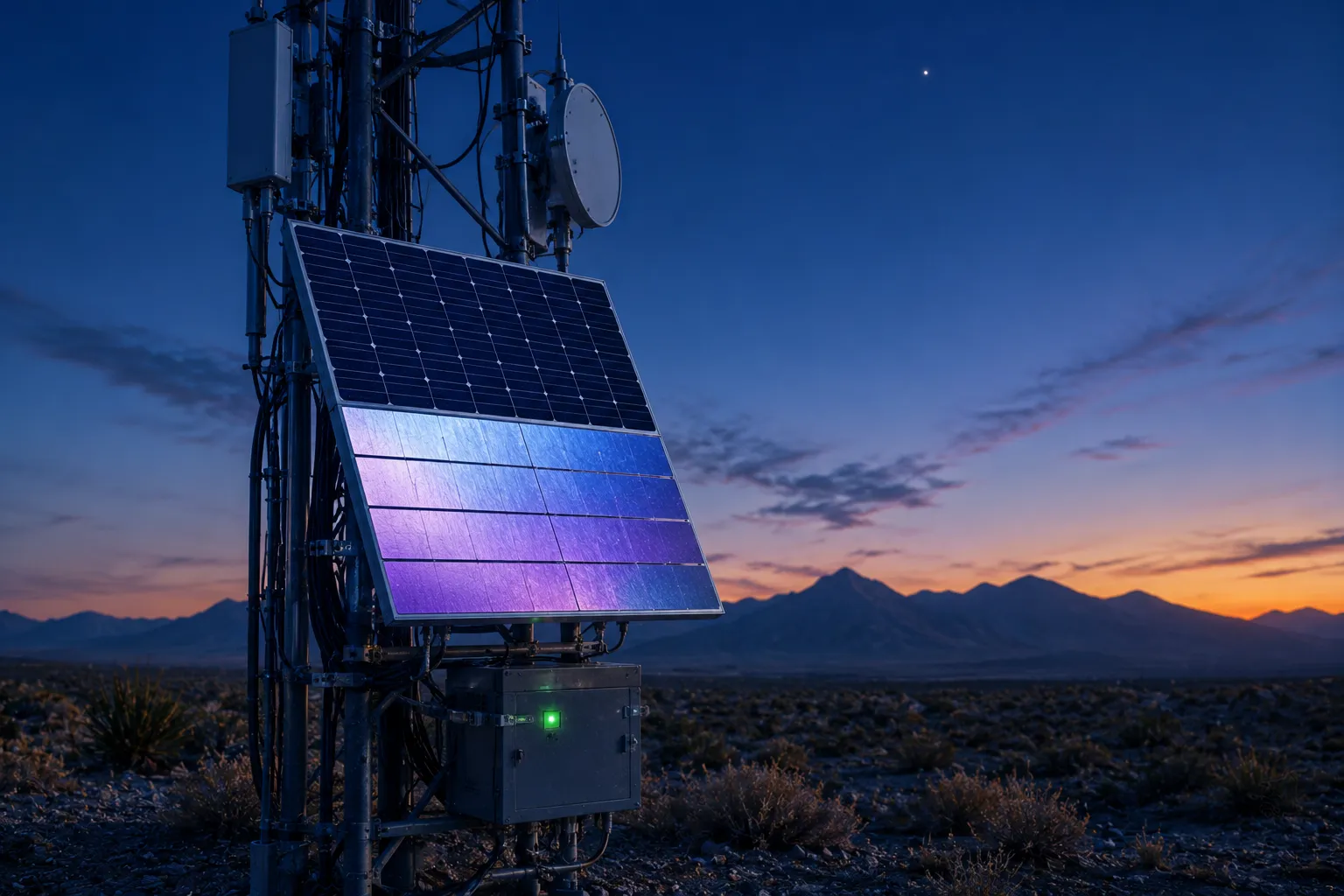
The Stanford prototype is a laboratory device, but field tests are already underway. A spin‑off company, NightSolar, has deployed 10 prototype panels at a remote weather station in the Mojave Desert. The panels are conventional silicon solar cells on top (for daytime) and thermoradiative MCT diodes on the bottom (for night). The bottom layer is bonded to a thermally conductive substrate that faces the sky through a transparent, low‑emissivity cover that lets infrared out but traps heat in.
The weather station runs on a small battery. During the first six months of testing, the thermoradiative layer contributed an average of 8 watt‑hours per night—not enough to run the station alone, but enough to reduce battery cycling by 22 percent. "That may not sound like much," said NightSolar CEO Dr. Priya Mehta, "but in battery terms, it extends lifespan by years. For off‑grid applications, that is a game changer."
A second test is underway on a rooftop in London, where cloudy days are common. The thermoradiative diode actually works better in cloudy conditions than on clear nights? Counterintuitively, yes—because clouds trap heat near the ground, keeping the panel warmer while the sky remains cold. The temperature difference is smaller but more consistent. The London test has shown night‑time output of 60 to 70 milliwatts per square meter, slightly higher than the desert test.
"The desert has very cold nights, which increases the temperature difference but also makes the panel cold," Dr. Mehta explained. "The diode works best when the panel is warm and the sky is cold. That happens more often in humid or cloudy environments than you might think."
Beyond Night‑Time Solar: The Wider Potential
The thermoradiative diode is not limited to solar panels. Any warm object radiating to a cold environment could generate power. Researchers are exploring three other applications.
Waste heat recovery is the most immediate. Industrial processes—steel mills, glass furnaces, cement kilns—release enormous amounts of heat into the environment. That heat is infrared radiation. A thermoradiative diode placed on a hot pipe or a furnace wall could convert some of that otherwise wasted radiation into electricity. The temperature difference is much larger than the sky‑to‑panel difference, so power densities could be much higher. A team at MIT is testing MCT diodes on a steam pipe at a Massachusetts power plant; early results suggest 20 watts per square meter.
Body heat harvesting is a longer‑term goal. The human body radiates about 100 watts of infrared energy. A wearable thermoradiative diode could capture a fraction of that to power sensors, smartwatches, or medical implants. The challenge is that the device would need to be transparent to visible light (so it doesn't look like a metal patch) while absorbing infrared. Metamaterials—engineered surfaces with sub‑wavelength structures—may provide a solution.
Deep‑space power is the most exotic. Spacecraft in the outer solar system receive very little sunlight; they rely on radioisotope thermoelectric generators (RTGs) that use the heat of decaying plutonium. RTGs are expensive and politically controversial. A thermoradiative diode facing deep space (which is extremely cold) could generate power from the spacecraft's own waste heat, without any radioactive material. NASA is funding preliminary studies.
"The thermoradiative principle is universal," said Dr. Raman. "Anytime you have a warm object looking at a cold background, you have a potential power source. The Earth looking at space is one example. A human body looking at a room is another. A spacecraft looking at the cosmic microwave background is a third. We are just beginning to explore the possibilities."
The Limits of the Laws
There are, of course, hard limits. The Carnot efficiency of a heat engine operating between ambient temperature (300 K) and space (3 K) is about 99 percent—absurdly high. But that is the theoretical maximum for a reversible engine. A real thermoradiative diode is limited by the fact that it must absorb some radiation from the environment (otherwise it would cool to absolute zero, which it cannot). The Stanford team's device has an efficiency of about 1.5 percent relative to the Carnot limit. Improving that to 10 or 20 percent is the focus of current research.
"There is no fundamental reason why we cannot approach the Carnot limit more closely," Dr. Raman said. "Better semiconductors, better thermal isolation, better optical design. We are at the Wright Brothers stage. The first flight was 12 seconds and 120 feet. That did not look like a 747. But it proved the principle."
"We are at the Wright Brothers stage. The first flight was 12 seconds and 120 feet. That did not look like a 747. But it proved the principle." — Dr. Aaswath Raman
The Path to Commercialization
NightSolar plans to release its first commercial product in 2028: a hybrid panel that combines a conventional silicon solar cell on top with a thermoradiative MCT layer on the bottom. The panel will be roughly 20 percent more expensive than a standard panel, but it will produce night‑time power and will come with a 25‑year warranty. The target market is off‑grid telecommunications towers, remote weather stations, and rural health clinics—applications where battery replacement is expensive and reliability is critical.
"We are not trying to compete with grid‑tied solar farms," said Dr. Mehta. "Those have plenty of room for batteries. We are going after the places where batteries are a nightmare—deep in the forest, on a mountaintop, in the desert. Places where every watt matters and every kilogram of battery you don't have to helicopter in is a win."
The broader impact, if the technology scales, could be transformative. Solar power's biggest weakness—its intermittency—would be partially addressed. Not eliminated; the night‑time output is still far too small to run an air conditioner or charge an electric car. But the fact that a solar panel can produce any power at night changes the calculus for microgrids, for disaster relief, for any situation where every electron counts.
The Quiet Night
On the rooftop at Stanford, the LED glows faintly. The panel above it is warm from the day's sun, radiating infrared into the clear night sky. The diode captures a sliver of that outgoing energy, converts it to electricity, lights the bulb. It is a small light, barely visible from the ground. But it is steady, constant, unwavering. It does not care about clouds or seasons or the tilt of the Earth. As long as the panel is warmer than the sky, it will shine.
The sun will rise in a few hours, and the conventional part of the panel will roar to life, producing hundreds of watts. The thermoradiative layer will keep producing its trickle, adding to the total. At sunset, when the conventional cells fall silent, the trickle will continue. The panel that works at night is not a revolution. It is an evolution—a reminder that there is energy everywhere, if you know how to look. The universe is cold, and we are warm. That difference, that ancient gradient, is a gift. We are just learning to accept it.


