The Software Company That Bet 8 Years on a Battery: How KPIT Built India's First Indigenous Sodium-Ion Power Pack—and Handed It to a Manufacturer to Take on Lithium
PUNE — May 26, 2026 — In December 2023, a publicly listed automotive software company with no prior history in electrochemistry unveiled a battery technology that it had been developing, quietly and without fanfare, for eight years. The company was KPIT Technologies, a Pune-headquartered mobility solutions firm with a market capitalisation of roughly ₹45,000 crore, over 12,000 employees, and a client roster that includes some of the largest automakers on Earth. It was not a battery startup. It was not a research laboratory. It was a software company that had decided, in 2015, that India's electric vehicle revolution would never reach scale unless someone built a battery that did not depend on lithium—and that it was willing to be the company that tried.
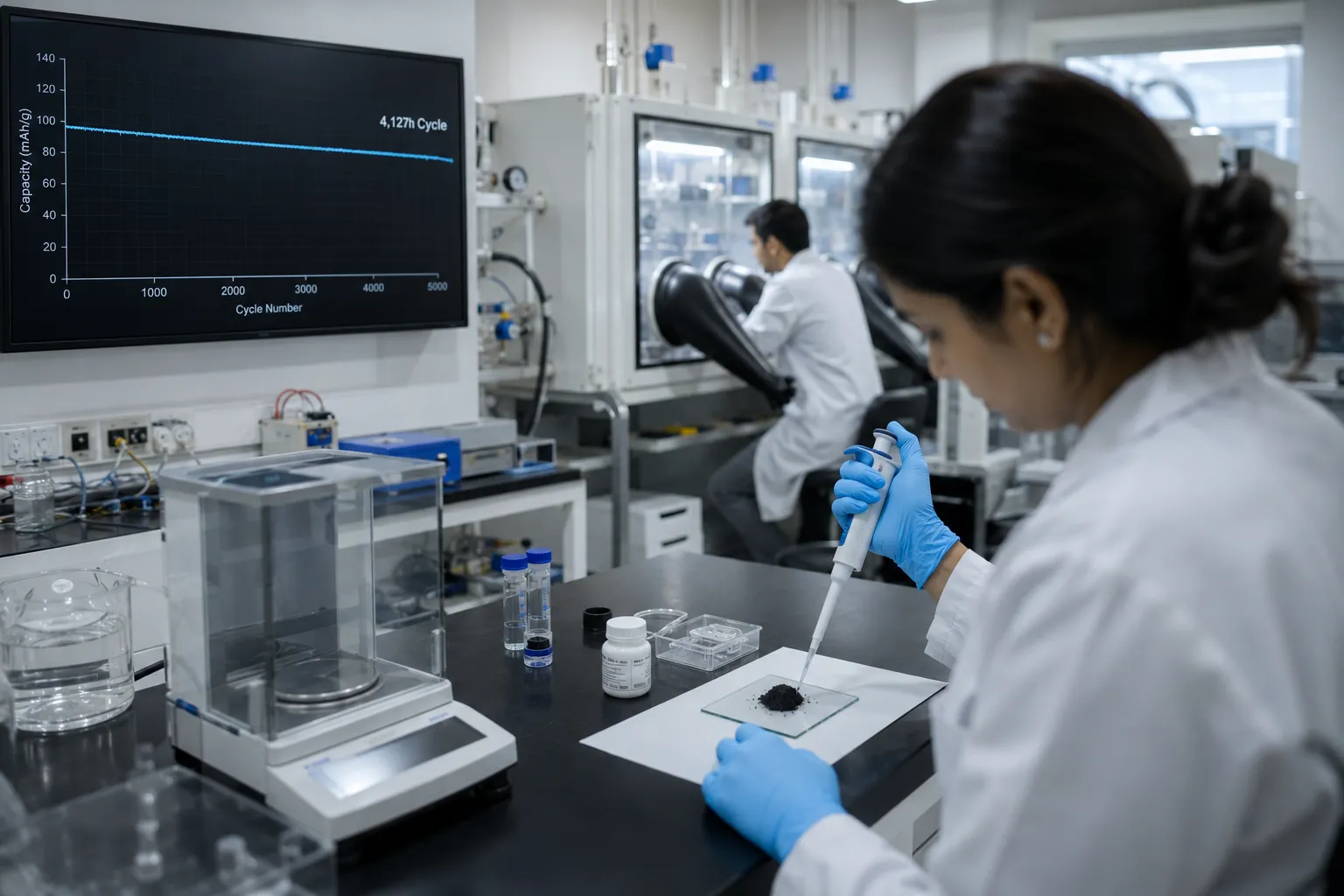
The result was India's first indigenous sodium-ion battery technology. It was designed to be 25 to 30 percent cheaper than equivalent lithium-ion cells. It promised 80 percent capacity retention after 3,000 to 6,000 charge-discharge cycles—roughly double the lifespan of most lithium-ion alternatives. It charged faster, operated safely at temperatures that would cook a lithium cell, and was built entirely from earth-abundant raw materials that could be sourced within India. And it was the product of an unusual, decade-long collaboration between a corporate R&D lab and a public university—the Indian Institute of Science Education and Research, or IISER, in Pune—that had produced something neither institution could have built alone.
In the two and a half years since that unveiling, the battery has moved from the laboratory to the factory floor. In February 2025, KPIT signed a technology transfer agreement with Trentar Energy Solutions, a company set up specifically to commercialise the technology. Trentar committed to building a 3 gigawatt-hour manufacturing facility—a plant that, when fully operational, will be one of the largest sodium-ion battery factories in the world. KPIT will receive upfront technology transfer fees and royalties over eight years. The partnership was not a sale. It was a licence—a structure that allows KPIT to continue developing the technology while Trentar handles the capital-intensive work of manufacturing, distribution, and sales.
And in May 2026, the broader market signalled that KPIT's bet was not an eccentricity. The company announced a major strategic deal with BMW Group for next-generation charging electronics, and disclosed that it had booked $349 million in new orders from European automakers in the first quarter of the year alone—contracts spanning electric powertrains, autonomous driving, and body electronics. The software company that had spent eight years developing a battery was now being sought out by the world's most demanding automotive customers, not just for its code, but for its deep understanding of the electrification technologies that are reshaping the global auto industry.
The 8-Year Bet That Made No Sense
To understand what KPIT has achieved, one must first understand the structural dependency that its battery was designed to break—and the improbability of a software company being the one to break it.
Lithium is the lifeblood of the global electric vehicle industry. Every lithium-ion cell—whether it powers a Tata Nexon, a Tesla Model 3, or a grid-scale storage installation—contains lithium in its cathode, and the global supply chain for that lithium is concentrated in a handful of countries. Australia and Chile mine the majority of the world's raw lithium. China refines it, processes it into battery-grade chemicals, and manufactures the cathodes, anodes, and finished cells. India, which has set ambitious targets for electric vehicle adoption—30 percent of new vehicle sales by 2030—has virtually no domestic lithium reserves of commercial significance, no lithium refining capacity, and no large-scale lithium-ion cell manufacturing beyond the nascent gigafactories being built by Tata's Agratas, Reliance, and Ola Electric. The country's EV ambitions rest on a supply chain that it does not control, for a mineral that it does not possess.
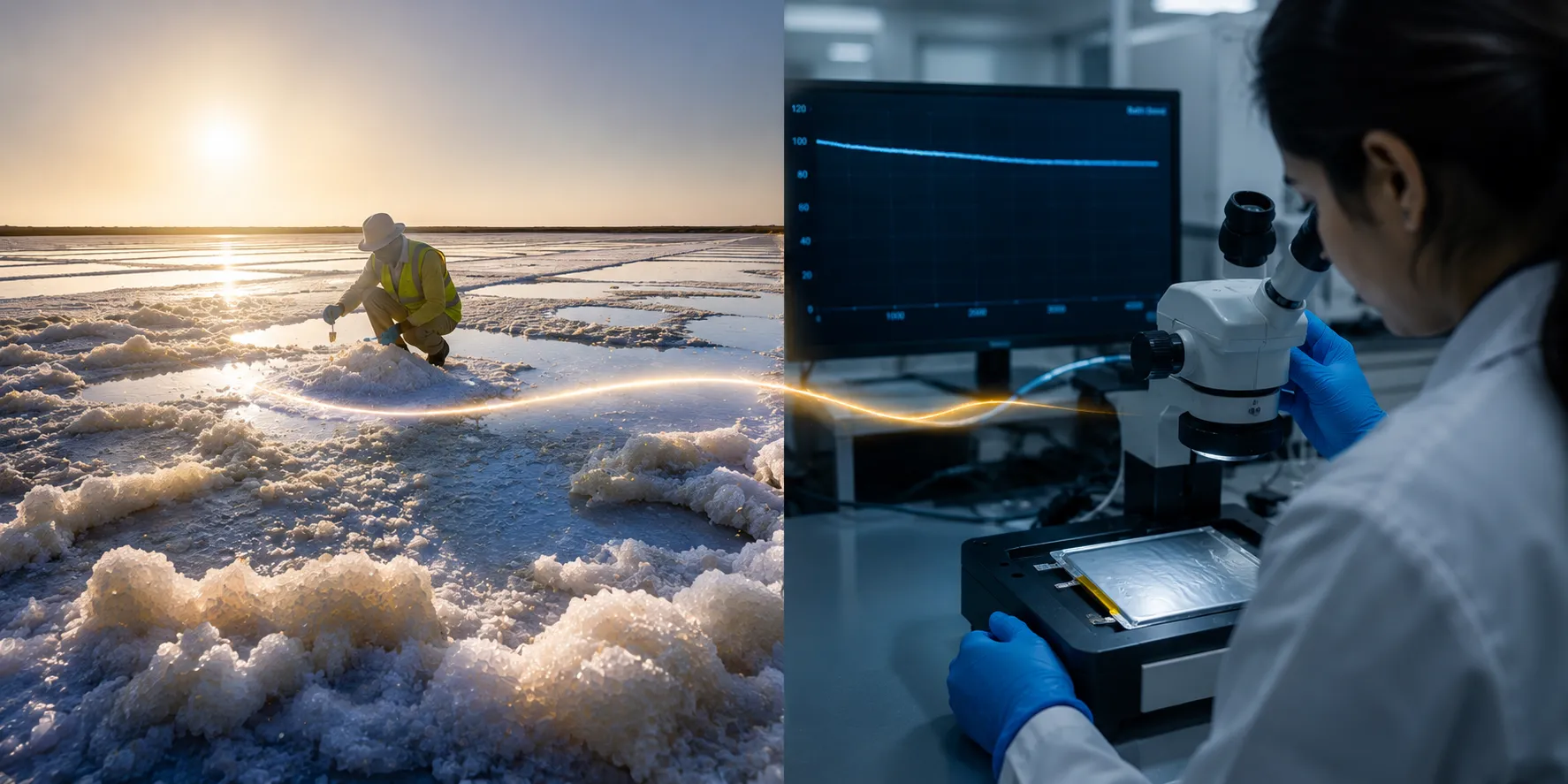
Sodium is different. Sodium is the sixth most abundant element in the Earth's crust. It is present in seawater, in salt flats, and in the common table salt that costs pennies per kilogram. A sodium-ion battery does not need lithium, cobalt, nickel, or any of the rare, expensive, and geopolitically contested minerals that define the lithium-ion supply chain. It needs sodium, which is essentially free, and it needs a cathode material—typically a layered oxide or a Prussian blue analogue—that can be synthesised from abundant precursors. The chemistry has been understood for decades, but commercialising it has been a slow, difficult process, because sodium ions are larger than lithium ions and move less efficiently through electrode materials. The energy density—the amount of power a battery can store per kilogram—has historically been too low to compete with lithium-ion for vehicle applications. The world's leading sodium-ion developers—CATL in China, Faradion in the United Kingdom, Natron Energy in the United States—have spent years solving these problems.
KPIT entered the race in 2015, not because it had any particular expertise in battery chemistry, but because its leadership saw something that the battery industry had missed. The market for electric vehicles in India was not the same as the market in China, Europe, or the United States. Indian consumers were not buying premium sedans with 500-kilometre ranges. They were buying electric two-wheelers, three-wheelers, and small commercial vehicles—the auto-rickshaws, delivery vans, and cargo carriers that form the backbone of urban transport—and they were buying them primarily because they were cheaper to operate than petrol or diesel alternatives. The most important metric for these customers was not range. It was total cost of ownership. A battery that was 30 percent cheaper than lithium-ion, even if it was slightly heavier and stored slightly less energy per kilogram, would transform the economics of India's electric vehicle market. Sodium-ion was not a compromise. It was the right chemistry for the right market.
The company partnered with IISER Pune, where a team led by Dr. Satishchandra Ogale had been working on advanced materials for energy storage. The collaboration was structured as a true research partnership—not a consulting arrangement in which the company wrote a cheque and the university produced a report. KPIT's engineers worked alongside IISER's scientists, contributing their expertise in systems integration, thermal management, and automotive-grade testing. The university contributed its expertise in material synthesis, electrochemical characterisation, and battery testing. The partnership lasted eight years, and it produced something that neither institution could have built alone: a battery that works, that is manufacturable at scale, and that has been validated by a technology transfer agreement with a company prepared to invest in a 3 GWh factory.
The battery's specifications are competitive with the best sodium-ion technologies globally. The energy density ranges from 100 to 170 watt-hours per kilogram, with a roadmap to reach 220 Wh/kg—approaching the lower end of lithium-ion territory. The cycle life of 3,000 to 6,000 charges with 80 percent capacity retention is roughly double what most lithium-ion cells achieve. The charging speed is faster than conventional lithium batteries, because sodium-ion cells have lower internal resistance and can accept higher currents without degrading. The temperature tolerance is exceptional: the battery operates safely at sub-zero temperatures where lithium cells would struggle, and at high temperatures where lithium cells would require active cooling. The safety profile is superior, because sodium-ion chemistry is inherently less prone to thermal runaway than lithium-ion. And the cost, once the technology reaches manufacturing scale, is projected to be 25 to 30 percent below equivalent lithium-ion cells—a differential that, in the price-sensitive Indian market, could be decisive.
KPIT's battery is among only a handful of matured sodium-ion technologies globally. The company has joined what Ravi Pandit described as a "small and elite club" of organisations—including CATL, BYD, and Faradion—that have developed sodium-ion-based battery solutions ready for commercial deployment. The technology has multiple variants, each with distinct performance characteristics, and its applications span automotive two- and three-wheelers, commercial vehicles, UPS backup systems, grid-scale energy storage, and the marine and defence sectors. The 3 GWh Trentar facility, when operational, will be one of the largest sodium-ion manufacturing plants in the world—a factory that does not need to import a single gram of lithium, cobalt, or nickel.
The Trentar Bet
The most strategically significant decision KPIT made was not to build the battery. It was to not build the factory.
The technology transfer agreement with Trentar Energy Solutions, signed in February 2025, is structured as a licensing arrangement. KPIT transfers its sodium-ion battery technology to Trentar, which assumes responsibility for manufacturing, marketing, and distribution. Trentar invests in the 3 GWh production facility—a capital-intensive commitment that would have strained KPIT's balance sheet and distracted from its core software business. KPIT receives upfront technology transfer fees and royalty payments over eight years, creating a recurring revenue stream from a technology it developed internally. The structure allows both companies to focus on what they do best: KPIT on technology development and systems integration, Trentar on manufacturing and commercialisation.
Subodh Menon, founder and vice chairman of Trentar, described sodium-ion technology as "a strategic focus" for the company. "With its cost-effectiveness, simplified supply chain, and enhanced safety, Sodium-ion technology represents a strategic focus for our organization," he said at the time of the announcement. "We are committed to developing a robust technological product line in this space, catering to diverse customers across mobility and energy storage verticals. This marks a significant step towards a more sustainable and scalable energy for the future."
The Trentar partnership also reflects a broader shift in how Indian technology companies are thinking about intellectual property. For decades, India's IT industry was built on services—the deployment and maintenance of technologies that were developed elsewhere. The KPIT-Trentar model is different. It is a technology licensing arrangement of the kind that has built the semiconductor, pharmaceutical, and automotive industries in the West: a company develops a core technology, protects it with patents, and licenses it to manufacturing partners who operate at scale. The model allows the technology developer to capture a share of the value created by the technology without becoming a manufacturer itself. It is the model that ARM used to dominate smartphone processors, that Qualcomm uses to dominate mobile chipsets, and that Dolby uses to dominate audio technology. KPIT is attempting to apply the same model to battery chemistry—and it is doing so from Pune, not Silicon Valley.
The BMW Validation
The BMW deal, announced in May 2026, does not involve sodium-ion batteries directly. It involves next-generation charging electronics—the power-management systems that control how electricity flows into and out of an electric vehicle's battery pack. But the deal is a validation of the broader thesis that has driven KPIT's battery strategy from the beginning: that the transition to electric mobility is creating demand for technologies that were not needed in the internal-combustion era, and that the companies that develop those technologies early will capture a disproportionate share of the value they create.
BMW does not award strategic contracts lightly. The German automaker is among the most demanding customers in the global automotive industry, with quality standards and validation requirements that can take years to satisfy. The fact that KPIT—a company that was best known, until recently, as an automotive software supplier—has won a major contract from BMW for charging electronics suggests that its expertise in electrification extends well beyond the software stack. The company understands, at a systems level, how electric vehicles work—how power flows from the grid into the battery, from the battery into the motor, and from regenerative braking back into the battery. That systems-level understanding is what enabled it to develop a sodium-ion battery in the first place, and it is what is now attracting the attention of the world's most demanding customers.
The $349 million in new orders booked in the first quarter of 2026 further validates the thesis. European automakers, under increasing pressure to electrify their fleets, are seeking partners who can help them accelerate their transition. KPIT's combination of software expertise, battery technology, and charging systems integration is unusual—few companies in the world can offer all three. The result is a pipeline of contracts that is growing faster than the company's traditional automotive software business.
The battery itself is now in Trentar's hands. The 3 GWh factory will take years to build, equip, and ramp to full production. The first cells are not expected to reach the market for at least two to three years. But the technology transfer is complete, the royalty structure is in place, and the manufacturing partner is funded and committed. The software company that spent eight years developing a battery has returned to its core business—building mobility technologies for a global customer base—with a battery that it does not have to manufacture, and a revenue stream that it will collect for years.
What This Signals
The KPIT sodium-ion battery story is not primarily about electrochemistry. It is about a publicly listed Indian technology company making an eight-year bet on deep-tech hardware—a bet that most of its peers, and most of its shareholders, would have considered unjustifiable.
For decades, the Indian technology industry has been defined by services. The IT giants—TCS, Infosys, Wipro, HCLTech—built their empires by deploying and maintaining technologies developed elsewhere. The model generated hundreds of billions of dollars in revenue, created millions of jobs, and transformed India's position in the global economy. It also created a structural aversion to risk. The companies that succeeded in services were the ones that executed reliably, managed costs carefully, and avoided the kind of speculative, long-gestation R&D investments that produce genuine intellectual property. The model was profitable, predictable, and profoundly innovation-averse.
KPIT's sodium-ion battery is a departure from that model. It is a deep-tech hardware bet, made by a software company, sustained over eight years of R&D, protected by patents, and commercialised through a licensing arrangement that will generate revenue for years. It is the kind of bet that Indian companies have almost never made—and the kind of bet that, if it pays off, will demonstrate that Indian technology companies can produce genuine intellectual property, not just deploy the intellectual property of others.
The 3 GWh factory that Trentar is building will not, on its own, solve India's lithium dependency. The country's demand for batteries is measured in tens of gigawatt-hours, and the sodium-ion chemistry, for all its advantages, will not replace lithium-ion in every application. Long-range passenger cars, for which energy density is paramount, will continue to use lithium-ion for the foreseeable future. But the commercial vehicle segment, the stationary storage market, and the two- and three-wheeler segments—the markets where cost and durability matter more than energy density—are large enough to support a substantial sodium-ion industry. The company that owns the core technology for that industry, and that collects royalties on every cell produced, will have a business that is measured in the hundreds of crores, not the tens.
Ravi Pandit, the co-founder and chairman of KPIT, has been deliberate about not overstating the significance of the sodium-ion programme. "We are working on multiple technologies to reimagine mobility," he said, and the battery is one of many—a piece of a larger strategy rather than the strategy itself. But the strategy that the battery represents—invest in deep tech, protect it with intellectual property, license it to manufacturing partners—is one that the Indian technology industry has spent decades avoiding. The BMW contract, the Trentar partnership, and the $349 million in new orders are the market's judgment that the strategy is working. The software company that bet eight years on a battery has been vindicated—not just for the battery itself, but for the model of innovation that produced it.


