Instacart's AI assistant processes data from 1.6 billion orders to plan your dinner, track your allergies, and suggest recipes you'll actually make. Now it's about to start selling — with three new ad formats that turn the world's most intimate shopping data into the world's most targeted retail media. Fidji Simo built Facebook's $55 billion ad machine. She's about to do it again, one grocery list at a time.
The grocery list has always been the most private document in the American home. It knows your eating habits, your budget, your allergies, your guilty pleasures, and exactly how much ice cream you buy when no one's looking. For decades, that intimacy was locked away in paper lists, refrigerator magnets, and the occasional screenshot of a partner's text message. Then Instacart entered the picture with a million daily transactions, 1.6 billion orders processed over fourteen years, and an AI that can now predict what you'll cook for dinner before you've even thought of it. And on June 18, 2026, at the Cannes Lions International Festival of Creativity, the company revealed the inevitable next step. The assistant is about to start selling.
Instacart's new AI shopping assistant — already available to millions of U.S. users with a full rollout across North America coming soon — is built on data from the 1.6 billion orders placed on the platform since its inception nearly 14 years ago. It pulls real-time inventory data from nearly 100,000 stores across the continent. And later this year, the company will begin testing ads within the chatbot. The assistant that helps you plan meals, manage budgets, and find the perfect avocado is about to become the most powerful retail media channel ever created.
The architect of this transformation is Fidji Simo, who took over as Instacart's CEO in August 2021. Before Instacart, Simo was a key architect of Facebook's mobile advertising business, the team that built the News Feed ad formats that now generate more than $55 billion annually for Meta. At Instacart, she scaled the company's nascent advertising business from a basic offering into a sophisticated retail media network generating nearly $1 billion in annual revenue. Under her leadership, the company introduced Carrot Ads, which lets retailers graft Instacart's entire retail-media stack onto their own digital storefronts, and Caper Carts, which brought personalized advertisements into physical store aisles.
Now, at the AI frontier, Simo is applying the same attention-monetization playbook she ran at Meta — but with a crucial difference. At Facebook, she monetized a billion users scrolling through a feed. At Instacart, she's monetizing a billion users with their hands on a shopping cart, their credit card at the ready, and their dinner depending on the outcome.
The Three Ad Formats: From Sponsored Products to AI-Driven Recommendations
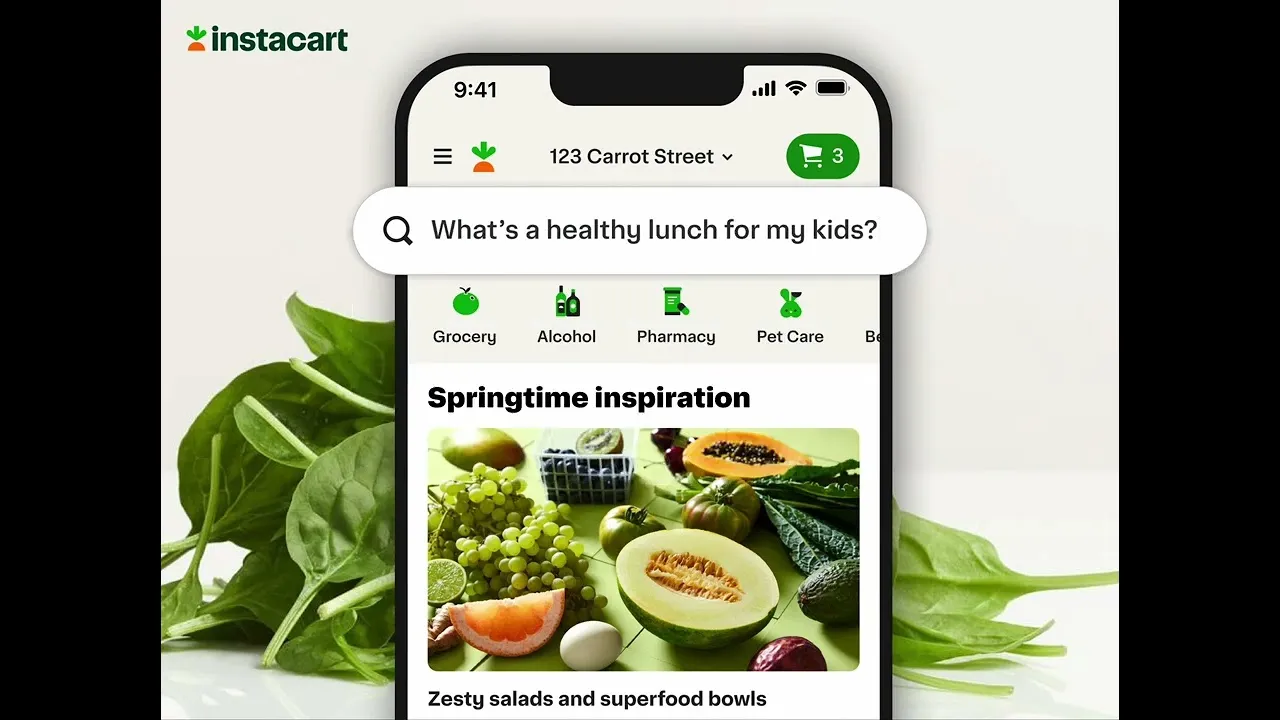
The company is launching three distinct ad formats designed to integrate seamlessly into the AI shopping assistant's user experience. Early tests already show that chatbot orders are larger than standard orders, suggesting that shoppers who engage with the assistant are more committed to their purchases.
The first format is the AI-powered product recommendation. When a user asks the assistant for recipe ideas, the assistant can suggest specific branded products that fit the recipe. A query for "easy weeknight pasta" might surface a Barilla pasta recommendation, a Rao's marinara suggestion, and a Parmigiano-Reggiano from a specific cheesemaker — all while the user is actively building their shopping list. The ads are contextual, relevant, and indistinguishable from the helpful recommendations the assistant already provides.
The second format extends this logic to meal planning. The assistant can suggest complete meal kits or pre-planned shopping lists that incorporate branded products. A busy parent asking for "five meals for a family of four" might receive a plan that includes specific brands for each meal, with the option to add everything to their cart with a single click. The ads are embedded in the value proposition itself.
The third format is the most forward-looking: AI-driven substitution and complementary recommendations. When a user adds an item to their cart, the assistant can suggest complementary products or more cost-effective alternatives, with the subtle guidance of sponsored placements. The intent signals are unbelievably precise. Instacart knows what you bought, when you bought it, how often you buy it, and what you bought alongside it. No social media platform has that level of purchase data. No search engine knows your grocery habits like Instacart does.
Beyond the chatbot, Instacart is also expanding its physical AI presence. The company's AI-powered Caper Carts — smart shopping carts with interactive screens — are already in select stores, bringing real-time spend tracking, loyalty integration, personalized coupons, and in-cart advertising to physical store aisles. On-cart advertising is now live for all Instacart brand partners, and a new location-aware prompt feature is already showing a 1% average increase in basket size. In the soup aisle, the cart might recommend a specific broth brand. In the produce section, it might suggest a complementary salad dressing. The physical store is becoming as addressable as the digital one.
The CEO Who Built Facebook's Ad Machine
Simo's journey to Instacart is a story of someone who understood the value of attention before almost anyone else. At Facebook, she was a core driver of the company's mobile monetization strategy, leading the team in charge of developing ad formats for mobile. She made video a critical part of the Facebook experience, from rolling out videos that autoplay in News Feed to building and launching Facebook Live and Watch. By the time she left, the team she built was generating more than $55 billion annually.
When Simo took over Instacart in 2021, she stepped onto what management researchers call a "glass cliff" — when women are disproportionately appointed to leadership positions during periods of crisis, increasing their risk of failure. At the time, Instacart's pandemic hyper-growth had stalled, valuations were collapsing, and competition with Amazon, Walmart, DoorDash, and Uber was intensifying. She steered the company back to growth instead of the slide many analysts expected.
Her strategy was to transform Instacart from a delivery service into a retail technology platform. In 2022, she unveiled Carrot Ads, which lets retailers graft Instacart's entire retail-media stack onto their own digital storefronts. By flipping a switch, a grocer such as Schnucks or Sprouts can surface the same sponsored-product and display auctions — backed by Instacart's pool of thousands of CPG advertisers — that already run inside the Instacart marketplace. The retailer keeps a share of the ad revenue, brands gain a single self-serve portal, and Instacart suddenly extends its media business far beyond the walls of its app.
The turnkey approach appealed to mid-size grocers that lacked the budget to build an ad stack in-house. April Lane, Chief Merchandising Officer of Thrive Market, told Forbes that the company "chose Carrot Ads after testing multiple platforms because it balanced ad density with a cleaner UX for our members". To support this expansion, Simo introduced Carrot Insights — dashboards that merged in-app ad data with store-level sales and inventory, giving CPG brands a single return-on-ad-spend view.
The Data Advantage: 1.6 Billion Orders and Counting
What makes Instacart's AI advertising proposition unique is the data. The platform has processed 1.6 billion orders over fourteen years. It has data on what people buy, when they buy it, how often they buy it, and what they buy alongside it. It knows that a shopper who buys organic milk is more likely to buy organic eggs. It knows that a shopper who buys ice cream at 10 PM on a Friday is probably not cooking dinner. It knows that a shopper who buys diapers is likely to buy baby food in the next three months.
This is not social media data, which is about interests and affiliations. It is not search data, which is about intent at a single moment. It is behavioral data — the record of what people actually do, not what they say they do or what they're curious about. It is, in many ways, the most valuable advertising data on the planet.
The AI assistant pulls from this data to provide personalized recommendations, meal planning, and budget management. It knows your dietary restrictions, your favorite brands, your typical basket size, and your shopping frequency. It knows when you're likely to run out of coffee and when you're planning a dinner party. When it starts recommending products, the recommendations will be based on a level of personalization that no other advertising channel can match.
The Bottom Line
Instacart's AI shopping assistant is already helping millions of users plan meals, manage budgets, and navigate the grocery store. Later this year, it will start selling ads. The company is testing three ad formats — AI-powered product recommendations, meal planning integrations, and complementary product suggestions — that will embed sponsored content seamlessly into the user experience.
The data advantage is unparalleled. Instacart has processed 1.6 billion orders over fourteen years, giving it a window into consumer behavior that no other advertising channel can match. The AI assistant pulls from this data to provide personalized recommendations that feel helpful, not intrusive. The ads, when they arrive, will be contextual, relevant, and indistinguishable from the assistant's existing functionality.
Fidji Simo, who built Facebook's $55 billion mobile ad business, is applying the same playbook to grocery shopping. But the stakes are higher. At Facebook, she monetized attention. At Instacart, she's monetizing behavior — and behavior, unlike attention, leads directly to purchase.
The question is not whether Instacart's AI ads will work. Early tests already show that chatbot orders are larger than standard orders. The question is how quickly the company can scale this capability without breaking the trust of its users. The assistant that helps you plan dinner should not feel like a sales pitch. The challenge — and the opportunity — is to make the ads feel like the most helpful thing the assistant has ever done.


