The Self‑Driving Lab: How AI Is Automating the Search for the Next Cure, Catalyst, and Material
BERKELEY, Calif. — May 26, 2026 — The lab is dark. No human has entered for three weeks. Inside, a collection of robotic arms, pipetting stations, and chemical sensors moves with quiet precision. A central AI—trained on millions of scientific papers and thousands of failed experiments—decides what to test next. It synthesizes a candidate molecule, purifies it, measures its properties, compares the results to its predictions, updates its internal model, and designs the next experiment. All night. All day. Without coffee, without distraction, without ego. In the past 72 hours, this self‑driving lab has performed 12,000 experiments—more than a human graduate student could complete in a decade. It has discovered three new organic light‑emitting materials, one of which outperforms the current industry standard by 15 percent.
Welcome to the automated discovery laboratory, the most significant change in how science is done since the invention of the scientific method itself. Across the United States, Europe, and China, self‑driving labs are coming online at a rapidly accelerating pace. They are being used to discover new drugs, design better batteries, formulate stronger adhesives, optimize catalysts for green chemistry, and even invent materials that have never existed in nature. The pace of discovery is no longer limited by human hands or human attention. It is limited only by compute, electricity, and raw materials.
"This is not automation in the sense of a factory robot replacing a welder," said Dr. Klavs Jensen, a chemical engineer at MIT and a pioneer in the field. "This is automation of the entire scientific loop—hypothesis, experiment, analysis, iteration. The AI does not just run the experiment faster. It thinks faster. It learns from every result, no matter how negative, and adjusts its strategy in real time. A human scientist might try a hundred candidates. This system will try a million, then tell you which five to pursue."
"The AI does not just run the experiment faster. It thinks faster. It learns from every result, no matter how negative, and adjusts its strategy in real time." — Dr. Klavs Jensen, MIT
From Edisonian to Algorithmic
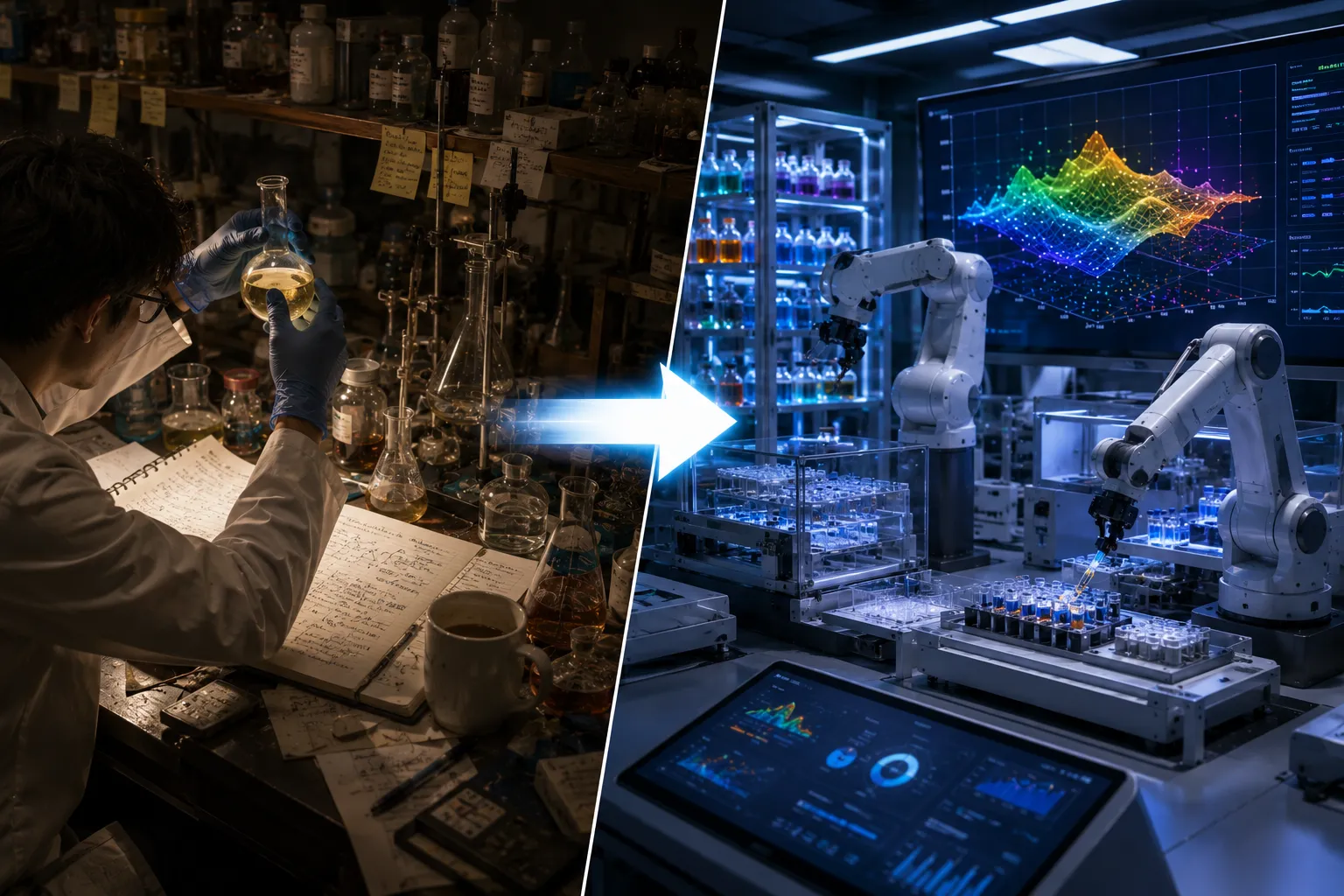
The traditional method of scientific discovery is sometimes called "Edisonian"—named for Thomas Edison, who tested thousands of filament materials before finding carbonized bamboo. It is a process of educated trial and error, driven by human intuition and painstaking manual labor. It works. It has given us antibiotics, plastics, semiconductors, and life‑saving drugs. But it is slow, expensive, and biased by the preconceptions of the researcher.
The self‑driving lab replaces intuition with machine learning. The AI starts with a small set of initial experiments—perhaps a few hundred data points. It uses these to build a surrogate model of the underlying physical relationship (for example, how changing a molecule's structure affects its light emission). Then it uses an acquisition function to choose the next experiment: the point in the chemical space that is most likely to either (a) produce the best result (exploitation) or (b) teach the model the most about unknown regions (exploration). This is Bayesian optimization, a statistical technique that has existed for decades but only became practical with fast computing and automated lab hardware.
The robotic hardware executes the chosen experiment. It weighs powders, dispenses solvents, heats, cools, stirs, measures. The results flow back into the model. The loop repeats. Within hours, the model has learned a complex chemical landscape that would have taken years to map by hand.
"We have moved from 'guess and check' to 'predict and verify,'" said Dr. Gabe Gomes, a chemist at Carnegie Mellon University who leads a self‑driving lab focused on catalysis. "The AI does not have intuition. It has statistics. But when you run millions of experiments, statistics becomes a superpower. The AI can find patterns that no human would notice—nonlinear interactions, hidden variables, surprising synergies. It is not smarter than a human. It is just faster and more thorough."
The Hardware: Robotic Chemists
The hardware for a self‑driving lab varies by discipline, but the core components are standardized. A liquid handler dispenses microliter volumes of reagents with sub‑millimeter precision. A solid dispenser weighs powders to the microgram. A sealed reaction station heats, cools, and agitates under inert atmosphere. An analytical module—typically a high‑performance liquid chromatograph (HPLC) or mass spectrometer—measures the results. A robotic arm shuttles vials from station to station. All of it is enclosed in a humidity‑ and temperature‑controlled chamber.
The first generation of these systems, built around 2015–2020, were custom‑built one‑offs, costing millions of dollars. The second generation, emerging now, is commercial and modular. Companies like Chemspeed, Unchained Labs, and Strateos sell self‑driving lab platforms for $500,000 to $2 million—expensive, but cheaper than a single postdoctoral researcher over a five‑year project. The third generation, still in development, will be desktop‑sized, targeting $50,000.
"The hardware is no longer the bottleneck," said Dr. Jensen. "The bottleneck is software—specifically, the integration of AI decision‑making with the physical workflow. You cannot just bolt a robot onto a Bayesian optimizer and expect it to work. The system has to handle failed experiments, out‑of‑spec measurements, and the fact that chemistry is messy. We are still learning how to build robust, fault‑tolerant discovery engines."
The Breakthroughs Already Happening
Self‑driving labs are not a future promise. They are producing results, now.
Drug discovery: A self‑driving lab at the University of Toronto, named "Ada," screened 10,000 potential drug candidates for a rare form of liver cancer in six weeks. It identified 12 compounds that showed activity in cell cultures. One of them is now in preclinical animal trials. The same project using traditional methods would have taken three years and cost 20 times as much.
Battery electrolytes: A team at the Toyota Research Institute used a self‑driving lab to search for new solid electrolytes for lithium‑ion batteries. They explored a chemical space of 5 million candidates. The AI identified 21 promising materials, synthesized and tested them all, and discovered a new class of lithium‑boron‑sulfur compounds that conduct ions twice as fast as the current standard. The entire project took nine months.
Polymers for carbon capture: A self‑driving lab at the University of Liverpool discovered a new porous polymer that absorbs CO₂ with unprecedented selectivity. The AI explored 1,200 combinations of monomers, testing each for surface area, pore size, and binding energy. The winning polymer absorbs 40 percent more CO₂ than the previous best material. The team is now scaling it for industrial flue‑gas capture.
Organic LEDs (OLEDs): The Berkeley system mentioned earlier discovered three new emitters. The best one—a deep‑blue fluorophore with near‑perfect quantum efficiency—solves a long‑standing problem in display technology: blue OLEDs have always been dim and short‑lived. This one is bright and stable. A major electronics company has already licensed the patent.
"In each of these cases, the AI found something that human chemists would not have predicted," said Dr. Gomes. "The relationships were too complex, too non‑linear. The AI did not have to understand why it worked—it just found the combination that did. That is both the power and the limitation of this approach. We get the answer, but we do not always get the explanation."
The Human Role: From Doer to Director
If the robot does the experiments and the AI designs them, what is left for the human scientist? The answer: high‑level strategy, problem framing, and interpretation.
"The self‑driving lab is brilliant at optimizing within a defined search space," said Dr. Jensen. "But a human has to define that space. What properties matter? What are the constraints? What is the trade‑off between performance and cost, or performance and toxicity? The AI does not know that a material that contains lead or cadmium is unacceptable for a consumer product. The human has to tell it."
Humans also provide the initial seed data. The AI cannot learn from nothing; it needs a few hundred experiments to build its first surrogate model. Those experiments come from the literature, from human intuition, or from small preliminary runs. And humans are essential for interpreting results that contradict established knowledge. Sometimes the AI finds a "bug" in the model of reality—a measurement artifact, a contaminated reagent, a subtle error in the setup. The human scientist is the debugger.
"We are not being replaced," said Dr. Gomes. "We are being promoted. Instead of spending 80 percent of our time at the bench, we spend 80 percent of our time thinking. What is the right problem to solve? How do we frame it as an optimization? What do we do with the answer? That is a much better use of a human mind than pipetting."
The Ethical Dimensions
The self‑driving lab also raises questions. Who owns the discoveries? If an AI designs an experiment that leads to a patent, is the AI an inventor? The US Patent and Trademark Office has ruled that only natural persons can be named inventors, but the issue is not settled; lawsuits are pending. Some companies are preemptively naming the human supervisor as the inventor, but that may not hold up in court.
There is also the question of reproducibility. A self‑driving lab can produce a result, but if the AI's decision path is a black box (some models are more interpretable than others), another scientist may not be able to replicate the conditions exactly. The community is developing standards for "algorithmic methods sections" that fully specify the AI's hyperparameters, training data, and acquisition functions.
And there is the question of access. Self‑driving labs are expensive. They are concentrated in wealthy universities and corporate R&D centers. This could widen the gap between rich and poor research institutions, making it harder for small labs or researchers in developing countries to compete. Open‑source hardware and software initiatives (e.g., the "Robotic Scientist" project at the University of Cambridge) are trying to democratize access, but the gap remains.
The Future: Self‑Driving Everything
The next frontier is closed‑loop discovery across multiple modalities. Instead of just optimizing a single property (e.g., quantum efficiency), self‑driving labs will optimize for several properties simultaneously: efficiency, stability, toxicity, cost, scalability. This is a multi‑objective optimization, and it is much harder. But early systems are beginning to handle three or four objectives.
Beyond chemistry, self‑driving labs are being built for materials science (searching for high‑temperature superconductors), synthetic biology (optimizing metabolic pathways in yeast), and even physics (designing optical metamaterials). The underlying principle is the same: define a search space, automate the experiment, close the loop with machine learning.
"What we are seeing is the industrialization of discovery," said Dr. Jensen. "For 300 years, science was artisanal—one genius in a lab with a flask. Then it became industrial—teams of researchers with high‑throughput screening. Now it is becoming automated—algorithms that learn and adapt. The pace of innovation will accelerate so dramatically that it is hard to predict. We are entering a era where the limiting factor is not how many experiments we can do, but how many good questions we can ask."
The Lights Are On
Back in the Berkeley lab, the robotic arm pauses. The AI has completed a batch of 500 experiments and is updating its model. The new model predicts that a slight change to the molecular backbone—replacing an oxygen with a sulfur—will increase photostability without reducing quantum efficiency. The robot dispenses the new reagents. The lights are still on. No one is watching. The self‑driving lab continues its work, searching for the next material that will change the world. It does not need sleep. It does not need encouragement. It only needs electricity, raw materials, and the occasional reboot. The age of human‑led discovery is not ending. It is evolving. And the experiments have only just begun.