
The Satellite That Thinks: How Two Bengaluru Startups Are Building India's First Orbital AI Data Center—and Beating SpaceX to the Punch
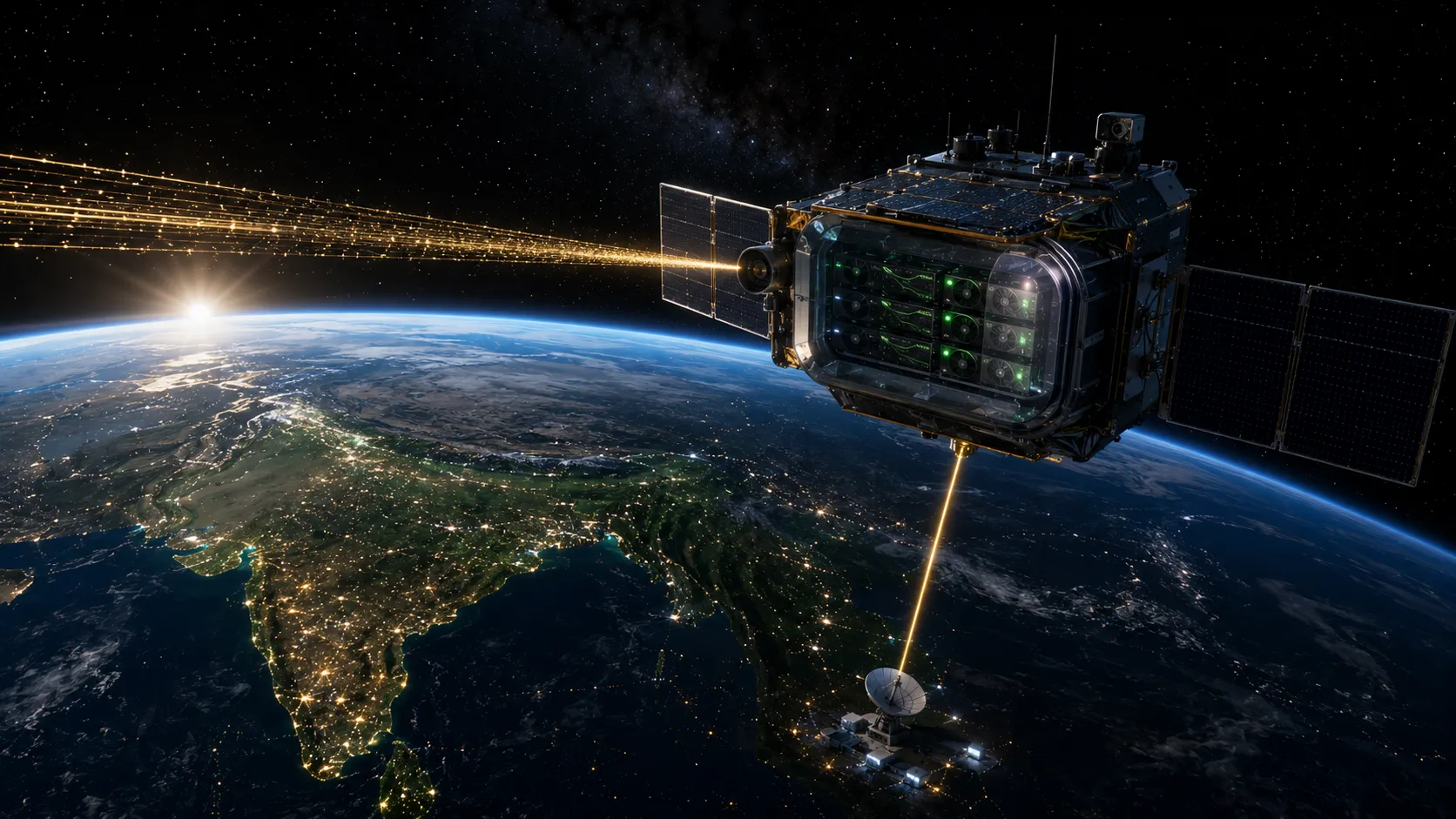
BENGALURU — May 24, 2026 — Sometime in the fourth quarter of this year, a 200-kilogram satellite will lift off from the Satish Dhawan Space Centre in Sriharikota. It will ride a Polar Satellite Launch Vehicle into low-Earth orbit, separate from its upper stage, and unfurl its solar panels to face the sun. At that moment, it will become something that has never existed before: India's first orbital AI data center. Not a communications relay. Not an Earth-observation platform. A flying computer, carrying data-center-class GPUs into space, capable of running sovereign AI models directly in orbit—processing data at the point of collection, without ever sending a single byte to a terrestrial server.
The satellite is called Pathfinder. It is the product of a partnership between Pixxel, the hyperspectral imaging startup that has built India's first private satellite constellation, and Sarvam AI, the foundational AI company that has raised $40 million from Lightspeed and Peak XV to build large language models trained on Indian languages. Together, the two Bengaluru-based startups are attempting something that no Indian company—and very few companies anywhere in the world—has ever tried: putting AI compute infrastructure in space, beyond the reach of terrestrial bottlenecks, beyond the latency of ground-to-orbit communication links, and beyond the jurisdiction of any single nation's data sovereignty laws.
The partnership was announced in early May 2026, but its implications are only beginning to be understood. The global AI infrastructure buildout is consuming land, electricity, and water at a rate that is straining the physical limits of the terrestrial grid. Data centers are facing regulatory pushback, community opposition, and the simple scarcity of suitable sites. The hyperscalers—Amazon, Microsoft, Google—are spending $725 billion on AI infrastructure this year, and a growing share of that spending is being consumed by the physical constraints of building on Earth. Space, by contrast, offers continuous solar power, passive radiative cooling, and the ability to process data at the point of collection—reducing the need for high-bandwidth downlinks and the latency that makes real-time AI applications impossible.
Pathfinder is the first Indian response to that opportunity. It is a bet that the future of AI infrastructure will not be confined to the planet's surface—and that the companies that build the orbital layer of that infrastructure will capture a disproportionate share of the value it creates.
The Two Startups That Found Each Other
The Pathfinder partnership is not a marriage of convenience between two random startups. It is the convergence of two companies that have been building toward the same vision from opposite directions.
Pixxel was founded in 2019 by Awais Ahmed and Kshitij Khandelwal, two engineers who believed that the next generation of Earth observation would be built on hyperspectral imaging—sensors that capture light in hundreds of narrow spectral bands, revealing information about crops, minerals, pollutants, and infrastructure that is invisible to standard RGB cameras. The company has since launched multiple satellites as part of its Firefly constellation, secured contracts from the Indian Ministry of Defence, and raised $95 million from investors including Google, Lightspeed, and Radical Ventures. Its satellites collect enormous quantities of data—far more than can be transmitted to Earth in real time. The bottleneck has always been the downlink: the narrow pipe through which orbital data must flow to reach terrestrial processors.
Sarvam AI was founded in 2023 by Vivek Raghavan and Pratyush Kumar, two AI researchers who believed that India needed sovereign foundational models—large language models trained on Indian languages, Indian data, and Indian cultural context, rather than depending entirely on models built by American companies and trained primarily on English-language internet data. The company has raised $40 million from Lightspeed and Peak XV, built models that support ten Indian languages, and positioned itself as the leading independent AI lab in India. Its models need data to train on and compute to run on—and the most valuable data for many Indian applications, from agricultural monitoring to disaster response to defence surveillance, is being collected by satellites that cannot transmit it fast enough.
The partnership solves both companies' problems simultaneously. Pixxel's satellites generate hyperspectral data that is too voluminous to downlink efficiently. Sarvam's AI models need compute infrastructure that is sovereign, secure, and capable of processing Indian data under Indian jurisdiction. Pathfinder puts Sarvam's models directly on Pixxel's satellite, processing the data in orbit and transmitting only the insights—the classified crop types, the detected pipeline leaks, the identified military assets—rather than the raw hyperspectral terabytes. The downlink bottleneck disappears. The data sovereignty concern is addressed. The two startups, each building toward the same vision from different starting points, have converged on a single platform.
The partnership also reflects a broader shift in how Indian deeptech startups are thinking about collaboration. For years, the Indian startup ecosystem was defined by competition—the food-delivery wars, the ride-hailing battles, the e-commerce slugfests. The deeptech generation is different. The problems are harder, the capital requirements are larger, and the global competitors are better-funded. Collaboration is not a luxury. It is a survival strategy. Pixxel and Sarvam are not competitors. They are complementary pieces of a sovereign AI infrastructure stack that neither could build alone.
The Orbital Compute Race
The Pathfinder satellite is not the only orbital AI data center in development. It is entering a race that has attracted some of the largest technology companies and most ambitious startups on Earth—and that is accelerating faster than most observers realise.
In January 2026, SpaceX filed a request with the U.S. Federal Communications Commission to launch up to one million compute-capable satellites, aiming to create a global mesh of orbital AI infrastructure powered by Starlink V3 hardware and integrated with Elon Musk's xAI models. The filing was breathtaking in its scale: a million satellites would represent more than 200 times the number of active satellites currently in orbit. The ambition is to make orbital compute a commodity—as ubiquitous and as accessible as Starlink internet bandwidth.
Lumen Orbit, a Silicon Valley startup, raised $175 million in April 2026 to build space-based data centers, with backing from some of the same investors who funded the terrestrial cloud revolution. Axiom Space, which is building the first commercial space station, has announced plans to host orbital data center modules as part of its broader commercial infrastructure platform. China's space programme, through its Tiangong space station and its expanding constellation of Earth-observation satellites, is developing its own orbital AI capabilities, though the details remain opaque.
The race is being driven by a convergence of three trends. The first is the physical constraint on terrestrial data centers: the land, power, and water required to build a hyperscale AI training cluster are becoming scarcer and more expensive, particularly in the densely populated regions where demand is highest. The second is the data sovereignty imperative: governments around the world are tightening regulations on where data can be stored and processed, and a satellite in orbit—beyond the territorial jurisdiction of any single nation—offers a legal and physical architecture for processing data without crossing borders. The third is the latency advantage: for applications that require real-time response—autonomous vehicles, disaster monitoring, military surveillance—the round-trip delay between a satellite collecting data and a terrestrial server processing it can be the difference between a timely intervention and a catastrophic failure.
Pixxel and Sarvam are positioning Pathfinder at the intersection of all three trends. The satellite will process data in orbit, eliminating the downlink bottleneck. It will operate under Indian jurisdiction, addressing the sovereignty concerns that have made the Indian government increasingly wary of depending on foreign cloud infrastructure. And it will demonstrate that an orbital AI data center can be built not by SpaceX or Lumen Orbit or the Chinese state, but by two startups in Bengaluru with a combined funding of less than $150 million.
The Data Sovereignty Imperative
The most strategically significant dimension of the Pathfinder project is not the technology. It is the sovereignty.
India has spent the past five years constructing a legal and regulatory architecture designed to ensure that Indian data remains under Indian control. The Digital Personal Data Protection Act, passed in 2023, imposes strict requirements on the storage and processing of personal data. The government's IndiaAI Mission, with its ₹10,000 crore budget, has explicitly prioritised the development of sovereign AI capabilities—models trained on Indian data, running on Indian infrastructure, governed by Indian law. The Reserve Bank of India has mandated that financial data be stored within the country. The defence establishment has been increasingly wary of depending on foreign satellite imagery and foreign cloud infrastructure for sensitive national security applications.
The orbital data center addresses these concerns in a way that no terrestrial alternative can. A satellite in low-Earth orbit, operated by an Indian company, processing data using Indian AI models, and downlinking only the insights rather than the raw data, creates a legal and physical architecture that is entirely within Indian jurisdiction. The data never touches a foreign server. The models never run on foreign GPUs. The entire stack—satellite, sensors, processors, AI models, ground station—is built, owned, and operated in India.
Awais Ahmed, Pixxel's CEO, has been explicit about the sovereignty dimension. "Historically, naval dominance defined a nation's geopolitical influence, which later shifted to air power. Now, that frontier is space," he said. "Countries that want to maintain a serious geopolitical stance in the coming decades must own indigenous space infrastructure. If global powers are developing orbital data centres, India must establish its own footprint to maintain data sovereignty." The statement is both a business case and a geopolitical argument. Pixxel is not asking the Indian government for permission or for funding. It is building the sovereign infrastructure that the government's own policies have demanded—and it is doing so at startup speed, with venture capital rather than government procurement.
The timing is not coincidental. The Trump-Xi summit on May 15, just days after the Pathfinder announcement, failed to produce any agreement on semiconductor or AI technology controls. The U.S.-China technology conflict is intensifying, and the global supply chains for AI compute are being fragmented along geopolitical lines. In that environment, a sovereign orbital AI data center is not a luxury. It is a hedge—a bet that the future of AI infrastructure will be defined not by the hyperscalers that dominate the terrestrial cloud, but by the nations and companies that build their own alternatives.
The Sarvam Models
The AI models that will run on Pathfinder are themselves a statement of intent. Sarvam AI has built large language models trained primarily on Indian languages—Hindi, Tamil, Telugu, Bengali, Marathi, Gujarati, Kannada, Malayalam, Odia, and Punjabi—as well as English. The models are designed to serve the specific needs of Indian users: agricultural extension services that can communicate with farmers in their native languages, healthcare chatbots that can provide medical advice in regional dialects, legal AI tools that can parse Indian statutes and case law, and government services that can reach citizens in the languages they actually speak.
The models are also designed to be efficient—small enough to run on edge devices and orbital platforms, rather than requiring the massive GPU clusters that power GPT-5 and Claude 4. Sarvam has invested heavily in model compression, distillation, and optimization techniques that reduce the computational requirements of its models without sacrificing accuracy. The Pathfinder satellite will carry data-center-class GPUs, but the Sarvam models running on them will be far more efficient than the hyperscale models that dominate the global AI conversation.
The combination of Sarvam's efficient models and Pixxel's orbital platform creates a capability that is genuinely differentiated. A hyperspectral image of a drought-stricken region of Maharashtra, collected by a Pixxel satellite and processed in orbit by a Sarvam model, can generate a crop-yield forecast, a water-stress assessment, and a recommended intervention—all in near-real time, without ever downlinking the raw data. The same image, processed through a terrestrial pipeline, would require hours of transmission time, cloud processing, and human analysis. The orbital alternative is not just faster. It is structurally different—a capability that cannot be replicated by any terrestrial system, regardless of how many GPUs it deploys.
The Pathfinder and the Public Markets
The Pathfinder project arrives at a moment of unusual corporate activity for both Pixxel and Sarvam. Pixxel is in the midst of a $55–60 million fundraise that is expected to expand to $80–100 million, with Zomato founder Deepinder Goyal in advanced talks to invest. The company has also secured formal contracts from the Indian Ministry of Defence to build dedicated satellites for the Indian Air Force—a validation of its technology that extends well beyond the commercial market.
Sarvam, meanwhile, has been scaling its enterprise AI business, working with Indian financial institutions, government agencies, and consumer internet companies to deploy its language models in production environments. The company has not disclosed its revenue figures, but it has been clear that its ambition is to become the default AI platform for Indian enterprises—a position that requires both model performance and infrastructure reliability.
The Pathfinder partnership strengthens both companies' hands. For Pixxel, it adds an AI capability that differentiates its satellite platform from the growing number of Earth-observation constellations. For Sarvam, it provides a sovereign compute platform that addresses the data-localisation requirements of its most sensitive customers. And for both companies, it establishes a position in the orbital compute race that neither could have claimed alone.
The satellite is scheduled for launch in the fourth quarter of 2026. The rocket is booked. The payload is being integrated. The AI models are being optimised for the orbital environment. The two Bengaluru startups that found each other are about to put a flying computer into space—and in doing so, they are laying the foundation for an orbital AI infrastructure that India has never had.
What This Signals
The Pathfinder satellite is not going to change the world on its own. It is a 200-kilogram technology demonstrator—a proof of concept that orbital AI compute is viable, sovereign, and commercially relevant. The real impact will come later, when the concept is scaled: when Pixxel launches a constellation of AI-enabled satellites, when Sarvam deploys its models across an orbital network, and when the Pathfinder architecture becomes the foundation for a new layer of infrastructure that operates above the atmosphere.
But the direction of travel is unmistakable. The global AI infrastructure buildout is beginning to strain against the physical limits of the terrestrial grid. The hyperscalers are spending $725 billion on data centers that consume land, electricity, and water at rates that are becoming politically and environmentally unsustainable. The regulatory environment for data sovereignty is tightening in every major economy. And the technology required to put AI compute into orbit—the miniaturised GPUs, the efficient models, the laser downlinks, the satellite buses—is maturing faster than most observers predicted.
Pixxel and Sarvam are not the largest companies in the orbital compute race. They are not the best-funded. They do not have the manufacturing scale of SpaceX or the venture capital war chest of Lumen Orbit. But they have something that none of their competitors can replicate: the backing of the Indian government's sovereignty agenda, the support of a domestic AI ecosystem that is growing faster than any in the world, and the ability to build an orbital AI platform that is entirely within Indian jurisdiction—a legal and physical architecture that no American or Chinese company can offer.
The satellite that will launch from Sriharikota later this year is a 200-kilogram box of GPUs, solar panels, and AI models. It is also a statement—that the future of AI infrastructure will not be confined to the planet's surface, and that India intends to be a participant, not a spectator, in the orbital compute race. The hyperscalers are watching. The sovereignty hawks are watching. The satellite is waiting.


