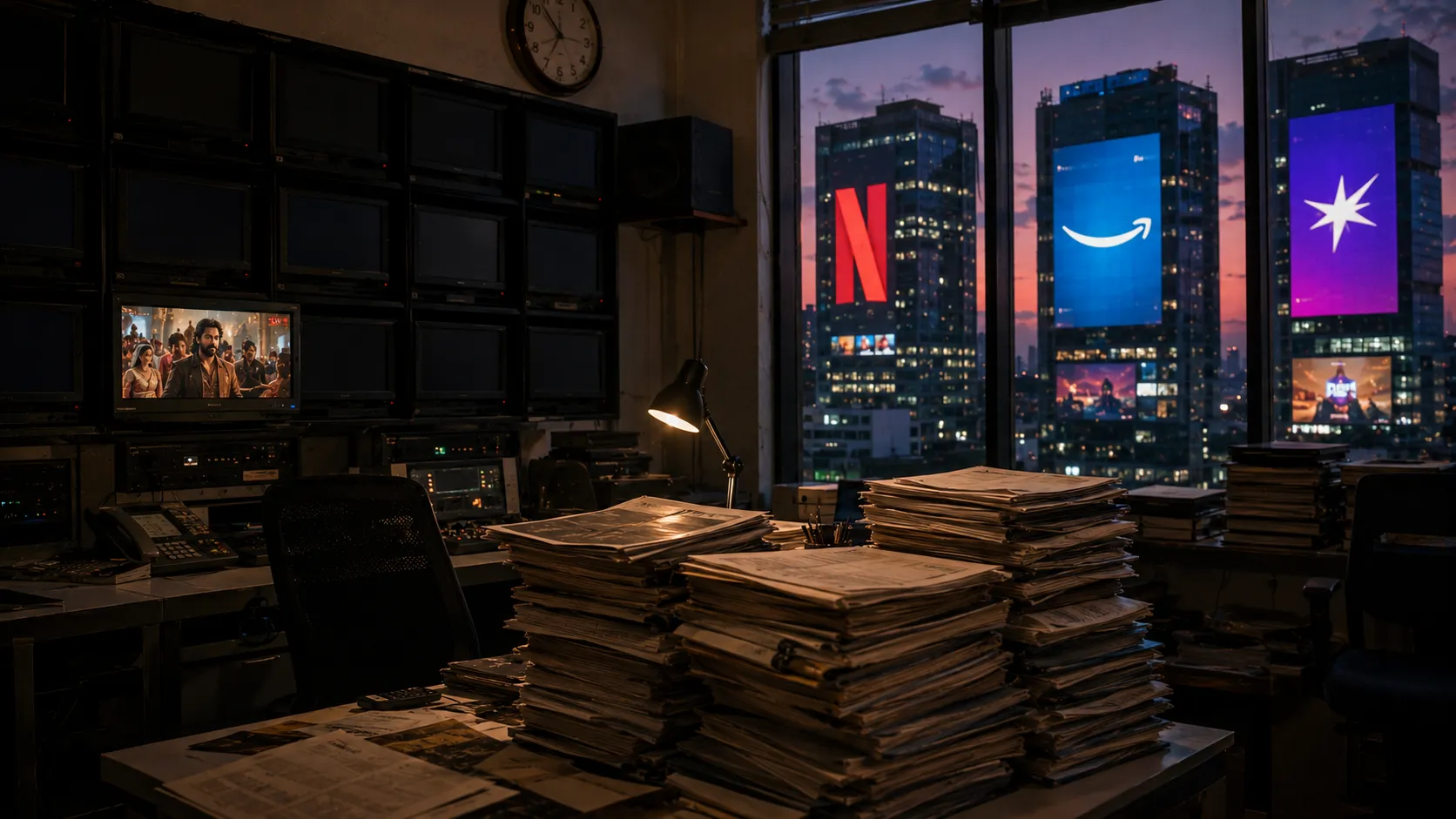
The Satellite Sunset: How the Quiet Collapse of TV Rights Revenue Is Rewriting the Economics of Indian Cinema—And Nobody Is Talking About It
MUMBAI — May 29, 2026 — Sometime in 2018, a major Bollywood studio sold the satellite rights to a moderately successful star vehicle for approximately ₹55 crore. The film had performed respectably at the box office—not a blockbuster, but profitable—and the satellite deal, which granted a national television network the exclusive right to broadcast the film for ten years, was the largest single revenue line item in the film's post‑theatrical lifecycle. The studio booked the revenue, the network scheduled the premiere, and the model—theatrical first, satellite second, digital third—continued to function as it had functioned for a generation.
Three months ago, the same studio sold the satellite rights to a comparably successful film for approximately ₹12 crore. The decline—roughly 78 percent in nominal terms, and even steeper in real terms—was not the result of a single decision or a single market shift. It was the result of a structural collapse that has been underway for nearly a decade and that has accelerated sharply in the past three years, driven by the same forces that have reshaped the media industry everywhere: the rise of streaming, the decline of linear television, and the fragmentation of the audience that once gathered, every Sunday afternoon, to watch the premiere of a new film on Star Gold or Sony MAX. The satellite rights market, which was once the most reliable source of post‑theatrical revenue for Indian films, is dying. The studios that depend on it are adapting—but the adaptation is painful, and the full implications of the decline are only beginning to be understood.
"The satellite rights market has been the silent subsidy of the Indian film industry for thirty years. It paid for the films that the box office couldn't. It underwrote the risks that the studios took. And now it's disappearing—not with a crash, but with a slow, steady, irreversible decline. The studios that have not prepared for its demise are the ones that will not survive it." — Media finance analyst, speaking to TIGI
The Collapse in Numbers
The decline of the Indian satellite rights market is not a matter of anecdote or speculation. It is a matter of data, and the data tells a story of structural collapse that is as stark as any in the modern Indian economy. In 2018, the combined satellite rights revenue of the Indian film industry was estimated at approximately ₹2,500 crore. By 2025, that figure had fallen to approximately ₹900 crore—a decline of nearly 65 percent in nominal terms, and even steeper when adjusted for the overall growth of the media and entertainment sector over the same period. The average satellite rights deal for a mid‑budget Bollywood film has fallen from ₹15 to ₹25 crore in 2018 to ₹5 to ₹10 crore in 2026. The blockbuster deals that once commanded ₹50 to ₹80 crore are now rare, and the networks that once competed aggressively for the biggest films have become increasingly selective, bidding only for the titles that they believe can still attract a linear television audience.
The reasons for the collapse are not mysterious. Linear television viewership in India has been declining steadily for years, driven by the same forces that have reshaped the television industry globally: the migration of audiences to streaming platforms, the fragmentation of the content landscape, and the decline of appointment viewing. The Sunday‑afternoon film premiere, which was once a cultural institution—the event that gathered families around the television, that launched the satellite careers of a thousand films, that provided the revenue floor on which the economics of the Indian film industry rested—is no longer a reliable audience draw. The viewers who once watched films on Star Gold or Sony MAX are now watching them on Netflix, Amazon Prime Video, or JioHotstar. The networks that once paid a premium for exclusive satellite rights are now paying a discount—because the audience that those rights once guaranteed is no longer there.
The satellite collapse has been accelerated by the streaming platforms' aggressive acquisition of digital rights, which has reduced the value of the satellite window. The platform that acquires a film's digital rights typically demands a period of exclusivity—a window during which the film cannot be shown on satellite television—and that exclusivity period has been lengthening as the platforms have grown more powerful. The satellite network that once premiered a film six weeks after its theatrical release now waits six months, or a year, or longer—by which time the audience that might have watched the premiere has already seen the film on a streaming platform, or on a pirate site, or not at all. The satellite window, which was once the first post‑theatrical window, is now the last—and the revenue it generates reflects that diminished position.

The Network Reckoning
The networks that were once the dominant buyers in the satellite rights market are now in a state of structural decline themselves. The major Indian television networks—Star India, Sony Pictures Networks, Zee Entertainment, Viacom18—have seen their advertising revenue stagnate or decline as advertisers have migrated to digital platforms. Their subscription revenue, which was once protected by the cable and DTH distribution monopolies, has been eroded by the rise of streaming and the fragmentation of the distribution landscape. Their balance sheets, which were once strong enough to support aggressive content‑acquisition budgets, are now constrained by the broader pressures on the linear television business.
The network reckoning has been particularly acute at Star India, which was once the most aggressive buyer of satellite film rights and which is now, under the ownership of Reliance Industries and as part of the JioHotstar merger, fundamentally rethinking its content strategy. The network that once paid ₹80 crore for the satellite rights to a major Bollywood blockbuster is now, through JioHotstar, acquiring the digital rights to the same film—and the satellite rights are an afterthought, bundled into the larger digital deal at a price that reflects their diminished value. The transformation of the network business from a satellite‑first model to a digital‑first model is the most significant structural shift in the Indian media industry since the advent of cable television, and the satellite rights market is its most visible casualty.
The smaller networks that once competed with Star and Sony for film rights have been squeezed even more severely. The regional networks that serve the Tamil, Telugu, Kannada, and Malayalam markets have seen their film‑acquisition budgets shrink as their audiences have migrated to streaming platforms. The satellite rights market, which was once a diverse, competitive ecosystem of buyers and sellers, is now dominated by a handful of large players—and those players are increasingly unwilling to pay the prices that the studios need to sustain their production models. The market has become a buyer's market, and the sellers are feeling the pain.
The Studio Adaptation
The studios that have been most exposed to the satellite decline are the ones that have historically depended most heavily on satellite revenue: the mid‑budget, content‑driven producers who make the films that fill the gaps between the blockbusters. The blockbuster franchise—the Dhurandhars, the K.G.Fs, the Pushpas—can survive the satellite decline because its primary revenue streams are the theatrical box office and the streaming pre‑sale. The mid‑budget film, which has always operated on thinner margins, has lost the revenue floor that the satellite deal once provided. The result is a production model that is increasingly precarious—and a growing number of mid‑budget films that are not being made at all.
The studios that are adapting most successfully to the satellite decline are the ones that have diversified their revenue streams most aggressively: the producers who have built streaming‑first production pipelines, who have invested in IP that can generate returns across multiple formats and multiple windows, and who have treated the satellite deal as a bonus rather than a foundation. The YRFs, the Dharmas, the Hombales—these are the studios that have the scale, the IP, and the institutional infrastructure to survive the satellite sunset. The smaller producers, the one‑film‑at‑a‑time independents, the regional studios that depend on a single market and a single revenue model—these are the ones that are most vulnerable. And their vulnerability is increasing with every passing quarter, as the satellite market continues its slow, inexorable decline.
The adaptation is not merely financial. It is creative. The producer who once made a film knowing that the satellite deal would cover a substantial portion of the budget now makes a film knowing that the streaming pre‑sale is the only comparable source of guaranteed revenue. And the streaming platforms, which are now the dominant buyers in the content market, have their own preferences—preferences that are different from the preferences of the satellite networks that preceded them. The film that was once made for the Sunday‑afternoon family audience is now made for the streaming platform's algorithmic recommendations—and the difference between those two audiences, and those two modes of consumption, is the creative consequence of the satellite sunset. The films that are being made today are different from the films that were made a decade ago, not merely because the technology has changed, but because the economics of their production have been transformed. And the transformation is still underway.
The Regional Divide
The satellite decline is not uniform across Indian cinema. It is most pronounced in the Hindi‑language market, where the penetration of streaming platforms is highest and the migration of audiences from linear television has been most rapid. The South Indian markets—Tamil, Telugu, Kannada, Malayalam—have been slower to decline, partly because the regional television networks still command significant audiences, and partly because the regional streaming market is less developed than its Hindi counterpart. But the direction of travel is the same. The regional satellite market is declining, and the regional studios that have depended on it are beginning to feel the same pressures that their Hindi counterparts have been experiencing for years.
The regional divide is also a generational divide. The older audience that still watches films on satellite television is concentrated in the smaller towns and rural areas where streaming penetration is lower and the habits of linear viewing persist. The younger audience that has abandoned satellite for streaming is concentrated in the urban centres and the Tier‑1 and Tier‑2 cities. The satellite market, which was once a mass market that reached every corner of the country, is becoming a residual market—a market that serves the audiences that the streaming platforms have not yet reached, and that will shrink as those audiences are inevitably connected to the digital infrastructure that is expanding across the country. The satellite sunset is not just a story about revenue. It is a story about the fragmentation of the Indian audience—and about the growing divide between the consumers who have access to the global content ecosystem and the consumers who are still waiting to be connected.
What This Signals
The satellite sunset is not primarily a story about television. It is a story about the structural transformation of the Indian media industry—a shift from a broadcast model, in which a small number of networks controlled the distribution of content to a mass audience, to a streaming model, in which a small number of platforms control the distribution of content to a fragmented, individualised, algorithmically sorted audience. The two models are not equivalent, and the transition between them is not complete. But the direction of travel is unmistakable. The satellite rights market, which was once the silent subsidy of the Indian film industry, is being replaced by the streaming pre‑sale market—a market that is more concentrated, more globally integrated, and more platform‑dominated than anything that came before.
The studios that understand this shift—that are building their businesses around the streaming platforms rather than the satellite networks, that are producing content for the global audience rather than the Sunday‑afternoon family viewing, that are treating the satellite deal as a bonus rather than a foundation—are the ones that will survive the transition. The studios that do not—that continue to depend on a revenue stream that is disappearing beneath them—are the ones that will not. The satellite sunset is not a crisis. It is a reckoning, and the industry that emerges from it will be leaner, more concentrated, and more platform‑dependent than the one that preceded it. The films that are made in that industry will be different—creatively, commercially, and culturally—from the films that were made in the satellite era. The Sunday‑afternoon premiere is over. The future is on‑demand.


