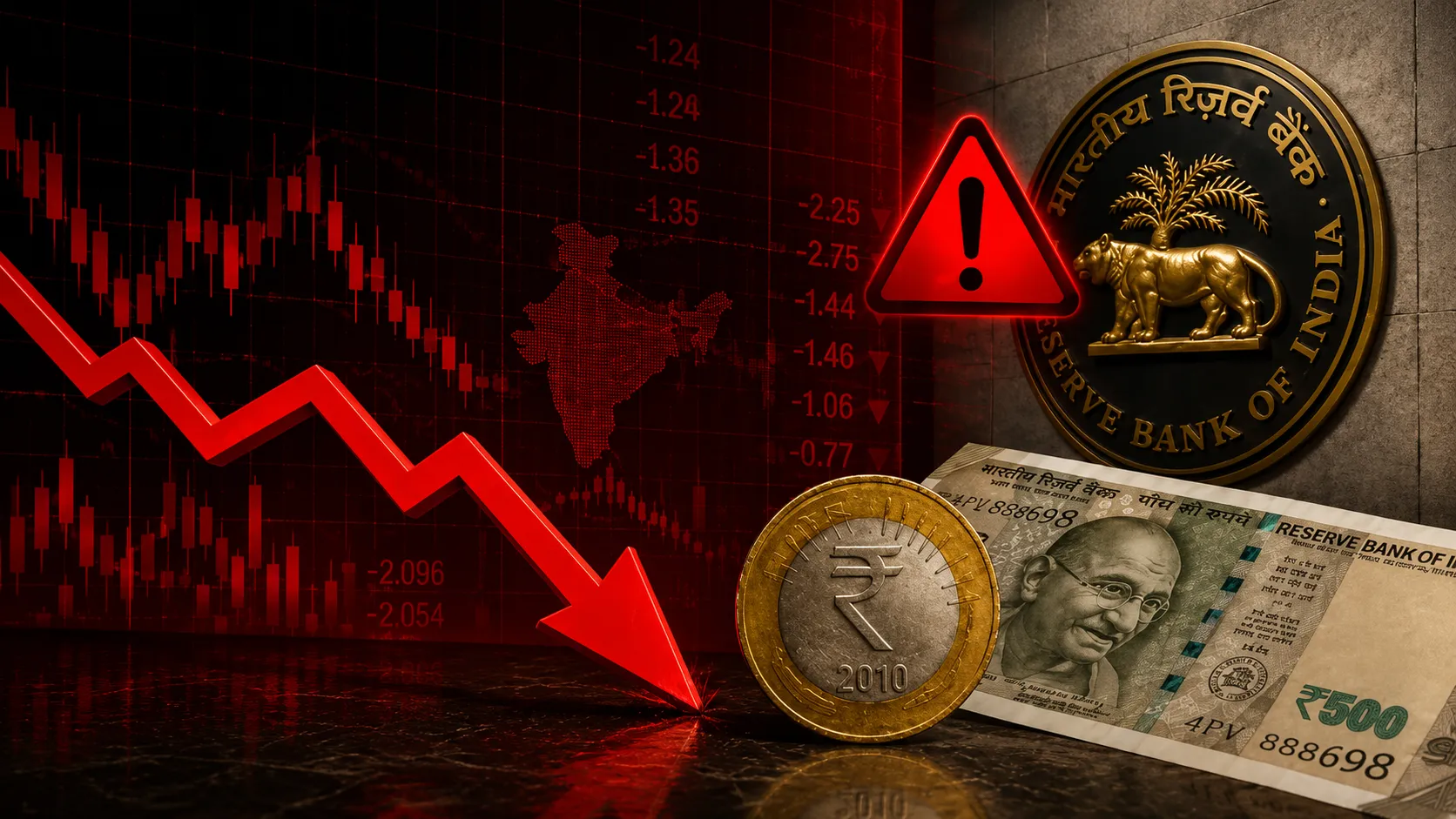
Somewhere between the headlines celebrating Dalal Street's July rally and the reassuring commentary from Indian policymakers about the economy's underlying resilience, a quieter but genuinely consequential story has been unfolding in India's currency markets: the rupee has spent much of July 2026 trading at or near its weakest levels in the currency's modern history, hovering in a band between roughly 95.5 and 96.9 against the US dollar, with the Reserve Bank of India repeatedly intervening — reportedly through state-run banks selling dollars on its behalf — to prevent the currency from breaching fresh record lows outright.
The proximate driver behind the rupee's slide is not difficult to identify: surging global crude oil prices, themselves a direct consequence of escalating tensions in the Middle East. Brent crude has traded well above $90 a barrel through much of July, at points pushing past $96, as fears over potential disruptions to shipping through the Strait of Hormuz — the narrow, strategically vital waterway through which a substantial share of the world's seaborne oil trade passes — have kept energy markets on edge. For India, which imports the overwhelming majority of its crude oil requirements, a sustained rise in global oil prices translates directly and mechanically into a wider import bill, greater demand for dollars to pay for that oil, and correspondingly greater pressure on the rupee's exchange rate — a transmission channel that has played out with textbook clarity through the second and third quarters of 2026. Traders warned the rupee could face renewed depreciation should Brent crude climb above the $100 mark, a threshold energy markets have flirted with but not yet decisively breached, even as the mere possibility has been enough to keep currency desks on high alert throughout the month.
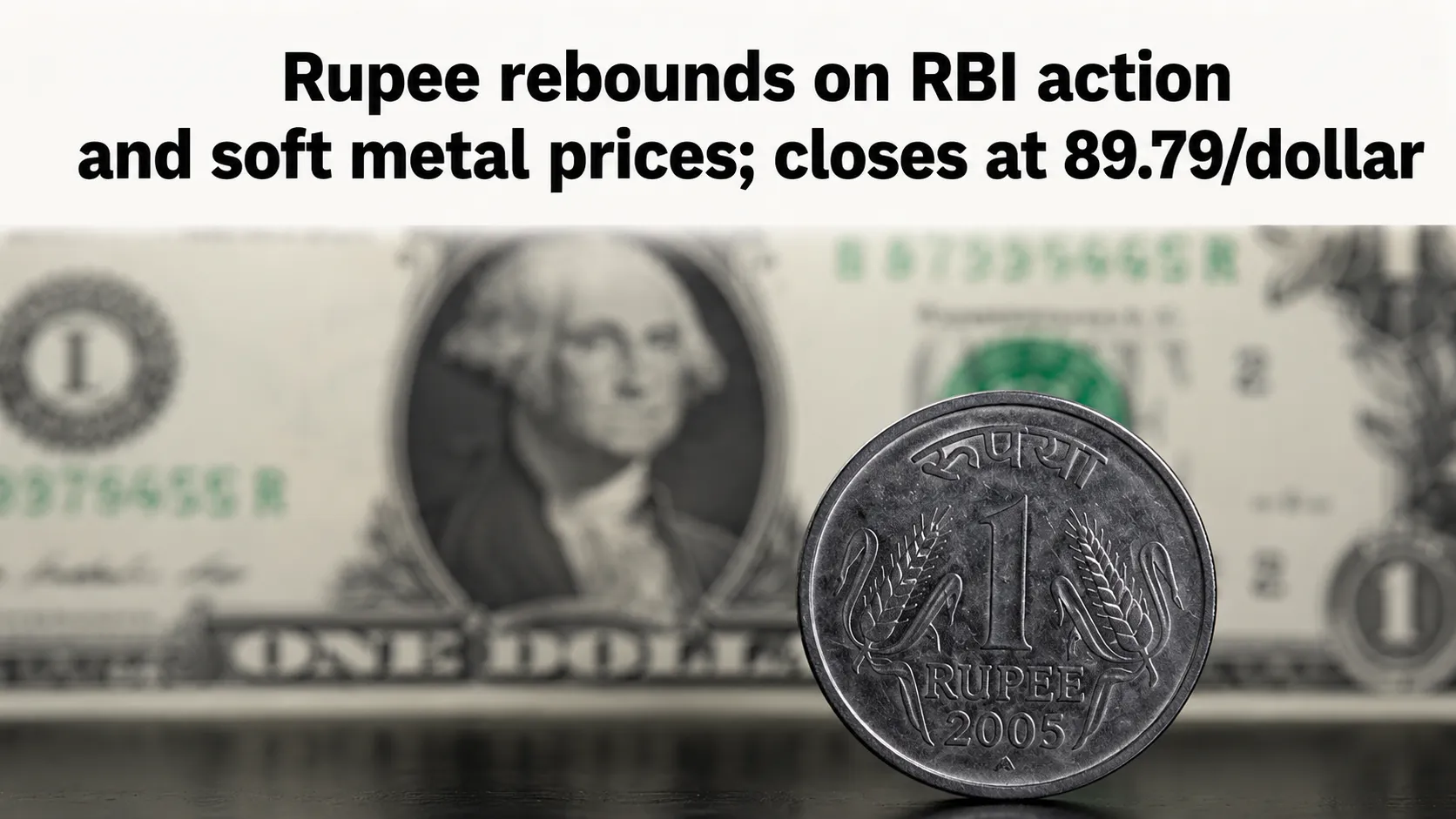
The Reserve Bank of India has not stood by passively as this pressure has built. Market reports through July described state-run Indian banks being seen selling dollars on the central bank's behalf at strategically timed intervals — a well-established RBI intervention technique that allows the central bank to lean against excessive currency volatility without necessarily announcing its actions publicly or committing to defend any specific exchange rate level outright. That intervention appears to have had genuine, if partial, success: the rupee strengthened to around 95.7 per dollar at one point in late July, extending gains for a third consecutive session to a two-week high, specifically attributed by currency traders to likely RBI intervention around the market open — a pattern of activity that several trading desks explicitly flagged as an active, ongoing defensive strategy rather than a one-off, isolated action.
The scale of the rupee's decline over the course of 2026 as a whole is worth placing in proper historical context, because the currency's trajectory this year has been genuinely dramatic. The best, or strongest, exchange rate for the rupee at any point in 2026 came remarkably early in the year — on January 7, 2026, when the currency traded at a comparatively robust 89.86 per dollar. From that starting point, the rupee has weakened by roughly 8 percent over the subsequent six months, touching its weakest 2026 level of 96.88 per dollar on July 23 — a decline that, expressed over a twelve-month period rather than calendar-year-to-date, works out to a depreciation of more than 9 percent against the dollar, among the more significant annual currency moves India has experienced in recent years.
Multiple, overlapping forces beyond the immediate oil-price shock have contributed to that broader depreciation trend through 2026. Foreign portfolio investors pulled substantial capital out of Indian equities through significant stretches of the year, driven heavily by the uncertainty surrounding the escalating and then partially de-escalating US tariff regime that dominated India-US trade relations for much of 2025 and 2026 — capital outflows that, independent of any single day's trading dynamics, exert their own persistent, structural depreciation pressure on the rupee by reducing net dollar inflows into India's capital account. The Reserve Bank's own May 2026 currency market data showed net dollar sales of $6.1 billion during that single month alone, following an even larger $8.9 billion in net dollar sales the preceding month — intervention figures that illustrate just how actively and continuously the central bank has been working throughout the first half of 2026 to manage the pace, if not necessarily the ultimate direction, of the rupee's decline.
The RBI's June 2026 monetary policy meeting brought a further, more structural response to the currency pressure, in the form of an unusually comprehensive package of capital-account liberalisation measures explicitly designed to attract additional foreign capital inflows and thereby ease the balance-of-payments pressure contributing to rupee weakness. The central bank expanded the Fully Accessible Route for foreign investment in government securities to cover all newly issued long-tenor bonds, removed investment and concentration limits for foreign portfolio investors under the General Route entirely, raised equity investment caps for non-resident Indians and Overseas Citizens of India, and introduced new tactical liquidity facilities — a coordinated package one senior fund manager described as a highly significant effort to attract foreign capital and ease pressure on the balance of payments. The government complemented those measures with its own parallel step, removing capital gains and withholding taxes on certain categories of foreign investment in government securities, in what several economists characterised as an unusually well-synchronised joint fiscal-and-monetary response to the currency pressure building through the first half of the year.
For India's broader economy, a weaker rupee carries a genuinely mixed set of consequences that make the currency's trajectory considerably more than a simple headline number for financial media to track. On the negative side of the ledger, a weaker currency directly raises the rupee cost of India's substantial energy and gold import bill — both categories that already contributed meaningfully to the trade deficit widening to $30.43 billion in June, a dynamic in which currency weakness and trade-deficit pressure feed into each other in a mutually reinforcing cycle that policymakers have had to manage carefully. Imported inflation is a further concern, since a weaker rupee raises the domestic cost of imported industrial inputs, energy and consumer goods, complicating the RBI's own separate task of managing inflation within its target band even as the central bank simultaneously tries to support economic growth through its interest rate policy. On the more positive side, a weaker rupee mechanically improves the price competitiveness of Indian exports in dollar terms — a dynamic some analysts have suggested partially explains the resilience of India's export growth even amid the tariff pressures documented extensively elsewhere in recent trade coverage, since exporters have been able to absorb at least some tariff-related cost pressure by benefiting from more favourable currency conversion on their dollar-denominated export earnings.
Corporate India's own currency hedging behaviour has evolved meaningfully in response to this extended period of rupee volatility. Treasury teams at major Indian exporters and importers alike have reportedly increased their use of forward contracts and other currency-hedging instruments through 2026, seeking to lock in exchange rates for future transactions rather than remaining fully exposed to the currency's ongoing volatility — a prudent, if costly, risk-management response that reflects genuine corporate uncertainty about where the rupee is likely to settle over the medium term, given how many distinct and largely uncorrelated forces — oil prices, geopolitical tensions, US tariff policy, and global capital flows — are simultaneously bearing on the currency's trajectory.
Looking ahead, the rupee's near-term path will likely continue to be dictated substantially by factors outside India's direct control: the trajectory of Middle East tensions and their impact on shipping through the Strait of Hormuz, the broader direction of global crude oil prices, and the evolving state of India-US trade relations following the fresh 10 percent Section 301 tariff imposed in late July. The RBI's own posture — active, sustained intervention combined with structural capital-account liberalisation measures — suggests the central bank views managing the pace and orderliness of any further rupee depreciation, rather than defending any specific exchange rate level, as its primary near-term objective, a pragmatic approach consistent with the managed-float currency regime India has operated under for decades. Whether that approach proves sufficient to prevent the rupee from decisively breaching fresh record lows in the weeks ahead will depend heavily on developments in the Middle East that remain, as they have throughout 2026, largely beyond any single central bank's control.
The rupee's weakness also carries direct, tangible implications for India's substantial diaspora and remittance economy, a channel that receives comparatively little attention in mainstream currency market coverage relative to its genuine economic significance. India remains the world's largest single recipient of remittances from overseas workers, and a weaker rupee mechanically increases the domestic purchasing power of every dollar, pound or dirham sent home by the millions of Indians working abroad — a dynamic that offers at least a partial silver lining to currency weakness for the specific households that depend heavily on remittance income, even as the same currency weakness raises costs for households and businesses more dependent on imported goods and energy. Financial advisors serving India's diaspora community have specifically noted increased client interest in timing large remittance transfers to coincide with periods of rupee weakness, treating the currency's volatility as a genuine, actionable financial planning consideration rather than simply background macroeconomic noise.
Comparative currency performance across other major emerging markets offers useful additional context for assessing how much of the rupee's 2026 weakness reflects India-specific factors versus broader, region-wide emerging-market currency pressure. Several other major emerging-market currencies have faced their own depreciation pressure over the same period, driven by many of the same underlying forces — elevated global oil prices, a broadly firm US dollar, and persistent uncertainty around US trade policy affecting capital flows into emerging markets generally rather than India specifically. That comparative context matters for policymakers and investors alike, since a currency move driven substantially by shared, external forces affecting the entire emerging-market currency complex requires a different policy response than one reflecting genuinely India-specific structural weaknesses — and the RBI's own public commentary through 2026 has consistently emphasised the former interpretation, pointing to global oil prices and geopolitical tensions rather than domestic economic mismanagement as the primary drivers of the rupee's current weakness.
For equity market investors specifically, the rupee's trajectory also carries direct implications for how foreign portfolio investors evaluate the total dollar-denominated returns available from Indian equities, independent of how individual Indian stocks themselves perform. A foreign investor who bought Indian shares in January 2026, even if those shares subsequently posted solid gains in rupee terms through the following six months, would have seen a meaningful share of that return eroded once converted back into dollars, given the currency's roughly 8 percent depreciation over the same window — a dynamic that helps explain, alongside the tariff-related uncertainty discussed extensively elsewhere in recent market coverage, why foreign institutional investors have remained considerably more cautious about Indian equity exposure through 2026 than the market's own rupee-denominated index performance alone might otherwise suggest.


