The Robot That Doesn't Do Cartwheels: Inside RJ Scaringe's $3.4 Billion Bet to Build the Factory of the Future
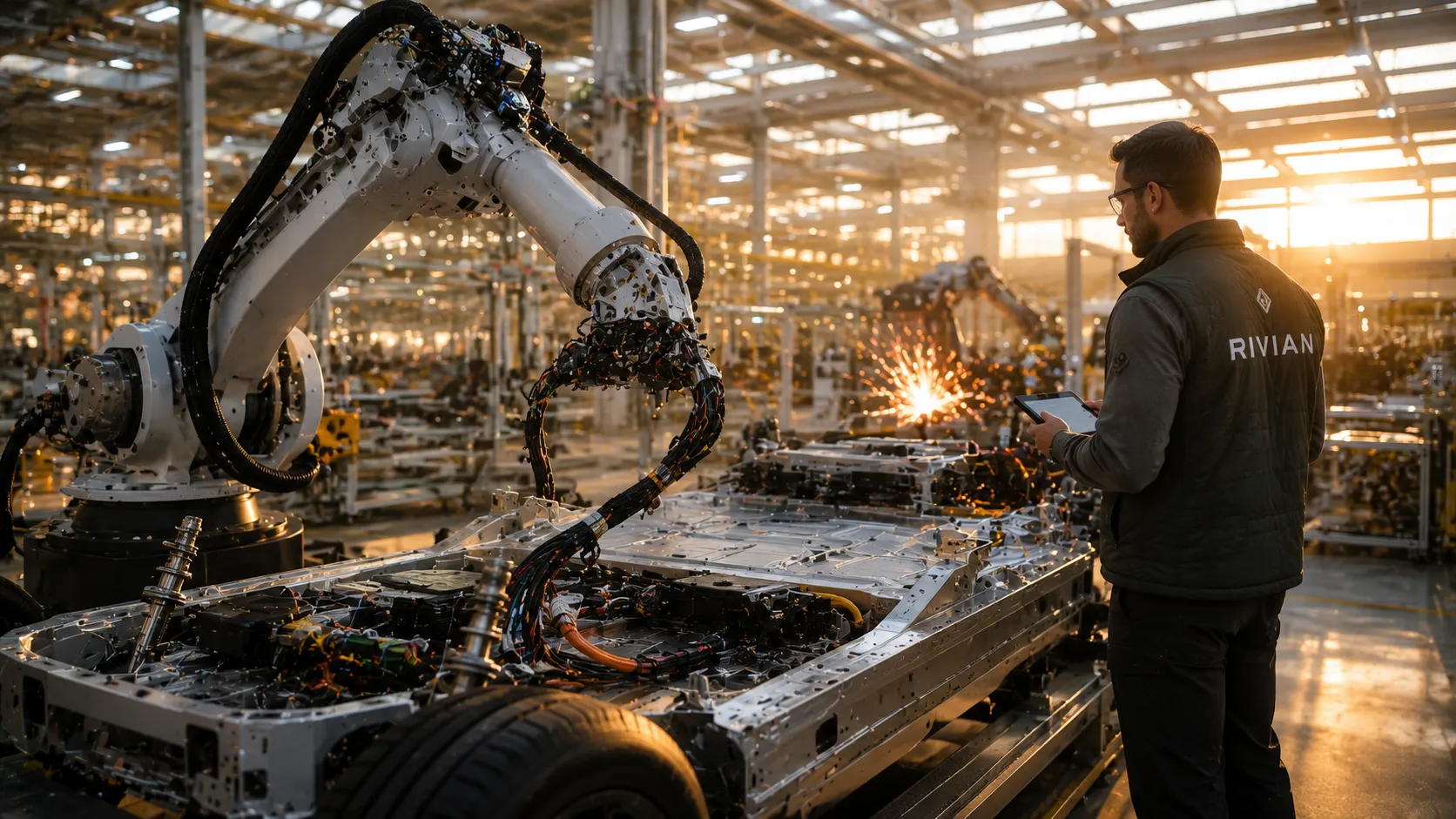
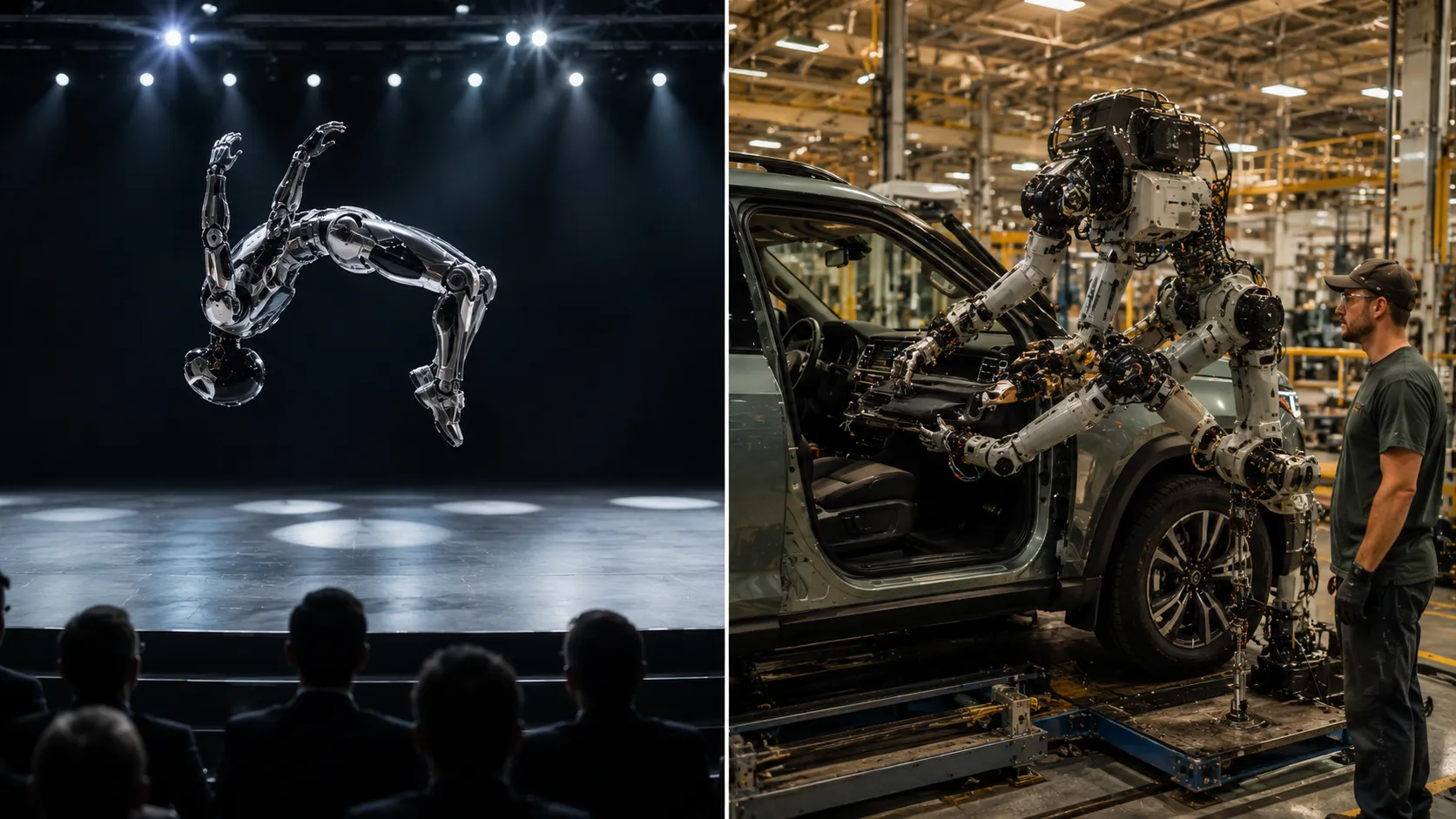
PALO ALTO, CALIF. — May 18, 2026 — RJ Scaringe wants to be very clear about one thing. The robots his new company is building will not perform backflips. They will not dance. They will not walk on two legs across a stage while engineers applaud. "Doing cartwheels does not create value in manufacturing," he told The Wall Street Journal earlier this year. "Backflips don't create value for manufacturing."
The line has become something of a mantra — repeated in interviews, echoed by investors, and wielded as a quiet but unmistakable dig at Tesla's Optimus, the humanoid robot that Elon Musk has paraded across carefully choreographed demonstrations while promising a future of general‑purpose mechanical laborers. Scaringe, a mechanical engineer with a doctorate from MIT and a decade and a half of experience actually building things in factories, has placed a different bet. His robots will not look like people. They will look like factory equipment. And they will do the unglamorous, physically complex, reasoning‑intensive work that still requires human hands on production lines across the world.
That bet is now worth $3.4 billion. In May 2026, Mind Robotics — the industrial automation company Scaringe spun out of Rivian in November 2025 — closed a $400 million funding round led by Kleiner Perkins, with participation from Salesforce Ventures and Incharge Capital, the venture arm of Volkswagen. The round brought the company's total funding to more than $1 billion and its valuation to $3.4 billion in under a year since its creation. It follows a $115 million seed round led by Eclipse Capital in late 2025 and a $500 million Series A co‑led by Accel and Andreessen Horowitz in March that valued the company at $2 billion. In the span of roughly six months, Mind Robotics has gone from an internal Rivian project codenamed "Project Synapse" to one of the most highly valued industrial robotics startups on Earth.
The Problem Scaringe Saw
The origin of Mind Robotics is not a story about a founder who woke up one day and decided to build robots. It is a story about a founder who spent more than a decade scaling an electric vehicle factory and concluded that the automation industry had failed him.
Scaringe founded Rivian in 2009, the day after he earned his Ph.D. in mechanical engineering from MIT. For years, the company operated in near‑obscurity. Then, between 2018 and 2021, it raised billions, went public in one of the largest IPOs in American history, and began manufacturing the R1T truck and R1S SUV at scale from its factory in Normal, Illinois.
Inside that factory, Scaringe encountered the limits of existing industrial robotics firsthand. Traditional factory robots — the kind that have welded car frames and painted body panels for decades — are extraordinarily good at a narrow set of tasks. They repeat the same motion thousands of times with micron‑level precision. But they are blind to variation. They cannot adapt when a wire harness is slightly out of position. They cannot handle the dexterous, reasoning‑intensive work — threading cables, manipulating flexible components, inspecting finished assemblies — that still consumes a significant share of labor hours on any production line. As Scaringe's frustration with existing technologies mounted, the project that would become Mind Robotics took shape inside Rivian under the codename "Project Synapse," drawing its name from the brain's neural connections and reflecting Scaringe's belief that AI would be the connective tissue linking perception, reasoning, and physical action.
That frustration is not unique to Rivian. The Manufacturing Institute reports that nearly 500,000 manufacturing jobs remain unfilled in the United States, and researchers project that as many as 1.9 million positions could go unstaffed by 2033 if current trends persist. A survey by CADDi found that 79 percent of U.S. manufacturing leaders cite the skilled labor shortage as their top barrier to growth. Ford CEO Jim Farley has warned that the country is short 600,000 factory workers and 500,000 construction workers, with "nothing to backfill the ambition" of America's industrial revival.
The structural gap that Mind Robotics was founded to address — "a large share of factory value‑add work requires human‑like dexterity, adaptation, and physical reasoning that classical robotics cannot address," as the company's press release put it — is not theoretical. It is the daily reality of every manufacturer trying to scale production in an economy that no longer produces enough skilled tradespeople to staff its assembly lines.
Not Humanoid. Not Dumb. Something In Between.
The most important strategic decision Scaringe has made at Mind Robotics is also the most counterintuitive, given the direction the robotics industry has been traveling. Figure AI, the humanoid robotics company, has raised more than $10 billion and was valued at $39 billion, backed by OpenAI, Microsoft, Nvidia, and multiple sovereign wealth funds. Agility Robotics is deploying its Digit humanoid in logistics environments. Tesla is pouring billions into Optimus. The narrative driving these investments is that a general‑purpose humanoid robot, capable of performing any task a human can, is the inevitable endpoint.
Scaringe disagrees — not with the ambition, but with the timeline and the first‑principle logic. The factory, he argues, does not need a robot that looks like a person. It needs a robot that can perform the specific tasks that classical automation cannot, in the specific environments where those tasks occur, with the reliability that production schedules demand. Humanoid robots, for all their investor appeal, introduce complexity — balance, bipedal locomotion, generalized manipulation — that adds years to development timelines without adding value to the manufacturing bottom line.
Mind Robotics is building a full‑stack system: AI foundation models trained on real factory data, purpose‑built robotic hardware designed for industrial tasks rather than stage demonstrations, and deployment infrastructure that allows the systems to be integrated into live production environments at scale. The robots are already operating inside Rivian's Normal, Illinois factory, using the site as a real‑world testing and training ground. Thousands of cameras inside the plant capture production data that feeds the company's models.
The company's approach also leverages another Rivian asset. In December 2025, Rivian announced it had been developing its own custom silicon to power autonomous vehicle software. Scaringe has suggested that those chips could eventually be supplied to Mind Robotics. "It doesn't take a lot of imagination," he told TechCrunch. "It's a robotics processor, so it could work really well for that."
The Three‑Company Founder
Mind Robotics is not Scaringe's only venture outside Rivian. In 2025, he also spun out Also, an electric micromobility company focused on high‑end modular electric bicycles and small electric delivery vehicles. Also raised more than $300 million, including a $200 million Series C led by Greenoaks in March 2026 that valued the company at over $1 billion. DoorDash invested alongside a multi‑year commercial agreement.
Between Rivian, Also, and Mind Robotics, Scaringe has now raised more than $12.3 billion across three startups. The overwhelming majority — more than $11 billion — went into Rivian, which today trades on the Nasdaq at a market capitalization of approximately $18.2 billion. But the pace of capital formation outside the mothership is accelerating. Mind Robotics alone absorbed $1 billion in under six months, and investors — including Kleiner Perkins partner Ilya Fushman, who called robotics "the ultimate frontier for what's possible with AI" and "the biggest market out there" — are showing no signs of hesitation.
What makes Scaringe's trajectory instructive for other founders is not the scale of the capital — few entrepreneurs will ever raise $12 billion — but the architecture of the bet. Rivian provided the data, the factory, the supply‑chain relationships, and the real‑world proving ground. Mind Robotics was incubated inside that ecosystem, solving a problem Scaringe had personally experienced. When the technology was sufficiently mature, it was spun out as an independent company with its own capitalization, its own investor base, and its own strategic logic. The spinout model — incubate internally, then capitalize externally — is not unique to Scaringe, but the speed and scale at which he has executed it across multiple companies is.
The Race
Mind Robotics is entering a robotics sector that is attracting capital at a rate that has no peacetime precedent. Venture funding for robotics more than tripled between 2023 and 2025, reaching $40.7 billion annually. Physical AI startups alone attracted $24.2 billion in North American funding and M&A in the first quarter of 2026 — the highest total on record. The International Federation of Robotics reports that 542,100 industrial robots were installed globally in 2024, more than double the 2014 figure, and projects installations could exceed 700,000 by 2028.
Scaringe's insistence on traditional robot form factors is not a rejection of ambition. It is a bet on timing. Humanoid robots may eventually become general‑purpose enough to replace human workers across every domain. But in the meantime, there are millions of specific manufacturing tasks — wire harness installation, precision assembly, quality inspection of flexible components — that require more than a repetitive actuator and less than a walking, talking android. The company that solves those tasks first, at scale, with reliability, will have a market measured in the hundreds of billions of dollars and a customer base that is already desperate for solutions.
Scaringe has said the company will have a substantial number of robots deployed by the end of 2026. The $400 million infusion will fund the transition from research‑phase testing inside Rivian's walls to broader industrial deployment. The target is not just automotive. The platform is being built to generalize across manufacturing sectors — a bet that the same AI models that learn to manipulate wire harnesses in an EV plant can learn to handle different components in an aerospace facility or a consumer electronics factory.
The backflips can wait. Scaringe is building robots that do real work, in real factories, on real production lines. The valuation is $3.4 billion. The factory floor is waiting.


