The Robot Babysitter and the 10,000-Machine Future: Inside the Factory Where Humans Are Already Working for Robots
HERZOGENAURACH, Germany — May 20, 2026 — Doug Thompson has worked at the Schaeffler auto-parts plant in Cheraw, South Carolina, for fourteen years. He has operated stamping presses, run assembly lines, and trained the new hires who cycle through the factory floor every few months, driven away by the repetition and the heat and the toll that three decades of industrial labor exacts on a body. He has seen automation arrive in waves — robotic welders, automated guided vehicles, computer-controlled machining — and he has watched each wave change the nature of his work without ever fully replacing it. Something, always, needed a human hand.
Then, in early 2025, Doug Thompson's employer assigned him a new task. His job, for eight hours a day, was to watch a robot. The robot, a bipedal humanoid called Digit built by an Oregon-based company named Agility Robotics, had been installed inside a plexiglass enclosure in the stamping-press area. Its assignment was to move baskets of parts from the press to a conveyor line. Its hourly cost was roughly $12.50. Entry-level human workers at the Cheraw plant start at $20 an hour. Doug Thompson's job was to stand outside the cage and make sure nothing went wrong.
"Efficiency is the name of the game and it's relentless," Thompson told the Wall Street Journal in a dispatch published in March 2026. "It's not going to stop." The sentence, reported in the flat cadence of a veteran factory worker who has learned not to be surprised by anything management installs on the line, captured something larger than one man's experience. It captured the moment the robotics industry stopped making demos and started making payroll decisions. The robot was not being tested. It was being deployed. And the human watching it was not a research engineer. He was a babysitter — the first member of a job category that may, within the decade, become one of the most common occupations in global manufacturing.
The Deal That Changed the Conversation
The Cheraw plant, for all its symbolic power, is a single robot in a single cage. What happened five thousand miles away in the second week of May 2026 was something else entirely. On May 13, a London-based robotics startup called Humanoid — founded in 2024 by Artem Sokolov, barely two years old, and until that morning largely unknown outside the insular world of industrial robotics — announced a binding, phased deployment agreement with Schaeffler to integrate a "four-digit number" of humanoid robots into the German industrial giant's global manufacturing operations by 2032. Reuters confirmed the target range: between 1,000 and 2,000 machines. It was one of the largest disclosed humanoid robot rollouts ever announced, and the most aggressive escalation yet seen between a humanoid original equipment manufacturer and an industrial customer.
The initial deployment phase begins in December 2026, just seven months from now. Two Schaeffler sites in Germany — the company's headquarters in Herzogenaurach and a facility in Schweinfurt — will receive the first cohort. In Herzogenaurach, the robots will focus on box-handling tasks within live production lines. In Schweinfurt, they will undergo a three-month capability demonstration and integration testing period, followed by a three-month phase dedicated to validating stable, continuous operation at near-full production scale. The first systems go live before the end of 2026 — a timeline that moves humanoid robots from the polished demo reels and carefully choreographed conference stages that have defined the category for years into the unforgiving reality of a working factory where uptime matters and failure has a cost.
The agreement is structured around a Robot-as-a-Service model — RaaS, in the inevitable industry acronym — under which Humanoid supplies not only the hardware but the fleet management software, maintenance, 24/7 technical support, updates, and ongoing performance management. Schaeffler pays for uptime, not for machines. It is the same model that transformed enterprise software, applied to industrial labor. And it comes with a parallel supply agreement that may be even more significant than the deployment itself: Schaeffler will become Humanoid's preferred supplier for more than half of its joint actuator needs for wheeled humanoid platforms through 2031, a contract expected to result in the supply of a seven-figure number of actuators. Forbes noted that a million actuators — at roughly 18 to 22 per robot — implies a production volume that stretches far beyond the Schaeffler deal. Humanoid is planning for 50,000 to 100,000 robots across all customers by the early 2030s. The ramp is not a pilot. It is a supply chain.
"Together with Schaeffler, one of our key industrial partners, we are taking an important step toward making humanoid robotics part of global manufacturing operations," Sokolov said in the announcement. "We have already seen strong results from our proof of concept together, and now we are taking the next step to staged deployment. Moving into real-world operations is where the true value of humanoid robots is proven." The statement was boilerplate. The substance was not. A two-year-old British startup, founded by a CEO who believes the factory floor is the first beachhead in a much larger war for physical labor, had just secured the kind of contract that usually goes to established automation vendors with decades of industrial relationships.
The Three-Robot Race
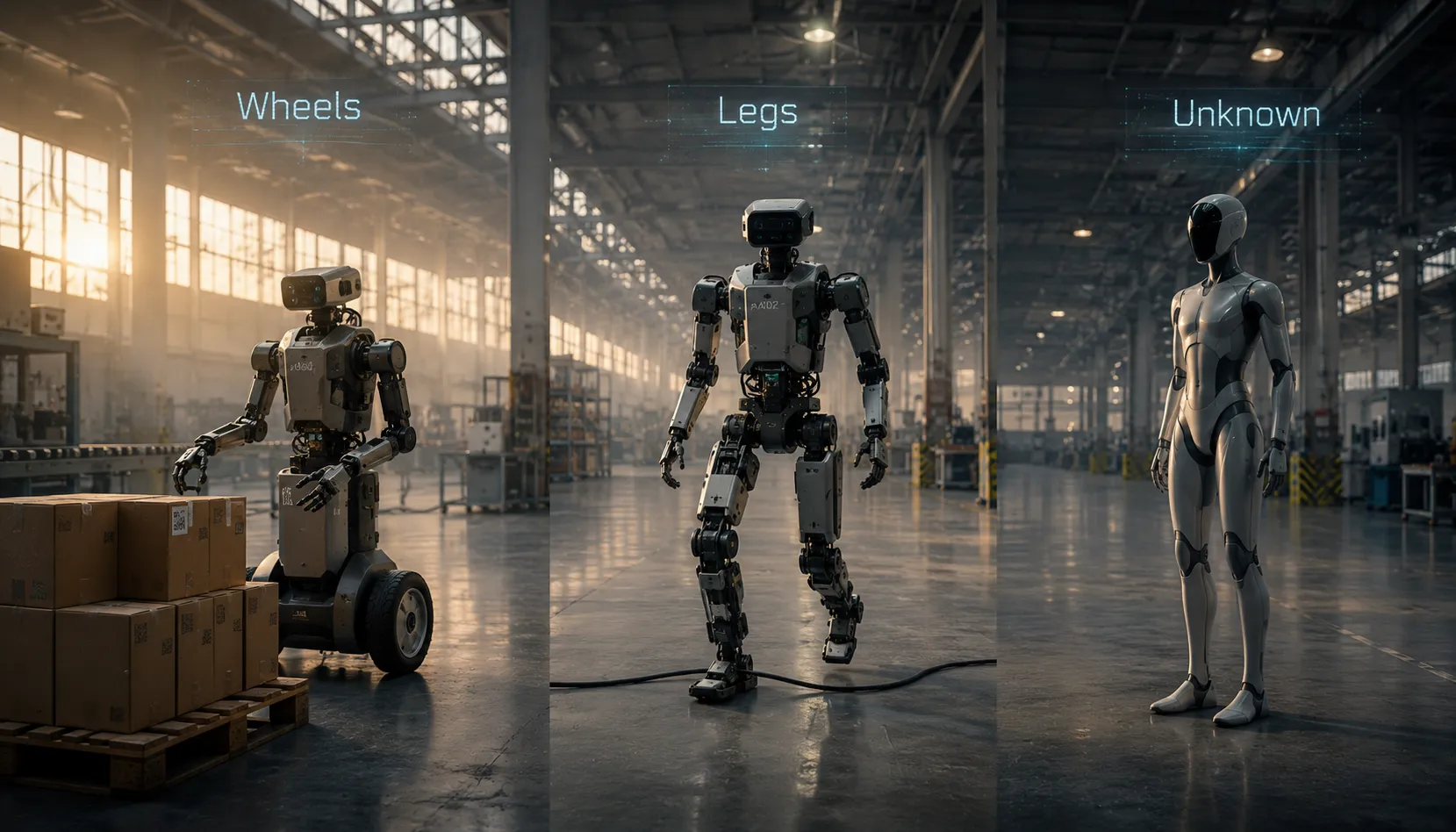
Humanoid's deal with Schaeffler is the most dramatic manifestation of a broader race that has been building for years and that is now, unmistakably, entering its operational phase. Three distinct approaches to the humanoid factory worker are converging on the same factory floors, backed by radically different theories of what a robot should look like, how it should move, and what it should cost.
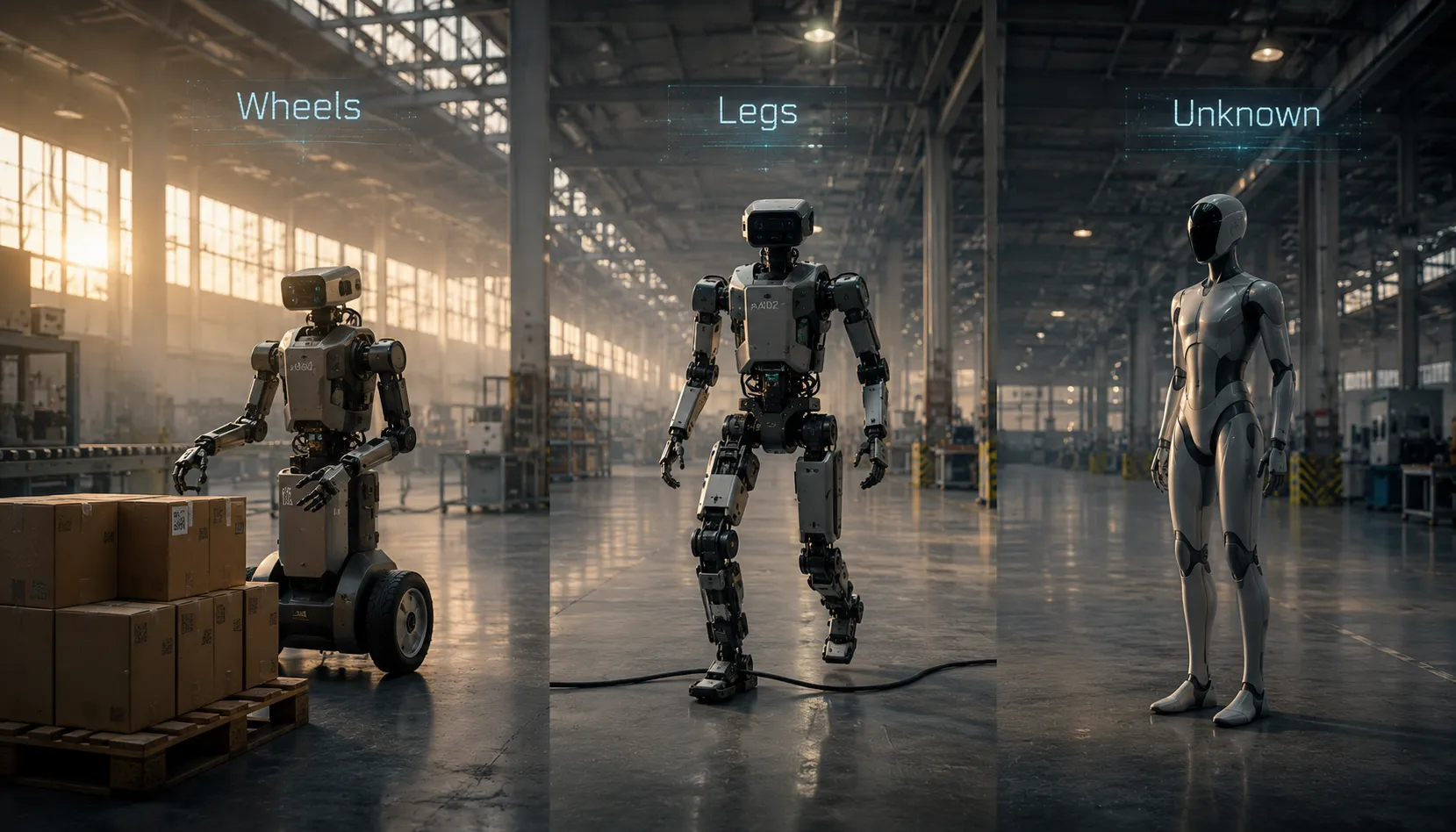
Humanoid's HMND 01 Alpha is a wheeled platform. It does not walk. It rolls, on a stable base that eliminates the balance and locomotion challenges that have consumed years of research at bipedal competitors. The tradeoff is clear: a wheeled robot cannot climb stairs or navigate uneven terrain, but it can begin doing useful work — box handling, palletizing, machine tending — today, in the flat-floor environments that characterize most factory interiors. The company's bet is that 80 percent of factory tasks happen on flat ground, and that the remaining 20 percent can wait until the technology matures.
Agility Robotics' Digit takes the opposite approach. It is bipedal — a walking robot designed to navigate human environments without modification. It can climb stairs, step over obstacles, and work in spaces built for human bodies. The cost of that flexibility is complexity. Digit currently operates inside a plexiglass cage because it cannot reliably detect humans in its environment — a limitation Agility says will be resolved by the end of 2026 — and its hourly operating cost, at $10 to $25 depending on the application, remains well above Agility's stated target of $2 to $3 per hour. The robot in Cheraw is learning. It is not yet competitive.
Then there is the third approach, represented by companies like Neura Robotics and the broader wave of Chinese humanoid manufacturers that have begun deploying bipedal robots in electric-vehicle factories. Schaeffler itself has a partnership with Neura Robotics to integrate humanoids into production operations by 2035, and has made a minority investment in Agility Robotics alongside an agreement to purchase Digit robots for use across its global plant network. The German industrial giant is hedging its bets across multiple robot architectures simultaneously — a signal that the winning form factor has not yet been determined, and that the company intends to be positioned regardless of which architecture prevails.
What This Means for Doug Thompson
The question that hangs over every humanoid robot deployment — the question that the industry's polished press releases and carefully worded investor updates are designed to avoid — is what happens to the Doug Thompsons of the world. The answer, so far, is complicated, and it is not yet clear whether "complicated" means "a transition that will create more jobs than it destroys" or "a transition that will destroy more jobs than it creates, at a speed that outpaces the ability of workers to adapt."
The most immediate effect is the creation of a job category that never existed before: the robot supervisor. At the Cheraw plant, a human worker is paid to watch a robot for eight hours a day. The job is not skilled in the traditional sense — it requires no programming knowledge, no engineering degree — but it is also not unskilled. It requires sustained attention, situational awareness, and the ability to intervene when the machine makes an error that its sensors cannot detect. It is, in some respects, the factory equivalent of a lifeguard: paid to watch for emergencies that almost never happen, but whose consequences are catastrophic if missed.
Agility Robotics' co-founder Damion Shelton told the Wall Street Journal that the company's goal is to drive Digit's operating cost down to $2 to $3 per hour — roughly the cost of electricity and depreciation, with minimal human oversight required. At that price, the economic logic of deploying humanoids in place of entry-level workers becomes unassailable. An employer choosing between a $20-an-hour human and a $3-an-hour robot does not need a consultant to run the numbers. The decision makes itself.
The broader labor-market implications are difficult to model because the deployment is happening in an environment of persistent manufacturing labor shortages. The Manufacturing Institute projects that 1.9 million U.S. manufacturing jobs could go unfilled by 2033. The robots arriving on Schaeffler's factory floors are not, in the near term, displacing workers who would otherwise have those jobs — because those workers do not exist. The threat is not to current employment. It is to future employment. The entry-level factory job that was a reliable pathway into the middle class for generations of Americans without college degrees is being filled — preemptively — by a machine.
Doug Thompson, fourteen years into his career at Schaeffler, is not in immediate danger. His experience, his institutional knowledge, and his ability to troubleshoot problems that no robot can yet diagnose make him more valuable than a Digit or an HMND 01 Alpha. But the new hire who might have started next month — the 22-year-old with a high school diploma and a willingness to work the third shift — will find a robot in the job that was supposed to be his. And the pipeline that once carried workers from entry-level labor into skilled trades, from the stamping press to the maintenance department to the supervisory role, is being severed at its source.
The Road to 10,000 Robots
Schaeffler's ambitions extend well beyond the two German sites that will receive the first robots in December. The agreement with Humanoid targets a four-digit number of machines across the company's global factory network by 2032. Internal planning documents, according to eWeek, anticipate "1,000+" robots deployed across multiple continents. The company operates more than 200 plants in over 50 countries. If the German pilot succeeds — if the robots prove capable of stable, continuous operation in live production environments, integrated into existing safety systems, IT infrastructure, and production workflows — the global expansion will follow.
The actuator supply agreement is the undercard that may ultimately prove more consequential than the deployment itself. Schaeffler, one of the world's largest manufacturers of precision motion components, will become the preferred supplier for the joints that make humanoid robots move. The contract is expected to deliver a seven-figure number of actuators through 2031 — a volume that implies Humanoid's ambitions extend far beyond a single customer. The startup that began two years ago in London is building a supply chain for an industry.
The wider context is a physical AI market that is attracting capital at a rate that has no peacetime precedent. Venture funding for robotics more than tripled between 2023 and 2025, reaching $40.7 billion globally. Physical AI startups — companies building the hardware, software, and systems to deploy autonomous machines in the physical world — attracted $24.2 billion in North American funding and M&A in the first quarter of 2026 alone. The International Federation of Robotics reports that 542,100 industrial robots were installed globally in 2024, more than double the 2014 figure, and projects installations could exceed 700,000 by 2028. Humanoid robots are the fastest-growing segment of that market, and the Schaeffler-Humanoid deal is the most significant commercial validation the segment has received.
Dr. Jochen Schroeder, Chief Operating Officer of Schaeffler AG, framed the partnership in terms that combined industrial pragmatism with strategic ambition. "The partnership with Humanoid underscores Schaeffler's commitment to innovation at the intersection of motion technology and artificial intelligence," he said. "By integrating humanoid robots into our production processes, we are not only increasing operational efficiency but also shaping the future of industrial manufacturing."
That future has a cage in Cheraw, South Carolina, and a box-handling line in Herzogenaurach, Germany. It has a fourteen-year veteran named Doug Thompson watching a robot do work that was once his. It has a two-year-old startup in London with a supply contract for a million actuators and a deployment target that extends into the thousands. It is not a demo anymore. It is a payroll decision. And it is not going to stop.


