The Return of the Indian Toy Story: How D2C Toy Brands Are Taking on Lego and Mattel
The Plastic Dragon Slayed
For three decades, the Indian toy industry told a single story: import. From Action Man to Barbie, from Lego bricks to Hot Wheels, the shelves of Indian toy stores were colonized by global brands. Domestic manufacturing was fragmented, quality was inconsistent, and "Made in India" was virtually absent from the toy aisle.
In 2026, that story is being rewritten. In a small manufacturing cluster in Rajkot, an Indian factory now produces STEM toys for Hasbro and FirstCry under one roof while building its own D2C brand under another. In Bengaluru, a bootstrapped startup has sold wooden Montessori toys to over 150,000 customers in six countries. In Gurugram, a young founder has built a character-driven universe around remote-control cars that offers free lifetime repair—a "repair-not-replace" model that global giants have never attempted.
This is the quiet, colorful, surprisingly profitable revolution of India's D2C toy industry. And it is finally, after decades of dormancy, coming of age.
The Canvas: $2.5 Billion and Growing Fast
India's toy market is no longer a blip on the global radar. According to multiple industry trackers, the sector was valued at approximately $2.09 billion in 2025 and is projected to reach $4.74 billion by 2034, growing at a CAGR of 9.53%. Other estimates place the 2026 market size at $2.52 billion, targeting $5.75 billion by 2033 with a CAGR of 12.5%.
The growth is driven by three structural shifts:
Rising disposable incomes: India's middle class is expanding, and parents are spending more on child development.
The Montessori effect: A generation of millennial parents, exposed to global educational philosophies, is actively seeking toys that teach, not just entertain.
D2C acceleration: With 38% of toys now sold online (the largest distribution channel), brands can reach customers directly without expensive retail intermediaries.
Unisex toys dominate the market with a 58% share, reflecting a growing parental preference for gender-neutral, inclusive play. Plush toys lead product segments at 16%, but the fastest growth is in STEM and electronic toys—precisely the categories where Indian D2C brands are innovating most aggressively.
The Brand Builders: India's D2C Toy Champions
Smartivity: The Rs 100 Crore Dream
Smartivity, founded in 2015 by four graduates including IIT Delhi alumni, is arguably the most funded player in India's D2C toy ecosystem. The ed-tech startup, which designs activity-based STEM learning toys, has raised $5.88 million across seven rounds.
In April 2026, Smartivity raised another $2 million (Rs 13 crore) led by stock market investor Ashish Kacholia, who invested $1.7 million after falling in love with the toys while bonding with his daughter. “I can see the improvement in her understanding of scientific concepts,” he explained.
The growth trajectory is staggering. Co-founder Tushar Amin told VCCircle that Smartivity has grown "over 10X in the past two years" and expects to cross Rs 100 crore revenue in the next three years, with plans to launch brand awareness initiatives in Indian, American, European, and other international markets.
Legend of Toys: The Kidult Collector's Dream
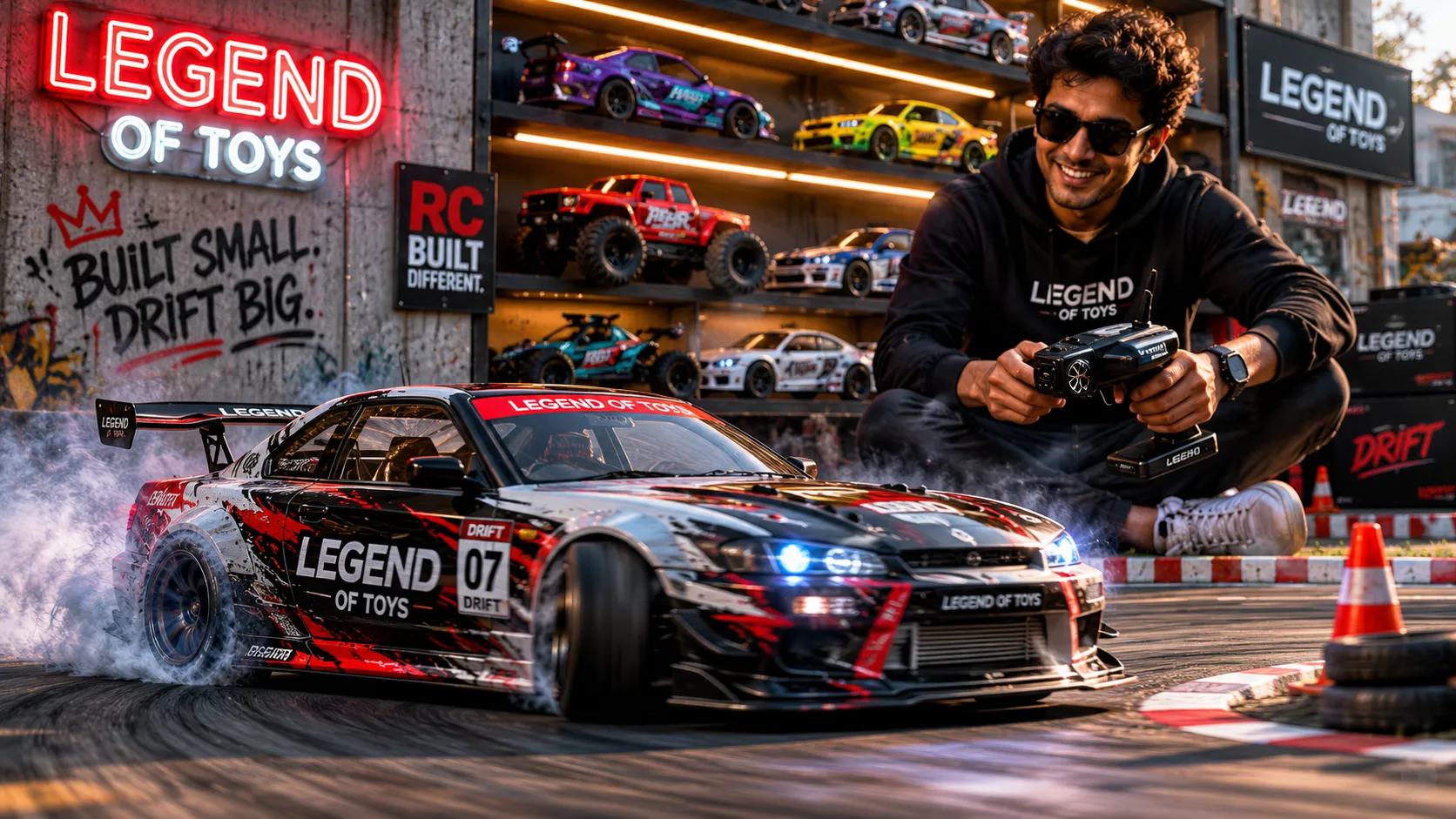
Perhaps the most audacious Indian D2C toy story is Legend of Toys. Founded in 2024, the Bengaluru-based startup builds character-driven play universes around remote-control drift cars, high-speed RC cars, and off-road RC trucks priced between ₹1,799 and ₹8,799.
In May 2026, Legend of Toys raised ₹21 crore ($2.2 million) in a pre-Series A round led by Singularity Early Opportunities Fund, with participation from Veltis Capital, Enzia Ventures, DeVC, Atrium Angels, and Stride.
The numbers are remarkable: ₹30 crore annualized run rate within 18 months of operations, with 20% month-on-month growth. The startup is especially focused on the "Kidult" collector community—deep-pocketed adults who are more likely to engage in repeat purchases of higher-value toys to build out their collections. Popular global collectibles include LEGOs, Barbies, and Hot Wheels, a $67.86 billion global market by 2030 that Legend of Toys believes India can capture.
Crucially, Legend of Toys offers a "repair-not-replace" after-sales model with free lifetime service—a bold value proposition that global giants have never matched. Each character in its universe has a background story, allowing children, enthusiasts, and collectors to engage with the brand beyond a single purchase.
Shumee: The Wooden Wonder
For a quieter, more traditional D2C play, consider Shumee. Founded in 2014, the Bengaluru-based brand sells Montessori-inspired wooden toys for children up to age 8, having garnered over 150,000 customers across six countries.
Shumee's revenue is more modest—approximately ₹7.72 crore in FY24 and ₹30.9 lakh in FY25—but its brand equity is significant. Bollywood actor Dia Mirza has invested in the company and serves as its brand ambassador. What Shumee lacks in scale, it compensates for in authenticity: handcrafted, non-toxic, plastic-free toys designed in India, for the world.
Aditi Toys: The Manufacturing Powerhouse
Not every D2C toy success story is purely digital. Aditi Toys, based in Rajkot, manufactures 280 toys across plastic, die-cast, electric, STEM, silicone, and wood categories in a 2.25 lakh sq ft facility. It serves 150 distributors and 15,000 retailers, counting Hamleys, Mumuso, Hasbro, and FirstCry among its clients.
In March 2026, Aditi Toys raised ₹36 crore ($3.9 million) led by GVFL to expand manufacturing capabilities, particularly in STEM and electronic toys where India still relies heavily on imports. The startup sells under its own D2C brand "Chanak – The Smartest Kid" while also serving as a private label manufacturer for global giants. It currently exports to more than 12 countries.
The Policy Tailwind: National Action Plan for Toys
Behind every successful D2C boom in India lies a government that has cleared the path. The toy industry is no exception.
In August 2020, Prime Minister Modi devoted an entire "Mann Ki Baat" episode to toys, urging India to become a global toy manufacturing hub. The National Action Plan for Toys (NAPT), coordinated by 14 central ministries, was subsequently developed, focusing on 21 specific action points covering design, quality, learning resources, and indigenous toy clusters.
The Union Budget 2025-26 allocated ₹1,500 crore for toy cluster expansion, interest subsidies for MSMEs, export incentives, and R&D. The scheme aims to "create high-quality, unique, innovative, and sustainable toys that will represent the 'Made in India' brand".
The results are already visible. Between FY21-22 and FY22-23, India recorded a 52% decline in toy imports and a 239% rise in toy exports. Nineteen toy clusters have been approved under SFURTI across Madhya Pradesh, Rajasthan, Uttar Pradesh, Karnataka, Andhra Pradesh, Maharashtra, and Tamil Nadu, benefiting over 11,700 artisans with government assistance of Rs 55.65 crore.
The Ministry of Textiles has identified 13 additional clusters, including Channapatna, Kondapalli, and Varanasi, for artisan development. Toycathon—a national hackathon for toy design—has been institutionalized, with MeitY organizing e-Toycathon 2025, which attracted 112 teams and over 400 engineering students from across India, with prototypes moving to commercial production.
The STEM Surge and Eco-Friendly Shift
The fastest-growing segment of India's toy market is STEM (Science, Technology, Engineering, Mathematics). Smartivity's 10X growth in two years is emblematic of a broader trend. Parents are moving beyond "entertainment" toys toward products that build analytical skills, reduce screen time, and align with modern educational philosophies.
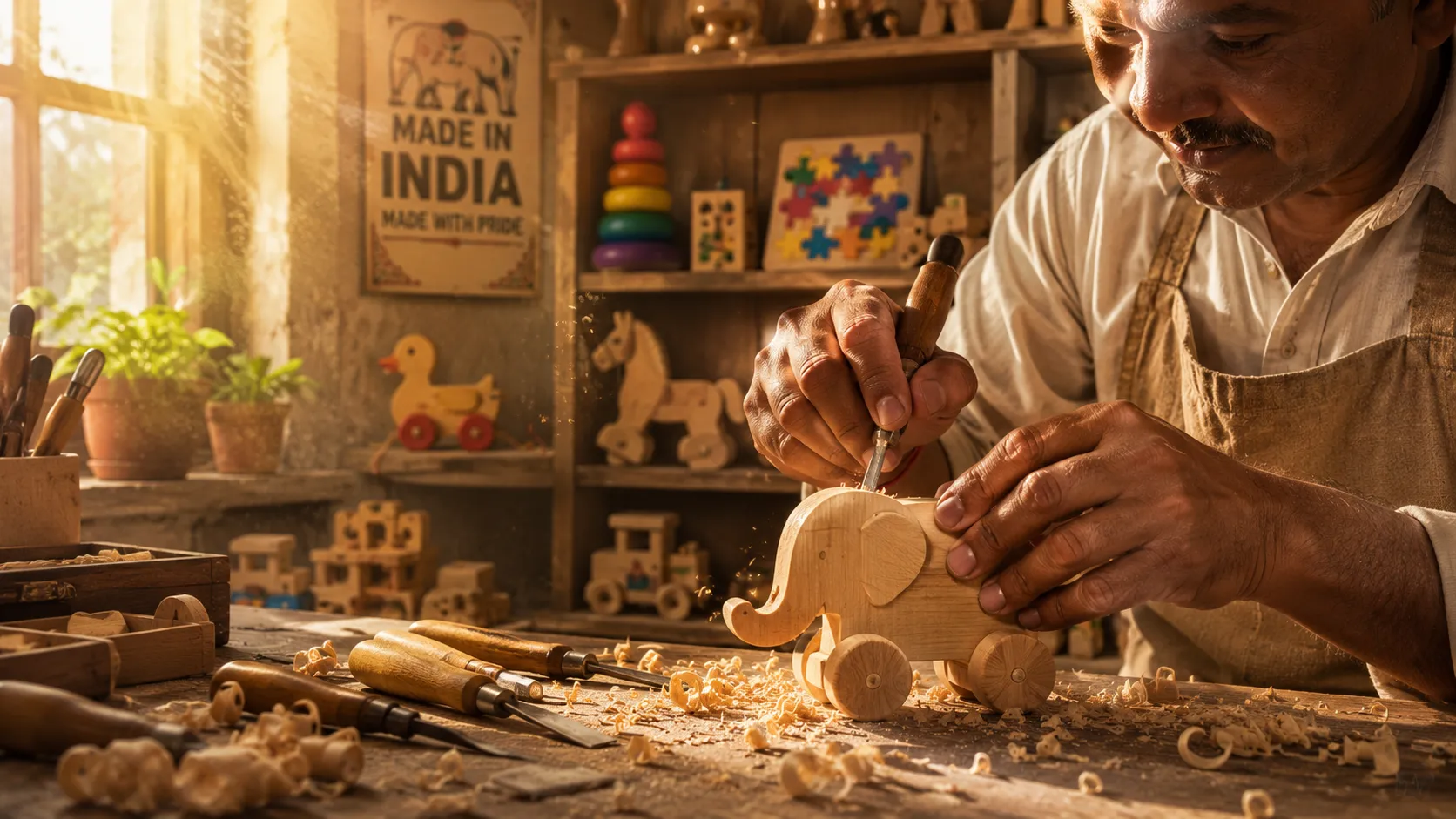
Equally significant is the shift toward eco-friendly materials. D2C brands like Shumee have built entire product lines around wooden, non-plastic toys. The government's push for indigenous, sustainable toys aligns perfectly with millennial parental preferences—and with export opportunities, as Western markets increasingly demand non-toxic, biodegradable alternatives to Chinese plastic.
The Funding Frenzy: Capital Flows Into Play
The investment community has taken note. In the past 18 months, D2C toy startups have attracted significant early-stage funding:
Aditi Toys: ₹36 crore ($3.9M) in March 2026
Legend of Toys: ₹21 crore ($2.2M) in May 2026
Mirana Toys: ₹57.5 crore ($6.4M) in Series A (November 2025)
Snooplay: ₹8 crore in pre-Series A1 for AI-driven discovery
EleFant: $1 million in pre-Series A for toy subscription model
Filli & Me: ₹1.5 crore in pre-seed for kids accessories
The message is unambiguous: venture capital sees India's D2C toy sector as a blue ocean.
The Global Indian Opportunity
For the diaspora, the D2C toy revolution offers three pathways to impact.
First, as investors: At an early stage, most Indian D2C toy brands remain undervalued compared to their Western counterparts. A ₹21 crore pre-Series A round in Legend of Toys is a fraction of what a comparable US brand would command. For diaspora angels, this is a compelling entry point.
Second, as exporters: Aditi Toys already exports to 12 countries. Shumee reaches six. The global market for wooden, sustainable, educational toys is vast, and Indian manufacturing costs remain highly competitive. Diaspora professionals with retail distribution networks in the US, UK, or Europe can serve as bridge partners.
Third, as parents: This may be the most personal opportunity. For Indian parents abroad, D2C Indian toy brands offer something global brands cannot: cultural resonance. A wooden Ganesha puzzle, a story-driven RC car universe rooted in Indian mythology, a STEM toy that teaches Sanskrit numerals—these are products that global giants cannot copy.
The Final Word
The Indian D2C toy revolution is not about nostalgia. It is about capacity. After decades of dependence on imports, India is finally building the infrastructure, design talent, manufacturing scale, and consumer trust to compete on the global stage.
From Smartivity's Rs 100 crore ambition to Legend of Toys' "repair-not-replace" loyalty model, from Aditi Toys' twin identity as global manufacturer and homegrown brand to Shumee's wooden Montessori quiet success, the message is consistent: India's toy industry has grown up.
The plastic dragon has not been slain. But it is finally being challenged—by wooden blocks, STEM puzzles, and remote-control cars with free lifetime service. And the children of India, like children everywhere, will be the richer for it.
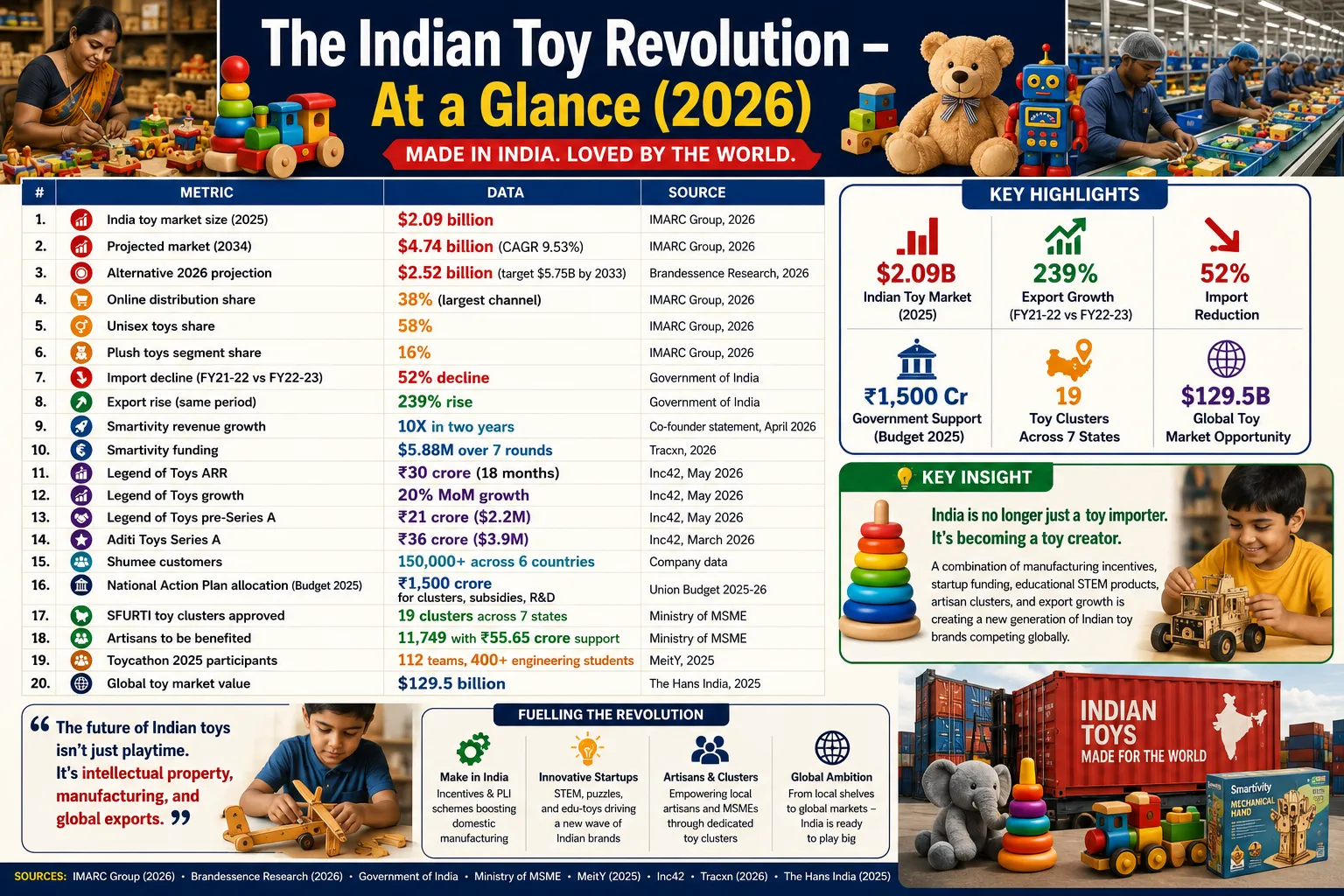
CHART: "The Indian Toy Revolution – At a Glance (2026)"
Metric | Data | Source |
|---|---|---|
India toy market size (2025) | $2.09 billion | IMARC Group, 2026 |
Projected market (2034) | $4.74 billion (CAGR 9.53%) | IMARC Group, 2026 |
Alternative 2026 projection | $2.52 billion (target $5.75B by 2033) | Brandessence Research, 2026 |
Online distribution share | 38% (largest channel) | IMARC Group, 2026 |
Unisex toys share | 58% | IMARC Group, 2026 |
Plush toys segment share | 16% | IMARC Group, 2026 |
Import decline (FY21-22 vs FY22-23) | 52% decline | Government of India |
Export rise (same period) | 239% rise | Government of India |
Smartivity revenue growth | 10X in two years | Co-founder statement, April 2026 |
Smartivity funding | $5.88M over 7 rounds | Tracxn, 2026 |
Legend of Toys ARR | ₹30 crore (18 months), 20% MoM growth | Inc42, May 2026 |
Legend of Toys pre-Series A | ₹21 crore ($2.2M), May 2026 | Inc42, May 2026 |
Aditi Toys Series A | ₹36 crore ($3.9M), March 2026 | Inc42, March 2026 |
Shumee customers | 150,000+ across 6 countries | Company data |
National Action Plan allocation (Budget 2025) | ₹1,500 crore for clusters, subsidies, R&D | Union Budget 2025-26 |
SFURTI toy clusters approved | 19 clusters across 7 states | Ministry of MSME |
Artisans to be benefited | 11,749 with ₹55.65 crore support | Ministry of MSME |
Toycathon 2025 participants | 112 teams, 400+ engineering students | MeitY, 2025 |
Global toy market value | $129.5 billion | The Hans India, 2025 |


