The Rental System Is Dead: How Ram Charan's ₹350 Crore 'Peddi' Became the Battleground for Telangana's Single-Screen Survival—And How Chiranjeevi Stepped In to Save It
HYDERABAD — May 28, 2026 — For nearly four decades, the single-screen theatres of Telangana have operated on a principle so simple it was never questioned: the exhibitor pays a fixed rent, the producer collects it, and the box office—whether triumphant or tragic—belongs to whoever took the risk. The system was designed for an era when audiences had nowhere else to go, when the only screen in town was the one with the faded posters and the creaking seats, and when the relationship between the man who made the film and the man who screened it was governed by handshake and habit rather than contract and calculation. That era is now over. The system that sustained it is being dismantled. And the film that finally broke it—or, more precisely, the film whose near-death experience finally forced the industry to acknowledge that the system was already broken—is Ram Charan's Peddi, a ₹350 crore sports action drama that was never meant to be a revolutionary document but has become one anyway.
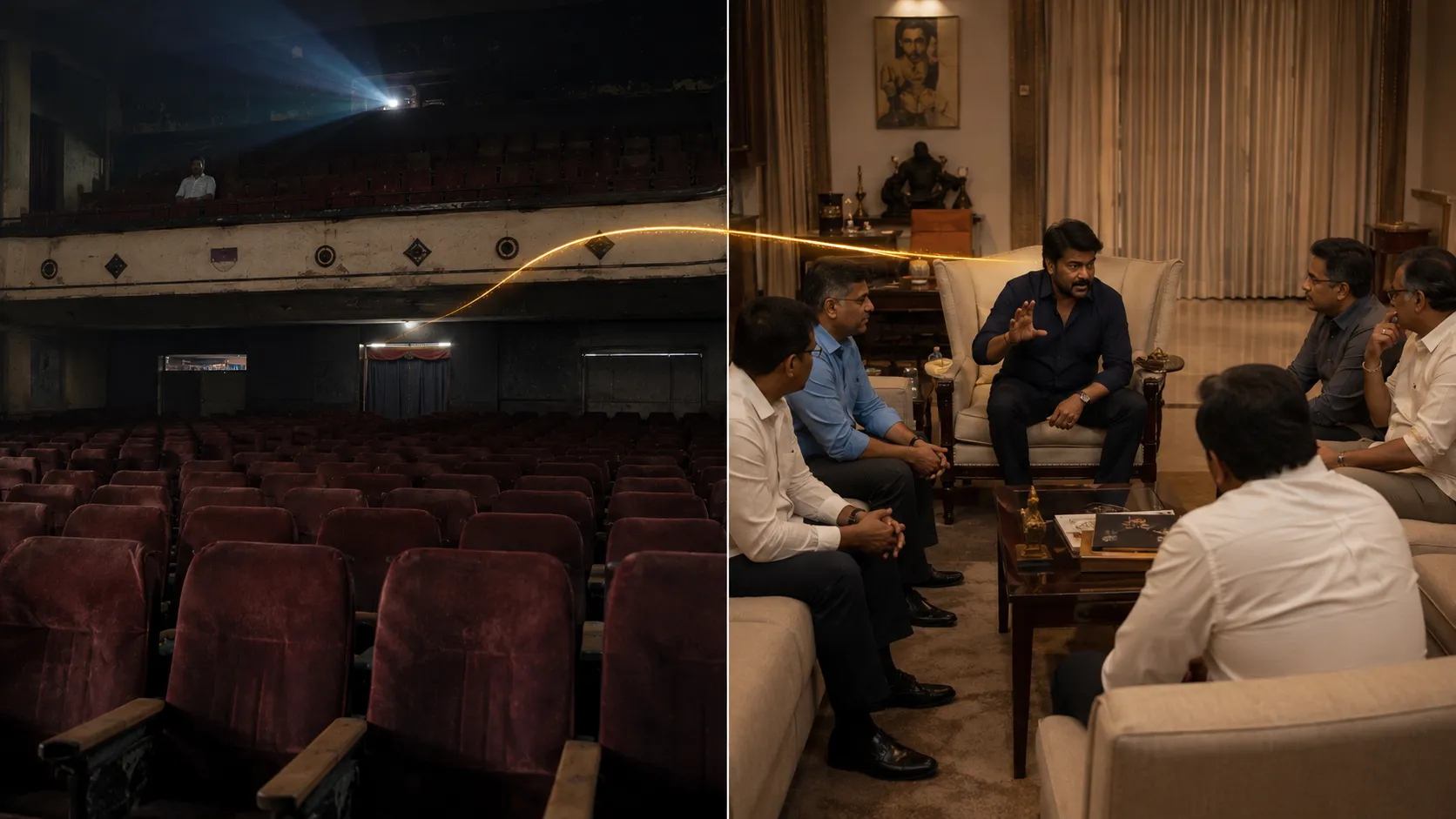
On May 28, the Telangana State Film Chamber of Commerce issued an official press note that will be remembered as a watershed in the history of Telugu cinema. After weeks of escalating confrontation between single-screen exhibitors and film producers—a standoff that had already claimed one film as a casualty and threatened to claim the biggest Telugu release of the summer—Megastar Chiranjeevi personally intervened. He met exhibitors at his Jubilee Hills residence on May 25. He listened to their grievances. He acknowledged the structural inequity of a system in which exhibitors bore all the risk and producers captured all the upside. And he gave them a commitment that no industry body had been willing to make: the rental system would end. From July 3, 2026, every film released in Telangana would be screened under a percentage-sharing model. The old way—the fixed rent, the predetermined payout, the exhibitor left holding the losses when a film failed—would be abolished. The new way—revenue shared between producer and exhibitor according to a formula that reflected the actual performance of the film—would replace it. The transition had been debated for years and blocked by producers at every turn. Chiranjeevi broke the blockade. Peddi will release on June 4 under the existing rental system—a temporary reprieve for the producers—but it will be, in all likelihood, the last major Telugu film ever to do so.
The System That Was Killing Single Screens
To understand what happened in the Telugu film industry in May 2026, one must first understand the arithmetic of the rental system—and why that arithmetic, which had sustained the single-screen economy for decades, had become an instrument of its destruction.
Under the prevailing rental model, a single-screen theatre paid a fixed amount to the producer or distributor to screen a film for a specified period. The amount was determined in advance, based on the theatre's seating capacity, its location, and the perceived commercial prospects of the film. Whether the theatre was full or empty, whether the film was a blockbuster or a disaster, the rent remained the same. If the film succeeded, the producer and distributor captured the upside. If the film failed, the exhibitor absorbed the loss. The risk was asymmetrical, and the asymmetry was structural: the party with the least control over the quality of the product—the exhibitor—bore the greatest financial exposure to its failure.
The numbers make the inequity stark. According to data presented by the Telangana Film Chamber, if a film earns a gross of ₹1 crore, a single-screen theatre receives approximately ₹7 lakh as rent. The remaining ₹93 lakh flows through the distribution chain back to the producer. A multiplex, by contrast—which already operates on a percentage-sharing model—would receive approximately ₹45 lakh from the same ₹1 crore collection, or roughly six times as much. The disparity is not a quirk of the market. It is the product of a system that was designed when single screens were the only exhibition infrastructure available, when audiences had no alternative, and when the bargaining power of the exhibitor was limited to the choice between accepting the terms offered and closing the theatre.
The exhibitors' argument, articulated with increasing urgency over the past year, is that the conditions that made the rental system viable no longer exist. Operating costs—electricity, maintenance, staff salaries, air-conditioning, property taxes—have risen substantially. Audience habits have changed: the post-pandemic consumer is more selective, more likely to wait for an OTT release, and less willing to visit a theatre for a film that does not generate strong word-of-mouth. The single screen, which once enjoyed a monopoly on the cinematic experience, now competes with multiplexes offering recliner seats and Dolby Atmos, with streaming platforms offering convenience and choice, and with the simple, brutal reality that the consumer who can watch a film on a smartphone may not be willing to pay for a ticket at all. "It is an existential crisis for single-screen theatre owners," Vishek Chauhan, CEO of Roopbani Cinema in Bihar, told Economic Times. "On the one hand, they pay a fixed fee to distributors irrespective of the performance of films. On the other hand, they do not have a say in the choice of films they want to showcase or even in the number of shows."
The crisis is measurable. According to the Telangana Exhibitors Association, more than 100 single-screen theatres have shut down in the state since the release of RRR in 2022—a casualty rate of roughly one theatre every two weeks. India currently has close to 5,000 single-screen theatres, nearly 70 percent of which are located in South India. Telangana alone accounts for approximately 10 to 11 percent of the region's single-screen capacity. The theatres that have survived are, in many cases, operating at a loss, sustained by owners who could earn more by converting their properties into warehouses or commercial complexes but who have continued running cinemas out of a commitment to the medium and to the communities they serve. "Producers don't understand the plight of exhibitors, while we are witnessing the crisis firsthand," Sirish Reddy, a leading distributor and exhibitor, said at a press conference earlier this month. "The situation is extremely bleak."
The percentage-sharing model that exhibitors demanded is not a radical innovation. It is already the standard in Maharashtra, Delhi, Karnataka, and virtually every other major film market in India. Multiplex chains in the Telugu states already operate on percentage-sharing terms. The anomaly is not that Telangana's single-screen exhibitors were demanding a change. The anomaly is that they had been denied it for so long. "Telugu producers are following the percentage-sharing model in other states," Reddy pointed out, "but they are refusing to implement the same system in Andhra Pradesh and Telangana. That is completely unfair."
The Standoff That Almost Killed a Blockbuster
The confrontation between exhibitors and producers reached its breaking point in the second week of May 2026. At an emergency meeting held at the Telugu Film Chamber of Commerce, the Telangana Exhibitors Association announced that it would discontinue the rental model and operate theatres exclusively on a percentage-sharing basis. More than 180 exhibitors reiterated their demand that the new system should begin with Peddi itself—the biggest Telugu release of the summer, a ₹350 crore sports action drama starring Ram Charan and directed by Buchi Babu Sana, with music by A.R. Rahman and featuring Janhvi Kapoor and Kannada superstar Shiva Rajkumar. The exhibitors made it clear that there would be no ticket price hikes for Peddi in Telangana, while such hikes might be permitted in Andhra Pradesh. They also wrote to Telangana Chief Minister Revanth Reddy, seeking government intervention in what they described as an existential threat to the state's single-screen exhibition sector.
The producers' response was a mixture of resistance and delay. They proposed a compromise: the rental model would continue, but with an additional 7.5 percent revenue-sharing component. Exhibitors rejected the offer. The producers then proposed that the percentage system be implemented after June 30, once the summer release window had passed and the financial risk to the big-budget films awaiting release had diminished. Exhibitors rejected that timeline as well. They wanted the change to begin with Peddi. They had been waiting for years—the demand, they pointed out, had been pending before the Telugu Film Chamber of Commerce for more than twelve months—and they were unwilling to wait any longer.
The conflict had already claimed one victim. Jetlee, a Mythri Movie Makers release that opened earlier in May, allegedly faced a virtual ban on its opening day, with exhibitors reportedly refusing to schedule the film amid the ongoing dispute. Mythri, which is also the producer and distributor of Peddi, condemned what it described as "unfair tactics," alleging that certain exhibitors had pressured multiplexes by withholding films over single-screen terms. The Jetlee episode demonstrated that the exhibitors' threat was not empty. If they were willing to boycott a film that had already been released, they were certainly willing to boycott a film that had not.
With Peddi scheduled to open on June 4—a date strategically chosen to capture the post-IPL window—the stakes could not have been higher. Trade analysts estimated that introducing a percentage-sharing model for Peddi at that stage could reduce the combined revenue of producers and distributors by ₹17 to ₹18 crore. The film's budget, at ₹350 crore, is among the largest in Telugu cinema history, and the producers—Vriddhi Cinemas, with Mythri Movie Makers and Sukumar Writings presenting—had structured their financial projections around the existing rental model. A last-minute switch to percentage-sharing would have blown a hole in those projections. The exhibitors, for their part, argued that the rental model was bleeding them dry and that Peddi, as the biggest film of the season, was the only release that carried enough leverage to force the producers to the table. The logic was brutal: if the producers wanted their film screened in Telangana's single-screen theatres, they would have to agree to share the revenue. If they refused, the theatres would remain dark. The damage to Peddi's box office would be enormous, but the damage to the exhibitors' survival would be, in their view, even greater.
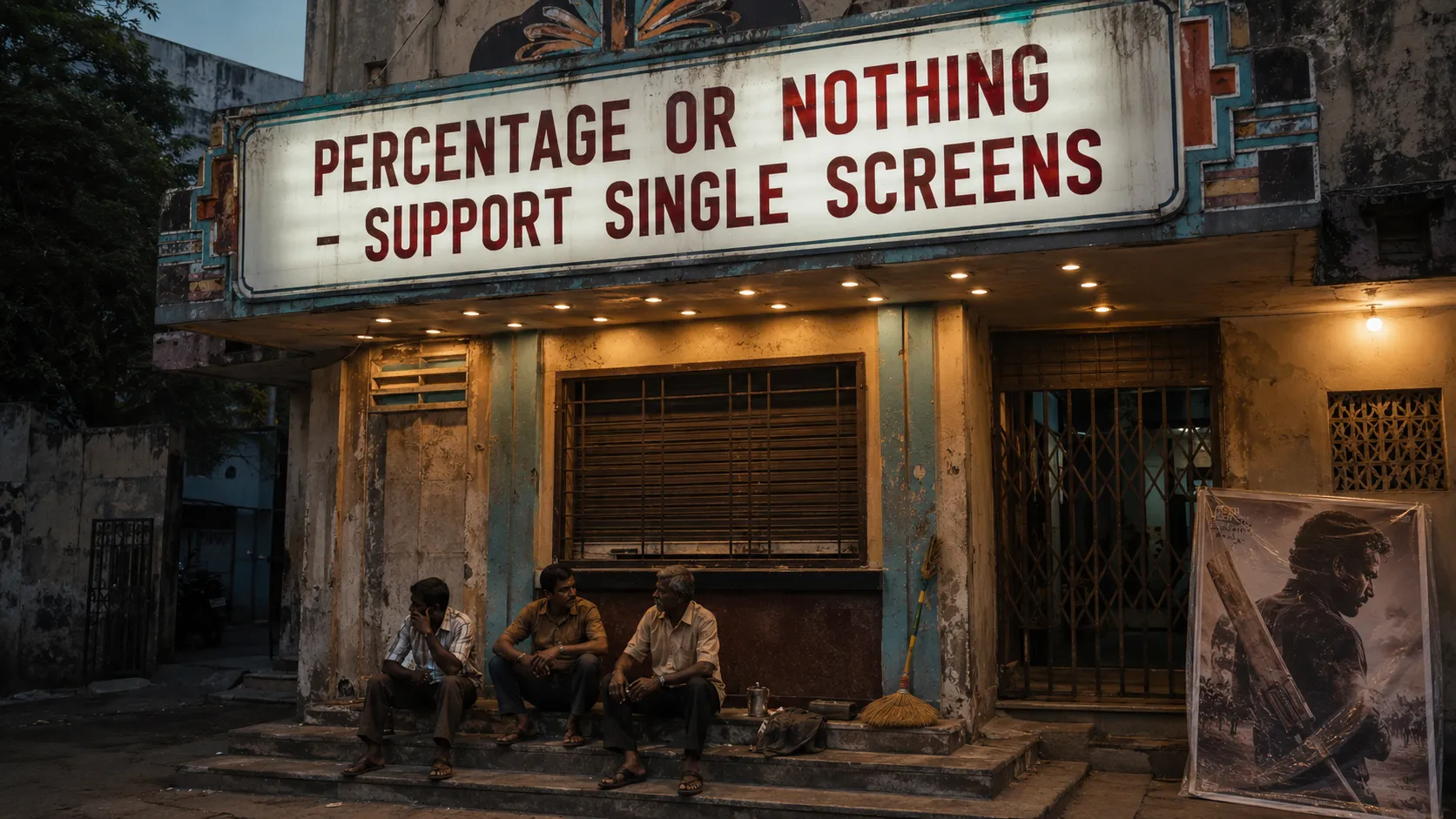
The Telangana Exhibitors Association issued what amounted to an ultimatum: "Percentage or Nothing." The phrase, repeated at press conferences and industry meetings, became the slogan of a movement that had been building for years and that had finally found its moment. The single-screen theatre owners of Telangana were no longer asking for a better deal. They were demanding a different system—and they were willing to sacrifice the biggest film of the year to get it.
The Megastar Who Stepped In
The resolution of the Peddi standoff was not the product of institutional negotiation. It was the product of personal intervention. Chiranjeevi—Megastar of Telugu cinema, former Union Minister, and the most respected figure in the industry—invited exhibitors, producers, and distributors to his Jubilee Hills residence on May 25 and spent more than an hour listening to both sides. The meeting was attended by producer Dil Raju, Telugu Film Chamber President Juvvadi Sekhar, leading exhibitor and distributor Sirish Reddy, and representatives of Suresh Productions, Mythri Movie Makers, and other major industry stakeholders. Allu Aravind, the veteran producer and father of Allu Arjun, was also present—a signal that the meeting carried the weight of the industry's most powerful families.
Chiranjeevi's role was not that of a neutral mediator. It was that of a patriarch intervening in a family dispute. He listened to the exhibitors' grievances. He acknowledged the structural inequity of the rental system. He reportedly urged both sides to soften their positions and arrive at an amicable settlement. And he gave the exhibitors a commitment that no one else had been willing to make: the percentage-sharing model would be implemented. The deadline would be July 3, 2026—a date that gave producers time to adjust their financial models and that gave exhibitors the certainty they had been denied for years. The sub-committee formed by the Telugu Film Chamber of Commerce would finalise the details of the new system by June 30. Chiranjeevi personally assured the exhibitors that he would monitor the committee's progress and ensure that justice was done.
The assurance was enough. The Telangana exhibitors agreed to withdraw their protest. They announced that they would cooperate to ensure the smooth release of Peddi without any obstacles, and that they would abide by the letter circulated by the Telugu Film Chamber. The film would release on June 4 under the existing rental system—a concession to the producers, who had argued that a last-minute switch would disrupt their financial planning—but the rental system itself had been given a death sentence. From July 3, it would cease to exist. "The old rental system in theatres will be completely abolished from July 3," confirmed V.L. Sridhar, secretary of the Telangana State Film Chamber of Commerce. "From that date onwards, all films releasing in theatres will be screened only under the percentage-sharing model."
The resolution was, in one sense, a compromise. The exhibitors did not get their demand for the percentage system to begin with Peddi. The producers did not get their preference for the rental system to continue indefinitely. But the compromise was weighted decisively in favour of the exhibitors' long-term interests. They had secured a binding commitment to end the system that was killing them, with a specific deadline, backed by the personal assurance of the industry's most powerful figure. The producers had secured a temporary reprieve for their most important release of the summer—but the reprieve was a stay of execution, not a pardon. The system they had defended for years was being dismantled, and the man who announced its dismantling was not an exhibitor or a regulator. It was Chiranjeevi, the Megastar, who had concluded that the survival of the single-screen theatre was more important than the preservation of a revenue model that had enriched producers at the expense of the people who screened their films.
The Telangana State Film Chamber of Commerce issued its official press note on May 28, clearing the path for Peddi's release and formally announcing the transition to the percentage-sharing model. The press note stated that after discussions with Chiranjeevi, the Telangana exhibitors had agreed to follow the letter circulated by the Telugu Film Chamber, allowing Peddi to release smoothly under the current rental system. Complete clarity on the new percentage-sharing model would be finalised before June 30. The new system would come into effect across the state from July 3. The rental system, which had governed the relationship between producer and exhibitor in Telangana for nearly forty years, had been given three weeks to live.
The Jetlee Casualty and the Mythri Front
The Peddi resolution cannot be understood without acknowledging the film that was sacrificed to the standoff. Jetlee, a Mythri Movie Makers release that opened in early May, became the first casualty of the exhibitors' protest. According to multiple trade reports, the film faced a virtual boycott on its opening day, with single-screen theatres across Telangana refusing to schedule it. The exhibitors' message was unambiguous: if the producers would not agree to the percentage-sharing model, the producers' films would not be screened.
Mythri, which is both the producer and distributor of Jetlee and the presenter of Peddi, emerged as the strongest opponent of the percentage-sharing proposal. The production house, one of the most powerful in the Telugu film industry, argued that the timing of the demand was opportunistic—that exhibitors were using the leverage of a major release to force a change that would benefit them at the expense of producers who had already structured their financial models around the existing system. Mythri condemned what it described as "unfair tactics," alleging that exhibitors had pressured multiplexes into complying with the boycott. The Jetlee episode demonstrated the exhibitors' resolve and signalled to the industry that the boycott threat was not a bluff.
The Jetlee incident also exposed a deeper structural fault line. The film was not a blockbuster. Its opening day collections were reportedly modest. In a rental system, a film that underperforms still generates a fixed payment for the producer, while the exhibitor absorbs the loss. In a percentage-sharing system, the exhibitor's exposure is reduced—they keep a share of whatever the film earns, rather than paying a fixed amount regardless of performance—but the producer's upside is correspondingly diminished. The exhibitors' argument was that the rental system exposed them to catastrophic losses when a film failed, and that a percentage-sharing model would distribute risk more equitably. The producers' counterargument was that the percentage system would reduce the revenue they needed to finance the large-budget spectacles that drew audiences to theatres in the first place. Both arguments had merit. The standoff was resolved not by determining which argument was correct, but by the intervention of a figure who had the authority to impose a solution regardless.
The Mythri position was further complicated by the fact that the production house had already been negotiating the terms of Peddi's release with exhibitors across multiple territories. The film's budget—₹350 crore—made it one of the most expensive productions in Telugu cinema history, and the financial projections that justified that budget had been built on the assumption of the existing rental model. A last-minute switch to percentage-sharing would have required a complete recalibration of those projections—and a significant reduction in the revenue that the producers and their financial partners had been counting on. The compromise that Chiranjeevi brokered—Peddi releases under the rental system, but the rental system ends three weeks later—gave Mythri the financial certainty it needed for its most important release while conceding the structural reform that exhibitors had been demanding. It was, in the circumstances, a masterful piece of mediation: neither side got everything it wanted, but both sides got enough to declare victory and move on.
The Peddi team has been aggressively promoting the film across multiple cities, including Mumbai, Bhopal, and Bengaluru, and the resolution of the Telangana standoff removes the last significant obstacle to what is expected to be one of the largest openings of the year. The film's June 4 release date positions it in a lucrative post-IPL window, and the combination of Ram Charan's star power, Buchi Babu Sana's directorial vision, and A.R. Rahman's music has generated anticipation that the trade expects to translate into substantial box-office returns. The Telangana single-screen theatres—all of them, without exception—will be screening the film. The boycott that threatened to derail the biggest Telugu release of the summer has been averted. The system that caused it has been dismantled. The film will open as planned, and the theatres that were almost dark will be full.
The Structural Legacy
The most significant dimension of the Peddi standoff is not the resolution itself. It is the structural transformation that the resolution has set in motion. The Telangana single-screen theatre, which had been dying a slow, unremarked death for years—more than 100 closures since RRR, an average of two per month—has been given a reprieve. The percentage-sharing model is not a guarantee of profitability, but it is a guarantee that the exhibitor will not be destroyed by a film that fails. In a rental system, the exhibitor pays the same amount whether the theatre is full or empty. In a percentage-sharing system, the exhibitor's revenue rises and falls with the film's performance, but the floor is higher and the risk is shared. The change is structural, and its effects will be felt for years.
The broader context is an Indian exhibition industry that is in the midst of a painful but necessary transition. The single-screen theatre, which was once the backbone of the Indian film economy, has been in decline for decades. The multiplex revolution of the 2000s concentrated audience attention—and producer attention—on the premium, air-conditioned, multi-screen complexes that offered a superior experience and commanded higher ticket prices. The pandemic accelerated the decline, as audiences grew accustomed to watching films at home and producers grew accustomed to selling their films to streaming platforms. The single screen, with its worn seats and its limited amenities and its dependence on a single film at a time, seemed destined for obsolescence.
The Telangana exhibitors' revolt is a reminder that the single screen is not dead yet—and that the people who own and operate these theatres are not passive victims of structural change, but active participants in a negotiation over the terms of their own survival. The percentage-sharing model they have secured will not, on its own, reverse the decline of the single screen. But it will make the decline slower, more manageable, and less catastrophic for the families whose livelihoods depend on these theatres. It will align the incentives of producer and exhibitor in a way that the rental system never did: both parties will benefit when a film succeeds, and both will share the pain when it fails. The alignment is not perfect—no revenue-sharing model ever is—but it is fairer than the system it replaces. And fairness, in an industry that has spent decades treating the exhibitor as a supplicant rather than a partner, is a revolutionary idea.
The three-week reprieve that Chiranjeevi negotiated for Peddi—the film releases under the rental system, but the rental system dies on July 3—is a fitting epitaph for the model that governed Telugu cinema for a generation. The last major Telugu film to be released under the old rules will be one of the most expensive films ever made in the language, a ₹350 crore spectacle that was almost brought down by a dispute over how to share the money it was expected to earn. The irony is not lost on the exhibitors who fought for the change. The system they were protesting was designed for an era when the producer held all the power and the exhibitor had no choice but to accept whatever terms were offered. That era ended on May 28, 2026, in a press note issued by the Telangana State Film Chamber of Commerce. The rental system is dead. Long live the percentage. The single screen, for the first time in years, has a reason to believe it might survive.


