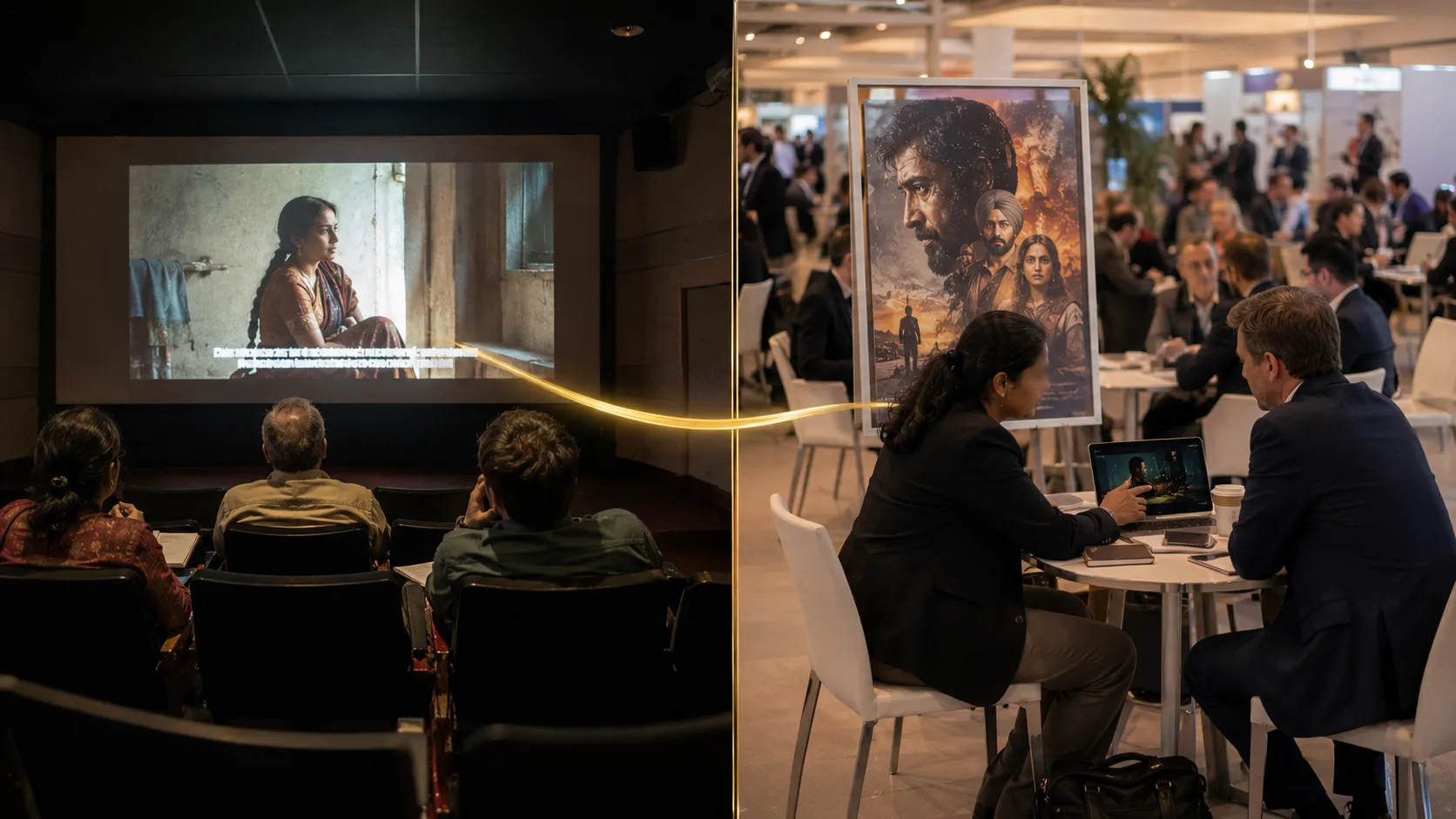
The Red Carpet Is Now a Distribution Pipeline: How Indian Indies and Regional Cinema Turned Cannes, Busan, and Sundance Into Their Most Valuable Theatrical Trailer
MUMBAI — May 29, 2026 — For most of Indian cinema's history, the international film festival was a gilded door that almost never opened. It was a place where a handful of auteurs—Satyajit Ray, Mrinal Sen, Adoor Gopalakrishnan—were celebrated by critics and ignored by audiences, where the applause of a Cannes audience was considered its own reward, and where the journey from festival premiere to commercial distribution was so rare, and so fraught, that most producers treated it as an impossibility. The festival was an honour. It was not a business.
That era ended quietly, somewhere between the Grand Prix victory of Payal Kapadia's All We Imagine as Light at Cannes in 2024 and the market premiere of Chardikala—a Punjabi‑language drama about a nurse falsely accused of a crime—at the same festival two years later. In the space of those two years, the Indian film industry has undergone a structural recalibration in its relationship with the global festival circuit. The festival is no longer a distant, aspirational destination. It is an integrated component of a film's commercial strategy—a launchpad for international distribution, a platform for market discovery, and a branding exercise that can transform a small, regionally rooted film into a globally traded asset. "This year's Cannes lineup was a testament to the fact that Indian cinema's global voice is no longer defined by Bollywood alone," a festival observer told Variety India. "The stories that are travelling—from Punjab, from Kerala, from Karnataka—are the stories that the world wants to see."
The numbers tell a quiet but unmistakable story. At the 79th Cannes Film Festival, which closed on May 23, India sent at least ten films across various sections—the Marché du Film, Critics' Week, La Cinef, Cannes Classics. Only two of those films were in Hindi. The remaining eight were in Punjabi, Malayalam, Kannada, and Gujarati. The linguistic diversity was not a coincidence. It was a reflection of a fundamental shift in how Indian regional cinema thinks about the global market—and of a growing recognition among international buyers that the most compelling Indian cinema is often being made far from the Mumbai studios that have historically dominated the global conversation.

The Busan Breakthrough
The most important festival in the history of Indian independent cinema is not Cannes. It is Busan. The South Korean festival, which was founded in 1996 and has since become the most significant film market in Asia, has been the primary launchpad for a generation of Indian regional films that would never have secured a Cannes premiere but that have found audiences—and buyers—through Busan's carefully curated sidebar programmes and its sprawling Asian Film Market.
The Busan model is instructive because it operates on a different logic from the prestige festivals of Europe. Cannes, Venice, and Berlin are, at their core, competitive festivals—their primary currency is the award, and their primary audience is the critics. Busan is a market festival—its primary currency is the distribution deal, and its primary audience is the buyers. The Indian films that premiere at Busan are not competing for Palmes. They are competing for attention—from the Japanese distributors who can place a Malayalam film in Tokyo theatres, from the European sales agents who can sell a Punjabi drama to Netflix or Amazon, from the American festival programmers who are looking for the next RRR or The Lunchbox to programme in their own sidebars.
The Busan pipeline has been particularly important for the Malayalam film industry, which has established a consistent presence at the festival over the past decade. Films like Ee.Ma.Yau (2018), Jallikattu (2019), and The Great Indian Kitchen (2021) all screened at Busan before finding international distribution, and the festival's programmers have become increasingly attentive to the Malayalam industry's output. The relationship is symbiotic: Busan gets access to some of the most critically acclaimed cinema in the world, and the Malayalam industry gets access to a global distribution infrastructure that no domestic producer could build alone. The pipeline is not yet a flood, but it is a steady, reliable stream—and the films that travel through it are generating revenue in territories that were previously inaccessible to Indian regional cinema.
The commercial returns from festival‑driven international distribution are, in most cases, modest—a few hundred thousand dollars in foreign sales, a streaming deal with a regional platform, a limited theatrical release in a handful of diaspora markets. But the returns are additive, not substitutive, and they are growing as the global appetite for Indian content expands. The Malayalam film that earns ₹30 crore domestically and an additional $500,000 in international sales is not a blockbuster, but it is a profitable enterprise—and the festival premiere is the mechanism that unlocks the international revenue. The Busan pipeline, like the Cannes pipeline, is a commercial infrastructure disguised as a cultural event, and the Indian filmmakers who understand that distinction are the ones who are using it most effectively.
The Sundance-Calcutta Connection
The Sundance Film Festival, which has been the most important launchpad for American independent cinema for four decades, has only recently begun to engage with Indian cinema in a sustained way. The reasons are partly geographical—Park City, Utah, is a long way from Mumbai or Chennai—and partly cultural: Sundance's programming sensibilities, shaped by the American independent tradition, have historically been more attuned to the social realism of Satyajit Ray than to the genre spectacles of the South Indian studios.
That is changing. The success of All We Imagine as Light—which premiered at Cannes rather than Sundance, but which drew the attention of the American independent-film community that Sundance represents—has opened the door for a new generation of Indian filmmakers who are working in the idiom that Sundance understands: intimate, auteur‑driven, formally adventurous. The documentary Writing with Fire (2021), which was nominated for an Academy Award after premiering at Sundance, demonstrated that an Indian film could use the Sundance pipeline to reach audiences that the traditional Bollywood distribution networks could not. The lesson has not been lost on the Indian documentary community, which has begun to treat Sundance as a primary commercial objective rather than a distant aspiration.
The Sundance‑to‑streaming pipeline is particularly valuable for Indian documentaries, which have almost no domestic theatrical market and which depend almost entirely on international sales for their revenue. The Indian documentary that premieres at Sundance and sells to Netflix or HBO is a viable commercial enterprise. The Indian documentary that premieres at a domestic festival and hopes for a theatrical release is, in most cases, a financial loss. The difference is the festival, and the festival is increasingly functioning as a distribution infrastructure for a category of Indian cinema that has no other infrastructure to rely on.
The Sundance connection has also been strengthened by the growing presence of the Indian diaspora in the American film industry. The programmers, producers, and executives who are shaping Sundance's engagement with Indian cinema are, in many cases, Indian‑Americans who understand both the cultural context of the films they are selecting and the commercial potential of those films in the American market. The diaspora is a bridge between the two industries, and the films that cross that bridge are the ones that are most likely to succeed on both sides of it.
The Market Function
The most significant structural change in the relationship between Indian cinema and the global festival circuit is not the increase in the number of Indian films premiering at festivals. It is the growing sophistication with which Indian producers are using those premieres as commercial tools. The festival premiere is no longer an endpoint. It is a launchpad—a mechanism for generating the international visibility, the critical validation, and the market buzz that translates into distribution deals, streaming acquisitions, and, in some cases, theatrical releases in territories that were previously inaccessible.
The market function of the festival operates on several levels. At the most basic level, a premiere at a major festival—Cannes, Venice, Berlin, Toronto, Sundance, Busan—functions as a quality signal to international buyers. The distributor in London or New York who has never heard of a particular Indian film, or a particular Indian director, will pay attention if the film has been selected by one of the world's most prestigious programming committees. The selection is a form of curation, and the curation reduces the information asymmetry that makes international distribution difficult. The buyer who acquires a Cannes‑premiered Indian film is not betting on an unknown quantity. They are betting on a film that has already been validated by the most demanding curatorial apparatus in the world.
At a more advanced level, the festival functions as a marketplace—a physical gathering of buyers, sellers, and intermediaries who conduct the business of international film distribution in the corridors, cafes, and hotel lobbies that surround the official screenings. The Marché du Film at Cannes, which runs alongside the festival, is the largest film market in the world, attracting over 12,000 industry professionals. The Asian Film Market at Busan is smaller but more focused on the specific dynamics of the Asian film industry. The Indian producers who attend these markets with their films are not merely seeking prestige. They are seeking deals—and the deals they secure are, increasingly, the difference between a film that is financially viable and a film that is not.
The Streaming Festival
The most disruptive development in the festival‑distribution pipeline has been the entry of the streaming platforms. Netflix, Amazon Prime Video, and a growing number of regional and international platforms have become the most aggressive buyers at the major festivals, acquiring films for global streaming distribution at prices that have reshaped the economics of the independent film market.
The streaming platforms have, in effect, become the festival's most important commercial partner—the buyer that can take a film from a Cannes premiere to a global audience of hundreds of millions within weeks. The model has been particularly valuable for Indian regional cinema, which has historically struggled to secure international theatrical distribution. A Malayalam film that premieres at Busan and is acquired by Amazon Prime Video for global streaming can reach audiences in 240 countries—audiences that no theatrical distributor could ever reach. The streaming acquisition is, in many cases, the most significant revenue source for the film, and the festival premiere is the mechanism that unlocks it.
The streaming‑festival nexus has also changed the calculus for Indian producers. The producer who secures a festival premiere and a streaming acquisition has, in effect, pre‑sold the film's international revenue before its domestic release. The festival is no longer a promotional expense. It is a revenue‑generating event—a sales call disguised as a cultural occasion. The producer who understands this dynamic can structure their film's financing around the festival premiere, using the anticipated streaming revenue as collateral for production loans and the anticipated festival visibility as a marketing asset for the domestic release. The model is not yet standard practice in India, but it is becoming so, and the producers who adopt it earliest will have a structural advantage over those who do not.
The streaming platforms have also changed the types of Indian films that get made. The platform that acquires a dozen Indian films at festivals every year is, in effect, commissioning those films indirectly—signalling to the market that there is demand for a particular type of content, and that the producers who supply that content will find a buyer. The signal has been particularly strong for the regional‑language, auteur‑driven, formally adventurous films that have historically been the most difficult to finance in the Indian market. The streaming platforms have become, in this sense, a de‑facto development fund for Indian independent cinema—a source of capital that did not exist a decade ago, and that has already begun to reshape the creative landscape of the industry.
The Payal Kapadia Effect
The most consequential Indian film of the past decade, from the perspective of the festival‑distribution pipeline, is not a blockbuster. It is Payal Kapadia's All We Imagine as Light, which won the Grand Prix at Cannes in 2024—the first Indian film to win a major prize at the festival in three decades. The film did not merely demonstrate that an Indian filmmaker could compete at the highest level of global cinema. It demonstrated that a festival prize could transform a film's commercial trajectory.
The Kapadia effect is visible in the programming decisions of every major festival. The Indian films that are being selected for Cannes, Venice, Berlin, Toronto, and Busan are, increasingly, films that share certain characteristics with All We Imagine as Light: they are made by emerging directors, they are rooted in specific regional and cultural contexts, they are formally ambitious, and they are produced on modest budgets that allow them to be profitable at a relatively low level of commercial return. The festivals are not merely selecting these films because they are good. They are selecting them because Kapadia's success has demonstrated that there is a global audience for this kind of Indian cinema—and that the festival that discovers the next Kapadia will be rewarded with the same kind of attention that Cannes received for discovering the first one.
The Kapadia effect has also changed the career calculus for Indian filmmakers. The director who wins a major prize at a major festival is not merely honoured. They are launched—into a global ecosystem of agents, managers, producers, and financiers who can turn their next film into a much larger enterprise. Kapadia's Critics' Week jury presidency at Cannes 2026—announced just weeks before the festival—is a measure of how far a festival prize can take an Indian filmmaker, and the filmmakers who are now competing for those prizes understand that the stakes are higher than they have ever been. The festival is no longer a gilded door. It is a launchpad, and the filmmakers who launch from it most successfully will be the ones who treat it as such.
What This Signals
The transformation of the film festival from a cultural event into a commercial infrastructure is not unique to Indian cinema. It is a global phenomenon, driven by the same forces that are reshaping the rest of the entertainment industry: the decline of traditional distribution, the rise of streaming, and the growing importance of curation in a world of infinite content. The festival has become the new theatrical trailer—the mechanism through which a film announces itself to the world, establishes its cultural and commercial credibility, and attracts the buyers who will determine its financial fate.
The Indian films that are using the festival pipeline most effectively are not the blockbusters. They are the indies, the regional dramas, the documentaries—films that are too small, too specific, and too culturally rooted to succeed through the traditional Bollywood distribution model, but that are perfectly suited to the globalised, curated, streaming‑enabled festival marketplace. The Punjabi film that premieres at Cannes and sells to Amazon. The Malayalam documentary that premieres at Sundance and gets an Oscar nomination. The Kannada period epic that premieres at Busan and secures distribution in forty territories. These are not anomalies. They are the leading edge of a structural shift, and the filmmakers who understand that shift are building careers that their predecessors could not have imagined.
The red carpet is now a distribution pipeline. The applause is now a price signal. The festival is now a business. And the Indian films that are walking that carpet, hearing that applause, and doing that business are proving, year by year, that the gilded door is finally open—and that the people walking through it are not the ones anyone expected.


