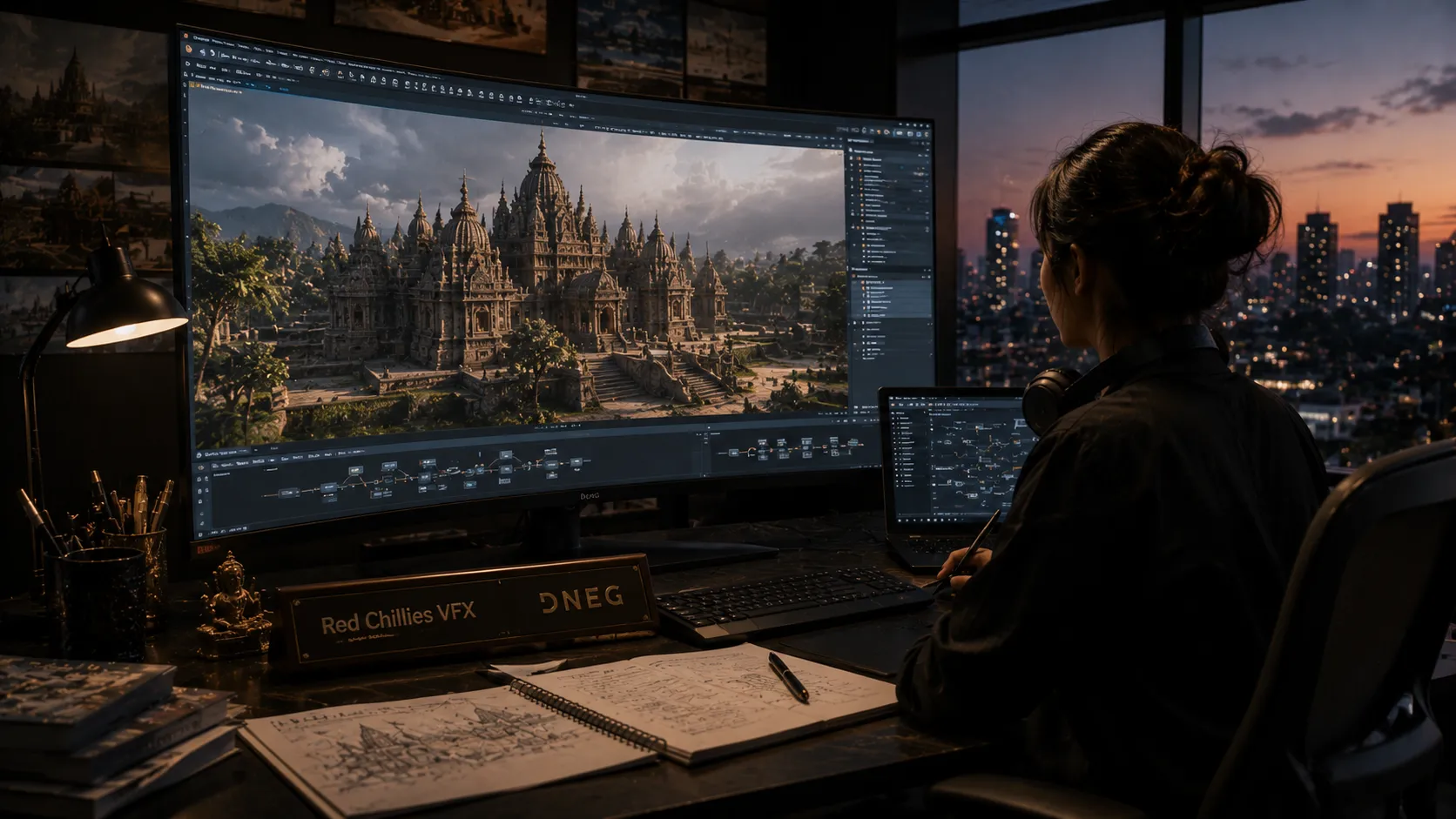
The Pixel War: How Shah Rukh Khan and Ranbir Kapoor Are Building Competing VFX Empires—And Why the Future of Indian Cinema Will Be Rendered, Not Filmed
MUMBAI — May 29, 2026 — Sometime in the summer of 2025, two conversations took place in two different corners of the Indian film industry, neither of which was reported in the press, and both of which, in retrospect, will be understood as the opening moves in a battle that will define the visual language of Indian cinema for a generation. In the first conversation, Shah Rukh Khan met with the leadership team of Red Chillies VFX, the visual‑effects division of his production company, and approved a ₹300 crore expansion plan that would more than double the studio's capacity—adding new motion‑capture stages, expanding its team of artists, and investing in the proprietary rendering technology that had already made Red Chillies one of the most respected VFX houses in Asia. In the second conversation, Ranbir Kapoor met with the leadership of DNEG India, the Indian arm of the London‑headquartered visual‑effects giant that has won seven Academy Awards for its work on films like Dune, Tenet, and Blade Runner 2049. Ranbir, who had quietly acquired a substantial stake in DNEG India over the preceding two years, approved a plan to position the studio as the primary VFX partner for Ramayana, the ₹4,000 crore epic in which he also stars as Lord Ram, and to compete directly with Red Chillies for the most technically demanding projects in the Indian pipeline.
The two conversations were separate, but they were about the same thing. The future of Indian cinema—the Ramayanas, the Kalkis, the Dhurandhars, the Kantaras—will not be filmed. It will be rendered. The battle sequences, the mythical creatures, the ancient cities, the interstellar spacecraft: all of them will be built, frame by painstaking frame, by the visual‑effects artists who sit in the air‑conditioned studios of Mumbai, Bengaluru, and Hyderabad, and who represent the fastest‑growing segment of the Indian film industry's workforce. The studios that control the most advanced VFX capabilities will control the creative and commercial direction of the industry. And the two men who have recognised this earlier than anyone else—the star who has spent his career building institutions, and the star who is only now beginning to build his—are racing to assemble the infrastructure that will determine who wins the pixel war.
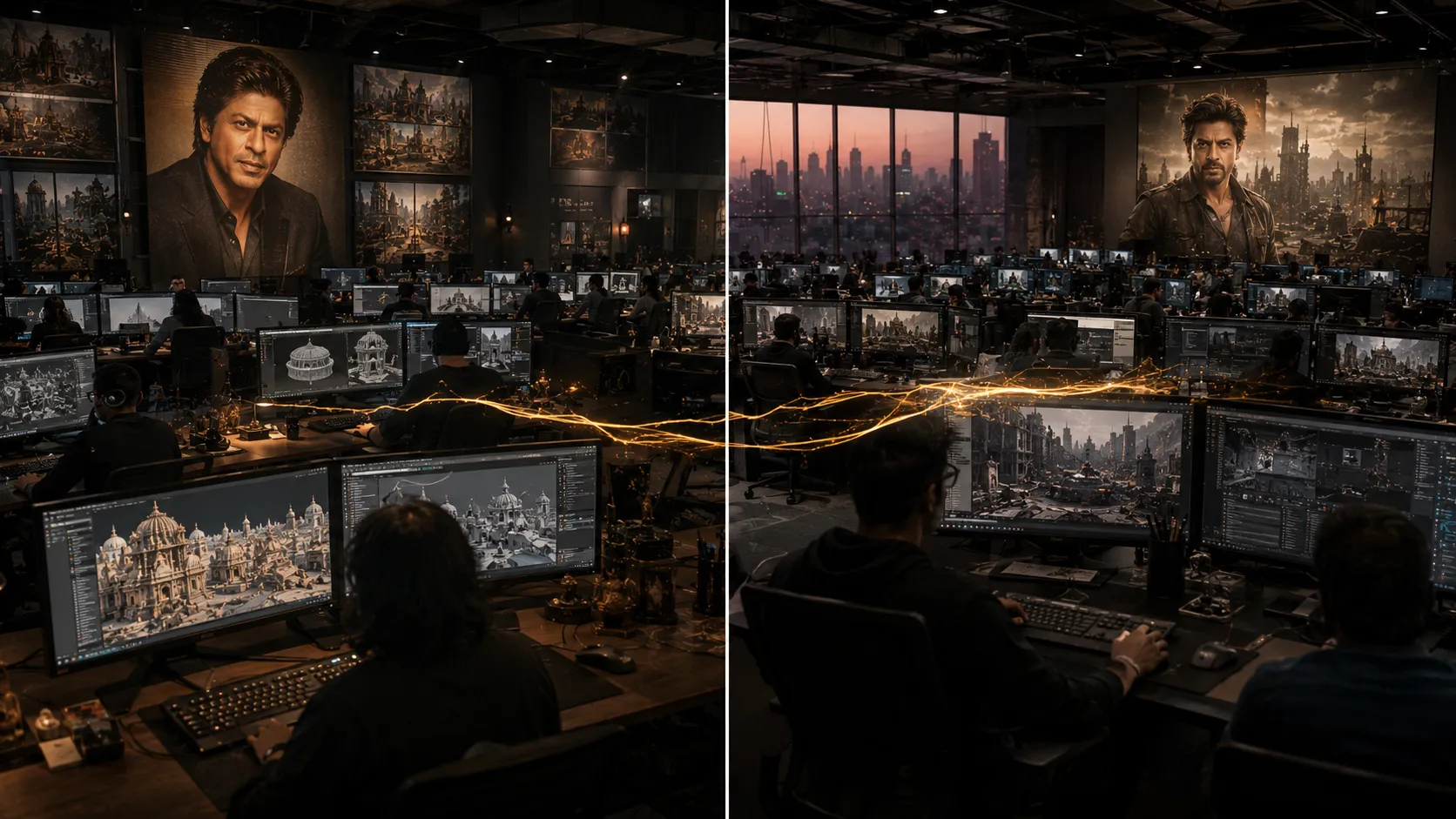
The Red Chillies Foundation
Red Chillies VFX was not built to win an arms race. It was built, like many of the most successful enterprises in the Indian film industry, to solve a problem that no one else could solve. In the early 2000s, Shah Rukh Khan was producing and starring in films that required visual effects—Ra.One, his ambitious but commercially disappointing superhero film, was the most VFX‑intensive Indian production of its era—and the Indian VFX industry was not equipped to handle the demands of those projects at a standard that SRK considered acceptable. The international VFX houses that serviced Hollywood productions were expensive, difficult to schedule, and culturally distant from the specific demands of Indian storytelling. The only solution was to build the capability himself.
The VFX division of Red Chillies Entertainment was founded in 2006, with a small team of artists working out of a converted warehouse in Mumbai's Andheri district. The studio's early work—on SRK's own films, on YRF productions, on a growing roster of Bollywood projects—was solid but unremarkable. The breakthrough came with Ra.One (2011), which, despite its commercial disappointment, represented a step‑change in the ambition and technical sophistication of Indian visual effects. The studio's work on the film—the digital double of SRK, the virtual Mumbai that served as the film's climactic setting, the complex particle effects of the superhero's powers—demonstrated that an Indian VFX house could produce work that was competitive with the mid‑tier international studios, if not yet with the industry leaders.
The second breakthrough came with the Krrish franchise and a series of YRF productions that required increasingly complex visual effects, but it was the pandemic that truly transformed Red Chillies. As international productions ground to a halt and Indian filmmakers found themselves unable to access the global VFX talent pool, the demand for domestic visual‑effects capability surged. Red Chillies invested heavily during this period—hiring aggressively, acquiring new rendering hardware, and developing proprietary tools that reduced the studio's dependence on third‑party software licences. By the time the pandemic subsided, Red Chillies had established itself as the leading VFX house in India, with a team of over 800 artists, a state‑of‑the‑art facility, and a client list that included every major Indian studio and several international productions.
The ₹300 crore expansion approved in 2025 is the logical next step. The expansion will add new motion‑capture stages, increasing the studio's capacity for performance‑driven visual effects—the kind of work that is essential for the superhero films, mythological epics, and science‑fiction spectacles that dominate the Indian production pipeline. It will expand the studio's team, which is already one of the largest VFX workforces in Asia. And it will invest in the proprietary rendering technology that has become Red Chillies' most significant competitive advantage: a suite of tools that allow the studio's artists to produce photorealistic environments, digital characters, and complex simulations more efficiently than the off‑the‑shelf software that most of its competitors rely on. The proprietary technology is the moat. The competitors who rely on third‑party software—the same software that is available to every other VFX house in the world—cannot match the efficiency, or the quality, that Red Chillies achieves with its own tools. The expansion is designed to widen that moat, and to ensure that Red Chillies remains the default VFX partner for the largest Indian productions for the foreseeable future.
The DNEG India Gambit
If Red Chillies represents the organic, build‑from‑scratch approach to VFX dominance, Ranbir Kapoor's investment in DNEG India represents the acquisition‑driven, partner‑with‑the‑best approach. The two strategies are fundamentally different, and the competition between them is the most revealing dynamic in the Indian VFX industry.
DNEG is not an Indian company. It is a London‑headquartered visual‑effects and animation studio that is one of the most respected in the world, with a client list that includes every major Hollywood studio and a trophy case that includes seven Academy Awards for Best Visual Effects. DNEG's Indian arm, based in Bengaluru with additional facilities in Mumbai and Chennai, was established primarily as a cost‑effective production base for the studio's Hollywood work—a way of accessing India's deep pool of technical talent at a fraction of the cost of the studio's London and Vancouver operations. For years, DNEG India was essentially an outsourced production facility, executing work that was designed and supervised from abroad.
Ranbir Kapoor's investment changed that calculus. The actor, who is not known as a business tycoon in the mould of Shah Rukh Khan, began acquiring a stake in DNEG India in the early 2020s, through a combination of personal investment and partnerships with financial backers. The stake, whose exact size has not been disclosed but which is understood to be substantial, gave Ranbir a voice in the studio's strategic direction—and he used that voice to pivot DNEG India toward the domestic market. The studio that had once served primarily as an outsourced production base for Hollywood began bidding for Indian projects—Ramayana, Pralay, the growing slate of VFX‑intensive Indian productions that Red Chillies had previously dominated.
The DNEG India advantage is twofold. First, the studio has access to DNEG's global technology platform—the proprietary tools, the rendering infrastructure, the R&D pipeline—that no Indian VFX house can replicate. The artist in Bengaluru who works on Ramayana is using the same software, the same workflows, and the same quality‑assurance processes as the artist in London who works on Dune. The technology transfer is not theoretical. It is operational, and it gives DNEG India a quality ceiling that its domestic competitors cannot match.
Second, DNEG India has access to DNEG's global talent pool. The studio can bring in senior supervisors, technical directors, and creative leads from its London, Vancouver, and Montreal offices to work on Indian projects, transferring knowledge and raising the quality of the local workforce. The Indian VFX industry's single greatest constraint is not hardware or software. It is talent—specifically, the senior creative talent that can supervise complex visual‑effects sequences and deliver work at a standard that meets the expectations of global audiences. DNEG India's ability to supplement its local workforce with international talent is a structural advantage that Red Chillies, for all its investment, cannot easily replicate.
The Ramayana partnership is the most significant expression of the DNEG India gambit to date. The film's visual effects—the ancient cities, the mythological creatures, the epic battle sequences—are among the most complex ever attempted in Indian cinema, and the producers' decision to partner with DNEG India rather than Red Chillies was a deliberate strategic choice. It signalled that the Ramayana team believed that DNEG's global technology platform, its international talent pool, and its track record of delivering Hollywood‑quality visual effects were essential to the film's success—and that Red Chillies, for all its domestic dominance, could not match those capabilities. The decision was a blow to Red Chillies, which had expected to be the primary VFX partner on the most important Indian film in a generation. It was also a signal to the rest of the industry that the VFX arms race was not merely a competition between two studios. It was a competition between two fundamentally different models of how to build a visual‑effects business—and the Ramayana team had voted for the global‑partnership model over the domestic‑build model.
The Talent War
The single most important variable in the VFX arms race is not technology. It is people. The visual‑effects artist who can build a photorealistic digital environment, or animate a convincing digital character, or simulate the physics of an exploding building—that artist is one of the most sought‑after professionals in the global entertainment industry. The Indian VFX workforce, which is among the largest in the world, is also among the most mobile: the artist who is trained in Mumbai can work in London, Vancouver, or Sydney with equal ease, and the global demand for VFX talent has created a seller's market in which the studios that can offer the best compensation, the most interesting projects, and the most advanced technology are the ones that attract and retain the best people.
The talent war between Red Chillies and DNEG India is intensifying. Red Chillies, with its ₹300 crore expansion, its proprietary technology, and its dominant position in the domestic market, can offer Indian VFX artists a career path that does not require them to leave the country. The artist who works at Red Chillies can contribute to the largest Indian productions, work with the most advanced tools in the domestic industry, and build a career without ever needing to emigrate. DNEG India, with its global technology platform and its international talent pool, can offer Indian VFX artists something that Red Chillies cannot: the opportunity to work on Hollywood productions, to learn from the best supervisors in the world, and to build a career that can take them to London, Vancouver, or Los Angeles. The two value propositions are fundamentally different, and the artists who are choosing between them are making decisions that will shape the Indian VFX industry for a generation.
The talent war is also being fought in the educational institutions that produce the next generation of VFX artists. Red Chillies has established partnerships with several of India's leading film schools and technical institutes, offering internships, training programmes, and a direct pipeline from the classroom to the studio floor. DNEG India has done the same, leveraging its global brand to attract students who aspire to work on Hollywood productions. The competition for talent begins long before the artist is hired. It begins in the classroom, and the studios that are investing most heavily in education and training are the ones that will have the deepest talent pools in the years to come.
The Ramayana Test
The most important project in the Indian VFX industry's history is Ramayana. Not because it is the most expensive Indian film ever made—though it is—but because it is the first Indian production that demands visual effects at a standard that is genuinely competitive with the best that Hollywood can produce. The ancient cities of Ayodhya and Lanka, the mythological creatures, the divine interventions, the epic battle sequences—each of these requires a level of photorealistic rendering, physical simulation, and artistic imagination that no Indian VFX house has ever been asked to deliver at this scale. The success or failure of the Ramayana VFX will determine the trajectory of the Indian VFX industry for the next decade. If DNEG India delivers work that meets the expectations of global audiences—work that is comparable to the visual effects in Dune, Avatar, or The Lord of the Rings—the Indian industry will have demonstrated that it can compete at the highest level of global visual‑effects production. If the VFX is disappointing, the damage to the film—and to the reputation of the Indian VFX industry—will be severe.
The stakes are not merely commercial. They are cultural. The Ramayana is, for hundreds of millions of Indians, not just a story. It is a sacred text, and the visual representation of its characters, its settings, and its events carries a weight that no fictional universe can match. The VFX artists who render Lord Ram, Sita, Hanuman, and Ravana are not merely creating entertainment. They are engaging with a religious and cultural tradition that extends back thousands of years, and the quality of their work—the beauty, the dignity, the authenticity of the images they create—will be judged by an audience that is not merely watching a film, but participating in an act of devotion. The pressure on the VFX teams is extraordinary, and the outcome of their work will be scrutinised with an intensity that no Hollywood production has ever faced.
The Ramayana test is, in this sense, a test of the entire Indian VFX industry. The film's producers chose DNEG India as their primary VFX partner, but the work is being executed by a combination of DNEG's global team, DNEG India's local workforce, and a network of Indian VFX vendors who are contributing to specific sequences. The film's success or failure will reflect not just on a single studio, but on the entire ecosystem. If the VFX is spectacular, the Indian industry will have proven that it can compete with the best in the world, and the pipeline of international projects that will follow—from Hollywood studios, from streaming platforms, from the growing global market for visual‑effects services—will be enormous. If the VFX is disappointing, the damage to the industry's reputation will take years to repair. The pixel war is not merely a competition between two studios. It is a competition for the future of Indian visual effects—and the Ramayana test is the examination that will determine whether the industry passes or fails.
The AI Disruption
The most uncertain variable in the VFX arms race is artificial intelligence. The same AI models that are transforming the software industry—generative AI for image creation, machine learning for rotoscoping and compositing, neural rendering for photorealistic environment generation—are now being applied to visual effects, and their impact on the industry is likely to be transformative.
The AI‑powered VFX tools that are currently in development will, within the next several years, be capable of automating many of the most labour‑intensive tasks that currently consume the majority of a VFX artist's time. Rotoscoping—the painstaking process of tracing around objects in a frame, frame by frame, to separate them from the background—will be handled by machine‑learning algorithms that can perform the task in minutes rather than weeks. Digital matte painting—the creation of photorealistic background environments—will be accelerated by generative AI models that can produce hundreds of variations in seconds. The AI disruption will not eliminate the need for human VFX artists, but it will fundamentally change the nature of their work. The artist who once spent weeks on a single rotoscoping task will spend that time on creative decisions—designing the look of a creature, composing a shot, refining the emotional expression of a digital character.
The AI disruption will also change the economics of the VFX industry. The studio that can automate the most labour‑intensive tasks will have a cost advantage that its competitors cannot match—and the savings will be passed on to the filmmakers who commission the work. The cost of producing a VFX‑intensive film will decline, the volume of VFX‑intensive films will increase, and the demand for the creative VFX artists who remain essential to the process will rise. The AI disruption is not a threat to the VFX industry. It is an opportunity—and the studios that are investing most heavily in AI‑powered tools, including Red Chillies and DNEG, are the ones that will be best positioned to capture the value that the disruption creates.
What This Signals
The pixel war between Red Chillies and DNEG India is not primarily a story about two studios. It is a story about the structural transformation of the Indian film industry—a shift from an era in which visual effects were an afterthought, a post‑production expense to be managed and minimised, to an era in which visual effects are the foundation of the industry's most valuable productions, the engine of its global competitiveness, and the primary driver of its creative evolution.
The stars who are building VFX empires today—Shah Rukh Khan and Ranbir Kapoor—are not merely diversifying their business interests. They are positioning themselves at the centre of the most important industrial transformation in the history of Indian cinema. The studio that controls the most advanced VFX capabilities will attract the most ambitious projects, command the highest margins, and shape the visual language of the films that define Indian culture for a generation. The Ramayana test will determine whether the domestic‑build model (Red Chillies) or the global‑partnership model (DNEG India) is the more effective strategy for achieving that control. The outcome of the test is uncertain. The stakes are not. The future of Indian cinema will be rendered, not filmed. The pixel war has only just begun.


