The Physicist Who Quit IBM to Build India's First Quantum Computer: How Dr. Nagendra Nagaraja Is Racing to Take His 25-Qubit Machine Public—Before the Americans and Chinese Lock Up the Market
BENGALURU — May 25, 2026 — In 2019, Dr. Nagendra Nagaraja was a senior quantum scientist at IBM Research, working on some of the world's most advanced superconducting quantum processors at the company's Thomas J. Watson Research Center in Yorktown Heights, New York. He had a comfortable salary, a prestigious position, and a front-row seat to the development of the hardware that would eventually power the world's largest quantum computing network. He was exactly where any ambitious quantum physicist would want to be—and he was restless. The machines he was building would be deployed everywhere except the country he came from. India, with its deep pool of scientific talent and its virtually nonexistent quantum hardware industry, was invisible in the quantum computing revolution. Nagaraja could not change that from Yorktown Heights. So he quit.
Later that year, he founded QpiAI in Bengaluru with a thesis that was either visionary or delusional, depending on whom you asked. He would build a full-stack quantum computing company—hardware, software, and applications—in a country that had never produced a single commercial quantum processor, that had no quantum fabrication infrastructure, and that most global quantum investors considered too risky to bet on. He would do it by generating revenue from day one, building a quantum software and consulting business that could fund the hardware development, rather than burning venture capital on an unproven research programme. And he would eventually build a 25-qubit superconducting quantum processor—not a prototype, but a machine that could run commercial workloads and be sold to customers. The timeline was longer than a venture capitalist's patience. The ambition was larger than any Indian quantum startup had ever attempted.
Six years later, the thesis is holding. QpiAI has generated approximately ₹35 crore in revenue before raising its first external funding—a rarity in the quantum computing industry, where most companies have burned hundreds of millions of dollars without ever selling a product. It has built a superconducting quantum processing unit at 25 qubits, with a roadmap to scale to 1,000 qubits over the next five years. It is preparing to raise a ₹500 crore pre-IPO round and target a public listing within two years, which would make it India's first publicly traded quantum computing company. And it is backed by YourNest Venture Capital, SIDBI, and a roster of angel investors who believe that the quantum computing market—projected to reach $65 billion by 2030—cannot be captured entirely by the American and Chinese giants who currently dominate it.
The Revenue-First Quantum Startup
The most strategically significant decision Nagaraja made when founding QpiAI was not a technical architecture choice. It was a business model decision that would define the company's trajectory and distinguish it from almost every other quantum startup in the world.
Most quantum computing companies—including the most prominent, such as Rigetti, IonQ, and D-Wave—have followed a familiar venture-capital playbook: raise large amounts of capital, invest heavily in hardware R&D, and hope that the technology matures before the money runs out. The model has produced remarkable scientific progress and equally remarkable financial losses. Rigetti, which went public in 2022 via a SPAC merger, has seen its stock price decline sharply as losses mounted and revenue disappointed. IonQ, the most prominent trapped-ion quantum company, has fared better, but remains deeply unprofitable. The quantum computing industry, for all its promise, has yet to produce a company that generates significant revenue, let alone profit.
QpiAI inverts the model. From its founding, the company has generated revenue by building quantum software and AI solutions for enterprise customers—simulation, optimisation, and machine learning applications that can run on classical computing infrastructure while the quantum hardware matures. The company's QpiAI Pro platform provides quantum-inspired algorithms that can be deployed today, solving problems in logistics, finance, materials science, and drug discovery that are beyond the reach of conventional computing. The platform does not require a quantum processor to run—it uses classical hardware, accelerated by quantum-inspired mathematical techniques—which means it can generate revenue while the company's quantum hardware team continues its development. The revenue, in turn, funds the hardware programme, reducing the company's dependence on external capital and giving it a longer runway than competitors that are burning venture funding on unproven technology.
The model has worked well enough that QpiAI generated approximately ₹35 crore in revenue before raising its first external funding round—a milestone that is almost unheard of in the quantum computing industry. The company is now preparing to raise a ₹500 crore pre-IPO round, which would give it the capital to scale its hardware programme and expand its software business simultaneously. The target is a public listing within two years, which would make QpiAI the first Indian quantum computing company to list on the stock market—and one of only a handful of publicly traded quantum companies in the world.
The financial discipline reflects Nagaraja's background at IBM, where he learned that the most successful technology companies are built not on promises, but on products that customers will pay for. The QpiAI Pro platform has attracted a growing roster of enterprise clients, including banks, pharmaceutical companies, and logistics firms, who need to solve complex optimisation and simulation problems today—not in five years, when the quantum hardware might be ready. The platform is not a placeholder for the company's quantum ambitions. It is a business in its own right, and it generates the cash flow that makes the quantum ambitions sustainable.
The 25-Qubit Machine
The hardware programme that the software business is funding is, by any standard, ambitious. QpiAI has built a superconducting quantum processing unit at 25 qubits—a scale that is modest by comparison with the 1,000-plus qubit machines that IBM and Google have demonstrated, but significant for a company that has raised a fraction of the capital those giants have deployed.
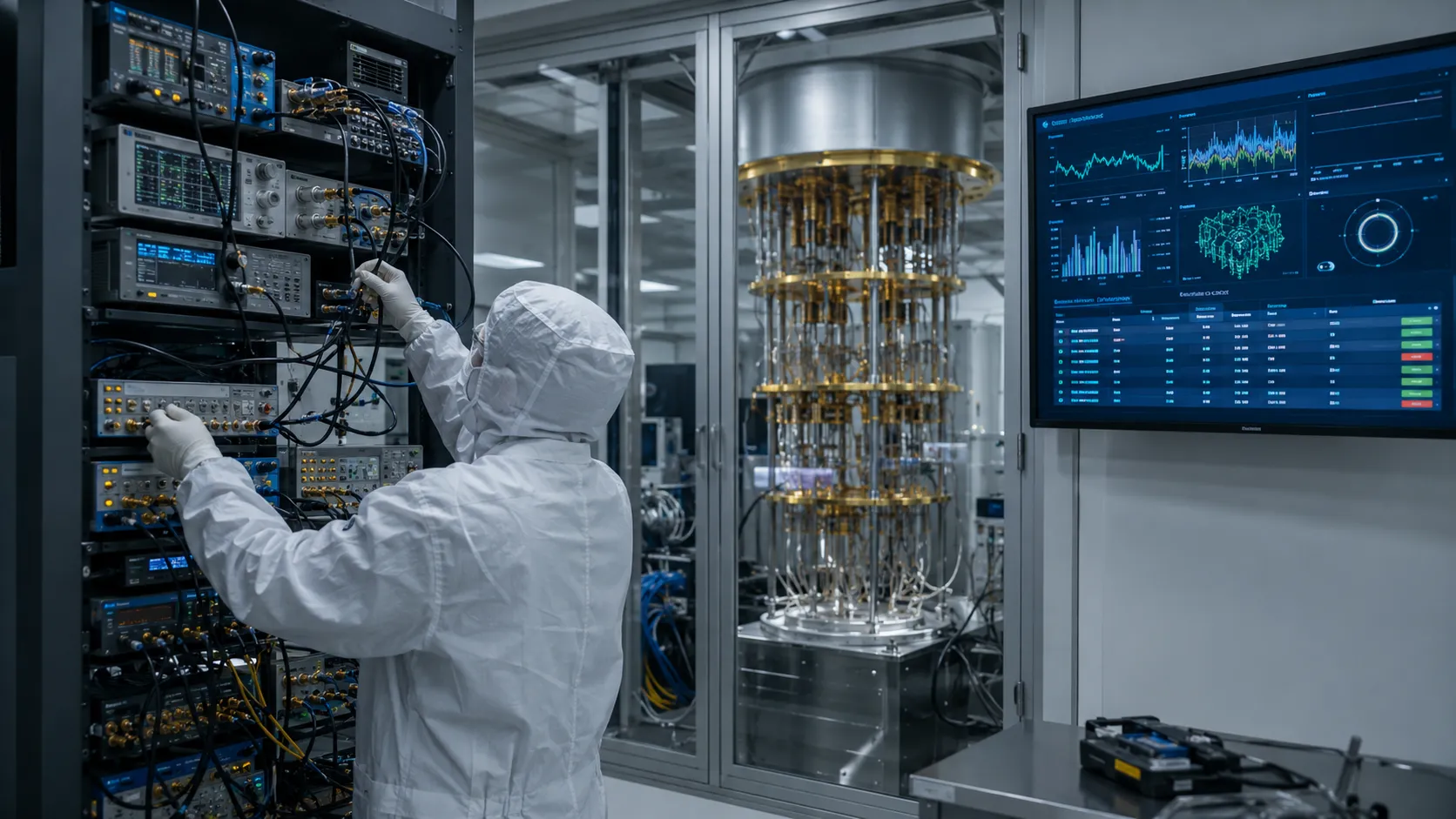
The machine is a superconducting quantum processor—the same architecture pursued by IBM, Google, and China's Zuchongzhi series—and it operates at millikelvin temperatures inside a dilution refrigerator. The processor is designed, fabricated, and tested in Bengaluru, making it one of the first superconducting quantum processors built entirely in India. The fabrication is done in partnership with Indian research institutions, and the company has invested in the cleanroom infrastructure, the cryogenic systems, and the control electronics required to operate a quantum processor at industrial scale.
The 25-qubit milestone is not, in itself, a commercial product. It is a technology demonstrator—proof that the company can build, calibrate, and operate a working quantum processor, and that it has the talent and the infrastructure to scale. The roadmap calls for scaling to 1,000 qubits over the next five years, a target that would place QpiAI among the leading quantum hardware companies in the world. The scaling will require significant capital—the ₹500 crore pre-IPO round is intended to fund the next phase of the hardware programme—and it will require solving the same error-correction, coherence, and control challenges that have bedevilled every quantum hardware company in the world.
The company's approach to these challenges is pragmatic. Nagaraja has been deliberate about not promising a fault-tolerant quantum computer on a specific timeline. "The quantum computing industry is at a tipping point," he told a business publication. "The hardware is maturing, the algorithms are being developed, and the commercial applications are beginning to emerge." The statement is careful—it acknowledges the progress without overpromising on the delivery date. The quantum computing industry has a long history of ambitious timelines that were missed, and Nagaraja has been determined not to join that list.
The company's technology stack is full-stack, spanning hardware, software, and applications. The QpiAI Pro platform provides the software layer, offering quantum-inspired algorithms that can run on classical hardware today and transition to quantum hardware as it becomes available. The QpiAI QDK (Quantum Development Kit) provides tools for developers to build and test quantum algorithms on simulators. The QpiAI Cloud platform will eventually provide remote access to the company's quantum processors, following the model established by IBM's Quantum Experience and Amazon's Braket. The full-stack approach is capital-intensive, but it creates a moat: a competitor cannot simply replicate QpiAI's hardware without also building the software ecosystem, or vice versa. The platform effect, once established, is difficult to breach.
The Quantum Geopolitics
The QpiAI story is not primarily about a startup building a quantum computer. It is about a country that missed the semiconductor revolution and is determined not to miss the quantum one. Nagaraja has been explicit about this framing, and it is the reason the company's investors have been willing to back a technology that most venture capitalists consider too risky, too long-term, and too capital-intensive for the Indian market.
The global quantum computing industry is in the early stages of a geopolitical alignment that mirrors the semiconductor industry of the 1980s and 1990s. The United States, through the CHIPS Act and the National Quantum Initiative, has poured billions of dollars into quantum research, and American companies—IBM, Google, IonQ, Rigetti—dominate the public conversation about quantum computing. China has made quantum computing a strategic priority under its 14th Five-Year Plan, and Chinese researchers have demonstrated quantum computational advantage on two separate hardware platforms—photonic and superconducting. The European Union has funded a €1 billion Quantum Flagship programme. India, with its deep pool of scientific talent and its growing technology economy, has been largely absent from this race. The country has no commercial quantum processor, no quantum fabrication infrastructure, and no publicly traded quantum company. The quantum computing industry is being built without Indian participation.
Nagaraja's ambition is to change that. "We did not participate in the semiconductor revolution," he has said. "We cannot make the same mistake with quantum." The statement is both a business case and a geopolitical argument. India's absence from the semiconductor industry has cost the country dearly—in lost economic value, in strategic vulnerability, and in the simple, cumulative effect of not being part of the most important technology platform of the late 20th and early 21st centuries. The quantum computing industry, which is still in its infancy, represents an opportunity to participate from the beginning—to build a domestic industry that can compete with the American and Chinese giants, rather than depending on them for a critical technology.
The Indian government has begun to recognise the opportunity. The National Quantum Mission, approved in 2023 with a budget of ₹6,000 crore, aims to build a 1,000-qubit quantum computer within eight years and to develop quantum communication, quantum sensing, and quantum materials capabilities. The mission is ambitious, but it is primarily focused on academic research and government laboratories, not on the kind of venture-backed, commercially oriented quantum startups that have driven the industry's growth in the United States. QpiAI is the closest thing India has to a Rigetti or an IonQ—a company that is building quantum hardware, generating revenue from quantum software, and preparing to access the public markets. The ₹500 crore pre-IPO round and the planned public listing are designed to give the company the capital to scale, and to give Indian investors a way to participate in the quantum computing industry.
The IPO Thesis
The decision to target a public listing within two years is unusual for a quantum computing company. Most quantum startups have either stayed private—raising ever-larger venture rounds to fund their hardware programmes—or gone public through SPAC mergers that have produced disappointing returns for investors. The public markets have been sceptical of quantum computing companies, which have historically generated minimal revenue and enormous losses.
QpiAI's argument is that it is different. The company has a revenue-generating software business that is growing and that funds the hardware programme. The ₹35 crore in pre-funding revenue is not large by the standards of public companies, but it is significant by the standards of quantum startups, most of which have never sold a product. The company's full-stack approach—hardware, software, and applications—creates a platform effect that is difficult for competitors to replicate. And the company is operating in a market—India—that is large, underserved, and strategically important, with a government that is increasingly willing to fund quantum technology development.
The IPO thesis is that the Indian public markets, which have demonstrated an appetite for technology companies over the past two years, will be willing to value QpiAI at a premium that reflects its scarcity value—the only pure-play quantum computing company listed in India, in a market that is projected to reach $65 billion globally by 2030. The ₹500 crore pre-IPO round is designed to bridge the company to the public markets, providing the capital to scale the hardware programme and expand the software business before the listing.
The risks are considerable. The quantum computing industry is still in its early stages, and the timeline to commercial viability remains uncertain. The company's 25-qubit processor is a technology demonstrator, not a commercial product, and scaling to 1,000 qubits will require solving engineering challenges that have defeated larger, better-funded companies. The competitive landscape is intensifying, with American and Chinese companies investing billions in quantum hardware development. The Indian public markets have historically been sceptical of unprofitable technology companies, and QpiAI will need to demonstrate a credible path to profitability before investors will value it at the multiples it is seeking.
But the opportunity is equally large. If QpiAI can execute on its roadmap—scale the hardware to 1,000 qubits, expand the software business, and go public as India's first quantum computing company—it will have a market position that is difficult for competitors to dislodge. The first quantum computing company to list in India will have a brand, a balance sheet, and a public-market currency that its private competitors will lack. The race is not over. It is just beginning.
What This Signals
The QpiAI story is not primarily about a quantum computing startup. It is about India's attempt to avoid repeating the mistake it made with semiconductors—the strategic blunder of missing the most important technology platform of the late 20th century, and of remaining dependent on foreign suppliers for a critical technology that underpins every dimension of the modern economy.
India missed the semiconductor revolution. The country was too poor, too inward-looking, and too focused on import substitution to build a domestic chip industry when the industry was being born. The cost of that failure has been enormous—measured in the billions of dollars spent on imported chips, in the strategic vulnerability exposed by every supply-chain disruption, and in the simple, cumulative effect of not being part of the most important technology ecosystem of the past fifty years.
The quantum computing industry is at the same stage today that the semiconductor industry was at in the 1970s: the hardware is maturing, the applications are being developed, and the commercial opportunities are beginning to emerge. The countries and companies that establish leadership now will capture a disproportionate share of the value the industry creates over the next fifty years. India's National Quantum Mission is a recognition of that opportunity, and QpiAI is the most credible private-sector expression of it.
Dr. Nagendra Nagaraja is no longer the IBM scientist building quantum processors for someone else. He is the founder of India's most ambitious quantum computing company, the architect of a business model that has generated revenue while building hardware, and the leader of a team that is racing to build a 1,000-qubit machine before the Americans and Chinese lock up the market. The 25-qubit processor in the Bengaluru laboratory is not a threat to IBM's 1,121-qubit Condor chip or Google's 1,000-qubit Willow. But it is a proof of concept—evidence that a company built in India, by Indian engineers, with Indian capital, can build a working quantum processor. The 1,000-qubit target is ambitious. The ₹500 crore pre-IPO round is the fuel. The IPO is the destination. The country that missed the semiconductor revolution is determined not to miss the quantum one. The machine in Bengaluru is the first step.


