The Photon, the Quantum Dot, and the 270-Meter Miracle That Just Brought the Quantum Internet One Giant Leap Closer
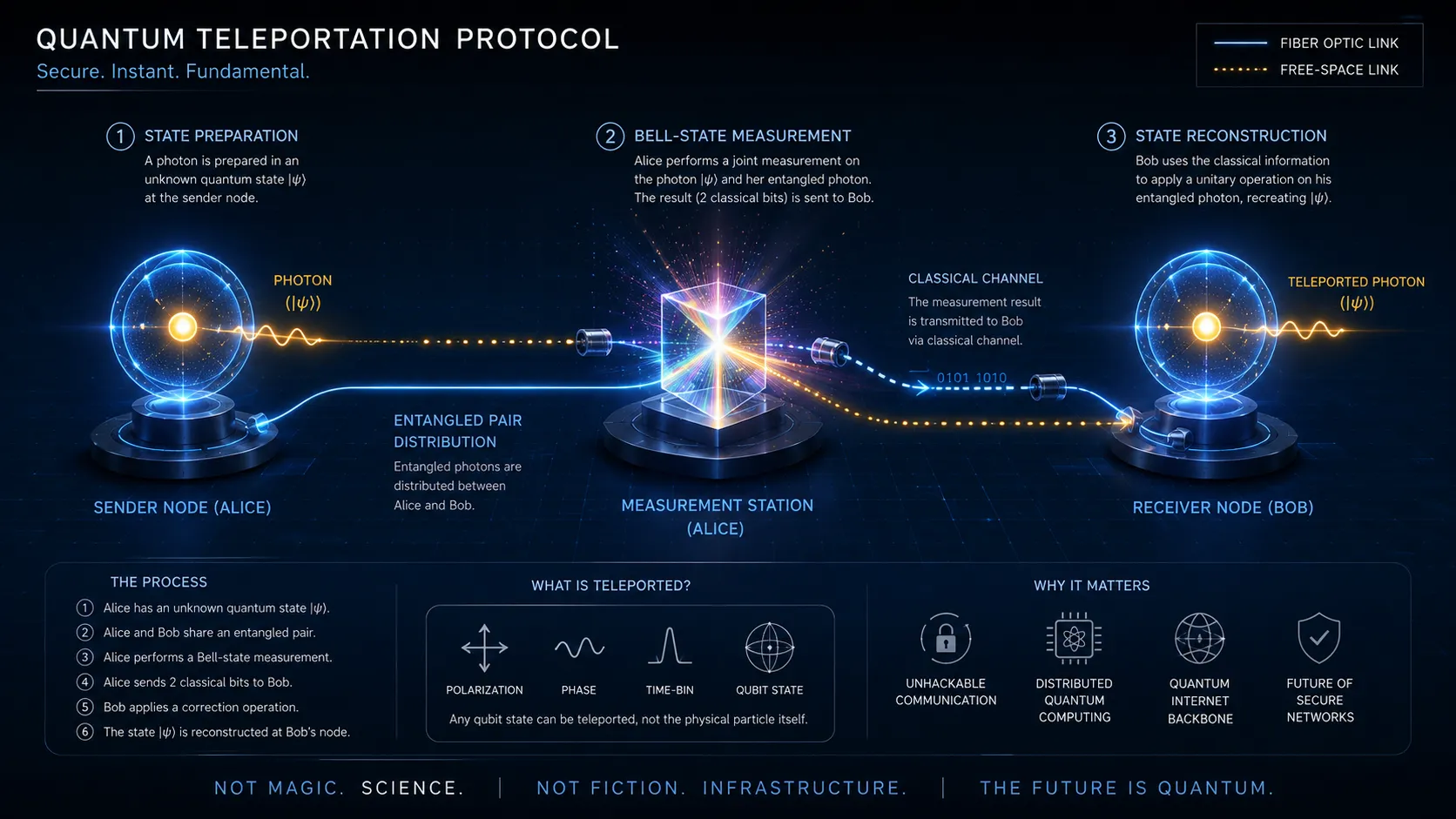
ROME — May 2026 – Two university buildings in Rome, separated by 270 meters of open air, a busy street, and the accumulated atmospheric chaos of an ancient city. In one building, a quantum dot—a semiconductor particle small enough to be governed by the strange laws of quantum mechanics—emitted a single photon. In the other building, a second quantum dot, physically different from the first, waited. What happened next, measured by instruments sensitive enough to detect the polarization state of a single particle of light, was something no one had ever done before: the quantum state of the first photon was teleported to the second, across the open-air gap, without either photon ever physically crossing the space between them.
The achievement, published in Nature Communications in late 2025 and now reverberating through the quantum technology community, represents the first successful teleportation between two independent and physically dissimilar quantum dot emitters over a hybrid fiber and free-space network. The fidelity reached 82%—comfortably above the classical threshold, meaning the result cannot be explained by any classical physics. The team, coordinated by Sapienza University of Rome with partners across Europe including Paderborn University, pulled off a feat that had been theorized for decades but never demonstrated outside of carefully controlled single-emitter laboratory conditions.
This is not teleportation in the Star Trek sense. No matter was moved. No human was beamed. What was transferred was information—the precise quantum state of a photon—and that, for the architects of the coming quantum internet, is everything.
The Two-Dot Problem
To understand why this experiment matters, one must first understand what had been holding quantum communication back. For years, researchers have demonstrated teleportation—the transfer of a quantum state from one particle to another—using photons generated from a single source. These experiments proved the principle. But they were not networks. A real quantum internet requires information to flow between devices that were not pre-matched at birth, built by different manufacturers, operating on different wavelengths, and separated by real-world distances. It requires, in the language of the field, dissimilar and independent emitters.
The Sapienza-Paderborn team solved this problem by engineering two quantum dots—nanoscale semiconductor structures that emit single photons on demand—with deliberately different electronic and optical properties. They then used advanced nanophotonic structures and external tuning mechanisms to precisely match the color and properties of the photons each dot produced. The synchronization was maintained using a GPS-disciplined oscillator, a technique borrowed from classical telecommunications but never before applied to quantum teleportation at this level of precision.
The 270-meter free-space link between the two university buildings was chosen deliberately to mirror the conditions that future quantum networks will face. "Free-space quantum links suffer tremendously from environmental conditions such as heat, air quality, rain, and sunlight," Jöns explained. The team had to stabilize, synchronize, and maintain the link over long measurement times, contending with real-world turbulence that no laboratory experiment had ever confronted. The fact that they succeeded—and maintained fidelity above the classical threshold—is as much a feat of engineering as of physics.
Why Quantum Relays Matter
The significance of the Rome experiment extends beyond a single demonstration. It opens a path toward quantum relays—devices that can extend the range of quantum communication beyond the inherent limitations of fiber optic cable. In classical communication, signals degrade over distance and must be amplified by repeaters. In quantum communication, the no-cloning theorem forbids amplification of unknown quantum states. The only way to extend range is through teleportation and entanglement swapping—techniques that this experiment brings closer to practical deployment.