
The Photon Breakthrough: How Caltech Taught Silicon to Behave Like Fiber Optic Cable — and What It Means for Everything from AI to Quantum Computing
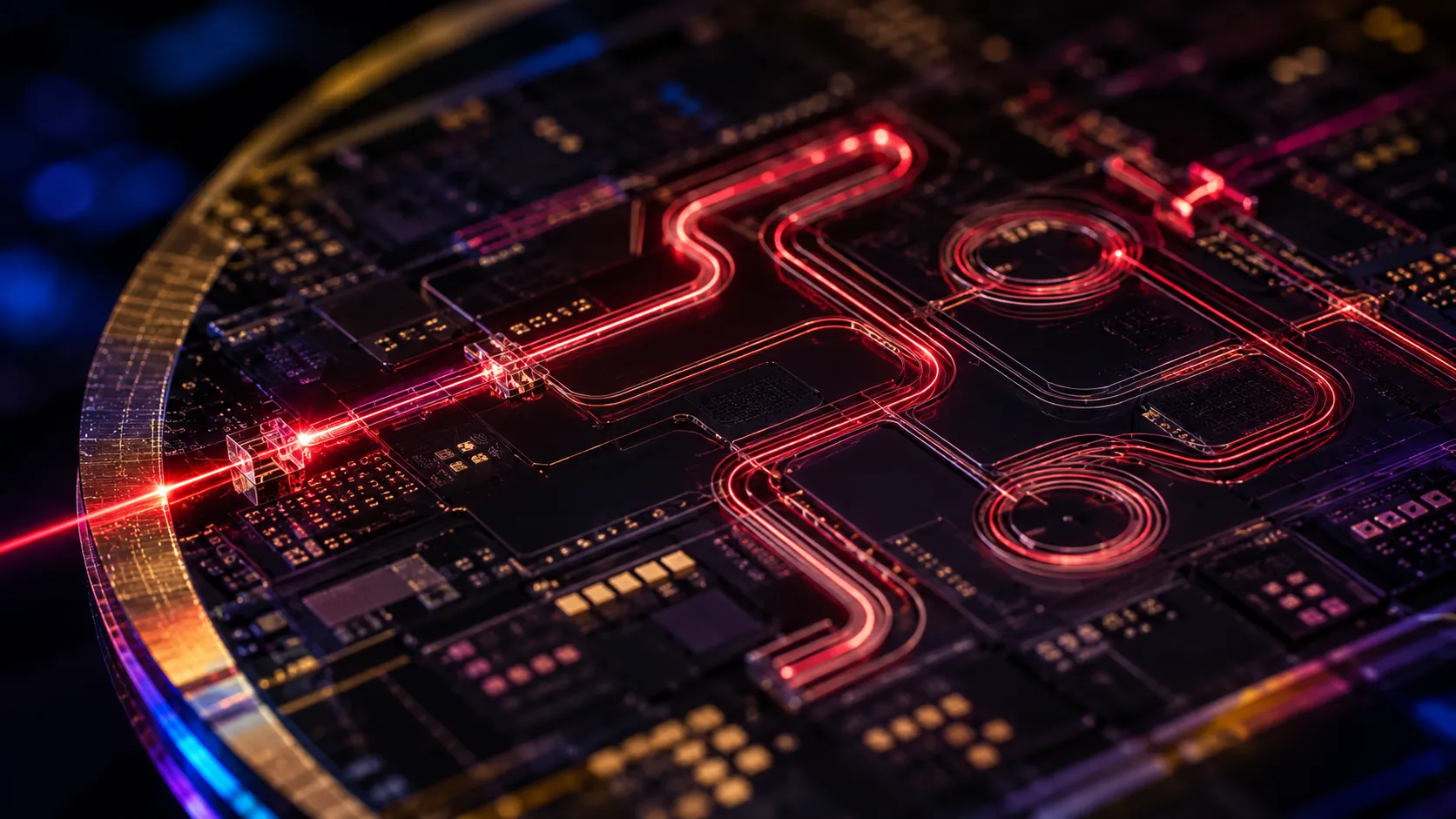
PASADENA, CALIF. — May 20, 2026 — In a cramped basement laboratory at the California Institute of Technology, a slab of silicon sits on an optical table, no larger than a fingernail. A beam of red light, no thicker than a human hair, enters one end of a microscopic channel carved onto its surface. It snakes through a maze of bends and splitters, bounces off a series of precisely angled mirrors, and exits the other side — not as a dimmed, scattered whisper of its former self, but nearly as bright and coherent as when it began. The loss, measured in decibels per meter, is so low that it flirts with the physical limits set by the material itself.
This is not a fiber optic cable buried under an ocean. It is a photonic circuit printed directly onto a standard silicon wafer — the same kind of wafer that churns out billions of computer chips each year. And the team that built it, led by Caltech professor Andrei Faraon and his graduate researchers, has just redrawn the map of what is possible at the intersection of light and silicon. In a study published earlier this year, the researchers describe a method for fabricating optical waveguides from the same ultrapure silica glass used in optical fiber — directly on top of an 8‑inch silicon wafer, using a low‑temperature process compatible with the semiconductor industry's existing toolset. The result: light can now travel through on‑chip pathways with a signal loss that until now had only been achievable in the glass fibers that span continents.
The implications are not merely academic. They reach into the churning heart of the world's data centers, the stalled promise of quantum computers, and the desperate search for a replacement for the copper wires that are beginning to choke the AI revolution.
The Copper Ceiling
To understand why the Caltech result matters, one must first understand a quiet panic building inside the world's data centers. For decades, the semiconductor industry has been governed by Moore's Law — the relentless shrinking of the transistor. But as transistors have become faster and more numerous, the wires that connect them have become the bottleneck. Electrons moving through copper traces generate heat, cause delays, and consume power at rates that are beginning to limit the performance of the largest AI training clusters and the densest cloud computing racks.
Nvidia's latest Kyber GPUs, expected in 2027, will push past 1,950 watts per chip. A rack of these machines will consume power equivalent to a small suburban block, and a significant fraction of that energy is wasted not on computation but on moving data from one chip to another across copper interconnects. The problem has a name — the "interconnect bottleneck" — and it is the single greatest threat to the continued scaling of AI infrastructure.
Light, by contrast, generates almost no heat and can carry vastly more data at vastly higher speeds. For years, the dream of "silicon photonics" has been to replace the copper wires inside computers with optical interconnects — tiny beams of light that shuttle data between chips, between servers, and eventually between the cores of a single processor. The problem has always been material. Silicon, the foundation of the semiconductor industry, is a lousy material for guiding light. It absorbs visible wavelengths. It scatters near‑infrared beams. It loses signal so quickly that even millimeter‑scale distances degrade performance to unusable levels. The industry's workaround has been to attach separate photonic chips made from exotic materials — indium phosphide, lithium niobate, silicon nitride — to the silicon processor. The approach works, but it is expensive, bulky, and difficult to manufacture at scale.
Faraon's team took a different approach. Instead of trying to force silicon to carry light, they built the optical pathways out of the same ultrapure silica glass that forms the backbone of the global fiber‑optic network — and they found a way to deposit that glass directly onto a silicon wafer at temperatures low enough to avoid damaging the underlying electronics. The process, a form of low‑pressure chemical vapor deposition, produces waveguides with a surface roughness measured in fractions of a nanometer and an optical transparency that rivals the best drawn fiber. "The material itself is not new," Faraon explained. "What's new is that we can integrate it with silicon at a quality that finally makes sense for real applications."
From Fiber to Chip
The numbers tell the story of a barrier broken. Optical fiber — the kind that carries internet traffic across oceans — typically exhibits a propagation loss of about 0.2 decibels per kilometer. That is the gold standard: a signal traveling through transatlantic fiber loses less than half its power over a hundred kilometers. On‑chip waveguides, by contrast, have historically posted losses measured in decibels per centimeter — thousands of times worse. The Caltech team's silica‑on‑silicon waveguides have now demonstrated losses as low as 0.3 decibels per meter at visible wavelengths. That is not yet fiber‑class performance over long distances, but over the millimeter‑ and centimeter‑scale distances that matter inside a computer chip, it is transformative. A signal can now be routed across an entire reticle‑sized chip with minimal degradation, enabling complex optical circuits that were previously impossible.
The immediate applications are in data centers. Nvidia, Broadcom, and Intel are all racing to develop optical interconnects that can replace copper links between GPUs and switches. The Caltech platform offers a path to building those interconnects directly on standard CMOS wafers, using a material — silica — that is already one of the most well‑understood substances in the semiconductor industry. The potential energy savings are enormous. A large AI training cluster today might spend 20 to 30 percent of its power budget simply moving data between chips. Replacing those copper links with low‑loss optical waveguides could reduce that overhead to single digits, freeing up megawatts of power for actual computation.
But the longer‑term implications extend well beyond data centers. Photonic integrated circuits are a foundational technology for quantum computing, where information is encoded in single photons and must be routed, split, and interfered with exquisite precision. The Caltech platform's combination of low loss, CMOS compatibility, and visible‑wavelength operation makes it a candidate for the optical control plane of future quantum processors. It could also enable a new class of biosensors — chips that use light to detect pathogens, proteins, or chemical signatures at the point of care — and coherent LiDAR systems for autonomous vehicles that are smaller, cheaper, and more robust than anything currently on the road.
The Global Race
The Caltech breakthrough lands in the middle of an intensifying global competition for photonic supremacy. The United States, through the CHIPS Act and the Defense Advanced Research Projects Agency's LUMOS program, has poured billions into domestic photonics research, aiming to reduce dependence on Asian foundries for advanced optical components. Europe's Horizon program has funded a pan‑European photonics pilot line. China has identified integrated photonics as a strategic priority in its 14th Five‑Year Plan, with state‑backed labs in Shanghai and Beijing racing to commercialize silicon‑photonics platforms for AI and quantum applications.
What distinguishes the Caltech approach is its embrace of the visible spectrum. Most integrated photonics platforms operate in the near‑infrared, around 1,550 nanometers — the wavelength that minimizes loss in standard optical fiber. The Caltech waveguides, by contrast, are optimized for visible light, a domain that has historically been neglected because silicon absorbs it so strongly. By building the waveguides from silica instead of silicon, the team sidesteps that absorption entirely. Visible light enables tighter focusing, higher resolution, and compatibility with a new generation of chip‑scale optical devices — including atomic clocks, quantum sensors, and neuromorphic processors — that operate at shorter wavelengths.
The road to commercialization is not short. The team has demonstrated the fabrication process on 8‑inch wafers, the same size used for many specialty semiconductor products, but scaling to the 12‑inch wafers that dominate leading‑edge chip production will require further engineering. The low‑temperature deposition process, while CMOS‑compatible, has not yet been tested in a full‑flow semiconductor manufacturing environment. And the ecosystem of design tools, packaging technologies, and testing infrastructure required to turn a laboratory waveguide into a product that ships in volume is still under construction.
But the trajectory is unmistakable. Light has been trying to break into the silicon chip for two decades. Copper has held it back, not because copper was better, but because the materials that could carry light efficiently refused to play nicely with the silicon fabrication process. Faraon's team has found a material that does both. It is, in the most literal sense, a bridge — between the fiber networks that encircle the globe and the silicon chips that process the world's information. When that bridge is fully built, the speed of computation will no longer be limited by the heat of moving electrons. The age of copper will give way to the age of light.


