The Payment Rail That Ate India Just Swallowed Greece: How UPI's Silent Global Takeover Is Redrawing the Map of Money
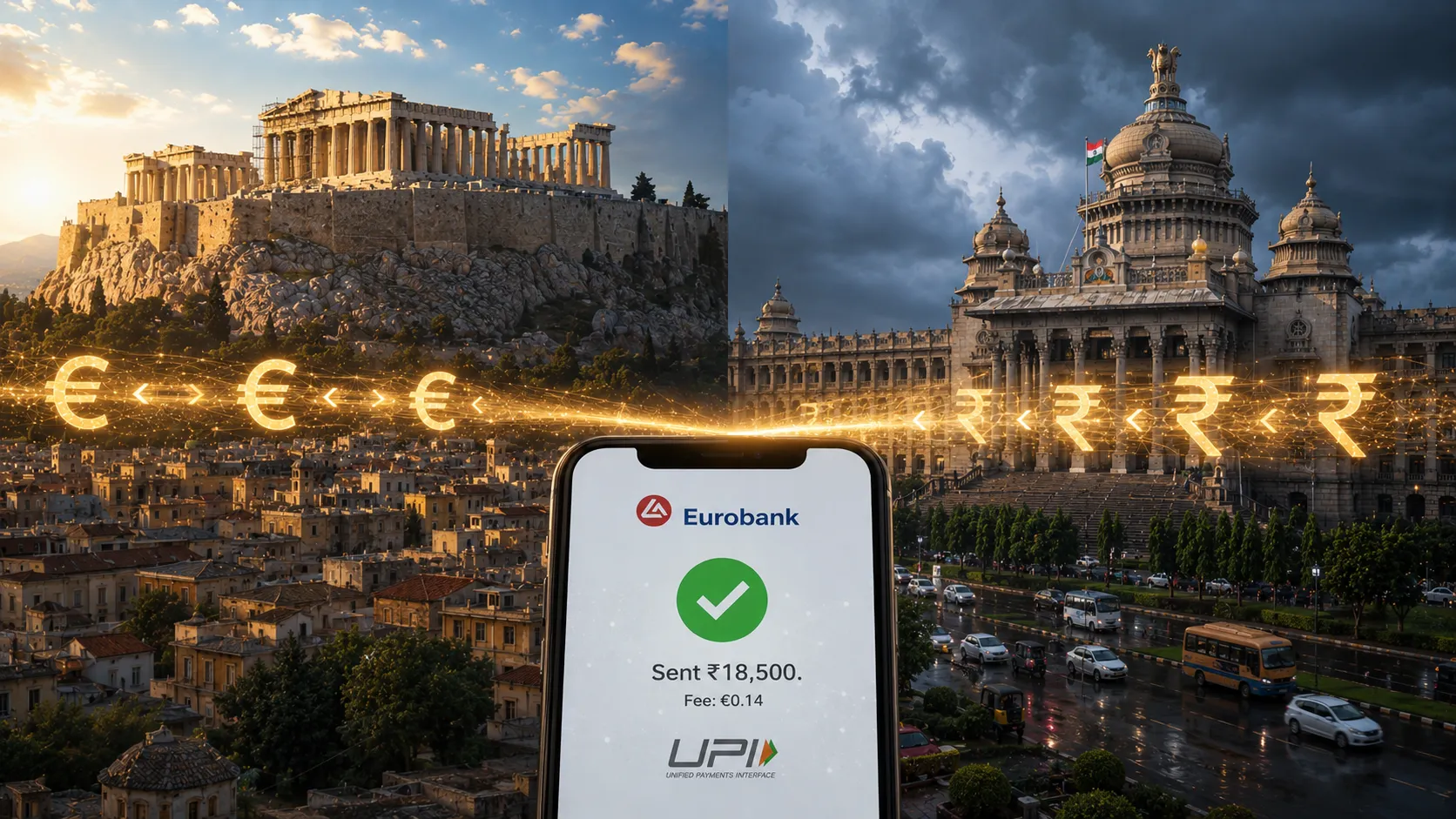
ATHENS — May 22, 2026 — On a quiet Wednesday morning in Athens, a Greek software engineer named Dimitris opened his Eurobank app and sent €200 to his freelance contractor in Bengaluru. The money left his account in euros, converted to rupees at a rate that was near-interbank, and landed in the contractor's Indian bank account approximately twelve seconds later. The fee was 0.07 percent. Dimitris did not need to enter a SWIFT code, an IBAN number, or any of the arcane alphanumeric identifiers that have made cross-border payments a multi-day ordeal for half a century. He typed a UPI ID—a virtual payment address that looks like an email address—and pressed send.
The transaction was unremarkable in its execution. It was historic in its implications. Eurobank, Greece's largest lender by market capitalization, had just become the first European bank to enable UPI-based remittances to India, connecting the eurozone's payments infrastructure to the real-time rail that has transformed India from a cash-dependent economy into the world's largest digital payments market in less than a decade. The launch, which also covers Cyprus, follows the EU-India Trade and Technology Council agreement signed in early 2026, and it marks the first time that a major European financial institution has integrated India's homegrown payments infrastructure directly into its consumer-facing products.
The transaction charge is near-zero. The settlement is instant. The interface requires no specialized knowledge. And the implications—for the global payments industry, for the dominance of Western payment networks, and for the economic relationship between the world's two largest democracies—are only beginning to be understood.
The Rail That Ate India
To understand why a Greek bank integrating an Indian payment system matters, one must first understand what UPI has done to India itself. The Unified Payments Interface was launched in 2016 by the National Payments Corporation of India, a coalition of Indian banks that had been tasked with building a real-time, interoperable, mobile-first payment system. It was not the first attempt. India had tried to digitize payments before, with limited success. But UPI was different: it was free for consumers, it settled instantly, and it worked on any smartphone, even the most basic Android devices that dominate the Indian market.
The result was one of the fastest and most complete transformations of a national payment system in history. In 2016, India was a cash economy: more than 90 percent of transactions were conducted in physical currency. By 2025, UPI was processing more than 16 billion transactions per month—roughly 530 million per day—with a total value exceeding ₹23 lakh crore, or approximately $280 billion. The platform had grown from zero to processing more transactions than Visa and Mastercard combined in India within less than a decade. It had become, in the words of the International Monetary Fund, "a global public good"—a payment infrastructure that was fast, cheap, interoperable, and demonstrably scalable to a population of 1.4 billion people.
The key architectural decision that made UPI work was its layered design. The NPCI built the underlying rails—the real-time settlement engine, the interoperable protocols, the security framework. Private companies—Google, Walmart-owned PhonePe, Amazon, and dozens of Indian startups—built the consumer-facing applications. The result was a public-private partnership that combined the reliability and reach of a government-backed infrastructure with the user experience and innovation of a competitive market. Google Pay and PhonePe account for the majority of UPI transactions, but they run on rails they do not own—rails that are open, non-discriminatory, and continuously upgraded by a non-profit consortium.
The Remittance Bridge
The Eurobank-UPI integration serves a specific and economically significant market: the Indian diaspora in Europe. Greece and Cyprus host a substantial and growing Indian community, including students, technology workers, and entrepreneurs. Remittances from Europe to India total approximately €12 billion annually, and the existing channels—SWIFT wire transfers, Western Union, and other money-transfer operators—charge fees that range from 1 to 5 percent and take between one and five business days to settle.
The UPI corridor eliminates both the cost and the delay. The Eurobank integration routes remittances through the NPCI's international arm, NIPL, which has been building UPI linkages with countries across Asia, the Middle East, and now Europe. The near-zero fee structure—the 0.07 percent charged by Eurobank covers only the currency conversion cost—represents a dramatic improvement over the existing alternatives. For a Greek business that pays Indian contractors monthly, the savings can amount to thousands of euros per year. For an Indian student in Athens receiving money from family in Mumbai, the instant settlement means no more waiting for a wire transfer to clear while rent is due.
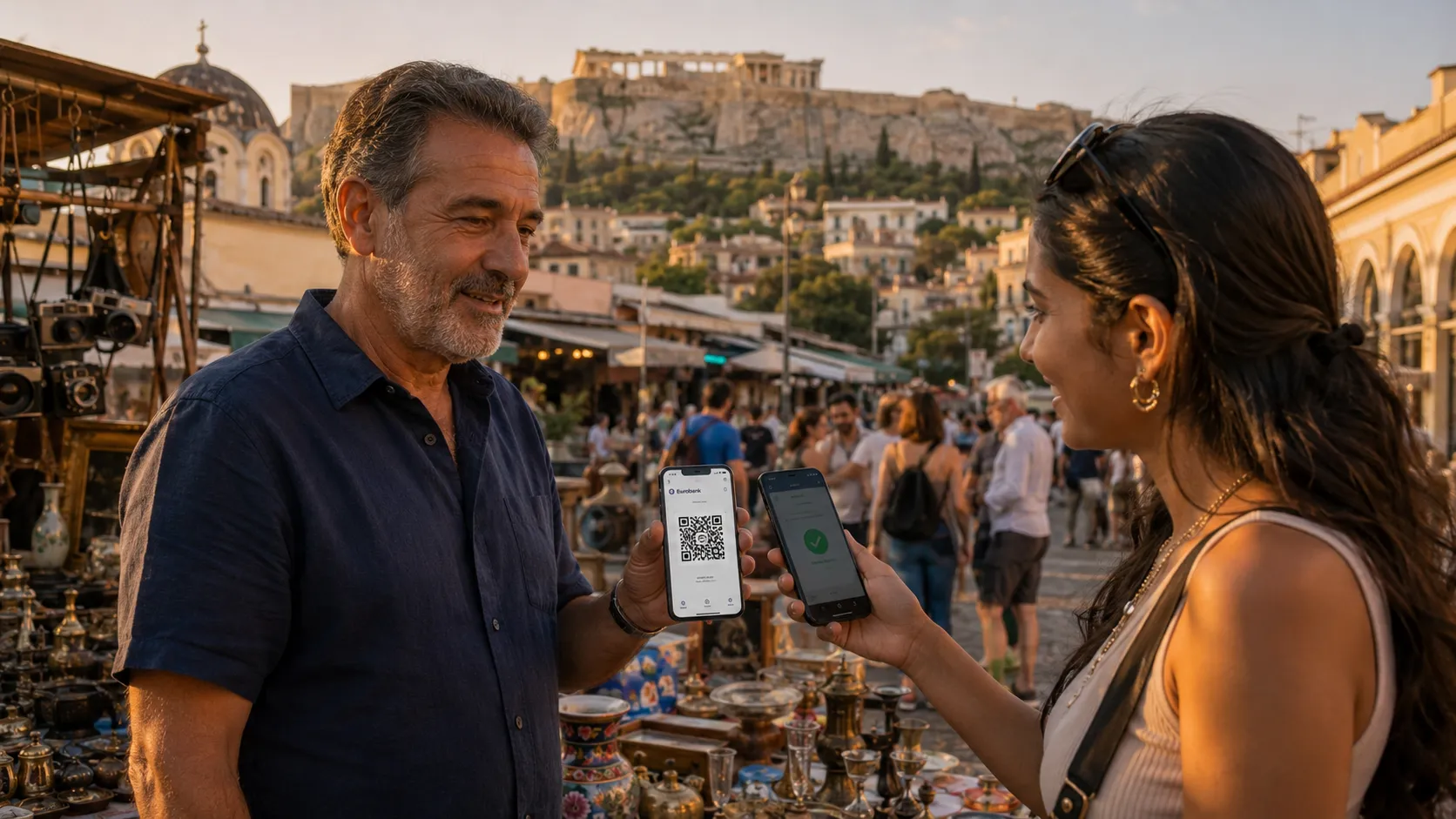
But the remittance use case is only the beginning. The Eurobank integration also enables real-time merchant payments: an Indian tourist in Athens can pay at any Eurobank-affiliated merchant using a UPI QR code, and the funds settle in euros to the merchant's account instantly. The tourist does not need to carry foreign currency, pay credit card foreign-transaction fees, or navigate the complexities of currency conversion. The merchant receives euros at a lower processing cost than a Visa or Mastercard transaction would incur. The payment rail does not discriminate by geography. It simply moves value, instantly, at near-zero cost.
The Geopolitics of Payment Rails
The Eurobank-UPI launch is not merely a commercial arrangement between a bank and a payment network. It is a geopolitical signal—a vote by a European financial institution that the future of cross-border payments may not be built on SWIFT, Visa, and Mastercard, but on the public digital infrastructure that India has spent the past decade constructing.
The dominance of Western payment networks has been one of the most durable features of the global financial system. SWIFT, the Belgium-based messaging network that facilitates most international wire transfers, processes roughly 50 million messages per day. Visa and Mastercard together account for approximately 90 percent of global card transactions outside China. These networks charge fees—typically 1 to 3 percent for card transactions, and variable fees for SWIFT messages—that generate hundreds of billions of dollars in annual revenue. The fees are rarely visible to consumers, but they are a structural tax on global commerce, and they have persisted for decades because there was no alternative.
UPI provides an alternative. It is not a card network. It is not a wire-transfer system. It is a real-time, account-to-account payment protocol that bypasses the card networks entirely, routing transactions directly between bank accounts through the central bank's settlement infrastructure. The cost per transaction is essentially zero. The settlement is instant. The protocol is open. And India has now demonstrated—at a scale that no other country has matched—that it works.
The Eurobank integration follows a pattern that has been building for several years. Singapore has linked its PayNow system to UPI. The UAE has integrated UPI into its national payment infrastructure. Bhutan, Nepal, Sri Lanka, and Mauritius have adopted UPI-based systems. France has piloted UPI acceptance at Eiffel Tower vendors. Japan, South Korea, and Saudi Arabia are in discussions. Each new country that adopts UPI—even for a limited use case—normalizes the idea that a public payment rail from India can compete with private payment networks from the West.
What This Signals
The Eurobank launch is a single commercial integration between a Greek bank and an Indian payment rail. It will not, on its own, dislodge SWIFT or Visa from their dominant positions. The volumes are small, the use case is narrow, and the integration is limited to a single corridor.
But the direction of travel is unmistakable. The global payments industry is in the early stages of a structural shift—from closed, proprietary, fee-based networks to open, interoperable, near-free protocols. India has built the most advanced example of such a protocol, and it is now exporting it, country by country, corridor by corridor. The European Union, through its Instant Payments Regulation and its Digital Euro project, is pursuing a parallel path. The convergence of these efforts—a European real-time payment infrastructure linked to an Indian real-time payment infrastructure, routing transactions at near-zero cost—would create a payments corridor that bypasses the legacy networks entirely.
The bank that enabled the first link is not a giant like Deutsche Bank or BNP Paribas. It is Eurobank—a Greek lender that, a decade ago, was fighting for survival during the country's debt crisis. The symbolism is not subtle. A country that nearly exited the eurozone is now the entry point for the eurozone's integration with the world's most advanced payment rail. The money moved in twelve seconds. The implications will take longer to unfold.


