The Ocean's Lungs Are Changing: How Underwater Forests Are Being Rebuilt by Robot Hands and Ancient Seeds
Kelp forests absorb carbon four times faster than tropical rainforests. Ninety percent of them have already disappeared. A new alliance of marine biologists, engineers, and indigenous fishermen is racing to bring them back.
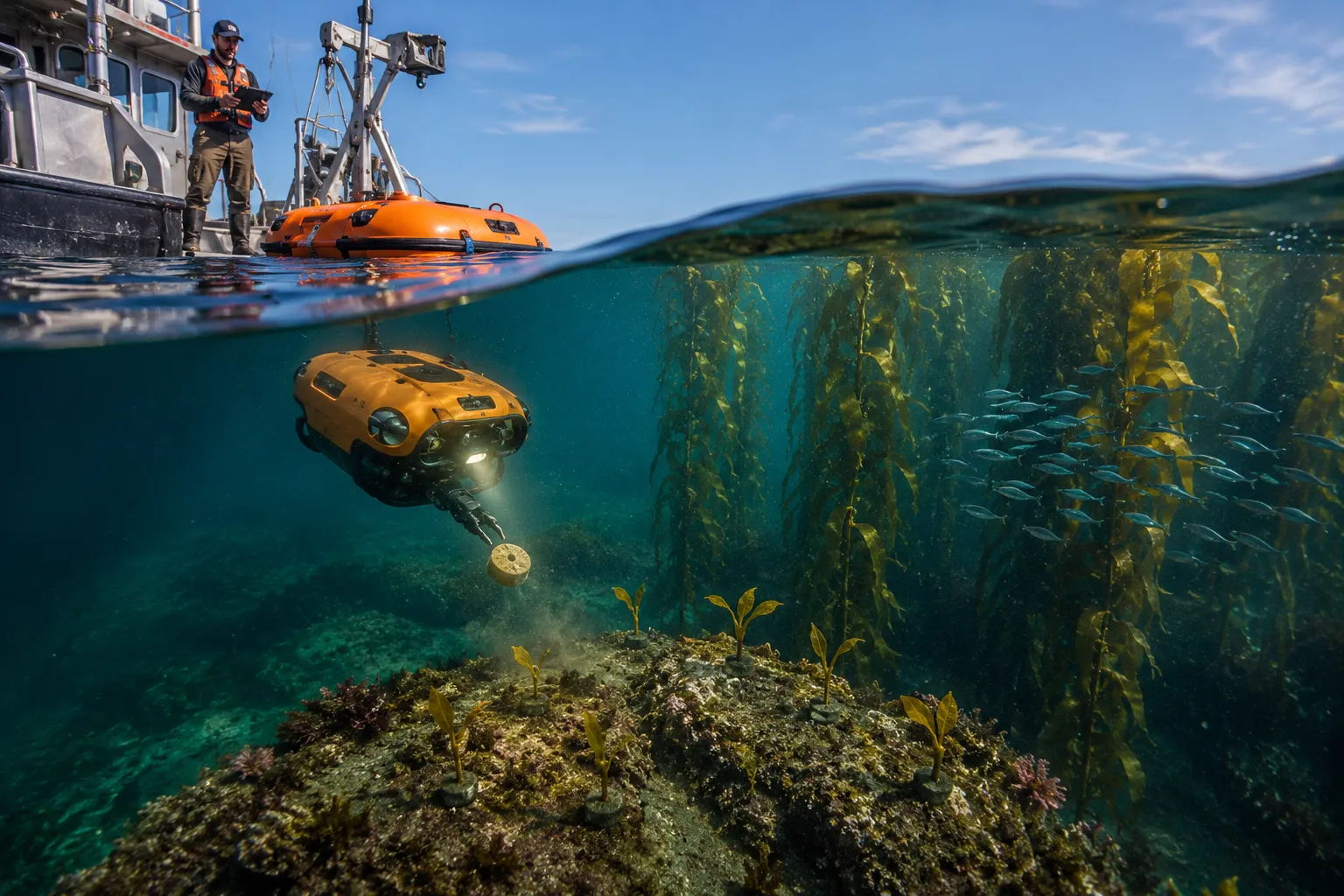
OFF THE COAST OF MAINE — May 26, 2026 — The robot dives without hesitation. It is shaped like a torpedo, painted bright orange, and guided by a single onboard camera and a set of inertial sensors. Thirty feet below the surface, in water so cold it aches, the robot reaches its target: a bare rock outcrop on a seafloor that was once a dense, swaying forest of sugar kelp. From a storage bay, the robot releases a small biodegradable disk. The disk contains a young kelp sporophyte, no larger than a grain of rice, attached to a short length of twine. The robot presses the disk against the rock, fires a single biodegradable nail, and moves to the next coordinate. In six hours, it will plant 10,000 of these disks. In three months, if all goes well, the rocks will be covered in golden-brown fronds, and the fish will begin to return.
This is kelp restoration at scale. For decades, efforts to rebuild the world's collapsing seaweed forests were small, artisanal, and heartbreakingly slow. Divers would hand-plant seedlings, one by one, in wetsuits so thick they could barely move. They restored acres, while the ocean lost millions. Then came the robots, the satellite imagery, the genetic sequencing, and the realization that kelp is not just a habitat—it is a climate solution.
"People think of rainforests as the lungs of the planet," said Dr. Mira Chen, a marine ecologist at the Bigelow Laboratory for Ocean Sciences in Maine. "But pound for pound, kelp forests sequester more carbon than any terrestrial forest. They also buffer coastlines, provide nursery habitat for a quarter of all marine species, and absorb excess nutrients that cause dead zones. Losing kelp is like losing a third of our planetary immune system. Restoring it is not optional. It is survival."
> "Losing kelp is like losing a third of our planetary immune system. Restoring it is not optional. It is survival." — Dr. Mira Chen, Bigelow Laboratory for Ocean Sciences
The Great Die-Off You Haven't Heard About
The destruction of the world's kelp forests is one of the least-reported environmental catastrophes of the past century. Along the coast of Northern California, 95 percent of the bull kelp forests have vanished since 2014, replaced by urchin barrens—acres of bare rock carpeted with spiny purple urchins that gnaw away any new kelp growth before it can establish. In Tasmania, the once-vast giant kelp forests have contracted by 95 percent. In Norway, warming waters have shifted kelp zones northward at a rate of 50 kilometers per decade. In Japan, the iconic kombu forests that sustained coastal fisheries for millennia have collapsed.
The causes are multiple but interconnected. Marine heatwaves—pulses of warm water that can last for months—stress kelp and make it vulnerable to disease. Overfishing of predators like sea otters and lobsters has allowed urchin populations to explode. Nutrient runoff from agriculture feeds algae that smother young kelp. And ocean acidification weakens the calcium carbonate structures of the tiny organisms that kelp needs to settle on.
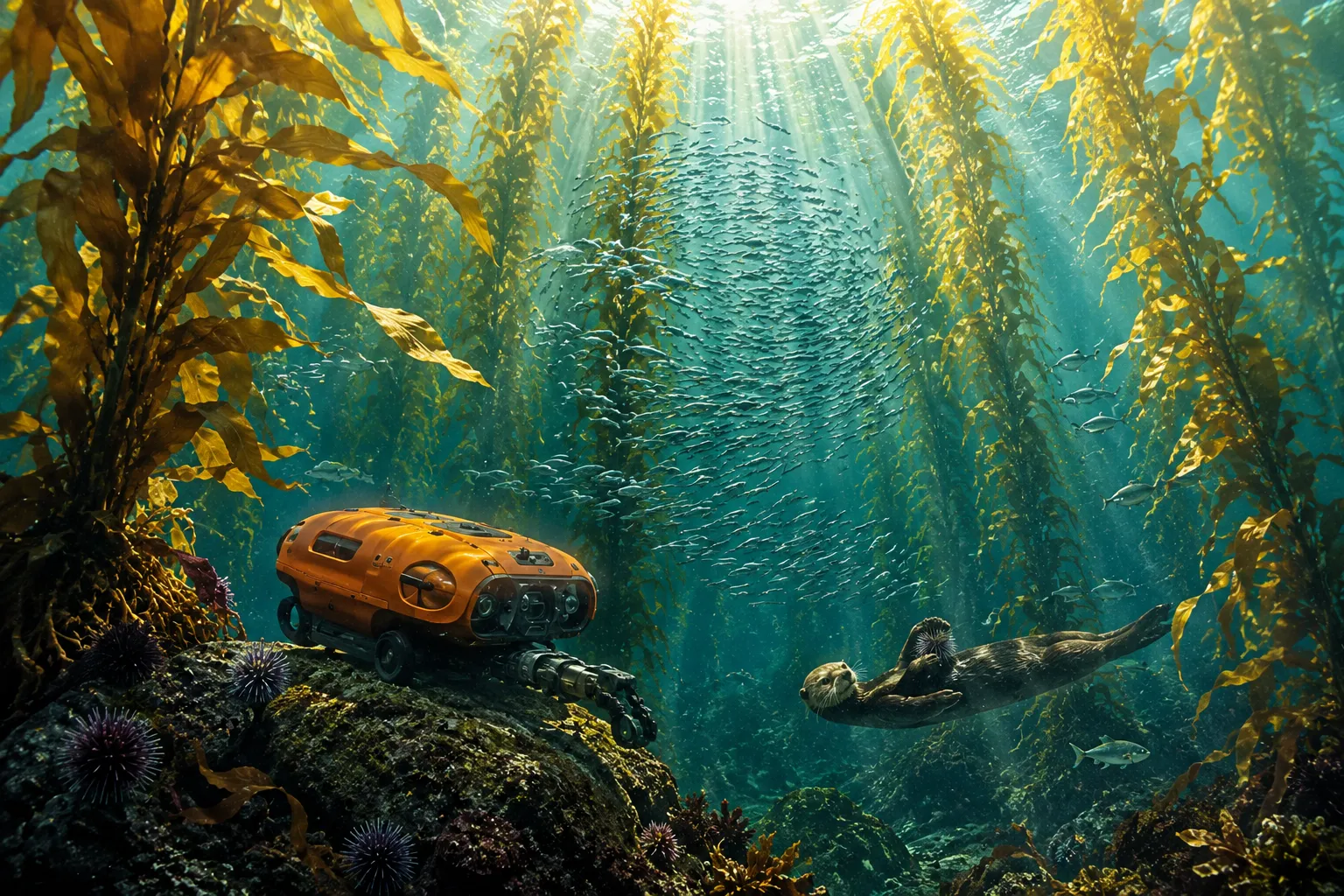
"We are watching a ecosystem collapse in real time," said Dr. Chen. "But unlike coral bleaching, which gets headlines, kelp loss happens quietly. Most people never see it, because it happens underwater, far from shore. By the time a fisherman notices that his catch is down 80 percent, the forest has been gone for years."
The Restoration Toolkit: Robots, Seeds, and Urchin Hunters
The new wave of kelp restoration is not a single solution. It is a toolkit of complementary interventions, each deployed where it fits best.
Robot planters are the most visible innovation. The Maine robot, developed by a startup called KelpVentures, can plant 50 times faster than a human diver, at one-tenth the cost. The robots are cheap enough to be deployed in swarms, and their biodegradable disks eliminate plastic waste. "The bottleneck used to be labor," said KelpVentures CEO James Okonkwo. "Now the bottleneck is sporophytes—growing enough seedlings to keep the robots busy. We are scaling up nurseries as fast as we can."
Genetic rescue is the second pillar. Kelp populations have genetic diversity that allows some individuals to tolerate warmer water, lower light, or higher acidity. Researchers are identifying these "super-kelp" strains, breeding them in laboratories, and using them for restoration. In Norway, a strain of sugar kelp that survives in water 3°C warmer than the historical average has been planted across 200 hectares of former forest. Early results show survival rates triple that of wild-type seedlings.
Urchin culling is the grim necessity. In California, the Nature Conservancy has partnered with commercial divers to remove purple urchins at an industrial scale. The urchins are collected and sold to a company that processes them into fertilizer and livestock feed—turning a pest into a revenue stream. In the areas that have been cleared, kelp restoration success rates have jumped from near zero to over 60 percent.
Indigenous knowledge is the fourth, and perhaps most important, tool. Along the Pacific Northwest coast, the Nuu‑chah‑nulth First Nation has been managing kelp forests for thousands of years using practices that European colonizers ignored. They selectively harvested older plants to leave younger, more productive ones. They removed grazing invertebrates by hand during low tides. And they understood that kelp forests are not static—they require active stewardship, not just protection.
"We never stopped knowing how to take care of the kelp," said Elder Helen Watts of the Tla‑o‑qui‑aht First Nation. "We just stopped being allowed to do it. Now the scientists come to us with their robots and their genetics, and we show them what our grandmothers showed us. It works better when we do both."
The Carbon Connection: Kelp as Climate Insurance
The climate benefits of kelp restoration extend far beyond habitat. When kelp grows, it pulls carbon dioxide from the water, converting it into biomass. Some of that carbon is eaten by grazers and returned to the water. But a significant fraction—perhaps 10 to 20 percent—is exported to the deep ocean, where it can be sequestered for centuries. A hectare of healthy kelp forest sequesters roughly 1.5 metric tons of carbon per year. That is four times the rate of a tropical rainforest on a per‑hectare basis.
But the real climate magic is kelp's role in deacidifying the ocean. As kelp absorbs CO₂, it raises the local pH. A dense kelp forest can buffer the water against ocean acidification, creating refuges where shellfish and corals can still build their skeletons. "Kelp is like a coral reef's best friend," said Dr. Chen. "They don't compete. They cooperate. Where kelp returns, shellfish recruitment often follows within a year."
Several companies are now developing kelp carbon credits—verified offsets based on the carbon sequestered by restored forests. The market is young and controversial; critics argue that measuring long-term sequestration is difficult, and that credits could be used to justify continued fossil fuel emissions. Proponents counter that any funding for restoration is better than none. The first kelp carbon credit transaction closed in 2025: 5,000 tons of CO₂ equivalent, sold to a European airline for $150 per ton.
The Global Scaling Challenge
Even with robots and super-kelp, the scale of restoration needed is staggering. The world has lost roughly 40 percent of its kelp forests since 1950—an area larger than the entire United Kingdom. To restore just 10 percent of that loss over the next decade would require planting roughly 5 billion kelp individuals per year. Current global capacity is less than 50 million.
"We need a kelp restoration equivalent of the Apollo program," said Okonkwo. "We need automated nurseries, distributed robotic fleets, satellite monitoring, and a workforce of trained local operators. This is not a niche environmental project. This is infrastructure."
Several governments are beginning to agree. Norway has committed $50 million to kelp restoration over five years. California's Ocean Protection Council has set a target of 50,000 restored hectares by 2030. And the United Nations Decade on Ecosystem Restoration has identified kelp forests as one of ten priority ecosystems for global action.
The money is important, but the urgency is greater. Kelp forests do not wait. Every year of delay means more urchin barrens, more warming stress, more genetic diversity lost. The robots can plant fast, but the ocean changes faster.
The Underwater Future
Three months after the robot's deployment off the coast of Maine, a dive team returns to the site. The biodegradable disks are gone, dissolved into the seafloor. In their place are young kelp plants, some already two feet tall. The rocks are no longer bare. A few small fish have appeared—cunner, codium, the first tentative signs of life returning.
"It is not a forest yet," said Dr. Chen, watching the video feed from the boat. "It is a sapling. But saplings grow. And with the robots, we can plant a million saplings next year. That is a forest. That is something."
The ocean's lungs are damaged, but not destroyed. They are waiting for the conditions to return—cooler water, fewer urchins, more spores. The robots, the seeds, and the ancient knowledge are giving them a chance. It is not too late. But it is very, very late. The robots dive again at dawn.


