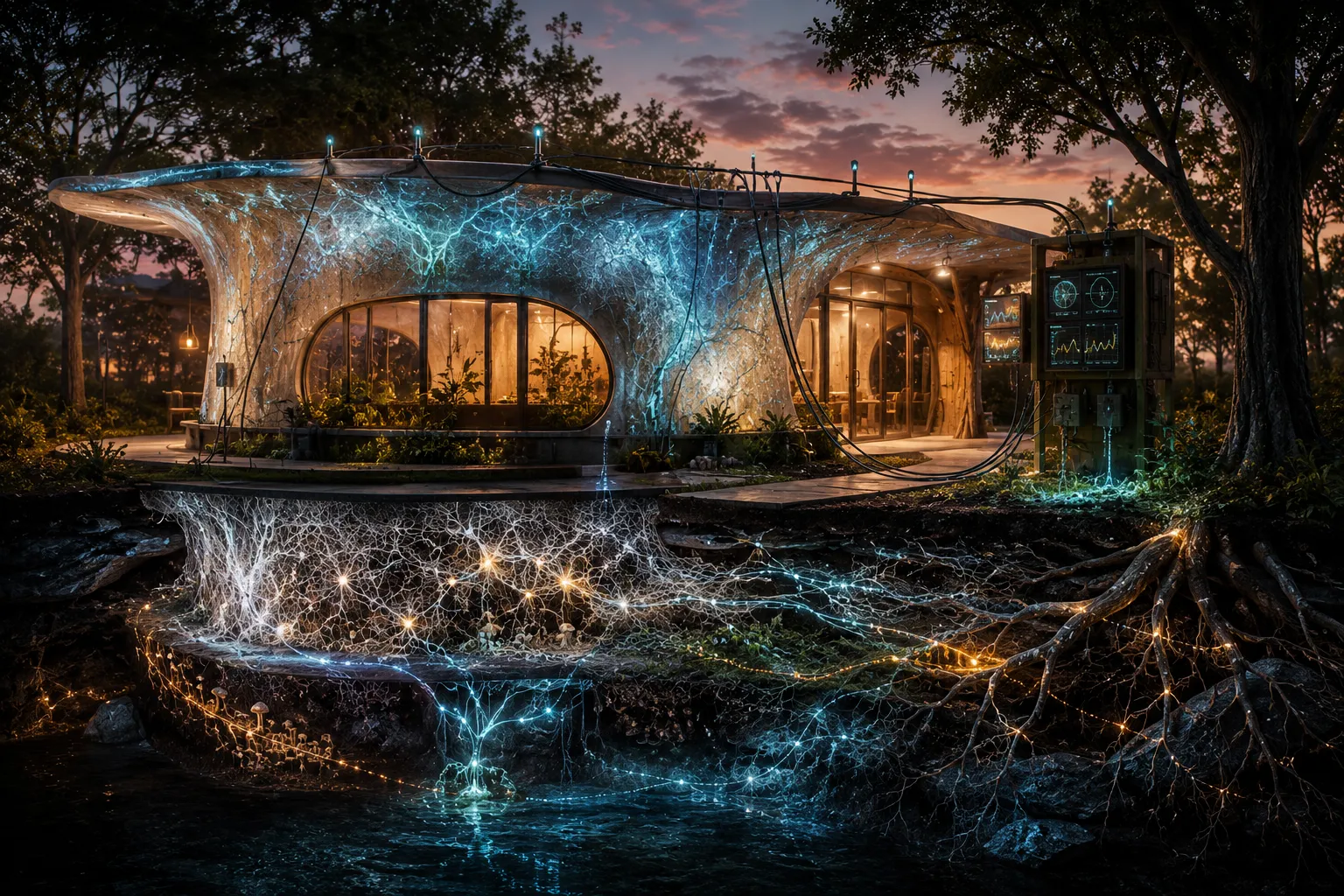
The Mycelium Underground: How Fungal Networks Are Becoming the World's Smartest Infrastructure
Beneath your feet, a trillion miles of fungal filaments are quietly solving problems that silicon cannot touch. From self-healing roads to toxin-eating building materials, the mycelium revolution has arrived.
BENEATH YOUR FEET — May 26, 2026 — The largest living organism on Earth is not a blue whale. It is not a sequoia tree. It is a fungus. In the Blue Mountains of Oregon, a single individual of Armillaria ostoyae covers nearly four square miles and weighs an estimated 35,000 tons. It has been growing for at least 2,400 years. You would never know it is there, because almost all of it is underground—a vast, interconnected web of thread-like hyphae that collectively form what scientists call the mycelium.
For most of human history, mycelium was a biological curiosity. Then, two decades ago, a group of artists and engineers discovered that fungal networks could be dried, compressed, and formed into bricks. Mushroom materials became a niche interest for sustainable design. But something much stranger and more profound has happened in the past five years. Researchers have realized that mycelium is not just a structural material. It is a living, sensing, communicating network—a form of natural computation that can process information, respond to stimuli, and even learn. And they are beginning to build with it.
"The mycelium is nature's internet," said Dr. Tobin Ellis, a mycologist turned civil engineer at the University of British Columbia. "It transmits chemical signals across vast distances. It redistributes nutrients based on need. It has memory without a brain. If we can learn to interface with it, we can build infrastructure that heals itself, filters its own toxins, and communicates its own structural health. We are not just growing buildings. We are growing nervous systems."
The Three Powers of the Fungal Network
To understand the mycelium revolution, you need to understand three properties that make fungal networks unlike any human-made material.
First, mycelium is a self-assembling adhesive. When hyphae grow through loose substrate—sawdust, agricultural waste, hemp hurds—they secrete enzymes that break down the material and then bind it together into a dense, solid matrix. After a few weeks, the substrate is transformed into a material as strong as medium-density fiberboard, completely biodegradable, and fire-resistant. Companies like Ecovative and MycoWorks have been selling mycelium composites for packaging and leather alternatives for years.
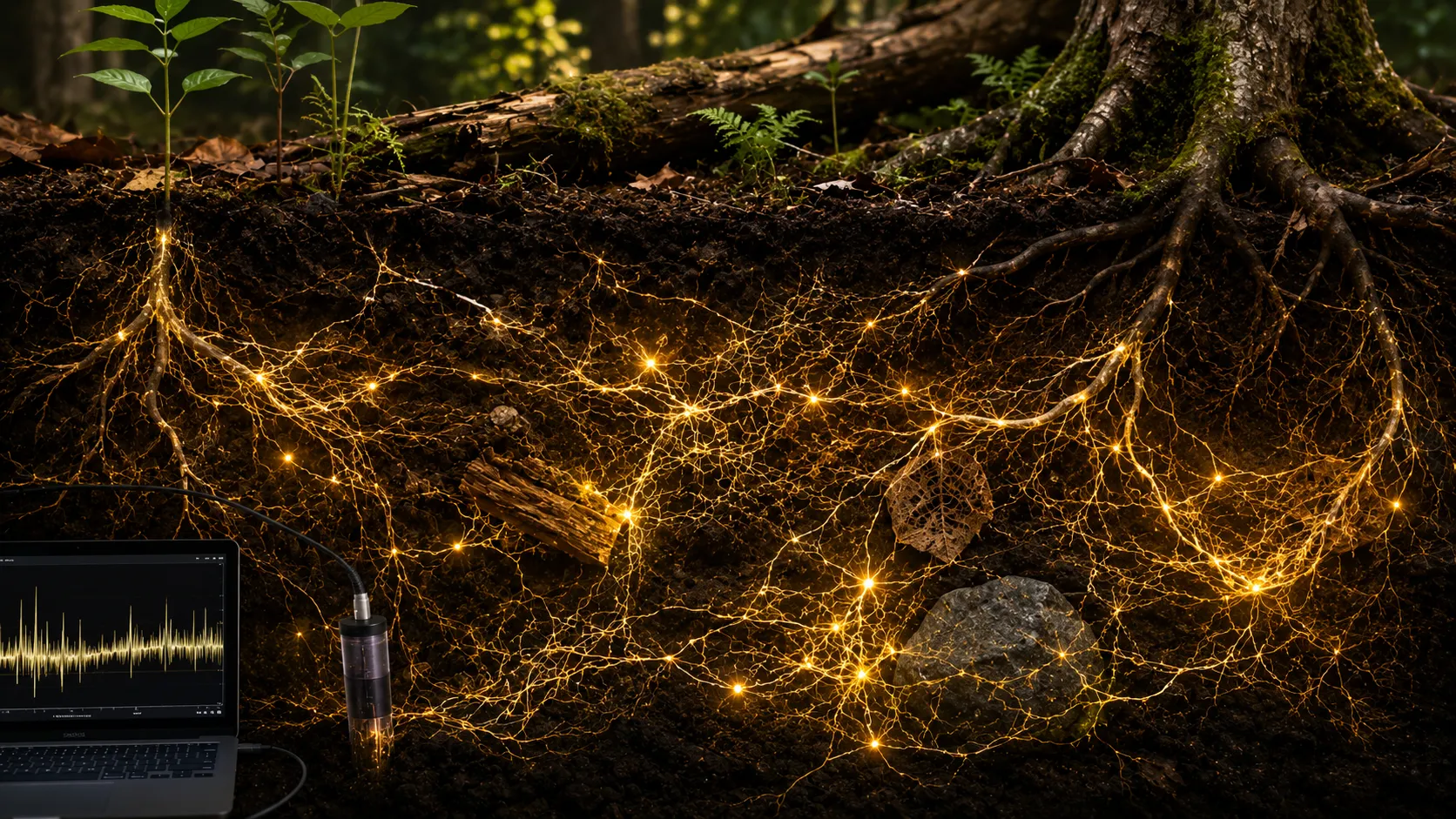
Second, mycelium is a living sensor. Fungal hyphae are exquisitely sensitive to their environment. They detect changes in temperature, humidity, pH, and the presence of specific chemicals. When a hypha encounters a toxin, it sends a chemical signal rippling through the network at speeds of up to a millimeter per second. Researchers at the Unconventional Computing Laboratory at the University of the West of England have wired mycelium to electrodes and shown that the electrical spikes produced by these signals are remarkably similar to neural action potentials. The fungus, in its own way, "thinks."
Third, mycelium can be trained. In a landmark 2024 study, a team at Tokyo University exposed a mycelial network to a repeating pattern of light pulses. After several hours, the fungus began producing electrical spikes in the same pattern—even after the light was turned off. The mycelium had formed a kind of primitive memory. "It is not consciousness," said lead author Dr. Yuki Tanaka. "But it is a form of learning without neurons. This suggests that intelligence may be a property of networks, not just brains."
The New Mycelium: From Passive Material to Active Infrastructure
The first generation of mycelium products treated the fungus as a dead material—grow it, kill it with heat, use the inert composite. The new generation keeps the fungus alive. This is the shift from mycelium material to mycelium system.
In the Netherlands, a startup called Fungal Architecture has built a pedestrian bridge using live mycelium bricks encased in a permeable resin shell. The mycelium continues to grow slowly, filling microscopic cracks as they form. If the bridge is stressed beyond a certain threshold, the fungal network releases a chemical that changes the color of an indicator strip—a self-reporting structural health monitor. The bridge has been standing for two years without maintenance.
In Chile, a team has lined an abandoned mine drainage tunnel with live mycelium mats. The fungus absorbs heavy metals—copper, arsenic, lead—and converts them into insoluble mineral crystals that stay trapped in the hyphal matrix. The water emerging from the tunnel now meets drinking standards. The mycelium mats are replaced every six months, and the spent mats are safe to landfill because the metals are biologically immobilized.
In California, a pilot project is using mycelial networks to monitor soil moisture across a wildfire‑prone watershed. Sensors are expensive and require batteries. Instead, researchers inserted pairs of electrodes into the ground at intervals and measured the natural electrical resistance of the living fungal network. As the soil dries, the mycelium becomes less conductive; the resistance change can be read from a distance. "The fungus is the sensor," said Dr. Ellis. "We just listen to what it is already doing."
The Computing Fungus: When Mycelium Meets Electronics
The strangest frontier is fungal computing. If mycelial networks produce electrical spikes that resemble neural activity, can they be used to perform computations? The answer, tentatively, is yes.
Researchers at the Unconventional Computing Laboratory have built simple logic gates using mycelium. They introduce specific chemical inputs to one part of the network and measure the electrical output from another. By training the fungus with repeated input-output pairs, they can coax it into performing basic operations—AND, OR, NOT—using the fungus's natural signaling pathways as the computing substrate. The processing speed is glacial compared to silicon, but the energy efficiency is astonishing. A square meter of mycelium consumes less power than a single LED.
"We are not trying to replace your laptop," said Professor Andrew Adamatzky, who leads the laboratory. "We are trying to build computers that are cheap, disposable, biodegradable, and capable of operating in environments where silicon cannot go—wet, dirty, biologically active. Imagine a soil sensor that computes whether fertilizer is needed, then releases a slow pulse of nutrient, all powered by the same fungus that is doing the sensing. That is not science fiction. That is next year's pilot project."
The Ethical Mycelium: Who Owns a Living Network?
As with any biological technology, mycelium infrastructure raises questions. If a fungal network spans multiple properties, who controls it? If it absorbs toxins from a factory upstream, can the downstream landowner sue for damages to "their" fungus? If a mycelial computer learns something from its environment, does that constitute data? And if a fungus can be trained to recognize patterns, does it cross any ethical threshold that requires new regulations?
These questions are not hypothetical. The first legal dispute over a living mycelial network is already working its way through a court in Oregon. A farmer claims that a neighboring mushroom farm's mycelial mats have invaded his field, altered the soil chemistry, and reduced his crop yield. The defendant argues that mycelium is naturally ubiquitous and cannot be "owned" or "contained." The case has attracted amicus briefs from biotech companies, environmental groups, and indigenous tribes who argue that traditional ecological knowledge includes respect for fungal networks as living relatives.
"We need a new legal framework," said Dr. Ellis. "Mycelium is not property in the same way a brick is property. It is alive. It moves. It communicates. Treating it like concrete will lead to absurd outcomes. But treating it like an animal is also absurd. We are in uncharted territory."
The Path Forward: From Lab to Landscape
The mycelium revolution is not about replacing all concrete with mushroom bricks. Concrete is cheap, strong, and predictable. Mycelium is alive—which means it is also unpredictable, variable, and sensitive. The goal is not domination but integration: using fungal networks for the things they do well (sensing, healing, filtering, computing at low speeds) while leaving industrial materials for the things they do poorly.
The next five years will see pilot projects in living roads (mycelium-stabilized gravel that repairs its own potholes), fungal air filters (living walls that metabolize volatile organic compounds), and mycelial communication networks (using electrical spikes to transmit simple data across long distances without wires). The research is moving from universities to startups, and from startups to municipal procurement.
The fungus under the Oregon forest does not know that it is the largest living organism on Earth. It does not know that humans are learning to read its electrical whispers. It just grows, senses, adapts. And in that ancient, patient, brainless intelligence, we may have found a partner for building a world that does not need to be rebuilt every generation.
The mycelium underground has been waiting for us to notice. Now, finally, we are listening.


