The Mother Who Needed Food That Wouldn't Spoil Across Continents: How Prathima Viswanath's Kitchen Experiments Became a ₹9.6 Crore Ready-to-Cook Empire—Making 90,000 Chapatis a Day
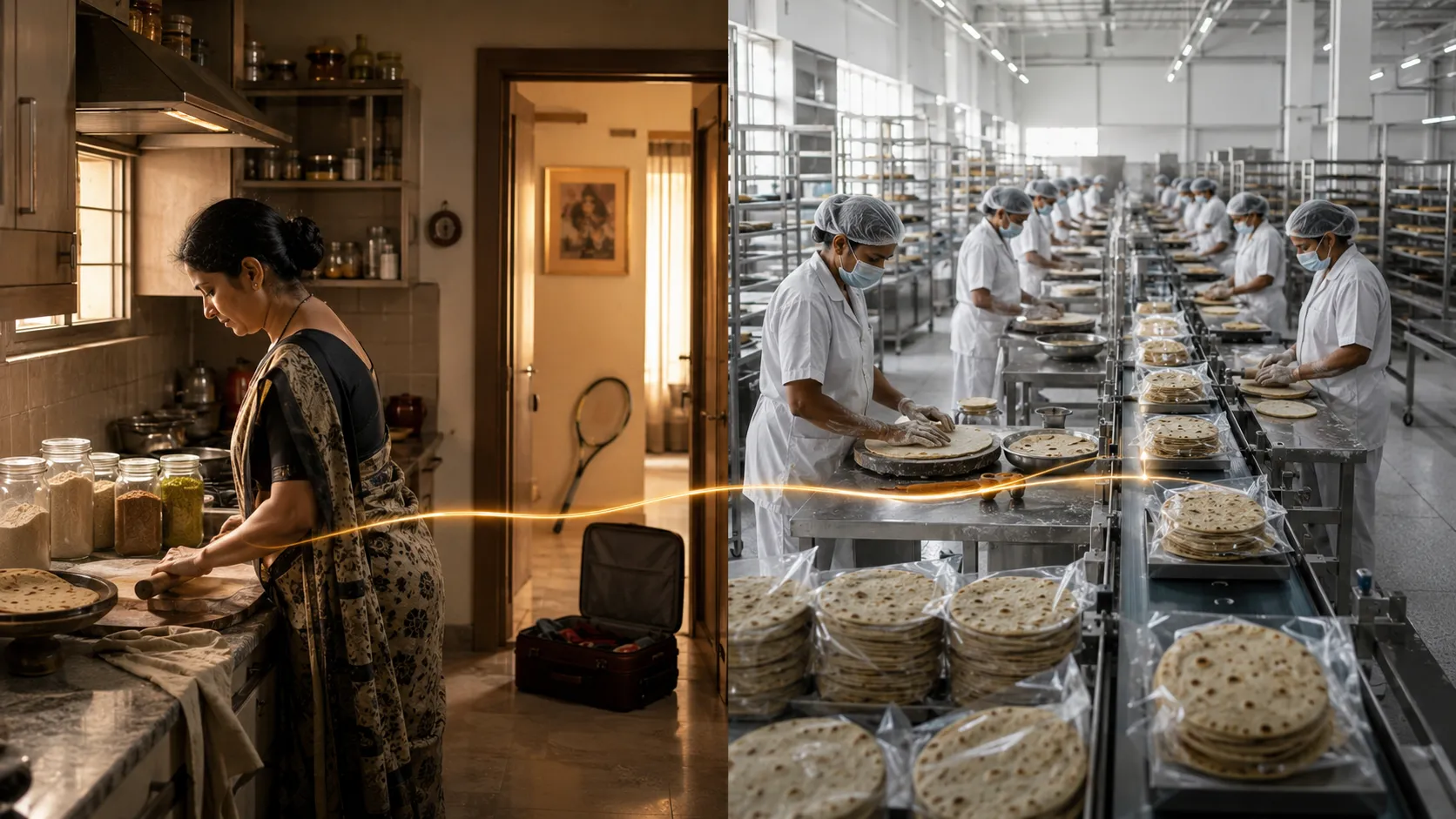
HYDERABAD — May 26, 2026 — For nearly two decades, Prathima Viswanath had one job that mattered more than any other: feeding her daughter. Not just any food—the right food. Nutritious, homemade, capable of surviving long journeys without spoiling, and portable enough to be carried across continents in a travel bag. Her elder daughter was a competitive tennis player, and Prathima had spent years accompanying her to tournaments across Africa and Asia. She had watched other mothers struggle with the same impossible equation: how do you feed a travelling athlete food that is neither fried nor oily, that meets caloric requirements, that tastes like home, and that does not require a kitchen to prepare?
She became an expert by necessity. She learned which chapatis could stay fresh for days, which batters could survive without refrigeration, which chutneys could travel in a jar. She infused her rotis with superfoods—moringa, ragi, methi—not because they were fashionable, but because her daughter needed the nutrition. She designed an entire portable kitchen around the needs of a young athlete who could not afford to eat badly. And then, in 2019, her daughter received a sports scholarship to study in the United States—and Prathima found herself standing in an empty kitchen, a mother whose purpose had just boarded a flight to another continent. "When my daughter received a sports scholarship to study in the US, I knew that the time had come for me to do something," she told The Better India.
She did not have a business plan. She had a conviction—forged across years of tournaments, travel cookers, and the quiet desperation of trying to feed a child who was always moving—that the problem she had solved for her own family was a problem that millions of Indian mothers were still struggling with every day. She recruited her husband, Viswanath—full name Nagasai Viswanath Saridey, a businessman who had spent years working in Africa while Prathima managed the household alone—as her co-founder. Together, they launched Ammamma's in 2019 with an initial investment of ₹10 lakh from their savings, operating from a 500-square-foot space with just three employees. The name means "maternal grandmother" in Telugu—a tribute to the source of all authentic home cooking, and a promise embedded in the brand.
Six years later, Ammamma's—owned by Mangamma Foods Private Limited—is one of India's fastest-growing packaged food brands. It sells over 90,000 chapatis daily, has achieved a turnover of ₹9.6 crore, and is growing at 40 percent year-on-year. Its products are available in more than 800 stores across Hyderabad, Secunderabad, and Bengaluru, as well as on its own website and major e-commerce platforms. The company employs over 130 people. Its product range has expanded from whole-wheat chapatis to a catalogue of over 100 items: methi, ragi, and moringa chapatis, pooris, idli-dosa batters, murukulu, chakodi, boondi, cow ghee, four varieties of chutney (alam or ginger, coconut chana, tomato, and peanut), pickles, millet products, sweets, and cold-pressed oils. The mother who started with a single recipe and a travel cooker has built a packaged food empire—and she did it without a single rupee of venture capital, without a famous co-founder, and without the kind of visibility that the consumer-internet economy bestows on its winners.
The Mother Who Built a Business From an Empty Kitchen
Prathima Viswanath was not supposed to be a packaged-food entrepreneur. She was an MBA graduate who had spent two decades focused entirely on raising her two daughters—managing their education, their activities, and in the case of her elder child, the demanding schedule of a competitive tennis player. Her husband worked in Africa for nearly a decade, which meant that Prathima was, for long stretches, a single mother in practice if not in name. She handled everything: the school runs, the tournaments, the younger daughter's extracurriculars, the endless logistics of keeping a family fed, clothed, and functional. She was good at it. She was also, by her own later admission, building a set of skills that she did not yet recognise as entrepreneurial.
The tennis tournaments were the crucible. Prathima accompanied her daughter across African and Asian countries, and on every trip, the same problem presented itself: how to provide nutritious, homemade food that could survive long travel hours without spoiling. "I struggled to make food that could be carried for long periods of time—food that isn't fried or oily, yet meeting the caloric requirements," she told The Better India. She could not rely on restaurant meals, which were unpredictable and often unsuitable for an athlete's nutritional needs. She could not cook fresh in hotel rooms that lacked kitchens. She needed food that was portable, shelf-stable, and genuinely healthy—and she needed it in quantities sufficient to sustain a growing athlete through days of competition.
She began experimenting. She developed recipes for chapatis that stayed fresh longer than conventional rotis—infused with whole wheat, ragi, moringa, and methi for added nutrition. She perfected batters that could travel without refrigeration. She created chutneys that could be packed in jars and carried across borders. Over the years, she designed what was essentially a portable kitchen—a system of foods that could be prepared in advance, transported without spoilage, and consumed without reheating. The system worked so well that other mothers on the tennis circuit began asking her for recipes, for advice, for the chapatis themselves. Prathima, who had never thought of herself as a businesswoman, began to wonder whether what she had built for her daughter could be built for others.
The moment of decision arrived when her daughter received a sports scholarship to study in the United States. The child who had been the centre of Prathima's culinary life for nearly two decades was leaving—and with her departure, the purpose that had driven years of experimentation suddenly vanished. "I felt a sense of vacuum," Prathima said. But she also recognised something else: the gap in the market that she had experienced firsthand was not unique to her. Millions of Indian mothers faced the same dilemma—the desire to provide homemade food in a world where time constraints were inescapable. The recipes she had developed for her daughter, she realised, were a business waiting to be born.
In 2019, with her husband Viswanath—who had returned from his years of working abroad—she launched Ammamma's. They invested ₹10 lakh of their own savings. They hired three employees. They began by selling whole-wheat chapatis to families in Hyderabad's gated communities, distributing them directly to customers who had heard about the brand through word of mouth. The response was immediate. The chapatis were fresh, preservative-free, made from 100 percent whole-wheat chakki-fresh atta, and they tasted like home—because they were made the way home cooking is made, just at a larger scale. Within months, the brand had outgrown the gated communities and was being stocked in modern trade stores across Hyderabad. Within years, it had expanded to more than 800 stores across Telangana, Andhra Pradesh, and Bengaluru, with plans to go national.
The 90,000-Chapati Machine
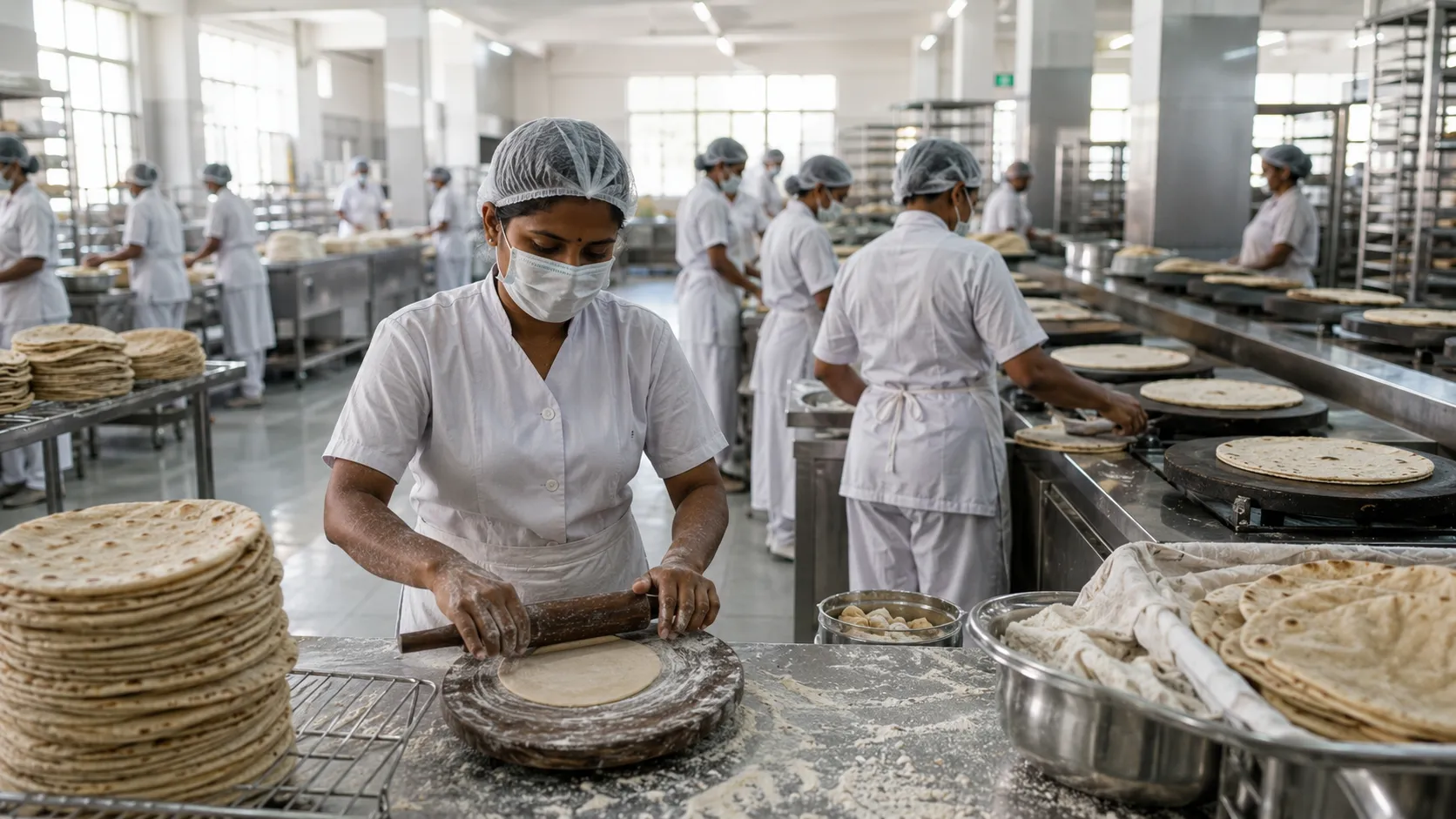
The single most impressive operational achievement of Ammamma's is not the revenue or the growth rate. It is the chapati. Specifically, the 90,000 chapatis that the company produces every single day—each one rolled by hand, cooked on a tawa, and packaged for sale across hundreds of retail outlets.
The scale of the operation is, by the standards of the Indian packaged-food industry, extraordinary. Most ready-to-cook chapati brands operate at a fraction of Ammamma's volume, and most of them rely on mechanised production lines that sacrifice texture and taste for efficiency. Prathima's kitchen, by contrast, is built around the same process that she used in her home kitchen—just multiplied. The dough is made fresh each day from 100 percent whole-wheat atta, stone-ground in a traditional chakki. The chapatis are rolled by hand—a deliberate decision that preserves the texture and the slight irregularity that distinguishes a home-cooked roti from a machine-made one. They are cooked on large tawas, allowed to cool, and then packaged in sealed pouches that give them a shelf life of up to seven days without preservatives. "Ammamma's chapatti is made of 100 percent whole wheat chakki-fresh atta and follows food product guidelines from good authorities," Viswanath told Daijiworld. "They have a shelf life of seven days."
The company now employs over 130 people, the vast majority of them women—a deliberate choice that reflects Prathima's conviction that the skills that women have always possessed in Indian kitchens are commercially valuable and deserve to be compensated as such. The women who roll the chapatis, who prepare the batters, who pack the boxes, and who manage the quality control are, in many cases, women who had never held formal jobs before joining Ammamma's. Prathima trains them herself, and the kitchen she has built is designed to accommodate their lives—flexible hours, safe working conditions, and the dignity of formal employment. "Hiring the right people was always more important than hiring more people," she has said, and the culture of the company reflects that priority.
The product range has expanded steadily from the original whole-wheat chapati. The brand now offers methi chapatis, ragi chapatis, and moringa chapatis—each one formulated to provide specific nutritional benefits while retaining the taste and texture of a home-cooked roti. Pooris and idli-dosa batters followed, along with a range of traditional South Indian snacks: murukulu, chakodi, boondi. Cow ghee—pure, handmade, and essential to the South Indian kitchen—was added to the catalogue. Four varieties of chutney—alam (ginger), coconut chana, tomato, and peanut—were launched in 2023, completing the meal. The bestsellers remain the whole-wheat chapatis, the idli-dosa batter, and the methi chapatis, each of which has built a loyal customer base that returns week after week. The company's customer base now exceeds 10 lakh people, with online sales accounting for approximately 10 percent of revenue.
The expansion has not been without cost. Getting products onto retail store shelves involved significant investment in distribution, branding, and the relationships required to convince store managers to stock an unfamiliar product. "Getting the right distributors and convincing stores to stock your product is not a cakewalk," Prathima told The Better India. "We have pumped in almost all of our savings into this, which is more than ₹4 crore." The investment has paid off—the company is growing at 40 percent year-on-year, its products are available in more than 800 stores, and the brand is poised to expand across India in the next five years. But the journey from 500 square feet to ₹9.6 crore was not a straight line, and the couple who built it have risked everything they had to get there.
The Husband Who Came Home
The most strategically significant dimension of the Ammamma's founding story is not Prathima's recipes. It is her husband's return. Nagasai Viswanath Saridey had spent nearly a decade working in Africa—a common path for Indian professionals seeking international experience and higher earnings—while Prathima managed the household, raised the children, and navigated the tennis circuit alone. The arrangement was practical, but it meant that when Prathima decided to launch the business in 2019, she was effectively doing it as a solo founder with a remote co-founder.
Viswanath's return to India, and his decision to join the business full-time, was the moment Ammamma's became a true family enterprise. He brought complementary skills to the partnership: business experience, operational expertise, and the financial discipline that a capital-intensive food-manufacturing business requires. Prathima remained the creative force—the product developer, the quality controller, the keeper of the culinary philosophy that defined the brand. Viswanath became the operator—handling distribution, retail relationships, and the scaling of production from a cottage operation into a professional enterprise. The division of labour was organic, born of years of partnership and a shared commitment to the vision that Prathima had launched from their home kitchen.
The dynamic echoes a pattern that appears across many of India's most successful family-run food businesses: a woman who understands the product at a visceral level, and a man who understands the market. The partnership works not because the roles are gendered, but because each founder stays in their lane, and each lane is essential to the whole. Prathima does not try to negotiate with distributors. Viswanath does not try to formulate new chutney recipes. They trust each other's judgment in their respective domains, and that trust has allowed them to move faster, argue less, and execute more consistently than many venture-backed startups with larger teams and deeper pockets.
The company's structure reflects the family ethos. It is owned by Mangamma Foods Private Limited—the name itself a tribute to the maternal grandmother, the "ammamma" who is the source of all culinary wisdom in the Telugu household. The brand identity is built around the same figure: the grandmother whose cooking was always the best, whose recipes were always the most authentic, and whose kitchen was always open. The customer who buys an Ammamma's chapati is not just buying a roti. They are buying a promise—that this food was made the way her grandmother would have made it, with the same ingredients, the same care, and the same refusal to compromise on quality.
The company has plans to expand across India in the next five years, building on the foundation of its existing presence in Telangana, Andhra Pradesh, and Bengaluru. The expansion will require capital, and the couple has indicated they are open to raising funds for growth—but they have also been deliberate about not rushing. The business is profitable, the growth is organic, and the brand has been built on trust that took years to establish. The mother who started with a single recipe and a travel cooker is in no hurry to become the next multinational. She is building something that will last—and she is building it at her own pace.
What This Signals
The Ammamma's story is not primarily about chapatis. It is about the structural neglect of the Indian mother's time—and about what happens when a mother decides that the problem she solved for her own family can be solved for millions of others.
For generations, the Indian packaged-food industry has been built around a single, unexamined assumption: that the primary customer for convenience foods is the young, urban professional who lacks the time or the skill to cook. The instant noodles, the frozen parathas, the ready-to-eat meals—all of them were designed for the bachelor, the student, the office worker who wanted something quick and did not care very much whether it tasted like home. The mother who wanted to feed her children homemade food but could not find the time to cook was invisible to the industry. The industry assumed she would cook anyway—because mothers always cooked, because that was what mothers did, because the labour of the Indian mother was not a market opportunity but a cultural given.
Prathima Viswanath broke that assumption. She did not build a convenience food for single professionals. She built a convenience food for mothers like herself—women who knew exactly what their children should be eating, who cared deeply about nutrition and quality, and who simply did not have the hours required to produce it from scratch every day. The whole-wheat chapati that could be heated and served in minutes, the idli-dosa batter that eliminated the soaking and grinding, the chutney that replaced the labour of stone-grinding spices—each of these products was designed to give a mother back something the market had never valued: her time. The 90,000 chapatis that Ammamma's produces every day are not just chapatis. They are hours—hours that mothers are now spending with their children, at their jobs, on their own health, rather than standing in front of a tawa.
The broader context is an Indian food industry that is in the early stages of a structural transformation. The same forces that reshaped food in the West—the entry of women into the workforce, the collapse of domestic help as a reliable institution, the growing awareness of nutrition and its connection to health—are now arriving in India. The market for healthy, preservative-free, home-style packaged food is large, underserved, and growing, and the companies that recognised it earliest—Ammamma's, iD Fresh Food, MTR Foods—have captured a disproportionate share of the value it has created. The difference with Ammamma's is that it was built not by a corporate strategist who identified a market gap, but by a mother who had lived in that gap for two decades and who understood, at a visceral level, what the customer needed. The understanding is not market research. It is experience, and the experience has produced a brand that no amount of advertising could replicate.
Prathima Viswanath is no longer the mother standing in an empty kitchen, wondering what to do with the skills she had spent decades building. She is the founder of one of India's fastest-growing packaged-food brands, the employer of 130 people—most of them women—and the quiet, persistent embodiment of a truth that the food industry has spent generations learning: that the person who cooks for her family is not just a homemaker. She is an expert, and the expertise she has accumulated over years of feeding the people she loves is commercially valuable. The tennis scholarship that sent her daughter to America emptied her kitchen and filled her calendar. The business she built to fill the emptiness now feeds tens of thousands of families.


