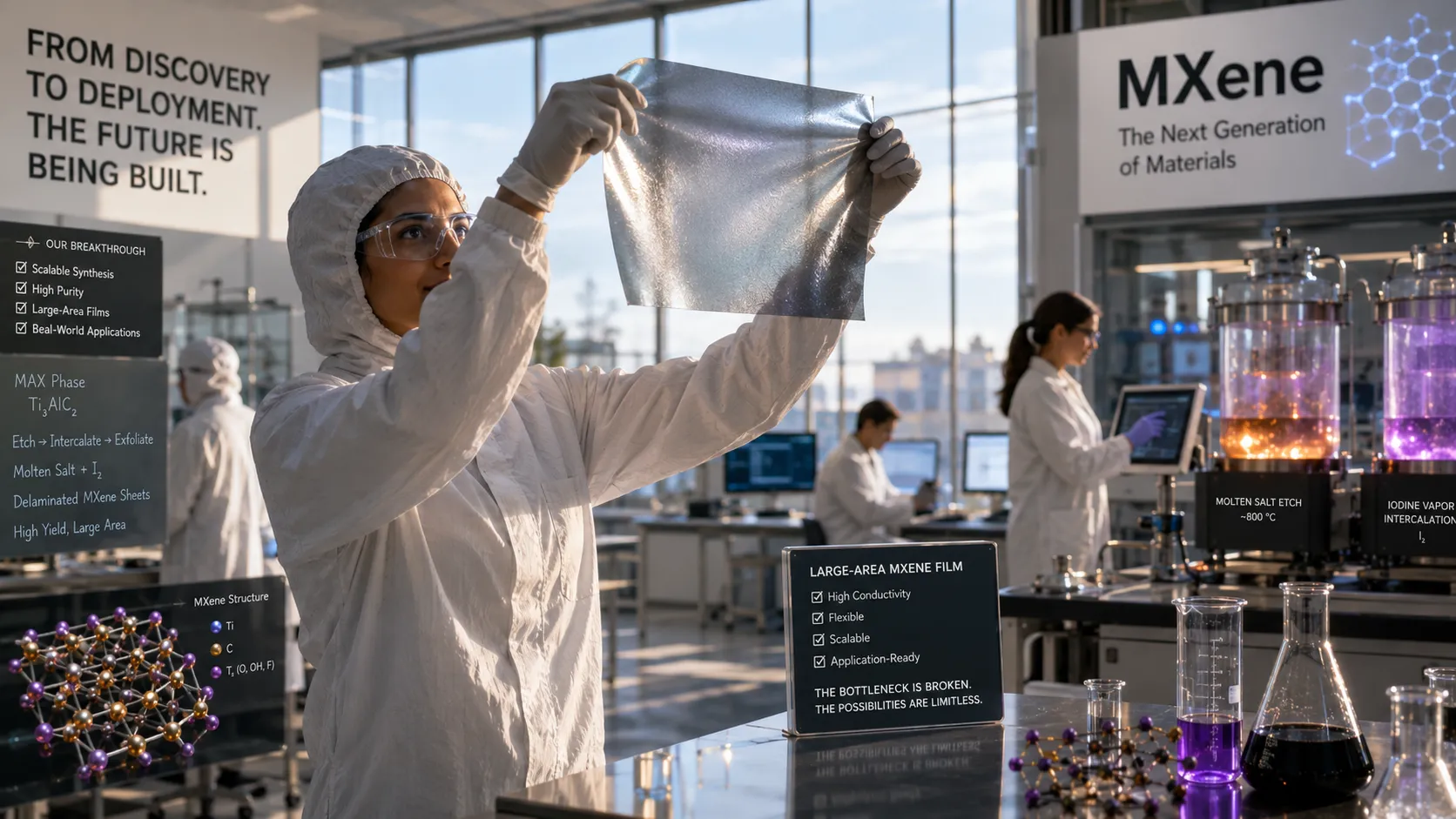
The Molten Salt Alchemy: How a 160x Conductivity Breakthrough Just Unleashed the Next Generation of Ultra-Thin Materials
DRESDEN — May 2026 – In 2011, a team of materials scientists at Drexel University discovered a new family of ultra-thin materials that seemed almost too good to be true. Called MXenes, these atomically thin layers of transition metal carbides and nitrides promised extraordinary electrical conductivity, mechanical strength, and chemical versatility. They were touted as candidates for next-generation batteries, supercapacitors, electromagnetic shields, water purification membranes, and more. Papers proliferated. Patents were filed. Excitement built.
And then, quietly, progress stalled.
The problem was not the material itself. It was how it was made. The standard synthesis process used hydrofluoric acid—one of the most dangerous chemicals in industrial use—to etch layers of aluminum from a precursor material. The process was hazardous, difficult to control, and left the MXene surface coated with a random mix of oxygen, fluorine, and chlorine atoms. That surface disorder was not cosmetic. It trapped and scattered electrons, degrading electrical performance in ways that made MXenes unreliable for the applications that most needed them.
Now, after years of painstaking research, a team at the Helmholtz-Zentrum Dresden-Rossendorf and TU Dresden has solved the surface problem. In a study published in April 2026, they described a new gas-liquid-solid synthesis method that uses molten salts and iodine vapor instead of hydrofluoric acid. The result is a MXene with a perfectly ordered surface, no detectable impurities, and an electrical conductivity boost of up to 160 times compared to the same material made by traditional methods.
The Surface Problem
To appreciate what the Dresden team achieved, it helps to understand why surface disorder matters at the atomic scale. MXenes are, by definition, surface-dominated materials. They are typically only a few atoms thick, meaning a significant fraction of their atoms are on the surface, exposed to the environment. Those surface atoms dictate how electrons flow through the material, how it interacts with light and chemicals, and how stable it remains over time.
When MXenes are produced using conventional hydrofluoric acid etching, the surface becomes coated with a random distribution of oxygen, fluorine, and chlorine atoms. This randomness creates what materials scientists call disorder—a landscape of atomic irregularities that scatter electrons like potholes scatter a car's suspension. The result is lower conductivity, inconsistent performance, and difficulty in predicting how a given MXene will behave in a specific application.
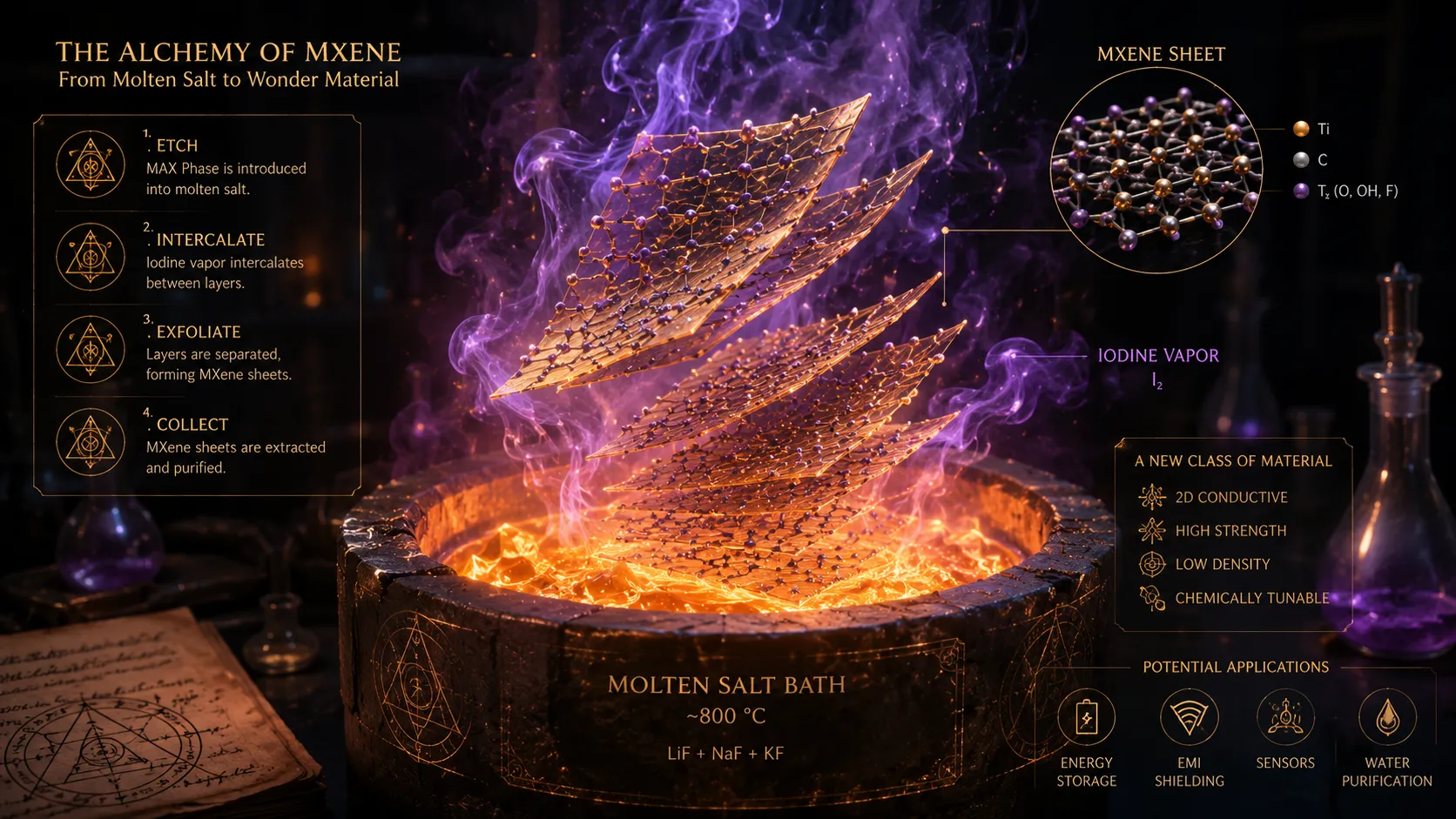
The Dresden team's insight was to replace the messy wet-chemical process with a precisely controlled gas-liquid-solid method. They started with MAX phases—solid precursor materials containing transition metal, aluminum, and carbon or nitrogen. Instead of etching with acid, they used molten salts combined with iodine vapor. The iodine selectively reacts with the aluminum in the MAX phase, removing it layer by layer, while the molten salt provides a controlled environment that allows the researchers to specify exactly which halogen atoms—chlorine, bromine, or iodine—end up on the MXene surface.
The result is a material with a perfectly uniform surface termination. No random oxygen atoms. No fluorine contamination. Just ordered layers of the chosen halogen, arranged in a crystalline pattern that allows electrons to flow with minimal scattering.
The 160x Leap
The team demonstrated the power of their method on titanium carbide MXene (Ti₃C₂), the most widely studied member of the MXene family. When produced conventionally, this material typically contains a mix of chlorine and oxygen on its surface, and its electrical performance reflects that disorder. Using the gas-liquid-solid method, the Dresden team produced Ti₃C₂Cl₂—a version with only chlorine atoms arranged in a clean, ordered structure.
The results were dramatic. Macroscopic conductivity increased by 160 times. Terahertz conductivity improved by a factor of 13. Charge carrier mobility—a measure of how freely electrons can travel through the material—nearly quadrupled. These are not marginal improvements. They are step changes that transform MXenes from promising laboratory curiosities into credible candidates for industrial applications.
The team went further, demonstrating that the method works across eight different MAX phases, producing MXenes with a range of surface terminations and properties. This versatility is crucial because different applications require different material characteristics. A battery electrode needs high ionic conductivity. An electromagnetic shield needs high electrical conductivity. A chemical sensor needs specific surface reactivity. The gas-liquid-solid method allows researchers to tune the surface termination to the application, opening a design space that was previously inaccessible.
What Every Entrepreneur Can Learn
The MXene breakthrough offers transferable lessons for anyone building at the intersection of science and business.
First, the synthesis problem often matters more than the discovery problem. MXenes were discovered in 2011, but their promise was bottlenecked for 15 years by a manufacturing process that was both dangerous and imprecise. The Dresden team did not discover a new material. They discovered a new way to make an existing material properly. Entrepreneurs in advanced materials should ask not just "what can this material do?" but "can we make it cleanly, safely, and consistently at scale?"
Second, surface properties dominate in ultra-thin systems. This principle extends far beyond MXenes. As devices shrink and materials become thinner, the surface—not the bulk—determines behavior. This is true in semiconductors, in battery electrodes, in catalysts, and in sensors. The companies that master surface engineering will capture disproportionate value in every industry where miniaturization is a trend.
Third, the most transformative innovations often replace a dangerous process with a safe one. Hydrofluoric acid is not just imprecise; it is a safety and environmental liability that limits where and how MXenes can be produced. The molten salt and iodine method is cleaner, safer, and more controllable. It expands the addressable market by making production viable in more locations and under less stringent regulatory regimes. Safety is not just a compliance issue. It is a market-expansion strategy.
The Road Ahead
The Dresden breakthrough clears a critical bottleneck, but MXenes still face challenges on the path to commercialization. Scaling the gas-liquid-solid synthesis from laboratory batches to industrial volumes will require engineering work that has not yet been done. Long-term stability—how MXenes behave after years of operation in a battery or a sensor—remains largely unknown. And the competitive landscape is shifting as other ultra-thin materials, including graphene and transition metal dichalcogenides, also advance toward commercial applications.
But the significance of the 160x conductivity improvement is hard to overstate. It transforms MXenes from a material with potential into a material with performance metrics that justify serious investment. The Dresden team has demonstrated that the surface problem that stalled MXene development for over a decade is solvable. The next phase is not about whether MXenes can perform. It is about how quickly they can be integrated into the batteries, supercapacitors, and electromagnetic devices that the world is already building.


