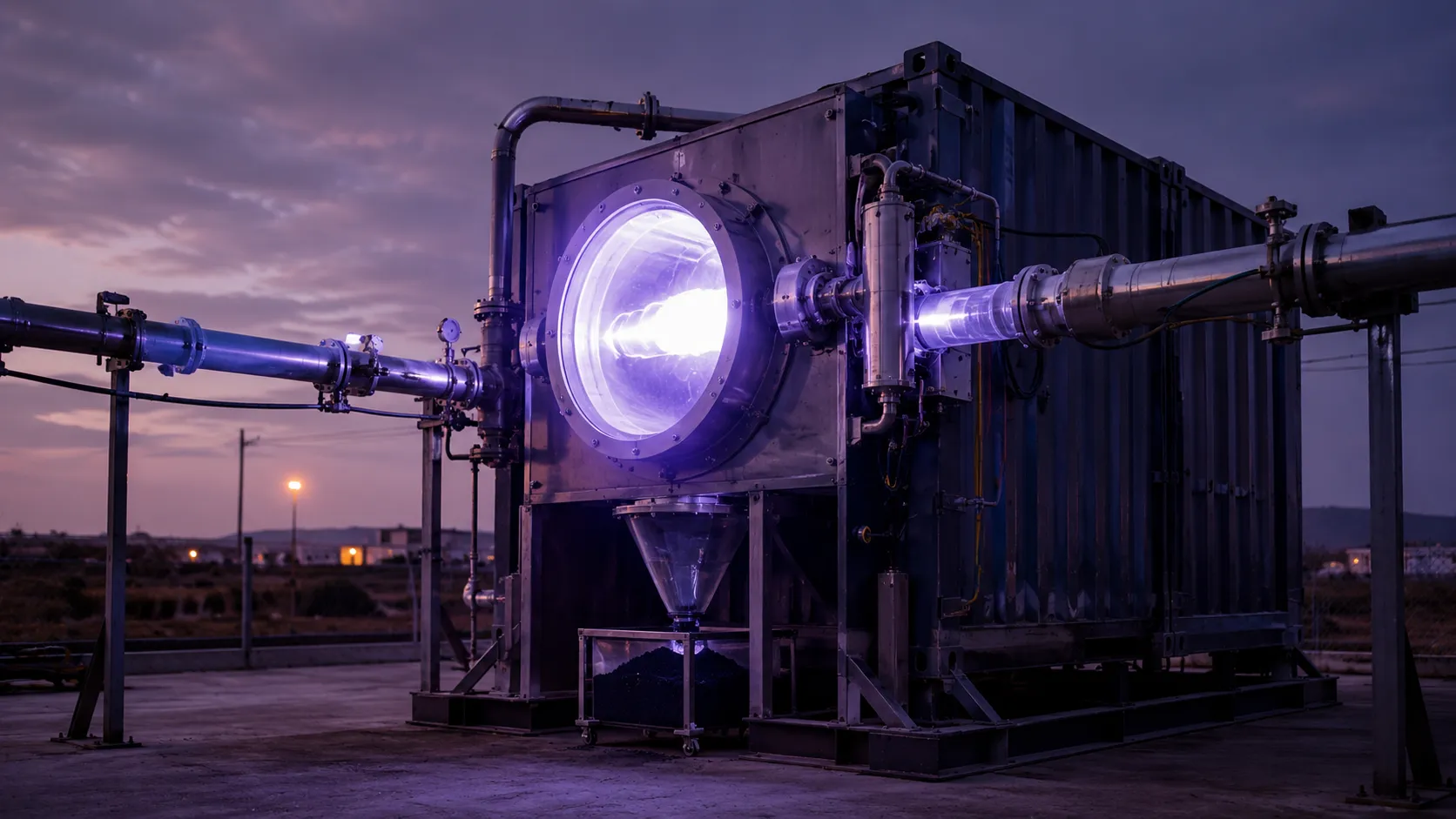
The Microwave Plasma Maverick: How a Belagavi Martial Artist Is Turning Natural Gas Into Clean Hydrogen and Nanocarbon—at the Same Time
BELAGAVI, KARNATAKA — May 21, 2026 — Prakash Mugali did not build his first microwave plasma reactor in a pristine cleanroom or a university laboratory. He built it on the outskirts of Belagavi, a tier-2 city in northern Karnataka, surrounded by foundries, hydraulic shops, and the quiet hum of small-scale manufacturing that most venture capitalists never see. He is a scientist, an engineer, a third-degree black belt in Bruce Lee's martial arts discipline, and—as of this summer—the founder of a company that may have solved one of the hardest dual-output problems in clean energy.
Enerzi, the startup Mugali founded with CEO Kiran Hittalmani, will switch on its first pilot plant this June: a 20-tonne-per-annum facility that uses microwave plasma to split natural gas into two products that the world is desperate for. The first is hydrogen, the clean-burning fuel that governments across the globe are betting will power the decarbonization of steel, cement, shipping, and heavy transport. The second is carbon nanopowder—a material so fine and so valuable that it sells into EV batteries, conductive coatings, conductive polymers, and potentially advanced semiconductors. One input. Two high-value outputs. No combustion. No carbon dioxide released to the atmosphere.
The company has raised approximately ₹20 crore in seed funding led by Capital A, and its prototype machines are already running, producing early batches that are being sent to customers across multiple industries for validation and benchmarking. "We are already supplying materials for evaluation," Mugali said. "That feedback loop is critical before we scale."
The Accidental Discovery
The technology at the heart of Enerzi did not originate in the hydrogen industry. It came from diamonds. In 2019, Mugali and his team began working with the lab-grown diamond industry, developing microwave plasma components and systems used to grow synthetic gemstones layer by atomic layer. The work gave the company deep, hands-on exposure to the microwave plasma ecosystem—the power supplies, the waveguide engineering, the thermal management, the materials science of what happens when you pump kilowatts of microwave energy into a chamber full of gas.
"Hydrogen and carbon nanopowder stood out," Mugali said. "And we realized we could build on our existing expertise in microwave systems." The insight was not that microwave plasma could split methane—that had been known in principle for years. It was that the same plasma systems the company had already built for one industry could be re-engineered for another, and that the economics of producing two high-value products simultaneously could transform hydrogen from an expensive green-fuel aspirant into something commercially competitive with fossil fuels.
The hydrogen market in India is expected to be enormous. The government has set ambitious targets for green hydrogen production, and industrial consumers in steel, refining, and ammonia production are under increasing pressure to decarbonize. But hydrogen is difficult to transport, so Enerzi will focus its hydrogen sales domestically, at least in the near term. "Logistics and supply-chain constraints make hydrogen more of a local play for now," Mugali said. "But India itself is expected to be a major hub, so the demand will be strong."
The carbon nanopowder tells a different story. It is easier to transport, easier to integrate into global supply chains, and in high demand from battery manufacturers—both lithium-ion and lead-acid—as well as companies working on conductive materials and industrial coatings. Enerzi will export nanopowder to international markets while building its domestic customer base. The dual-revenue model hedges the company against the volatility of either market.
The Supply-Chain Hedge Built Into the Technology
One of the most strategically significant features of Enerzi's platform is its feedstock flexibility. The pilot plant in Belagavi runs on piped natural gas, a readily available industrial feedstock. But the microwave plasma reactor is designed to be raw-material agnostic. It can also run on biogas—a resource that India is rapidly scaling through its compressed biogas program, which aims to build thousands of biogas plants across the country.
"That's a key advantage for us," said CEO Kiran Hittalmani. "We are not locked into one type of input." At a moment when manufacturing startups globally are grappling with supply-chain disruptions—natural gas prices that swing with geopolitics, raw material shortages that delay production—Enerzi's fuel flexibility could prove decisive. With biogas infrastructure expanding in parallel, the company is confident it can avoid the feedstock bottlenecks that often plague industrial startups.
The capital discipline is equally unusual. Enerzi raised its seed round, led by Capital A and other angel investors, and has since deliberately held off on raising additional capital. The approach is methodical, almost old-fashioned in a startup ecosystem that often rewards aggressive fundraising over operational milestones. "First, we want to get the pilot operational," Mugali said. "Then we'll evaluate the next phase." If the pilot succeeds, the next step—a tenfold scale-up to a 200-tonne-per-annum commercial plant—could unlock significantly larger funding opportunities and position Enerzi as a serious player in the global hydrogen supply chain.
Why Belagavi, Not Bengaluru
For a deeptech startup, location can be both a constraint and an advantage. Enerzi is based in Belagavi, not Bengaluru, a decision that has puzzled some investors. The reasons are both personal and strategic. Mugali grew up in Belagavi and began his career there before spending time in Bengaluru. But beyond familiarity, the city offers tangible benefits: a strong base in hydraulics and foundries, a culture of small-scale manufacturing, and significantly lower operating costs than India's major technology hubs.
"It's a place full of entrepreneurs building things," Mugali said. The company still relies on larger cities like Bengaluru, Pune, and Mumbai for specialized capabilities and ecosystem support. But access to capital has not been a constraint. "Today, most investor conversations happen online. Once there is interest, geography doesn't matter."
The team has grown to about 70 people, with nearly 80 percent of the workforce in technical roles. A significant portion is focused on research, with the rest spread across engineering, production, and administration. The company is now gearing up for aggressive hiring as it prepares to scale operations and build its first commercial plant. Hittalmani, who joined as CEO in 2023 after a stint at Bosch, brought deep experience in the automotive and energy sectors that has been instrumental in shaping Enerzi's industrial direction.
The Martial Artist's Approach to Building
What makes Mugali's story stand out is not just his technical journey but what runs parallel to it. For more than a decade, he has been deeply immersed in martial arts, particularly Bruce Lee's philosophy. He has trained consistently since 2012, earned a third-degree black belt, and represented India at an international championship in Russia.
"It started as an interest, but it became something much deeper," he said. The discipline, resilience, and mental clarity that come with martial arts have shaped his approach to entrepreneurship. Building a deeptech company is rarely a story of quick wins. It requires patience, persistence, and the ability to navigate long cycles of uncertainty—qualities that Mugali credits directly to his training. "It's not about how much time you spend, but how consistently you show up."
That consistency is about to be tested. The pilot plant goes live in June. The customer feedback loop is already running. The tenfold scale-up is on the horizon. And a company built in a tier-2 city by a martial artist who learned microwave plasma from the diamond industry is about to find out whether the world wants what it can make.


