The Metal That Could Not Be Explained: How a Hong Kong Lab Built a Super Steel to Unlock the Hydrogen Economy
HONG KONG — May 2026 – For more than a century, stainless steel has protected itself the same way. Chromium inside the alloy reacts with oxygen to form an invisible, corrosion-resistant film—a passive shield no thicker than a few atoms, yet strong enough to guard bridges, ships, and surgical tools from the relentless assault of rust. It is one of the quiet miracles of materials science, a trick of chemistry so reliable that humanity has come to take it entirely for granted.
But inside a hydrogen electrolyzer, that ancient defense collapses. The voltage required to split water into hydrogen and oxygen—roughly 1,600 millivolts—punches straight through the chromium oxide layer, oxidizing it into soluble fragments that dissolve into the electrolyte. Even the most corrosion-resistant super stainless steels on the market, alloys like 254SMO designed for aggressive seawater environments, cannot survive at these potentials. The industry's workaround has been expensive and inelegant: build the electrolyzer out of titanium, coat it with platinum or gold, and accept that the structural materials alone will consume more than half the capital cost of the entire system.
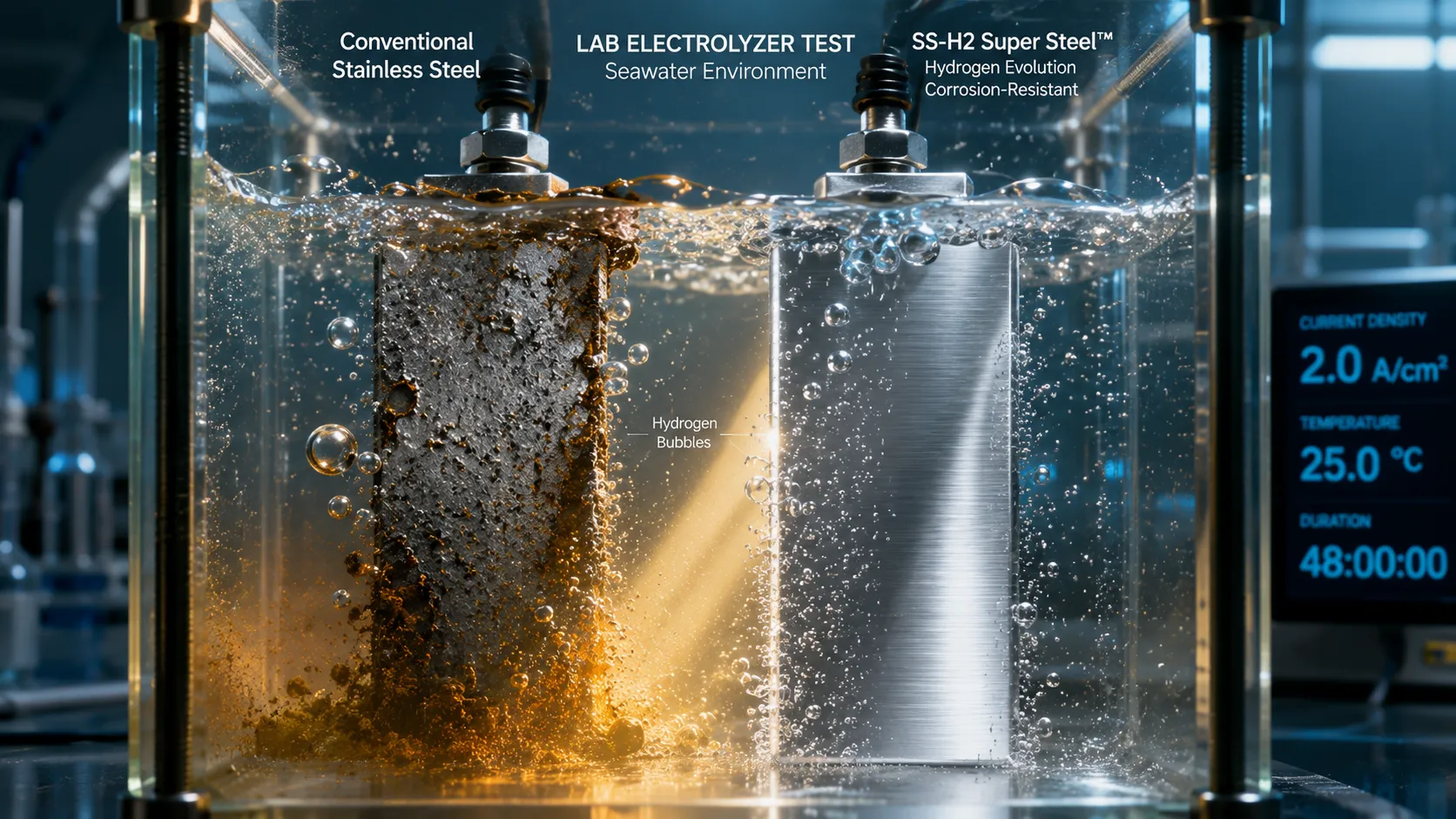
That workaround may be coming to an end. On May 10, 2026, a team at the University of Hong Kong led by Professor Mingxin Huang published a study in Materials Today describing a new stainless steel alloy—designated SS-H2—that does something no stainless steel has done before. It protects itself twice. First with chromium, as steel has done for a hundred years. Then, at higher voltages, with a second layer of manganese that forms on top of the first, creating a sequential dual-passivation mechanism that allows the material to operate stably at potentials up to 1,700 millivolts—comfortably within the range required for water splitting. The discovery was so counterintuitive that the researchers themselves did not believe it at first.
The Manganese Mystery
Manganese has been the black sheep of stainless steel metallurgy for as long as anyone can remember. Standard textbooks teach that manganese impairs corrosion resistance. It is added to steel for other reasons—to improve hot-working properties, to bind with sulfur—but when it comes to fighting rust, metallurgists have treated it as a liability to be minimized, not an asset to be exploited. The idea that manganese could form a protective passive layer at high electrochemical potentials was, until the HKU team's work, not merely unknown. It was considered impossible.
The discovery emerged from a six-year investigation that began, as many breakthroughs do, with a puzzling observation. The team noticed that a particular stainless steel composition was behaving strangely under high-voltage conditions. Instead of degrading as expected, it seemed to stabilize. The researchers spent years chasing the mechanism, using atomic-level characterization techniques to understand what was happening at the metal-electrolyte interface. What they eventually found was a sequential process: the chromium oxide layer forms first, as conventional theory predicts, but then—at around 720 millivolts—a manganese-based layer begins to grow on top of it. The two layers work in tandem, each protecting against different degradation pathways, extending the material's stable operating range into territory that no stainless steel had ever reached.
The counterintuitive nature of the discovery made it difficult to publish. Reviewers were skeptical. The corrosion science community had built decades of research on the understanding that manganese was harmful to passivation. The HKU team had to produce overwhelming atomic-level evidence before the work was accepted. When Materials Today finally published the study, the headline finding was striking not just for what it achieved, but for what it overturned: a fundamental assumption about how metals protect themselves had been wrong, or at least incomplete, and the correction had opened a door that no one knew was there.
The Titanium Problem
To understand why SS-H2 matters, one must first understand the economics of green hydrogen.
Green hydrogen is produced by using renewable electricity to split water into hydrogen and oxygen. When the water is seawater—abundant, free, and covering 71% of the planet—the process is called direct seawater electrolysis. It is, in theory, one of the most promising pathways to a decarbonized energy system. In practice, it has been held back by a single, stubborn bottleneck: seawater destroys electrolyzer components. Salt corrodes metal. Chloride ions trigger side reactions. Catalysts degrade. The structural materials that hold the system together must survive an environment that combines high voltage, high salinity, and high acidity, and very few materials can manage all three.
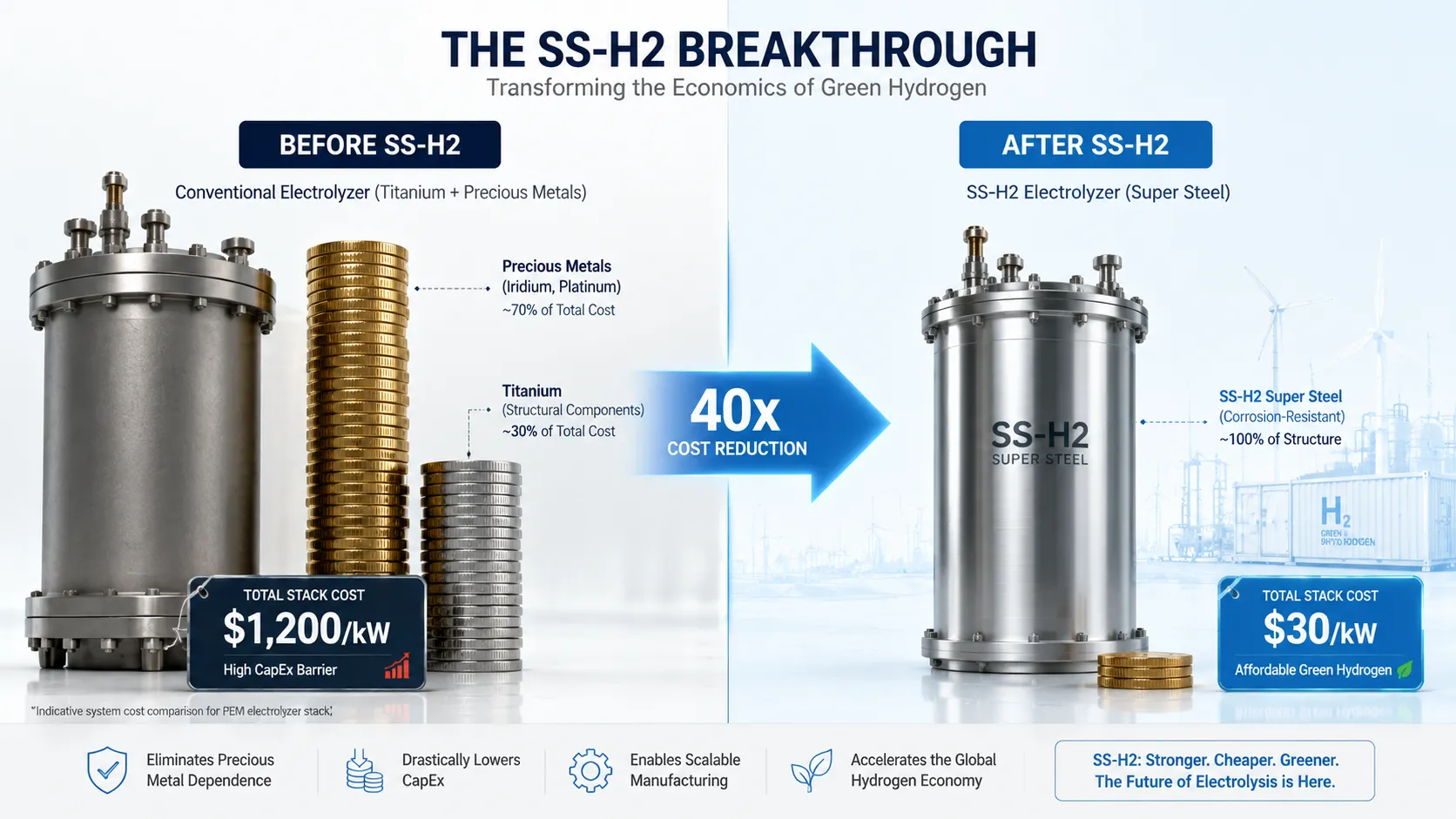
Current industrial practice relies on titanium components coated with precious metals like platinum or gold. These materials work. They are stable. They are also ruinously expensive. In a 10-megawatt PEM electrolysis tank system, the total cost at the time of the HKU report was estimated at approximately HK$17.8 million, with structural components consuming as much as 53% of that figure. The team estimates that replacing titanium-based structural materials with SS-H2 could reduce those costs by approximately 40 times. Even a more conservative real-world estimate—accounting for manufacturing scale-up, quality control, and system integration—would represent a dramatic reduction in the capital cost of green hydrogen production.
The implications extend beyond a single number. Green hydrogen has long been trapped in a chicken-and-egg problem: it is too expensive to deploy at scale, but without scale, costs cannot come down. The expensive materials inside electrolyzers—titanium, platinum, iridium—are not expensive because of temporary supply chain disruptions. They are expensive because they are rare, difficult to refine, and subject to geopolitical concentration. Stainless steel is none of these things. It is produced by the megaton, in dozens of countries, using supply chains that have been mature for a century. Swapping titanium for a stainless steel that can do the same job is not a marginal improvement. It is a structural shift in the economics of the hydrogen industry.
From Laboratory to Factory Floor
One of the most telling details in the SS-H2 story is how quickly it has moved beyond the laboratory. The research achievements have been submitted for patents. More significantly, tons of SS-H2-based wire have already been produced in collaboration with a factory in Mainland China. The team is working on transforming experimental materials into real products—meshes, foams, structural components for water electrolyzers—and has acknowledged that "there are still challenging tasks at hand." But the direction of travel is unmistakable. This is not a curiosity trapped in an academic paper. It is a material that is already being produced at industrial scale, with a clear line of sight to commercial deployment.
The speed of this translation—from initial discovery to tons of wire—is unusual in materials science, where the journey from lab to factory typically takes a decade or more. The HKU team had an advantage: the Super Steel Project, Huang's long-running research program, had already produced a series of high-profile alloys, including anti-COVID-19 stainless steel in 2021 and ultra-strong, ultra-tough super steels in 2017 and 2020. The infrastructure, the industrial partnerships, and the reputation were already in place when the dual-passivation discovery emerged. The SS-H2 breakthrough is not an isolated achievement. It is the latest chapter in a sustained, two-decade effort to reimagine what steel can do.
The timing is fortuitous. A 2025 Nature Reviews Materials review described direct seawater electrolysis as promising but still held back by corrosion, side reactions, metal precipitates, and limited long-term durability. The core problem identified in that review—corrosion-resistant structural materials—is precisely the problem that SS-H2 appears to solve. The hydrogen industry has been waiting for a materials breakthrough. It may have just received one.
What Every Entrepreneur Can Learn
The SS-H2 story offers lessons that extend far beyond metallurgy.
First, counterintuitive discoveries are worth the fight. When the prevailing view in a field says something is impossible, and you have atomic-level evidence that it is happening anyway, you are not looking at an error. You are looking at a moat. The HKU team spent years convincing reviewers that manganese-based passivation was real because the discovery violated established theory. That very violation is what makes the work defensible. If the mechanism had been obvious, someone would have found it decades ago.
Second, cost reduction is the most underrated form of innovation. The technology press tends to celebrate the new, the fast, and the intelligent. But the history of industrial civilization suggests that the most transformative innovations are often the ones that make something cheaper. The Bessemer process did not invent steel. It made steel affordable. SS-H2 does not invent green hydrogen. It makes green hydrogen affordable. The entrepreneurs who focus on cost reduction rather than feature addition often build the largest and most durable businesses.
Third, materials are infrastructure. The conversation about climate technology tends to focus on energy generation—solar panels, wind turbines, fusion reactors. But the bottleneck in many clean energy technologies is not the energy source. It is the materials that must contain, transport, and convert that energy without being destroyed in the process. The entrepreneurs who solve materials problems—corrosion, degradation, thermal instability—will capture value that is invisible to the consumer but indispensable to the system.
The Road Ahead
SS-H2 is not a panacea. The challenges facing green hydrogen extend beyond structural materials. Catalysts must still be improved. Chlorine side reactions must still be suppressed. System designs that survive real seawater, not just idealized laboratory conditions, must still be developed and tested at scale. A material that works in a research electrolyzer may encounter unforeseen failure modes after years of continuous operation in the field. The gap between a promising alloy and a deployed, bankable technology is real, and it has swallowed many breakthroughs before.
But the direction of travel is unmistakable. The world is investing trillions in the energy transition. Green hydrogen, long considered a promising but expensive niche, is being pulled toward the center of the global energy system by the sheer scale of decarbonization commitments. The International Energy Agency projects that hydrogen demand could grow sixfold by 2050. Meeting that demand will require electrolyzers that are not just efficient, but cheap—cheap enough to deploy by the thousands, in coastal deserts and offshore platforms and industrial zones from Chile to Saudi Arabia to Australia.
Stainless steel has been waiting for this moment for a century. It is strong, abundant, and understood. What it lacked was a way to survive the voltage. The team in Hong Kong appears to have found one—not by inventing a new material, but by discovering a hidden capability in an old one. The manganese that metallurgists had dismissed as a corrosion liability turned out to be, under the right conditions, a shield. The prevailing view was wrong. The textbooks will need to be rewritten. And the hydrogen economy, for the first time, can begin to imagine a future built not on titanium and gold, but on steel.


