The Meat Brand That Vegetarian VCs Refused to Fund: How Two Outsiders Built India's Most Unlikely Unicorn—and Are About to Take It Public at $2 Billion
BENGALURU — May 23, 2026 — When Vivek Gupta walked into his first investor meeting for Licious a decade ago, he thought he was ready. He had a pitch deck. He had a co-founder. He had a thesis—that India's ₹4 lakh crore meat and seafood market was a branding desert waiting for someone to build a premium, trust-driven consumer label. What he did not have was an answer for the question that would define the next two years of his life. The investors in the room were mostly vegetarian. Some were religiously observant. Several told him, in the polite, elliptical language of Indian venture capital, that they could not bring themselves to fund a meat company. Others made a more pragmatic suggestion: pivot to plant-based protein, and the money would flow. Gupta and his co-founder, Abhay Hanjura, refused. "I thought I knew how to raise money," Gupta recalled later. "Then I walked into a room full of VCs."
That room—and the dozens of rejections that followed—now belongs to the folklore of Indian entrepreneurship. Licious closed FY26 with net revenue of ₹1,166 crore, a 47 percent year-on-year leap from ₹795 crore in FY25. The company operates more than 60 physical stores, plans to build 400 dark stores, delivers fresh meat and seafood in under 30 minutes to 55 percent of its online customers through a service called Flash, and counts Temasek Holdings among its largest backers. It is targeting an initial public offering in 2026 at a valuation of more than $2 billion. The same venture capital industry that once recoiled from its business model has poured over $550 million into the company. The vegetarians, it turns out, were wrong.
The Two Outsiders Who Chose Meat
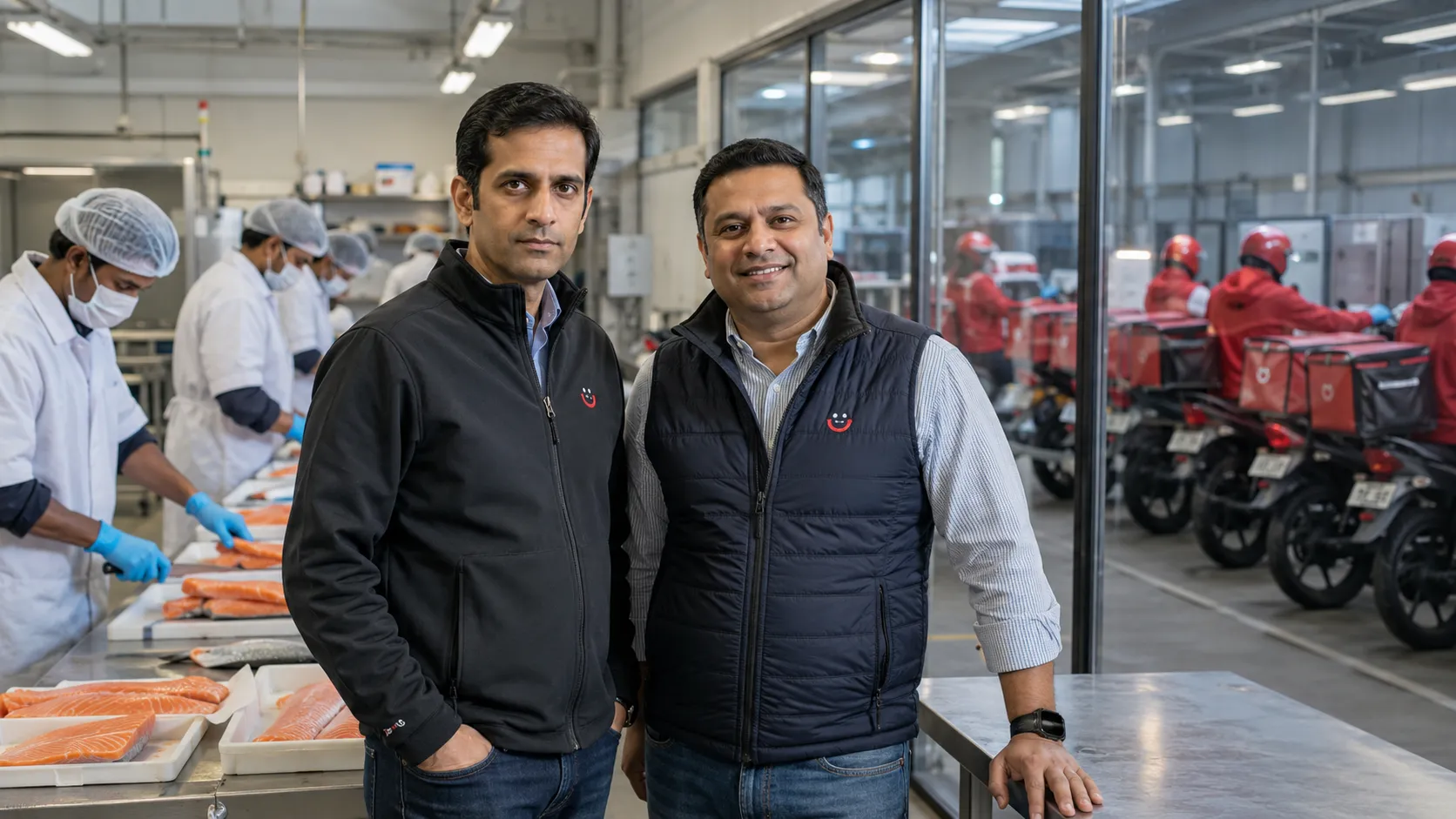
The founding story of Licious begins not with a business plan, but with a friendship. Gupta, a chartered accountant from Chandigarh, moved to Bengaluru to work for a software company. Hanjura, who grew up in Jammu, came to the city in 2004 to pursue a degree in biotechnology and genetics at Bangalore University. The two met through mutual friends, bonded over a shared frustration with the quality of meat available in Indian cities, and spent years discussing—over dinners, on weekend drives, in the idle hours between corporate jobs—the idea of building a meat brand that treated protein the way premium dairies treated milk.
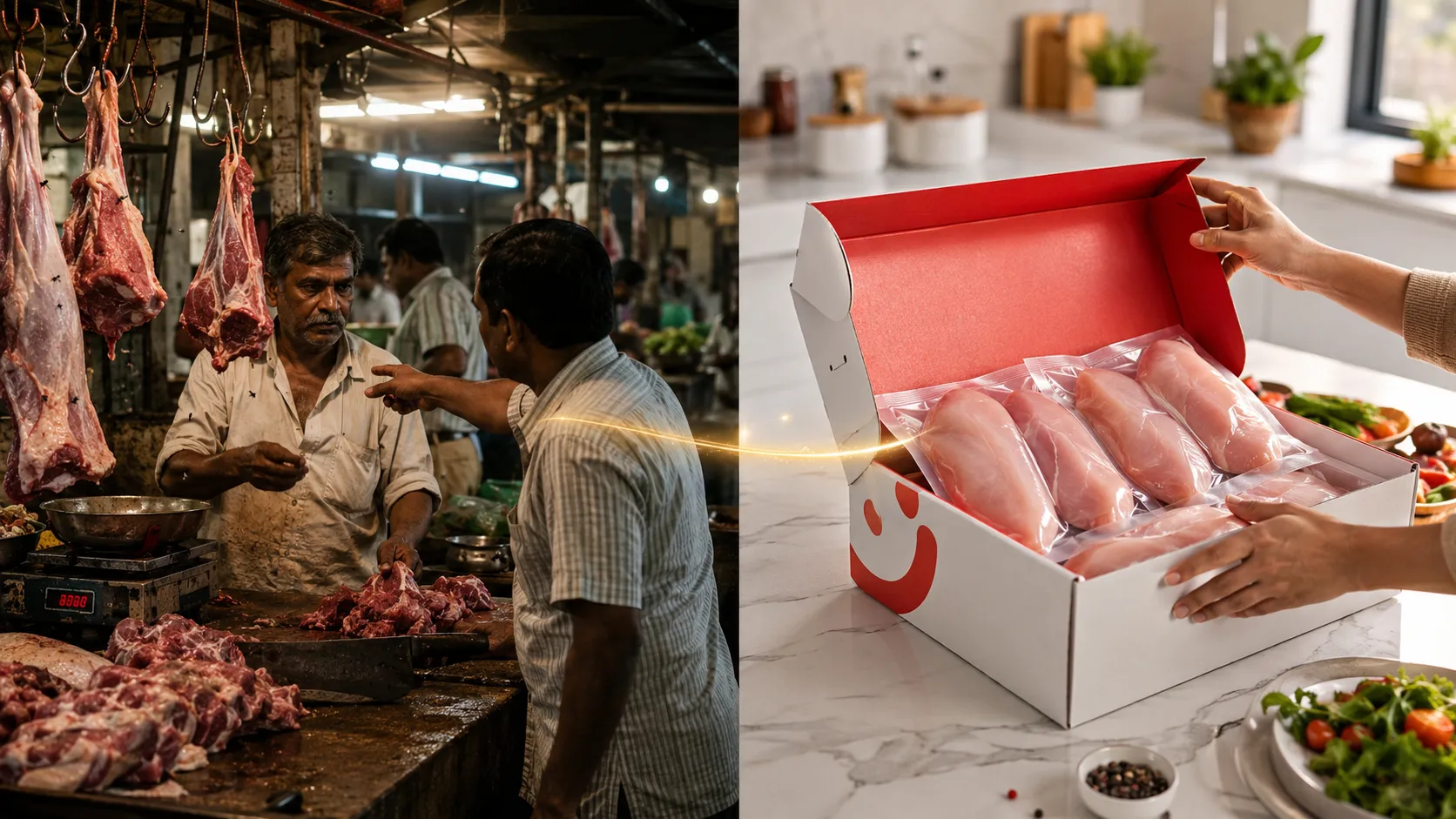
The insight was not complex. India was one of the world's largest consumers of meat, but the supply chain was almost entirely unorganised. Wet markets accounted for the vast majority of sales. There were no national brands. No cold-chain infrastructure. No quality standards that a consumer could trust. The chicken breast you bought from your local butcher might have been handled by six different intermediaries before it reached your kitchen, each one working in ambient temperatures that would make a food-safety inspector weep. "The idea of working in the meat space was always at the back of our mind," Hanjura said. "One day, we just decided to stop talking and start doing."
That decision, made in 2015, was an act of either extraordinary conviction or extraordinary naivete. The Indian startup ecosystem was in the midst of its first great e-commerce boom—Flipkart, Snapdeal, and Amazon were pouring billions into online retail—but almost no one was applying the D2C model to fresh food. The cold-chain infrastructure required to deliver perishable meat within hours was vastly more complex than the warehouse-and-ship model that powered online fashion or electronics. The regulatory environment was fragmented, with different states enforcing different rules on animal slaughter and meat transport. And the cultural stigma—the quiet, persistent assumption that meat was not a "respectable" business for educated, English-speaking founders—was real.
Gupta and Hanjura ignored all of it. They built their first supply chain from scratch: sourcing directly from farmers and slaughterhouses, owning the cold-chain logistics, and delivering to customers' doorsteps in temperature-controlled packaging. The farm-to-fork model, as they called it, was not a marketing slogan. It was the operating system of the company. By controlling every link in the chain—procurement, processing, quality control, cold storage, last-mile delivery—they could guarantee a level of freshness and hygiene that no wet market could match. They could also capture the margin that, in the traditional supply chain, was dispersed across layers of middlemen.
The Growth Math
The numbers tell the story of a company that has crossed the threshold from startup to scaled enterprise. Licious reported net revenue of ₹1,166 crore in FY26, up 47 percent from ₹795 crore in FY25—its highest-ever single-year absolute revenue growth. Online sales remain the primary driver, growing 28 percent to nearly ₹1,000 crore, while offline revenue surged from ₹26 crore to ₹177 crore as the company expanded its physical footprint beyond 60 stores. The company is targeting ₹1,800 crore in revenue for FY27, a 54 percent jump, driven not by entering new cities but by deepening penetration within existing ones.
The most remarkable customer metric is not a growth number. It is a retention number. Repeat customers account for 94 percent of Licious's business. Monthly active users crossed 1.5 million. The 30-minute delivery service, Flash, now serves 55 percent of online customers and has improved both conversion rates and order frequency. The average order value climbed to ₹675. These are not the metrics of a company that is buying growth with discounts. They are the metrics of a company whose customers keep coming back because the product is better than the alternative.
The path to profitability, however, remains incomplete. Licious's EBITDA burn increased to ₹187 crore in FY26 from ₹168 crore a year earlier, driven by investments in dark stores, offline expansion, and delivery infrastructure. But as a proportion of net revenue, the burn narrowed by 5.2 percentage points, indicating improving operating leverage. The company's net loss remained roughly flat at ₹200–210 crore, compared with ₹218 crore in FY25. The trajectory is toward profitability, but the company has not yet arrived.
The micro-market strategy is the engine of that trajectory. Rather than expanding aggressively into new cities, Licious has focused on deepening its presence within Bengaluru, Mumbai, and Delhi NCR—identifying high-density clusters of customers and saturating them with dark stores that can fulfil orders in 30 minutes or less. The company currently operates 130 dark stores and plans to scale to 400 over the next five years, including 70 new additions in FY27 alone. The long-term goal is 120 micro-markets across the top seven Indian cities. Each micro-market functions as a self-contained unit: a dark store, a delivery fleet, a marketing budget, and a local supply chain, all optimised for the specific consumption patterns of that neighbourhood.
This is not a growth strategy borrowed from a Silicon Valley playbook. It is closer to the hub-and-spoke model that Dominos used to dominate pizza delivery, applied to fresh protein. The insight is that meat, like pizza, is a frequency-driven, habit-forming purchase that rewards speed and reliability above all else. The customer who orders chicken breasts every Tuesday evening does not want to comparison-shop. She wants the product to arrive, fresh and cold, within 30 minutes, every single time. Licious has built its entire infrastructure around delivering that promise.
The IPO and the Meat Market That Is Just Opening
Licious is preparing for an initial public offering in 2026, targeting a valuation of more than $2 billion. The company has raised over $550 million from investors including Temasek, 3one4 Capital, and IIFL, and joined the unicorn club in 2021. A pre-IPO funding round is expected before the listing. The public-market debut would be a watershed moment not just for the company, but for the category. India has never had a publicly listed premium meat brand. If Licious succeeds, it will create a template for every other D2C brand in the country's food ecosystem.
The competitive landscape is intensifying. ITC-owned Meatigo, Zepto's Relish, Zappfresh, FreshToHome, and Tendercuts are all pursuing overlapping segments of the market. Quick-commerce platforms—Blinkit, Zepto, Swiggy Instamart—are adding fresh meat to their catalogues, threatening to disintermediate the D2C brands by offering comparable delivery speeds with larger product assortments. Licious's response is to double down on what the platforms cannot replicate: supply-chain ownership. The company does not source from third-party vendors and deliver on someone else's infrastructure. It owns the entire chain, from farm to fork. That ownership gives it control over quality, freshness, and margins that a marketplace model cannot match.
The offline expansion—from ₹26 crore to ₹177 crore in a single year—is both a growth driver and a strategic hedge. Physical stores serve as discovery and trust-building touchpoints for customers who are not yet comfortable buying meat online. They also function as fulfilment hubs for Flash deliveries, collapsing the distinction between retail and e-commerce into a single, unified supply chain. Gupta and Hanjura have been clear that offline is a complement to online, not a replacement. But the complement is growing fast, and the 400-store target suggests the founders see physical retail as a significant part of the long-term picture.
What This Signals
The Licious story is not primarily about meat. It is about the structural transformation of Indian consumption—and about what happens when founders refuse to accept that certain categories are too unglamorous, too unorganised, or too culturally complicated to build a brand in.
For decades, the Indian consumer market was defined by a stark binary. On one side, branded, packaged, premium products—soaps, biscuits, shampoos—sold by large corporations through formal retail. On the other, unbranded, unpackaged, commodity products—meat, vegetables, spices—sold through informal wet markets and kirana stores. The line between the two was not accidental. It was the result of a supply-chain gap that made it impossible to brand perishable goods without owning the cold chain. Licious bridged that gap by building the cold chain itself. In doing so, it proved that a category long dismissed as un-brandable could support a premium D2C brand with high retention, strong unit economics, and a credible path to public-market valuation.
The IPO, when it comes, will test whether the public markets agree. The revenue trajectory is strong. The customer retention is exceptional. The path to profitability, while not yet complete, is visible. The $2 billion valuation target is ambitious—roughly 1.7x FY26 revenue—but not unreasonable for a company growing at 47 percent annually with a category-defining brand.
Vivek Gupta and Abhay Hanjura are no longer the two outsiders who could not get a meeting with a vegetarian VC. They are the founders of India's largest premium meat brand, preparing to take it public at a valuation that would have been unthinkable when they started. The room full of VCs that once rejected them now competes for allocations in their pre-IPO round. The wet markets are still there—India's meat supply chain will take decades to fully formalise—but the brand that proved it could be done is no longer an experiment. It is a company with ₹1,166 crore in revenue, 1.5 million monthly active users, and a conviction that has survived every rejection the market could throw at it. The IPO is just the next course.


