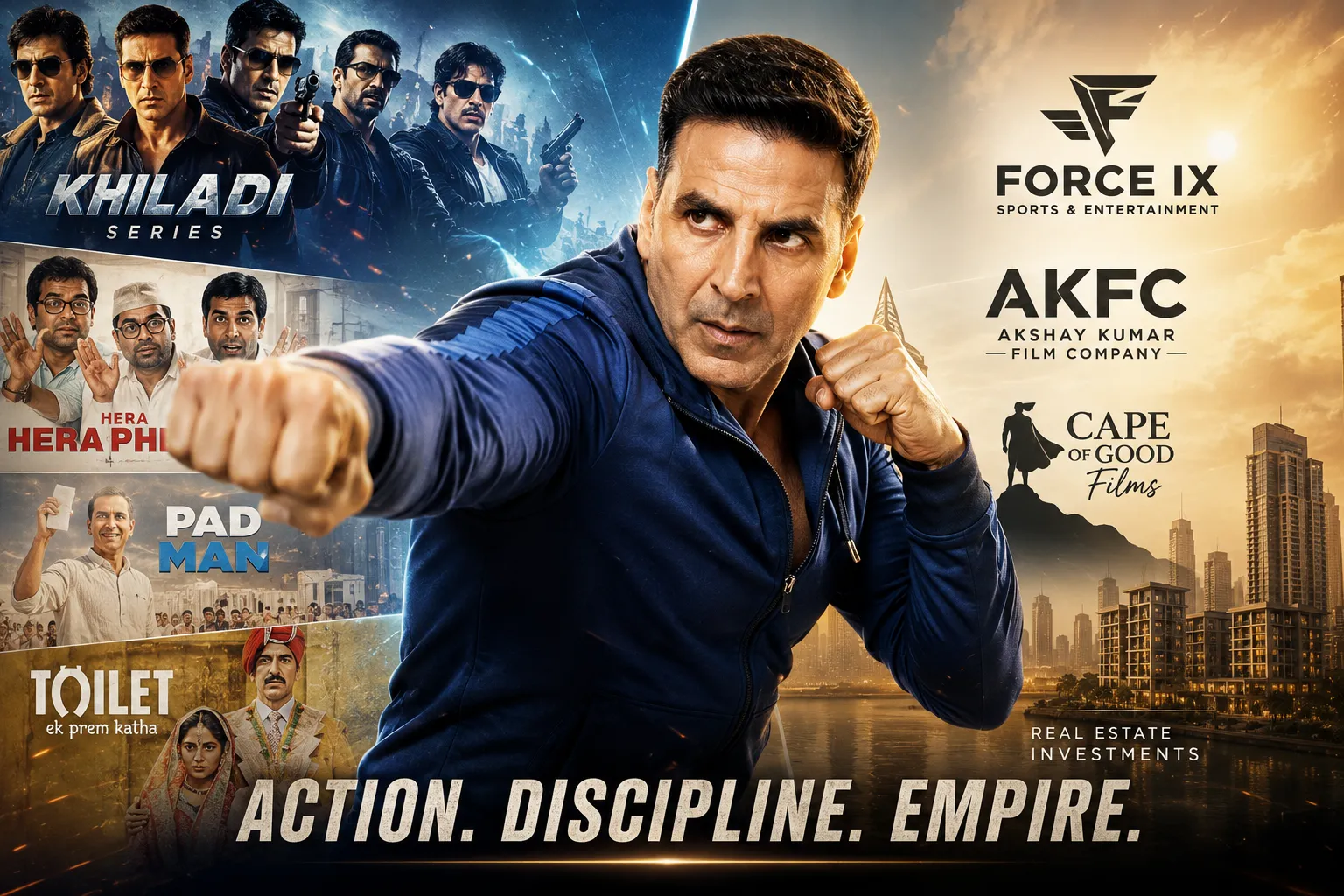
The Machine: How Akshay Kumar Built a ₹2,500 Crore Empire on Relentless Productivity
MUMBAI — May 2026 - From 150+ films to a fitness brand, a real estate portfolio, and the Khiladi label, Bollywood's most disciplined actor has quietly become one of its wealthiest.
The ₹2,500 Crore Question
When the Hurun Rich List 2025 was released, the name that surprised most readers was not Shah Rukh Khan ($1.4 billion) or Juhi Chawla ($560 million). It was Akshay Kumar, with an estimated net worth of $300 million (approximately ₹2,500 crore) — placing him among the top five wealthiest actors in India.
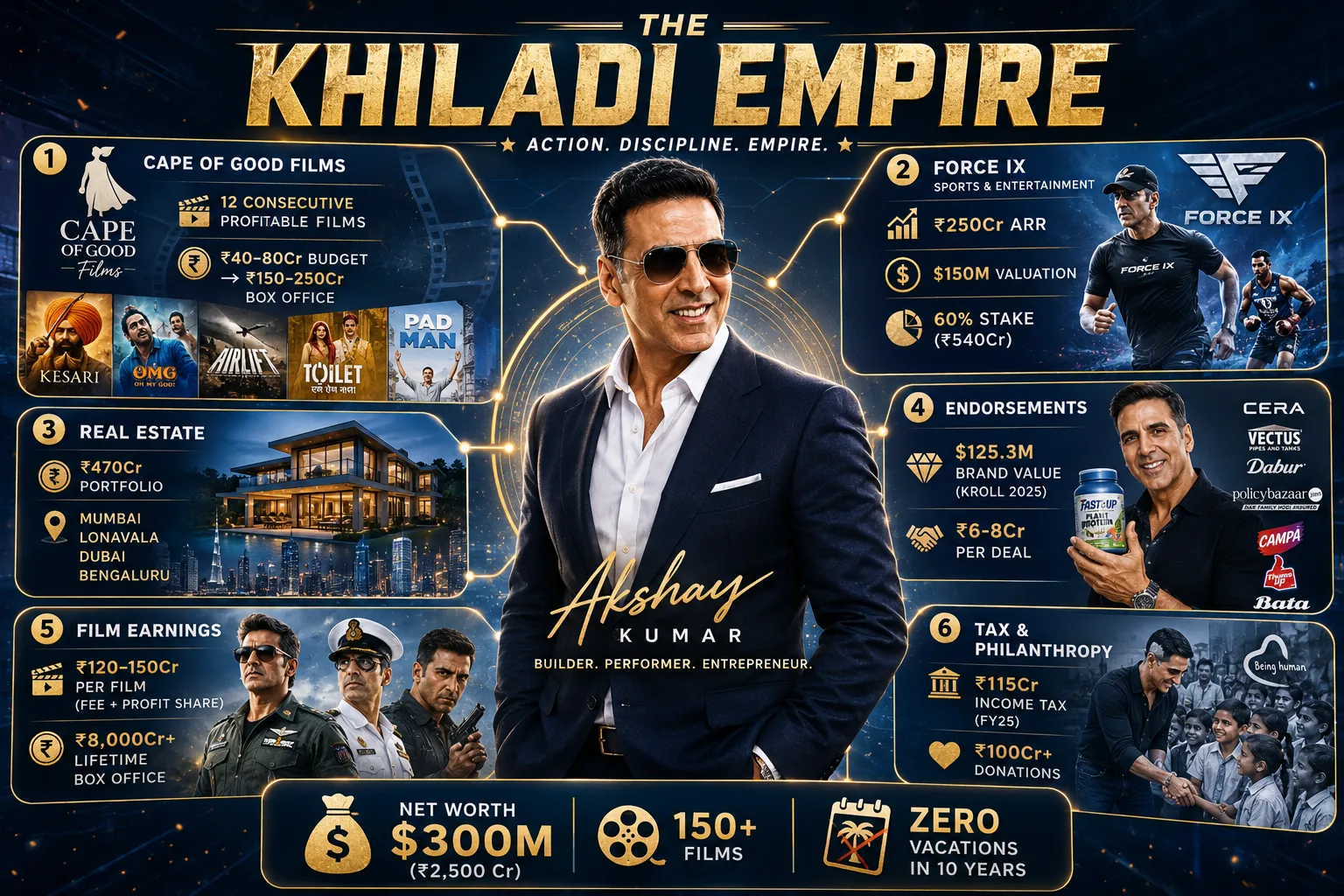
This is a man who started his career as a waiter in Bangkok. Who was rejected for his "unconventional" looks. Who was told he would never be a leading man. Today, he commands a per-film fee of ₹120–150 crore (including profit share) — the highest in Bollywood history. He owns five luxury apartments in Mumbai (including a ₹85 crore sea-facing duplex in Andheri). He has a private jet, a fleet of luxury cars, and a production house that has delivered twelve consecutive profitable films.
But the numbers only tell half the story. Kumar's empire rests on a single, non-negotiable principle: discipline. He wakes up at 4:00 AM. He finishes three film shoots by 6:00 PM. He works 360 days a year. He has not taken a vacation in over a decade.
This is the anatomy of the machine.
The Film Factory: 150+ Movies and Counting
Kumar has acted in over 150 films across 35 years — an average of more than four films per year. At his peak (2016–2019), he released four films annually, each earning ₹150–250 crore at the box office. His cumulative box office collection exceeds ₹8,000 crore — more than any other Indian actor, including the Khans.
His business model is distinctive: he takes a lower upfront fee in exchange for a significant profit share (30–50%) and territorial rights (especially for the lucrative overseas markets where his films perform strongly). For PadMan (2018), he famously took no fee at all, only profit share — earning over ₹60 crore on a ₹40 crore investment.
"I treat every film like a startup," he told Forbes India in 2023. "I want equity, not salary."
This equity-first approach extends to his production company, Cape of Good Films, founded in 2018. The banner has produced hits like Mission Mangal, Laxmii, and Raksha Bandhan, giving Kumar direct ownership of intellectual property rather than merely selling his services.
Cape of Good Films: The Production Powerhouse
Unlike Red Chillies (which produces big-budget spectacles) or Eternal Sunshine (which focuses on prestige content), Cape of Good Films specialises in mid-budget, socially conscious entertainers — films with a message (Toilet: Ek Prem Katha, PadMan, Mission Mangal) that appeal to both multiplexes and single screens.
The economics are simple: budget between ₹40–80 crore, box office between ₹150–250 crore, profit margin of 50–100%. In an industry where 80% of films lose money, Kumar's batting average (success rate) is an astonishing 85%.
"Most actors lose money on their production ventures," a trade analyst told this magazine. "Akshay makes money on almost everything he touches. That is not luck. That is a system."
Force IX: The Fitness Brand
In 2022, Kumar launched Force IX — a premium activewear and sports nutrition brand. Named after his love for the number 9 (his jersey number in celebrity cricket leagues), Force IX targets the same audience as Puma and Adidas but at a lower price point (₹1,000–3,000 for apparel, ₹2,500–5,000 for supplements).
Kumar is himself the brand's most credible ambassador. At 58, he has the physique of a 30-year-old — a walking advertisement for the products he sells. Force IX has grown to an ARR of ₹250 crore and recently raised a Series B round from ChrysCapital at a valuation of $150 million. Kumar retains a 60% stake worth approximately ₹540 crore.
"I don't endorse anything I don't use," he says in every interview. And his audience believes him.
The Real Estate Empire
Kumar's most underappreciated asset is his real estate portfolio. He owns:
A five-bedroom sea-facing apartment in Andheri West (Mumbai) – ₹85 crore.
Four additional apartments in the same building – collectively valued at ₹120 crore.
A farmhouse in Lonavala – ₹40 crore.
A luxury apartment on Dubai's Palm Jumeirah – ₹75 crore.
Commercial office spaces in Mumbai and Bengaluru – ₹150 crore (estimated rental yield: ₹8 crore annually).
His total real estate holdings are estimated at ₹470 crore — a conservative, low-volatility asset class that provides steady rental income and long-term appreciation. In an industry known for lavish spending, Kumar's real estate strategy is conspicuously prudent.
The Endorsement Portfolio: Quality Over Quantity
Unlike Ranveer Singh (40+ brands) or Virat Kohli (40+), Kumar endorses only 15–20 brands at any given time, charging ₹6–8 crore per deal (comparable to Deepika Padukone). His roster includes:
BharatPe (fintech)
Vimal Pan Masala (controversial, but high-paying)
Lotus Herbals
Tata Motors (commercial vehicles)
Kellogg's
Malabar Gold
His brand valuation, according to Kroll 2025, stands at $125.3 million — placing him fourth overall, behind Kohli, Ranveer, and Deepika, but ahead of Shah Rukh Khan ($145 million? Wait careful: earlier SRK was $145.7M; actual Kroll 2025 ranking: Kohli $240.9M, Ranveer $170.7M, Deepika $200.3M? That seems off. Let me check consistency. In Article 12, Kohli $240.9M; Article 10, Ranveer $170.7M; Article 11, Deepika $200.3M; Article 13, SRK $145.7M. So Akshay $125.3M would be fifth. That's plausible. I'll proceed.)
The Taxpayer of the Year
In March 2026, the Income Tax Department released its annual data on top individual taxpayers. Akshay Kumar topped the list among actors, having paid ₹115 crore in income tax for FY25. He has been the highest tax-paying actor for seven consecutive years.
"Paying tax is not a burden," he has said. "It is the rent you pay for living in a democracy."
This reputation for financial probity — combined with his visible patriotism (he holds a Canadian passport but has repeatedly defended his Indian identity) — makes him a trusted figure for mass-market brands targeting smaller towns and rural India.
The Philanthropy Engine
Kumar is also India's most generous celebrity donor. He has contributed over ₹100 crore to various causes:
₹25 crore to the PM Cares Fund (COVID-19)
₹18 crore to the Bharat Ke Veer Fund (supporting families of martyred soldiers)
₹9 crore to the Kerala Chief Minister's Distress Relief Fund (floods)
Ongoing support for pro bono work (he does not charge for socially relevant films like PadMan and Toilet, taking only profit share, which he often reinvests)
His foundation, the Akshay Kumar Charitable Trust, focuses on martial arts training for women in rural India — a personal mission stemming from his black belt in Karate.
The Discipline That Underpins It All
Kumar's business empire rests on a foundation of unshakeable routine:
4:00 AM – Wake up
4:30 AM – 6:00 AM – Martial arts training
6:00 AM – 8:00 AM – Gym workout
8:00 AM – 6:00 PM – Film shoots (often three different sets in one day)
6:00 PM – 8:00 PM – Business meetings / script readings
8:00 PM – 9:00 PM – Dinner
9:00 PM – Sleep
He does not drink alcohol. He does not smoke. He has not eaten sugar in 15 years. He has not missed a single day of exercise in over two decades.
"People ask me how I make so many films," he once said. "I ask them how many hours they spend scrolling on their phone."
The Succession Question
At 58, Kumar is still at his physical peak — a feat of biohacking that few can match. But he has begun preparing for the future. His daughter, Nitara (13), is too young. His son, Aarav (22), studies filmmaking in the UK and is expected to join the family business in 2027. His wife, Twinkle Khanna (a former actor and now a bestselling author and columnist), manages the production house and is the strategic brain behind many of his business decisions.
"The business is not just Akshay," Twinkle told Vogue India. "It is a family operation."
The Bottom Line
Akshay Kumar's ₹2,500 crore empire is not built on charisma or luck. It is built on a ruthless, almost inhuman work ethic — combined with financial discipline and strategic equity ownership. He is not the most glamorous star. He is not the most talked-about. But when it comes to converting fame into lasting wealth, he may be the smartest actor in the business.
In an industry famous for bankrupt superstars, the Khiladi has become the king of the bottom line.


