The Lunar Land Grab: How a Colorado Startup Is Racing to Build the First Industrial Park on the Moon
GOLDEN, COLO. — May 20, 2026 — Justin Cyrus had exactly 25 minutes to decide. It was a Friday morning in late March, and Cyrus, the 32-year-old founder and CEO of Lunar Outpost, had just watched NASA Administrator Jared Isaacman appear on a livestream from the agency's Ignition event at Kennedy Space Center and announce, with no advance warning to the commercial contractors whose fortunes depend on the Artemis program, that NASA was abandoning its Lunar Terrain Vehicle acquisition strategy. The three companies competing to build the moon's first crewed rover — Lunar Outpost, Astrolab, and Intuitive Machines — would not, as they had expected, be awarded a contract that day. Instead, Isaacman told them to go back to their factories and design something simpler, faster, and cheaper. The new deadline for a flight-ready rover: the end of 2027. The new mandate: get it done now.
Cyrus did not panic. He did not write an angry memo. He walked out of the conference room at Lunar Outpost's headquarters in Golden, Colorado, and within hours had launched a fundraising process that would, in less than five weeks, close an oversubscribed $30 million Series B led by Industrious Ventures, with participation from Type One Ventures, Eniac Ventures, Promus Ventures, and Reliable Equity. The round drew $90 million in investor interest. Cyrus turned away $60 million, closing at $30 million to keep the cap table clean and the company focused. "In response to NASA saying, 'Hey, we want to get this done and we want to get it done now,' we decided to open a quick fundraise," Cyrus told Reuters. The round came together in less time than most startups spend negotiating term sheets.
The Rover That Made History
Before Lunar Outpost became a $30 million Series B story, it was a bootstrapped startup operating out of a rented garage in Denver. The company was founded in 2017 by Cyrus, an aerospace engineer with master's degrees in electrical engineering and space resources from the Colorado School of Mines, and two friends: AJ Gemer, a carbon-composite drone builder who became the company's chief technology officer, and Forrest Meyen, a MIT-trained aeronautics PhD who had helped design the MOXIE oxygen-production experiment that still operates aboard NASA's Perseverance rover on Mars. They had no venture backing, no government contracts, and no guarantee that anyone would ever pay them to build a lunar robot.
What they had was a conviction that the moon was about to become the most important industrial site in human history — and that the companies that got there first with reliable, scalable robotic infrastructure would own the foundation layer of a new economy.
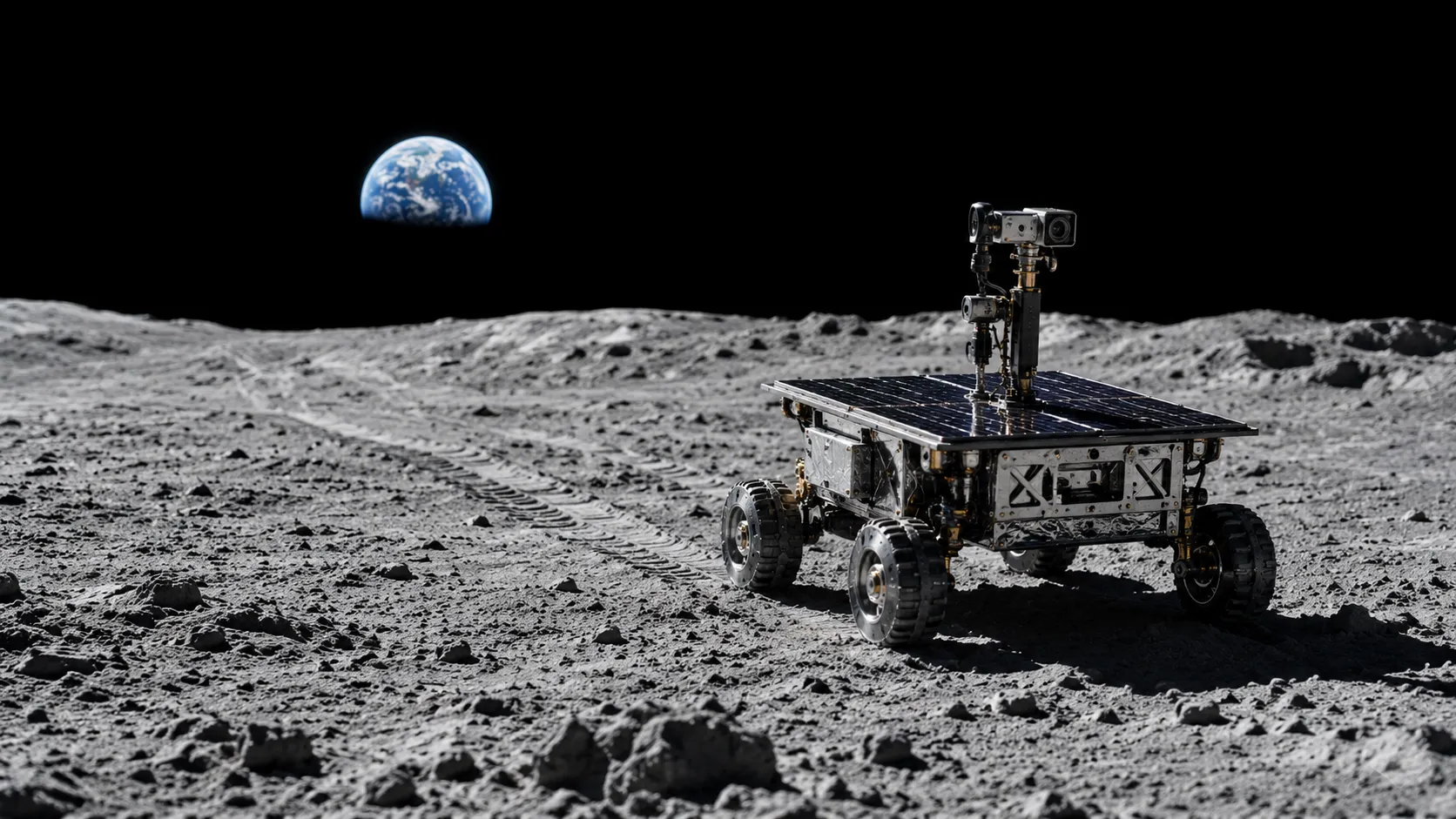
In February 2025, that conviction was vindicated in the most concrete way possible. Lunar Outpost's Mobile Autonomous Prospecting Platform — MAPP, a rover roughly the size of a large suitcase — landed at the Moon's South Pole aboard an Intuitive Machines lander as part of NASA's Commercial Lunar Payload Services program. It was the first commercial rover to operate on another planetary body, the first rover to explore the lunar South Pole region, and the first vehicle in history to complete a commercial sale of space resources — lunar regolith, sold to NASA for a symbolic sum, establishing the legal precedent that private companies can extract and sell resources from celestial bodies. The rover also carried payloads from MIT, served as a testbed for Nokia's Lunar Surface Communications System — the first 4G/LTE cellular network on the moon — and transmitted data back to Earth that is still being analyzed today.
Four missions are now planned. Eight are fully contracted. Lunar Outpost has more rovers headed to the moon than all other commercial companies combined. The company has doubled its revenue every year for the past four years — a growth rate that, in the world of deep-tech hardware startups, is nearly unheard of.
The Eagle Becomes the Pegasus
The Artemis program was supposed to be the big leagues. Lunar Outpost, in partnership with Leidos, MDA Space, Goodyear, and General Motors, had spent years designing Eagle, a pressurized lunar terrain vehicle described as "the most capable crewed and cargo transport ever built" for human spaceflight. The vehicle was the size of a small car, designed to carry two astronauts across the lunar surface, with Goodyear developing specialized tires and GM contributing electric-vehicle technology. A full-scale prototype had been displayed at the Kennedy Space Center visitor complex, drawing crowds and media attention. Eagle was Lunar Outpost's bid for the crown jewel of NASA's commercial lunar transportation portfolio.
Isaacman's Ignition announcement changed the calculus entirely. NASA did not cancel the LTV program. It restructured it. The agency told the three competitors — Lunar Outpost, Astrolab, and Intuitive Machines — that the first rover needed to be smaller, simpler, and ready to fly by the end of 2027. The larger, more capable designs like Eagle would be pushed to a later phase, launching around 2030. The near-term prize was a stripped-down, human-rated rover that could scout landing sites, prepare terrain, and support early Artemis missions — and the contract for that prize could be awarded within weeks, not years.
Lunar Outpost's answer was Pegasus. The new rover was designed from the start to reuse 72 percent of Eagle's components — the same sensors, the same avionics, the same tires — in a smaller, faster-to-build chassis that could meet NASA's 2027 deadline. Within weeks of the Ignition announcement, the company had worked through the design, built a "human-in-the-loop" mockup, and tested it with former NASA astronaut John Grunsfeld, who served as an evaluator. The proposal was submitted. The company expects a response from NASA before the end of this quarter. The $30 million Series B is, in the most literal sense, a bridge loan to get Pegasus to the launch pad.
The Industrial Vision
What separates Lunar Outpost from many of its space-startup peers is the breadth of its ambition. The company does not describe itself as a rover manufacturer. It describes itself as the builder of "the critical industrial layer required for a permanent human presence in space." The distinction matters because it implies a business model that extends far beyond selling hardware to NASA.
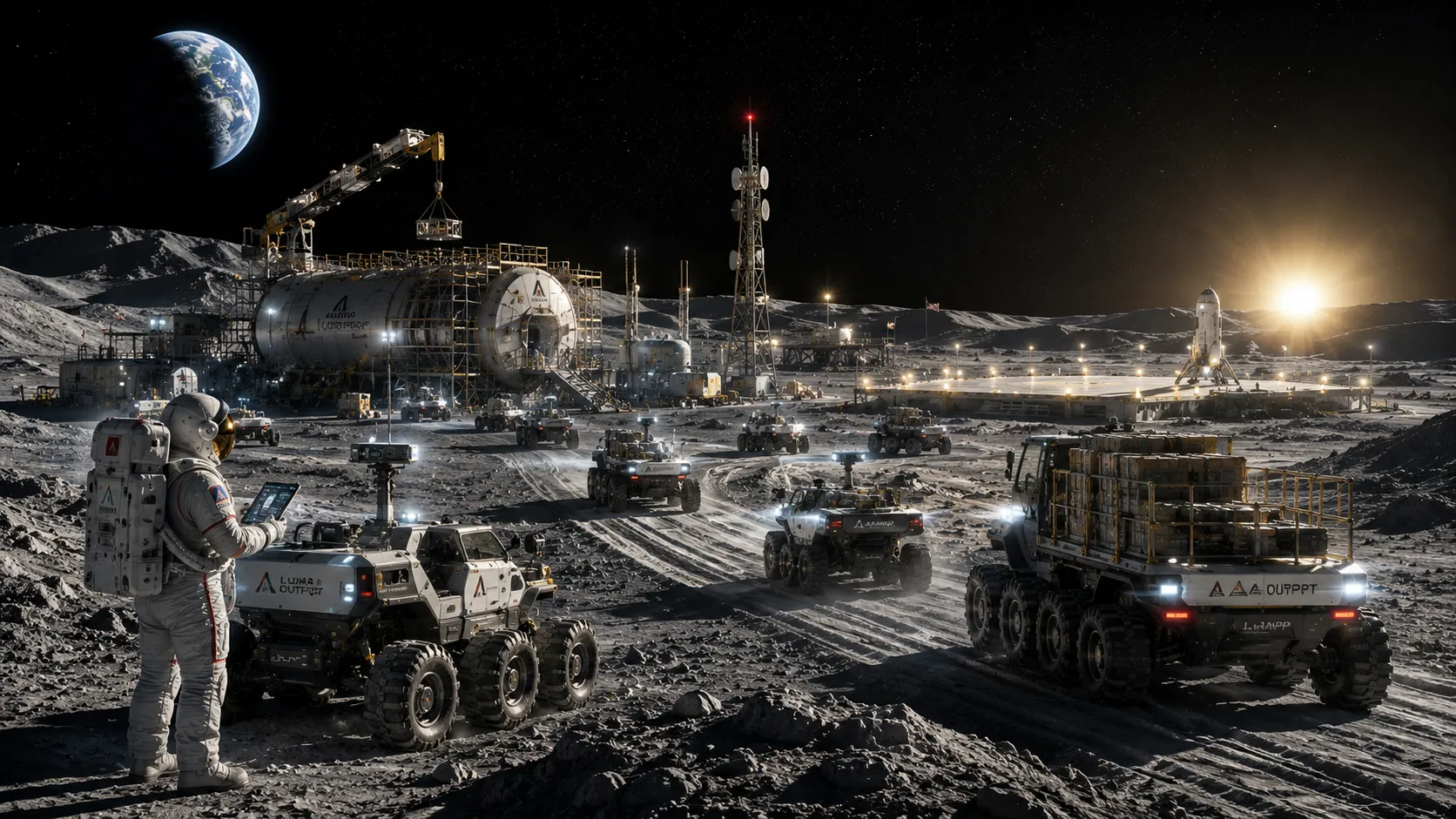
Lunar Outpost's public announcements enumerate a sweeping vision of what the lunar economy requires: power generation and distribution, communications networks, autonomous vehicle swarms, excavation and site-preparation robots, habitat modules, launch and landing pads, and in-situ resource utilization — the extraction of water ice, minerals, and construction materials from the lunar surface itself. The company's Starweave software enables autonomous multi-vehicle coordination in GPS-denied environments — a capability that is as valuable on the lunar surface as it is in defense applications. Its Stargate Command, Control, and Communications platform serves as the central nervous system for robotic operations across multiple missions simultaneously.
The strategic logic is straightforward. Whoever builds the infrastructure — the roads, the power plants, the cell towers, the construction robots — owns the platform on which the rest of the lunar economy will be built. The company that can deploy a fleet of autonomous rovers that prospect for water ice, level terrain for landing pads, and lay cable for communications networks will not merely participate in the lunar economy. It will define its physical architecture.
The market is not speculative. NASA's Artemis program, originally created during the first Trump administration and now being accelerated under the second, envisions a permanent moon base at the lunar South Pole by the end of the decade. The agency plans to send regular astronaut missions to the surface in a decade-long strategy costing more than $30 billion. The geopolitical stakes are explicit: the U.S. and China are in a race to establish a permanent presence on the moon, and the nation that controls the lunar South Pole — believed to contain vast deposits of water ice that can be converted into rocket fuel, breathable oxygen, and drinking water — controls the gateway to the solar system.
Taylor Sargent, partner at Industrious Ventures, articulated the investment thesis in terms that blend infrastructure economics with geopolitical urgency. "Lunar infrastructure development will come in phases over the next 10 years, shifting from site preparation to development to sustainment," Sargent said. "That progression depends not just on mobility, but on systems that can operate autonomously in extreme environments. Lunar Outpost has demonstrated the ability to execute in the field while building capabilities that translate directly to how work gets done on the lunar surface, in cislunar space, and beyond."
The Capital Constraint That No Longer Exists
Cyrus, reflecting on the Series B round that came together in five weeks, said something that captures the changed state of the commercial space industry as succinctly as any analysis. "One thing that's been a constraint so far for companies looking to operate in cislunar space has been capital," he told Reuters. "That no longer exists."
The statement is not hyperbole. The Series B was oversubscribed by a factor of three. Investor interest in lunar ventures has surged as NASA's mission cadence has accelerated, as Artemis 2 successfully sent four astronauts around the moon and back in April 2026, and as the broader space economy has crossed a threshold from speculative to tangible. Lunar Outpost declined to disclose its post-money valuation, but the company's revenue trajectory — doubling every year for four years — and its contracted mission manifest suggest a valuation comfortably in the hundreds of millions.
The round was led by Industrious Ventures, a firm that explicitly backs founders "building the core technologies required for the next era of industrial capability on and beyond Earth." Mason Angel, founding partner at Industrious, framed the bet in language that underscores the firm's conviction. "As activity on the lunar surface and space accelerates, the systems that can operate reliably and scale will define what's possible," Angel said. "Mobility is a critical foundation for everything that follows and increasingly requires autonomy to operate in complex environments. Lunar Outpost is building with that full system in mind."
The Colorado Crucible
Lunar Outpost's location — Golden, Colorado, a former mining town in the foothills of the Rockies — is not an accident. Colorado has quietly become one of the densest clusters of commercial space activity in the United States, home to more than 280 space-related companies and a talent pool drawn from the Air Force Academy, the University of Colorado at Boulder, and the Colorado School of Mines, whose space resources program is the only one of its kind in the country. Cyrus himself is a Mines alumnus. Forrest Meyen, the co-founder and chief strategy officer, earned his PhD from MIT. AJ Gemer, the CTO, holds dual master's degrees from Colorado and built carbon-composite UAV airframes before turning his attention to the moon. The company's team now includes veterans of Lockheed Martin, Draper, and multiple NASA mission teams.
The company's Earth-based work reinforces its lunar ambitions through a feedback loop that is unusual in the space industry. Lunar Outpost's rovers and autonomy software are being tested not only in simulated lunar environments but in real-world terrestrial applications — mining, construction, defense — where the same capabilities that enable autonomous navigation in GPS-denied environments on the moon translate directly to operations in underground mines, disaster zones, and contested military environments. The cross-pollination between Earth and space applications accelerates development, diversifies revenue, and provides a proving ground for technologies that will eventually operate on the lunar surface.
Lunar Outpost is also involved in Mars exploration. Forrest Meyen continues to support MOXIE operations as a member of the NASA Perseverance Rover science team, and the company's longer-term roadmap includes robotic systems designed for the Martian surface. The vision, in its fullest expression, is a company that builds the mobility and infrastructure layer for human expansion across the inner solar system — moon first, then Mars, then beyond.
The Road to the Launch Pad
Lunar Outpost's near-term future depends on a NASA procurement decision expected this quarter. Pegasus, the company's answer to Isaacman's call for speed, is competing against rover designs from Astrolab and Intuitive Machines. The winner will receive a contract that could eventually be worth billions, and will become the primary ride for NASA astronauts on the lunar surface during the Artemis missions that follow the first crewed landing, now targeted for 2028.
The $30 million Series B will fund the sprint to the launch pad regardless of the NASA outcome. If Lunar Outpost wins the contract, Pegasus flies in 2027. If it does not, the company has eight other contracted lunar and cislunar missions in its manifest, a growing commercial customer base, and a revenue trajectory that suggests it does not need to win a single NASA contract to survive. The oversubscribed round, the fourfold revenue growth, the MAPP rover that made history at the lunar South Pole, the Eagle LTV prototype that drew crowds at Kennedy Space Center, and the quiet expansion into terrestrial autonomy and defense applications all point in the same direction: a company that has moved beyond the "if" phase of its existence and into the "how fast" phase.
Justin Cyrus, at 32, has already led his company to historic accomplishments that most aerospace executives spend entire careers chasing: the first commercial rover on another planetary body, the first commercial sale of space resources, the first rover at the lunar South Pole, and a pipeline of missions stretching into the 2030s. The $30 million round that closed in five weeks is not a validation of his vision. That validation arrived when MAPP's first images came back from the moon, showing the grey, sun-blasted surface of the South Pole with Earth hanging on the horizon. The $30 million is fuel. The launch pad is waiting.


