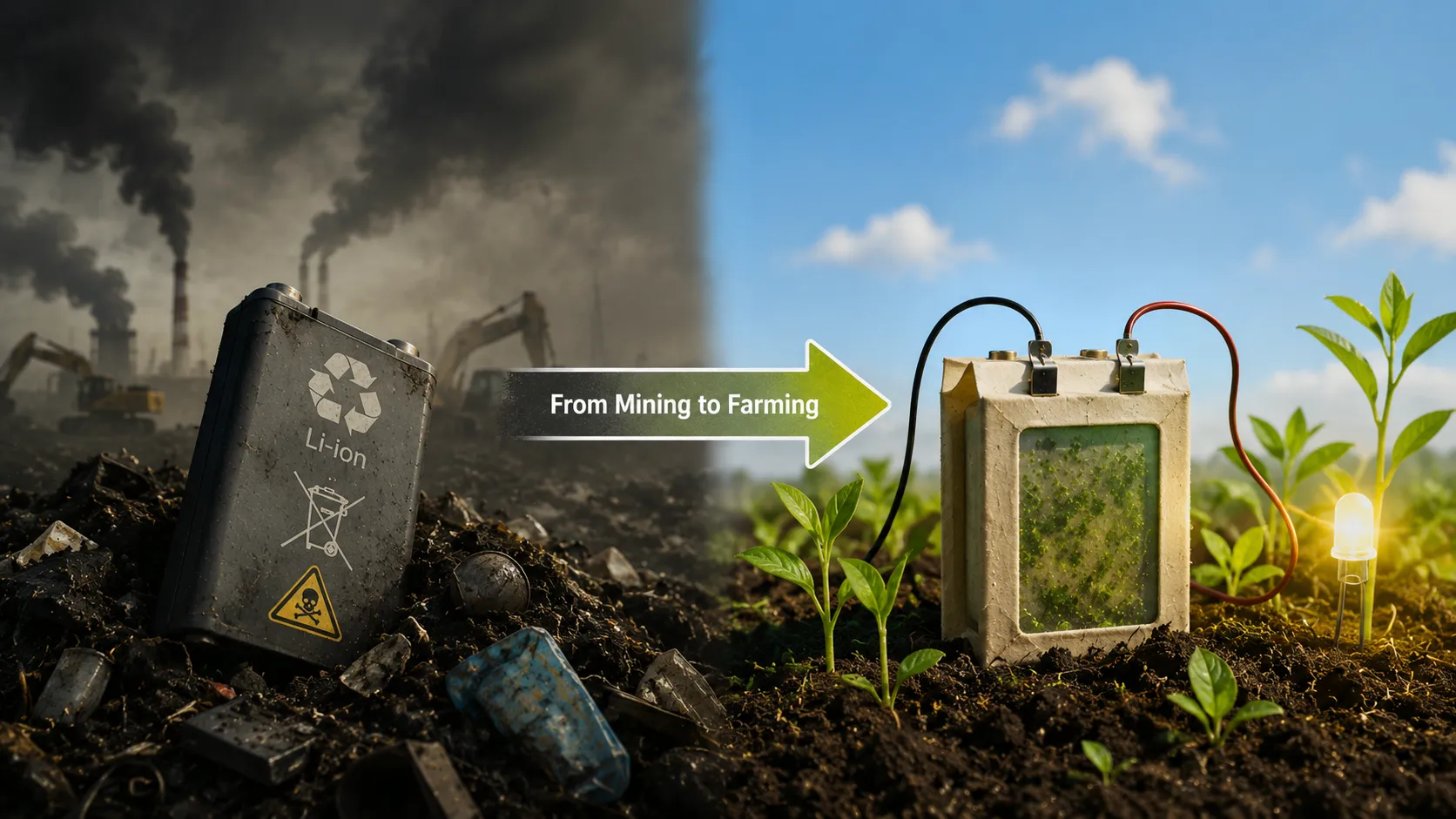
For more than a century, we have powered our world by burning things—coal, gas, oil. A quiet revolution in synthetic biology is about to replace combustion with respiration, and the fuel is everywhere.
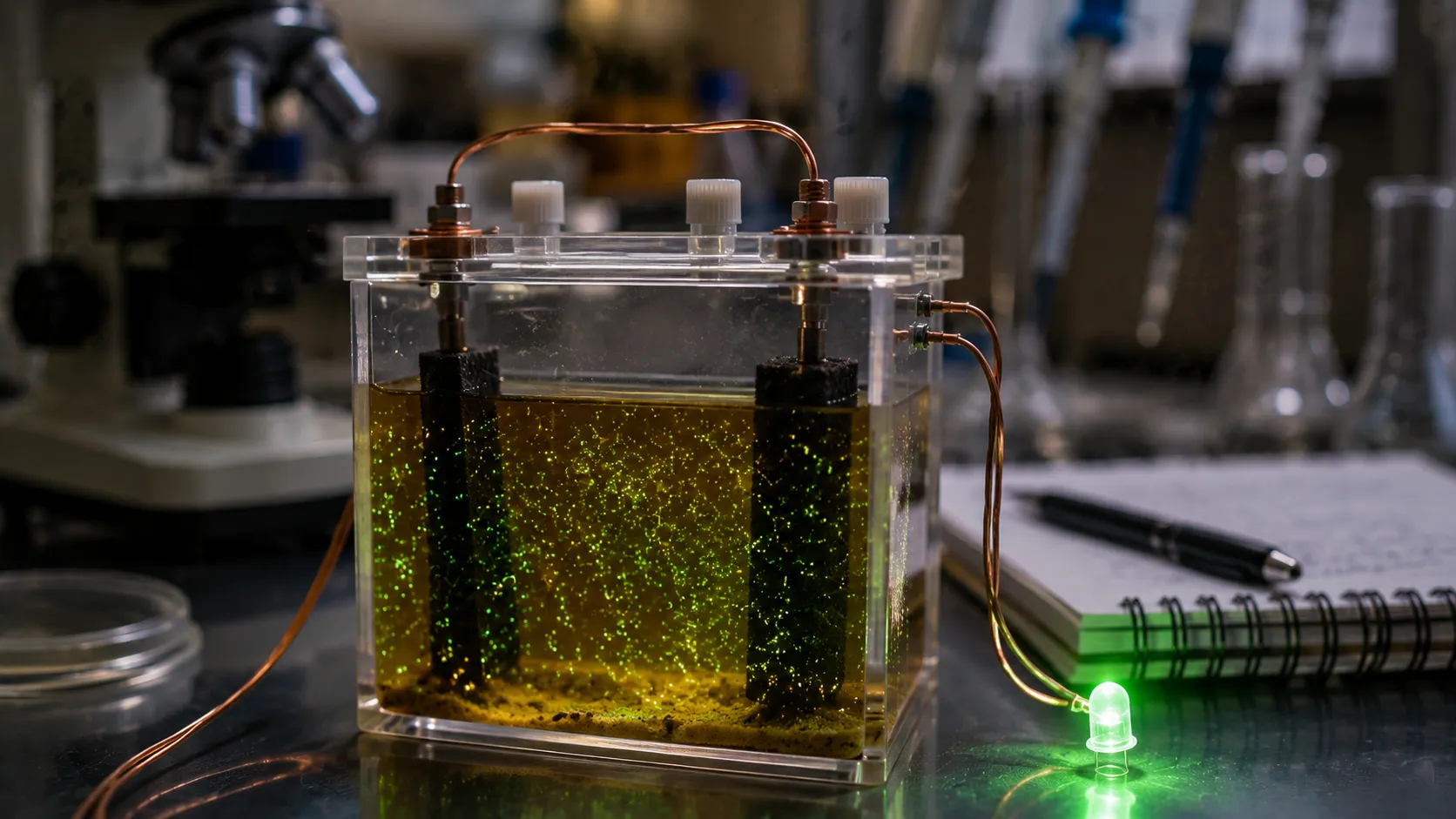
BINGHAMTON, N.Y. — May 26, 2026 — The battery is alive. You cannot see it with the naked eye—its power source is a single drop of water containing billions of Shewanella oneidensis, a bacterium that breathes metal the way humans breathe oxygen. The battery sits on a laboratory bench, connected by thin copper wires to a small LED. The LED glows a steady, faint green. It has been glowing for three months, powered entirely by the metabolic waste of microbes that cost less than a dollar to grow. When the light finally dims, the researchers will add a few drops of wastewater—the bacterial equivalent of a sugar rush—and the LED will brighten again.
This is the microbial fuel cell (MFC), a technology that has been whispering at the edges of energy science for two decades. The whispering is about to become a roar. Advances in synthetic biology, materials science, and electrode design have pushed MFCs from laboratory curiosities to the brink of commercial viability. Researchers at Binghamton University, led by Professor Seokheun "Sean" Choi, have developed paper‑based, biodegradable microbial batteries that can power sensors in remote environments for months without human intervention. A team at the University of Bristol has created a "urine‑turned‑light" system that powers off‑grid lighting in refugee camps. And a startup in the Netherlands, Plant‑e, is selling living lamps that run on the electricity generated by soil bacteria feeding on the waste products of living houseplants.
"We are at the beginning of a fundamental shift in how we think about energy," said Dr. Elena Marchetti, a microbiologist at MIT who studies electron transfer in bacteria. "For the entire history of technology, we have extracted energy by destroying something—burning carbon, splitting atoms, harvesting sunlight with silicon. Microbial fuel cells do the opposite. They work with living systems. They don't consume the fuel source; they just feed it. The bacteria keep living, keep eating, keep producing electricity, as long as you give them something to digest."
How Do You Wire a Bacterium?
The concept of a microbial fuel cell sounds like science fiction. In practice, it is elegant in its simplicity. The MFC consists of two chambers separated by a special membrane. In the anode chamber, bacteria are suspended in a nutrient solution (wastewater, mud, even urine). As the bacteria metabolize organic matter, they release electrons. Those electrons flow out of the bacteria, through a conductive material (usually carbon felt or graphene), and into an external circuit, where they do useful work—powering an LED, a sensor, a small motor. After passing through the circuit, the electrons enter the cathode chamber, where they combine with oxygen and protons to form water.
The key innovation that has unlocked MFC potential is extracellular electron transfer (EET)—the ability of certain bacteria to push electrons outside their cell walls. Shewanella and Geobacter are the superstars of EET. They produce tiny conductive nanowires, proteins that act like living jumper cables, shuttling electrons from the bacterium's metabolic engine to any nearby electrode. In the past five years, genetic engineers have boosted EET efficiency tenfold by splicing in electron‑transport genes from other species.
"We can now engineer bacteria that are essentially optimized for power generation," said Dr. Marchetti. "We give them genes from electric eels. We give them synthetic nanowires that conduct better than natural ones. We can even program them to only produce electrons when they detect specific chemicals, turning the battery into a sensor."
The Applications That Already Work
The first wave of MFC products is not about replacing lithium‑ion batteries in your laptop. The power density is still too low—a typical MFC generates about 1,000 times less power per square centimeter than a smartphone battery. But that is fine for applications where weight, safety, and longevity matter more than raw power.
Environmental sensors are the low‑hanging fruit. Millions of sensors are deployed each year to monitor water quality, soil conditions, air pollution, and wildlife. Most are powered by disposable batteries that must be replaced every few months—a logistical nightmare in remote locations. An MFC running on mud or river sediment can last for years. A team at the University of the West of England deployed MFC‑powered temperature sensors in a peat bog in Scotland; after 18 months, the sensors were still transmitting data, and the bacteria were still eating.
Wastewater treatment is the economic sweet spot. Treating sewage is energy‑intensive—about 3 percent of US electricity consumption goes to moving and cleaning water. MFCs can offset that cost by generating electricity from the waste itself. A pilot plant in the Netherlands uses MFCs to treat sewage while producing enough power to run its own pumps. The bacteria do the cleaning and the power generation simultaneously. The plant's energy bill dropped by 40 percent.
Off‑grid lighting is the humanitarian win. The Bristol team's "urine‑turned‑light" system is now deployed in several refugee camps. Users urinate into a container; the bacteria break down the urea; the electrons flow; an LED array lights a communal latrine or a schoolroom. No infrastructure. No fuel supply chain. Just waste, bacteria, and light.
The Obstacles—and Why They Are Falling
For years, MFCs were dismissed as a toy. The power output was laughable—microwatts from a coffee‑cup‑sized device. The electrodes were expensive. The bacteria died if the temperature shifted or the pH changed. And nobody had figured out how to stack MFCs into a useful voltage without internal losses.
The past three years have seen breakthroughs on every front. Graphene‑coated carbon felt electrodes, mass‑produced by roll‑to‑roll printing, cost pennies per square foot. Synthetic microbial consortia—carefully engineered communities of multiple bacterial species—maintain stable power output across a wider range of temperatures and pH than any single species. And fluidic stacking designs, borrowed from microelectronics, allow dozens of small MFCs to be connected in series and parallel without parasitic losses.
"The field has crossed a threshold," said Dr. Choi at Binghamton. "Five years ago, the question was 'Will this ever work outside a lab?' Now the question is 'Which application scales first?'"
The answer may be biodegradable power. Choi's paper‑based MFCs are printed on filter paper, inoculated with freeze‑dried bacteria, and sealed in a plastic envelope. To activate, add water. The bacteria wake up, start eating, and generate power for two to three weeks. When the envelope is discarded, the paper and bacteria decompose. No toxic heavy metals. No recycling required. The US Department of Defense is funding research into paper MFCs for disposable battlefield sensors; the Environmental Protection Agency is interested in single‑use water quality testers.
The Long Horizon: Power for Implants and Wearables
The holy grail is a microbial fuel cell that can power medical implants—pacemakers, glucose monitors, neural stimulators—using the body's own chemistry. The idea is almost too elegant: implant a small MFC that draws energy from glucose in the bloodstream or lactate in muscle tissue. The device would never need to be removed for recharging. It would last as long as the patient lives.
"There are groups working on this right now," said Dr. Marchetti. "The challenges are formidable—sterility, biocompatibility, long‑term stability. But the principle is sound. If a bacterium can power an LED on a bench, a different bacterium can power a pacemaker inside a human."
A team at ETH Zurich recently demonstrated a prototype "glucose fuel cell" that generated 100 microwatts from the interstitial fluid of a living rat—enough to run a basic sensor. They used a non‑pathogenic strain of E. coli engineered to transfer electrons directly to a carbon electrode. The rat showed no signs of inflammation or infection after six months.
The Philosophical Shift
Beyond the engineering, the microbial fuel cell represents a different way of relating to energy. A lithium‑ion battery is a closed box of finite charge. When it is empty, it is trash. An MFC is an open system. It requires feeding, not charging. It is not a reservoir; it is a metabolism.
"That is the deep shift," said Dr. Choi. "The bacteria are not a battery. They are a farm. You don't mine them. You tend them. That changes everything from supply chains to geopolitics. We are not extracting a finite resource. We are partnering with a living one."
The LED on the bench in Binghamton glows green. The Shewanella are eating, breathing, shuttling electrons across their nanowires. They do not know that they are powering a revolution. They are just surviving. But in their survival, they are lighting a path toward a future where our devices run not on fossil ghosts or mined metals, but on the oldest energy source on Earth: life itself.


