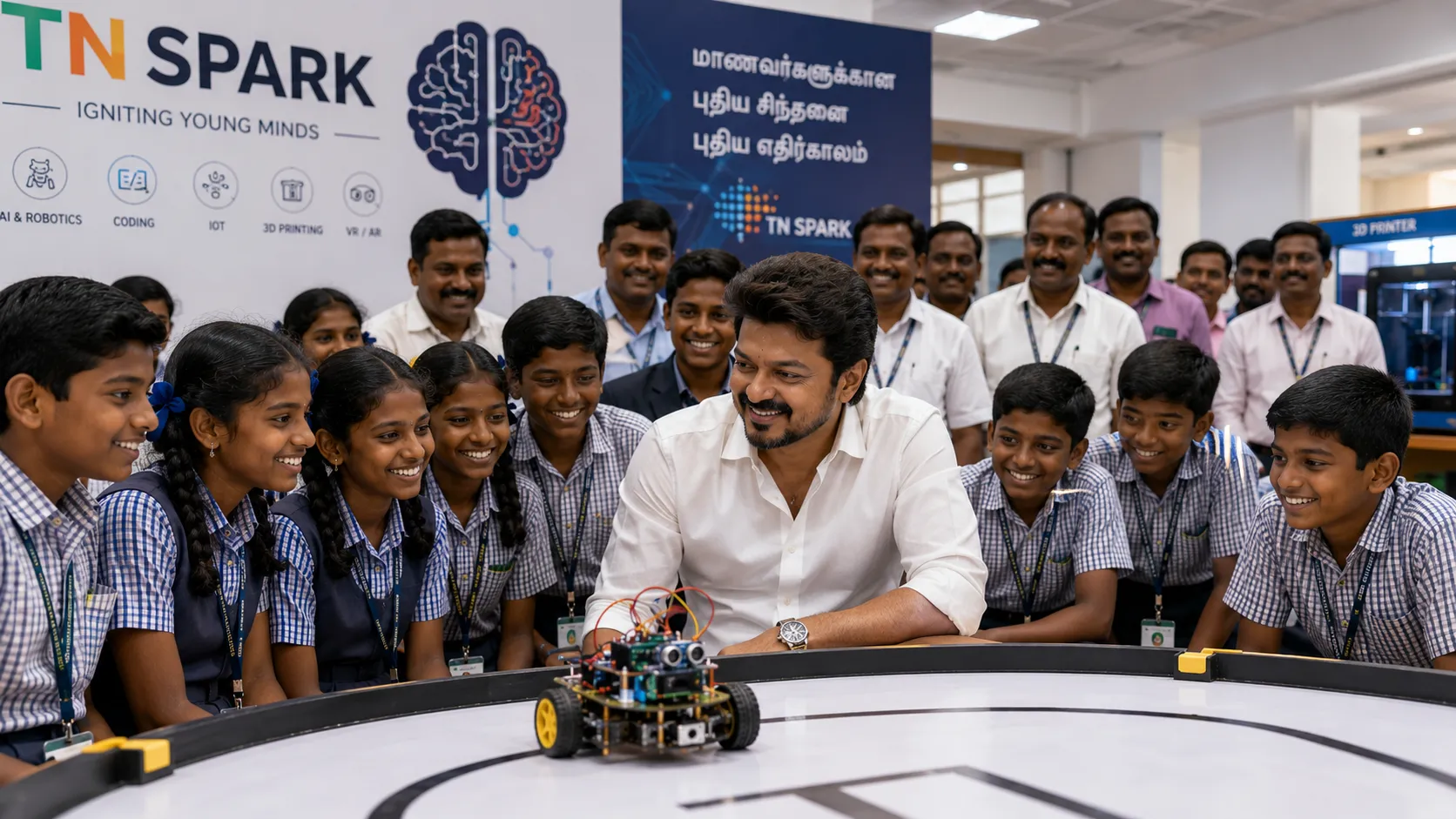
With 654 high‑tech labs, 9,000 smart classrooms, and 900,000 students learning to code before they learn calculus, TN SPARK isn't just teaching AI. It's rewriting what a government school can be.
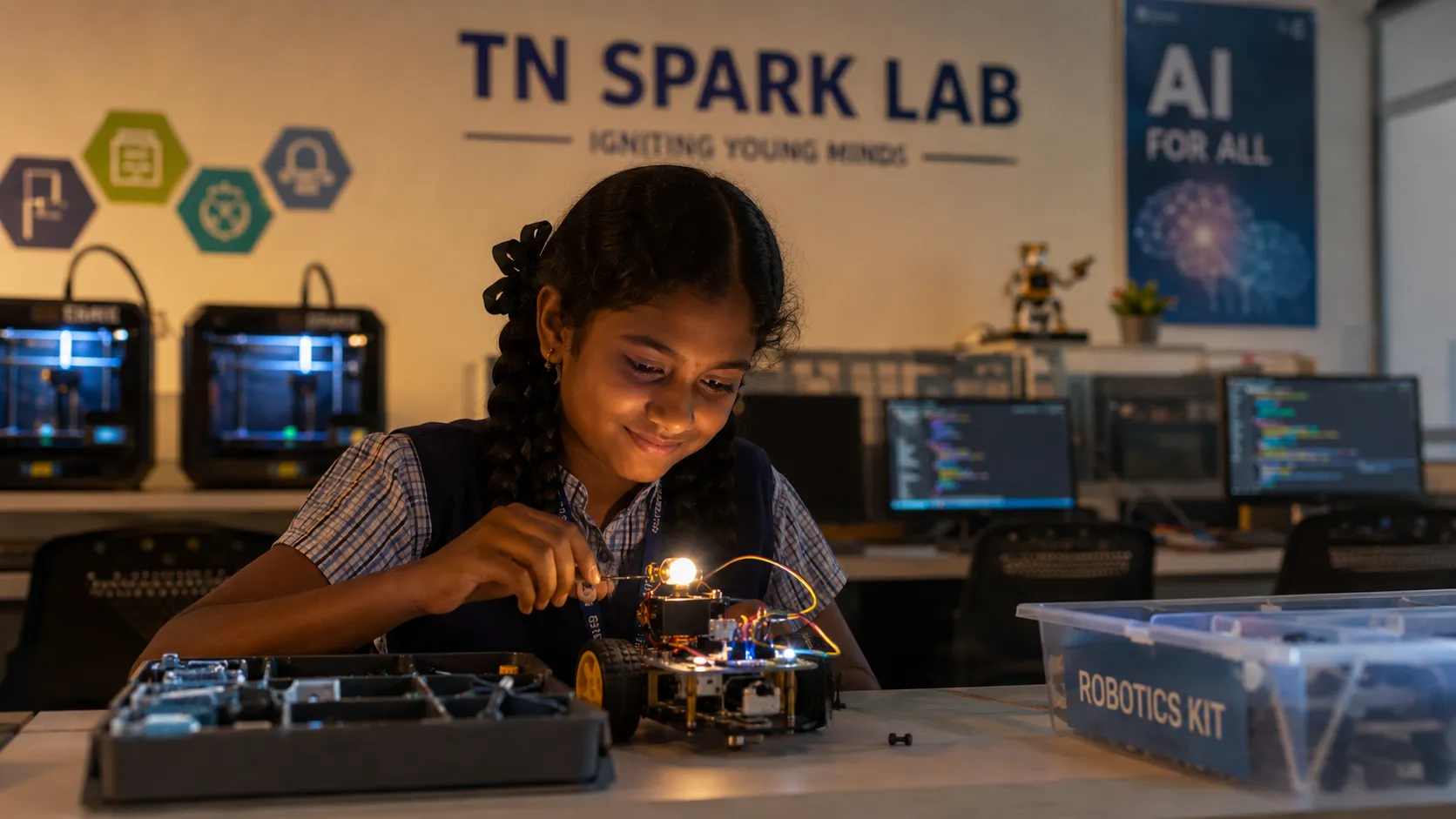
The first time 14‑year‑old R. Kavya from a government school in Coimbatore saw a robot move at her command, she cried. Not because it was difficult. Because it was the first time in her life that she felt like the future belonged to her. Two years ago, her school had no computer lab. The science textbooks showed diagrams of machines she would never touch. Today, she is writing Python code to control a line‑following robot, and her teacher says she has a gift for AI. Kavya is one of 900,000 students in Tamil Nadu who are now part of TN SPARK — the most ambitious school‑level AI education programme in India. And the rest of the country is watching.
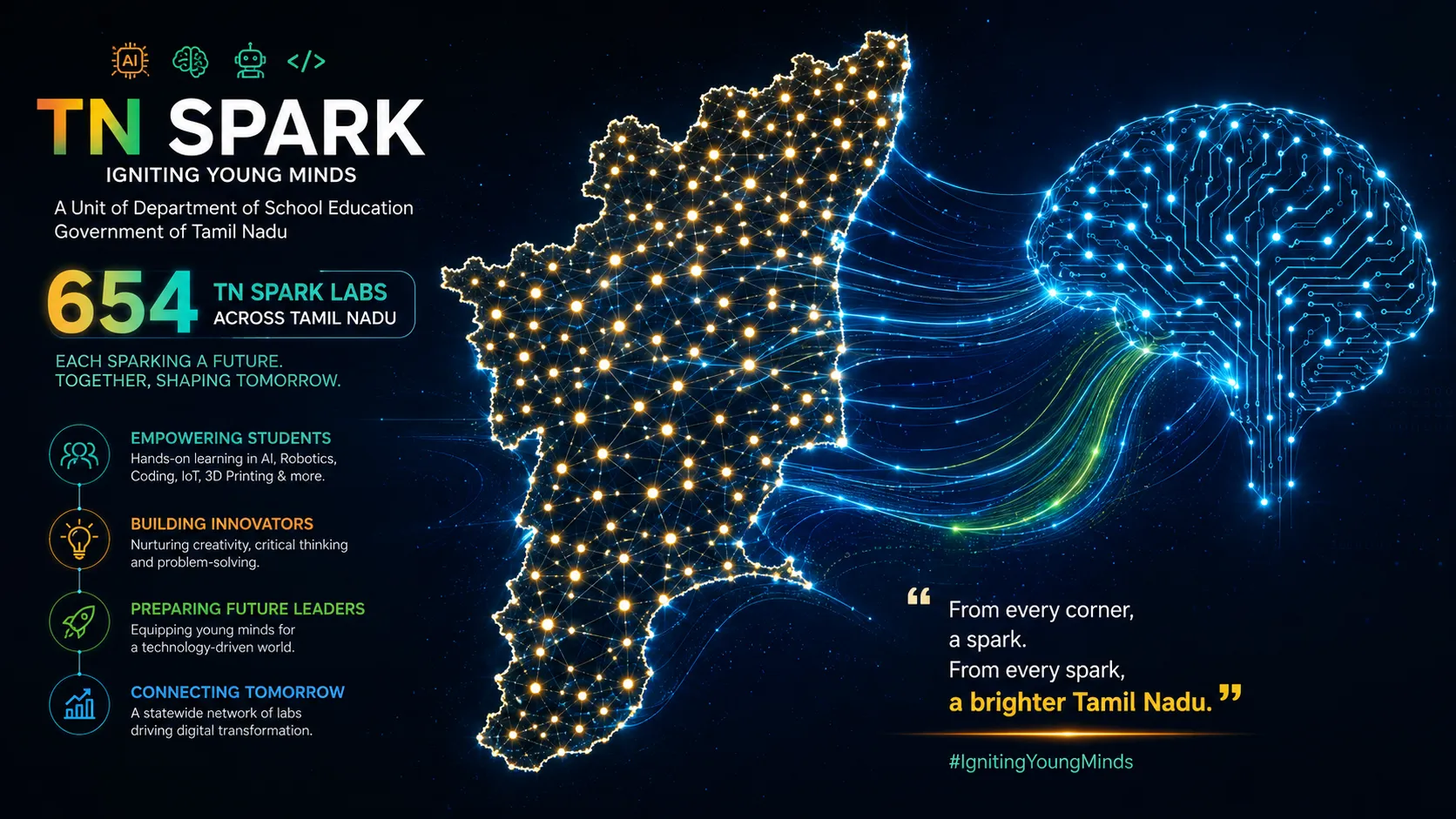
On paper, TN SPARK stands for Tamil Nadu State Platform for Advanced Robotics and Knowledge. In practice, it is a 654‑lab, 9,000‑classroom, ₹1,200 crore bet that the next generation of Indians must grow up not just using technology, but building it. The programme, launched in phases over the past two years and fully operational since March 2026, is already reaching nearly a million students across the state. A pilot programme in more than 150 schools has been expanded to cover every block, from the bustling corridors of Chennai to the remote villages of Kanyakumari.
The numbers are staggering. 654 high‑tech labs equipped with 3D printers, robotics kits, virtual reality headsets, and AI‑powered learning platforms. 9,000 new smart classrooms with interactive flat panels and high‑speed internet. 900,000 students enrolled in foundational courses on coding, data science, and machine learning. 12,000 teachers trained in the last 18 months alone. Tamil Nadu has not just launched a scheme. It has built a parallel education infrastructure within the existing system — and it is working.
"We are not teaching students to be passive consumers of AI," says a senior official from the state's School Education Department. "We are teaching them to be creators. By the time they finish Class 12, a TN SPARK student will have built at least one working AI model, written more than 500 lines of code, and led a robotics project. That is a level of preparation that most engineering colleges in India cannot even claim for their graduates."
The programme's curriculum is designed by a consortium of experts from IIT Madras, Anna University, the Tamil Nadu e‑Governance Agency, and industry partners including Tata Consultancy Services, Zoho, and the German robotics firm Festo. It is not a one‑size‑fits‑all add‑on. The syllabus is integrated into the regular science and mathematics curriculum, meaning that AI is not an extra subject — it is a new way of teaching existing subjects. When students learn about probability in math class, they also learn how a machine learning model uses probability. When they study optics in physics, they also learn how computer vision works.
The infrastructure is equally thoughtful. Each of the 654 labs is divided into four zones: a coding zone with high‑performance computers and cloud‑based IDEs, a robotics zone with programmable kits and sensors, a 3D printing zone for design and fabrication, and an AI application zone where students work on real‑world problems using pre‑trained models. The labs are open after school hours and on weekends, turning schools into community innovation hubs.
The impact is already visible. In the 150 pilot schools, student attendance has increased by an average of 12 percent — children are coming to school because they want to work in the lab. Dropout rates, particularly among girls in Classes 9–12, have fallen by nearly 8 percent. And scores in mathematics and science have risen by an average of 9.5 percent, as students who struggled with abstract concepts find that coding and robotics make those concepts concrete.
"We have a student in our school who was failing math last year," says a headmaster from a government high school in Madurai. "He could not understand algebra. But when we taught him to code a simple game using variables and loops, something clicked. He is now one of the best students in the class. He is not a different child. He just learns differently. TN SPARK gave him a different way to learn."
The programme is not without challenges. Teacher training remains the biggest bottleneck. While 12,000 teachers have been trained, the state needs nearly 20,000 more to fully staff all labs. The training itself is intensive — two weeks of residential instruction followed by ongoing online support and quarterly refresher courses. Some veteran teachers, comfortable with blackboard‑and‑chalk methods, have resisted the shift. But the state has made TN SPARK training mandatory for all computer science and mathematics teachers, and has created a cadre of "master trainers" who mentor their peers.
Another challenge is equity. Private schools have always had computer labs. Government schools have not. TN SPARK is designed to close that gap, but the gap was wide. In the first year of the programme, many government schools lacked even the basic electrical wiring and furniture needed to support the labs. The state has since invested heavily in infrastructure upgrades, but the process is ongoing. Students in remote villages still face internet connectivity issues, though the state's BharatNet rollout has helped.
The political ownership of TN SPARK is also notable. Chief Minister C. Joseph Vijay, who assumed office in 2024, has made AI education a personal priority. He has visited more than 30 schools under the programme, often sitting with students as they work on robotics projects. His government's budget for education has increased by 22 percent over two years, with a significant portion directed to TN SPARK. When the NITI Aayog released its latest School Education Quality Index, Tamil Nadu jumped from fifth place to first — a leap that officials attribute directly to TN SPARK.
The rest of India is watching. At least six other states have sent study teams to Tamil Nadu to understand the programme's design and implementation. The Union Ministry of Education has cited TN SPARK as a model for the proposed National AI Education Mission. And international organisations, including UNESCO and the World Bank, have expressed interest in replicating aspects of the programme in other countries.
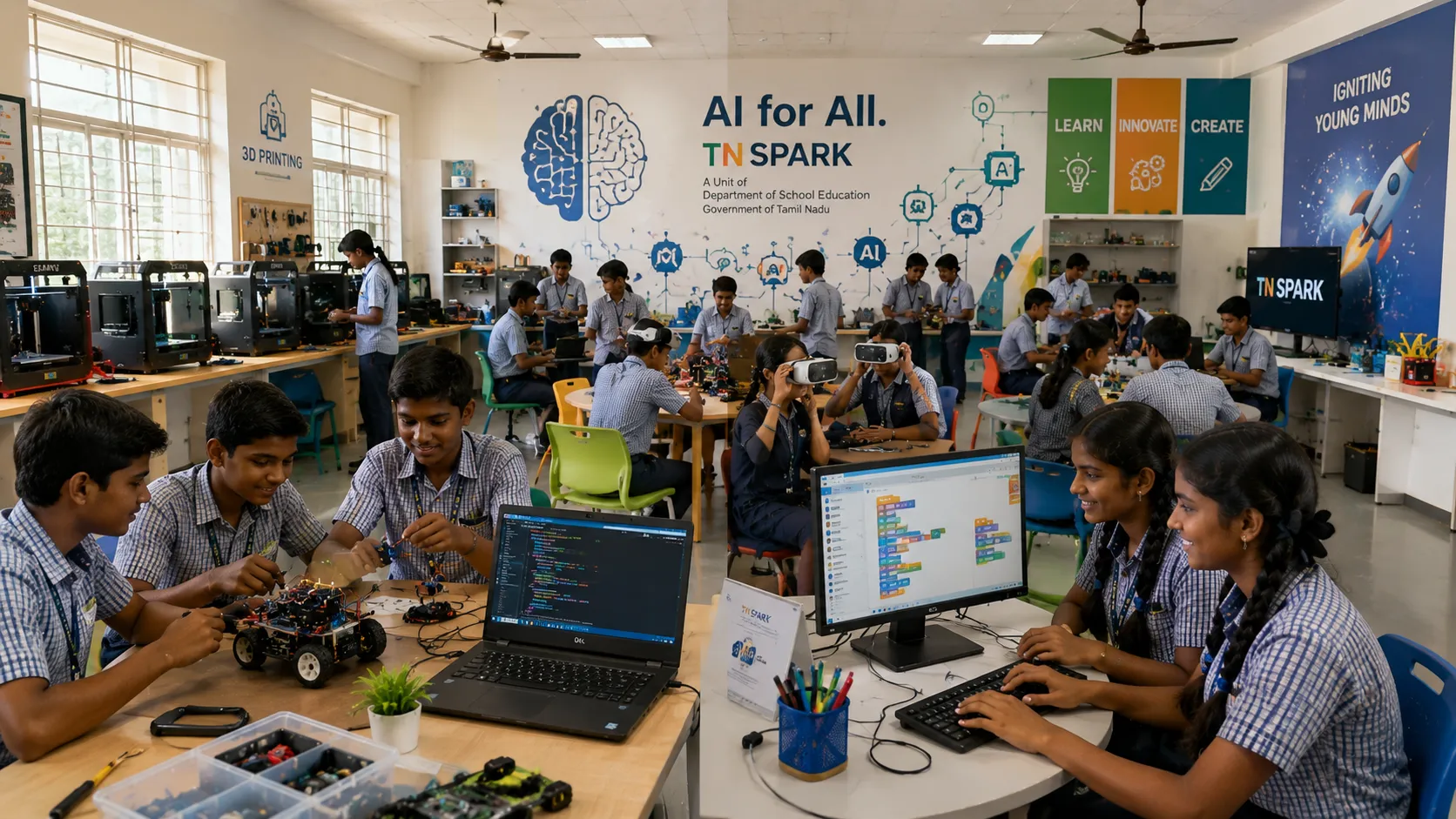
For the students themselves, the change is not abstract. They are not thinking about policy or budgets. They are thinking about what they will build next.
"We have a team working on a smart walking stick for visually impaired people using ultrasonic sensors and a voice AI," says R. Kavya, the girl from Coimbatore who cried when her robot first moved. "It is not just a school project. It is something that could help people. That is what I want to do with my life. Build things that help people."
Kavya wants to study computer science at IIT Madras. Two years ago, that dream would have seemed impossible. Today, her teachers say it is not just possible — it is probable. And there are 900,000 more like her across Tamil Nadu.


