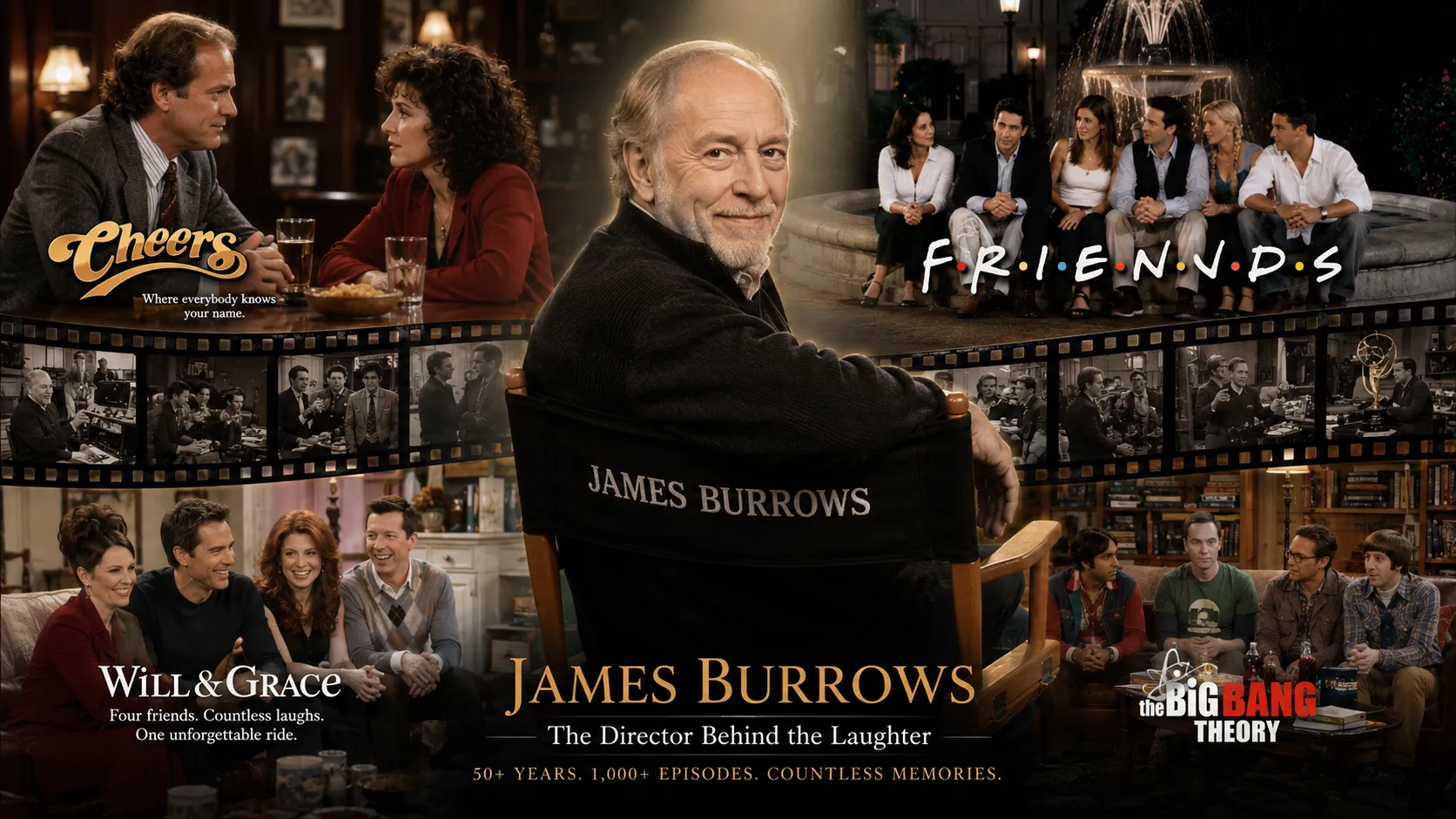
The co-creator of Cheers and director of over 1,000 sitcom episodes — from Friends to Will & Grace — passed away peacefully on Friday, closing the book on the multi-camera sitcom era he built. He directed 243 episodes of Cheers, all 246 of Will & Grace, and the pilots of Two and a Half Men and The Big Bang Theory. His 11 Emmys tell only half the story. The other half is written in the laughter of generations.
The news landed on a Friday, and by evening, the television industry had lost its North Star.
James Burrows, the legendary director and co-creator of Cheers, died on June 19, 2026, at the age of 85. His family confirmed his death in a statement to People, saying he "passed away peacefully today surrounded by his family." No location or cause of death was provided.
The tributes poured in within hours. Eric McCormack, who played Will in Will & Grace, called Burrows "the 800 lb gorilla of television comedy for fifty years" who "has left not a mark but a footprint". He added that Burrows brought "magic" to the sitcom and was like a "father figure".
But the tributes, however heartfelt, cannot capture the full measure of what Burrows built. He was not just a director. He was the architect of the multi-camera sitcom — the format that defined American television for three decades and gave the world some of its most beloved characters. He directed more than 1,000 episodes of television. He won 11 Emmy Awards and five Directors Guild of America Awards. He co-created Cheers, directed 243 of its 273 episodes, and directed every single episode of Will & Grace in its original run.
But the numbers, as impressive as they are, tell only half the story. The other half is written in the laughter of generations.
The Sweet Spot: Burrows' Philosophy of Comedy
Burrows had a simple philosophy about what made great television comedy. He called it the "sweet spot."
"When I direct a television show, I try to reach that sweet spot where the best script meets the best performance and the best chemistry between performers," Burrows wrote in his 2022 memoir, Directed by James Burrows. "Hitting that exact moment, where these factors land in combination, results in the sweetest and most enduring laugh".
It sounds simple. It was anything but. The multi-camera sitcom, filmed before a live studio audience, requires precision timing, flawless blocking, and an almost musical sense of rhythm. A joke lands not just because it is well written, but because the director has positioned the actors, timed the beats, and created the conditions for the audience to laugh at exactly the right moment.
Burrows was a master of that craft. Few viewers recognized him or knew his name, other than to see it flash quickly on the screen in the opening credits. But they knew his work. They felt it in the pacing of Cheers episodes, the warmth of Friends scenes, the sharpness of Will & Grace exchanges.
"He understood that great comedy was never simply about laughter," his family said in a statement. "It was about humanity, connection, and truth. That understanding became the foundation of a career that forever changed television".
The Road to Cheers: A Late Start and a Legendary Father
Burrows got his start in television relatively late. He was 35 years old in 1974 when he directed his first episodes of The Mary Tyler Moore Show, The Bob Newhart Show, and Laverne & Shirley.
But his path to the director's chair was shaped long before that. Born James Edward Burrows on December 30, 1940, in Los Angeles, he moved to New York when he was 5. He spent five years in the Metropolitan Opera Children's Chorus until his voice started to change. He attended LaGuardia High School of Music & Art.
His father was writer, director, and producer Abe Burrows, whose Broadway hits included Guys and Dolls and Can-Can. The elder Burrows also mentored Larry Gelbart, the future creator and producer of MASH*. The younger Burrows spent hours of his youth in theaters and studios watching his father work, dining with him at such famed New York haunts as Sardi's and Gallagher's, and meeting celebrities who attended his father's New Year's Eve parties.
After earning a bachelor's degree from Oberlin College, Burrows attended the graduate program of the Yale School of Drama, where his classmates included actor-comedian Robert Klein, playwright John Guare, and film director John Badham. At Yale, he was required to take directing classes — and he got hooked.
His first sitcom experience was as Burl Ives' dialogue coach on O.K. Crackerby!, which was directed by his father and ran for one season on ABC in 1965. From there, he was an assistant on The Patty Duke Show. He moved back to New York and worked for Broadway producers before meeting actor Mary Tyler Moore while working on the Broadway production of Holly Golightly, an adaptation of Breakfast at Tiffany's that was directed by his father.
That meeting would change his life. Moore gave him his first television directing job on The Mary Tyler Moore Show, launching a career that would span more than five decades.
The Cheers Miracle: From Ratings Flop to Cultural Institution
Cheers was not an immediate success. The show, which Burrows co-created with Glen and Les Charles, was a ratings bust in its inaugural season. It finished near the bottom of the Nielsen ratings. The network considered canceling it.
But the show won that year's Emmys for best comedy series (which Burrows shared as executive producer), best actress in a comedy series (for star Shelley Long), and a best directing award for Burrows himself. The critical acclaim bought it time.
And time proved the show's worth. Cheers grew to become one of the highest-rated shows on television — and the most-watched show of the 1990-91 season. It won a total of 28 Emmys over its run. It spawned a spin-off, Frasier, which ran for 11 seasons and won 37 Emmys of its own.
Burrows directed 243 of the 273 episodes of Cheers. He was the steady hand behind the show's signature blend of wit, warmth, and working-class authenticity. He created the rhythm of the bar — the way Sam, Diane, Norm, Cliff, Carla, and the rest of the cast bounced off each other. He made the audience feel like they were regulars at the bar.
The show's legacy is immeasurable. It defined the workplace sitcom. It launched the careers of Ted Danson, Shelley Long, Woody Harrelson, and Kelsey Grammer. It taught a generation of writers and directors how to build comedy around character, not just jokes.
The Will & Grace Era: All 246 Episodes
After Cheers ended in 1993, Burrows could have retired. He had already achieved more than most directors could dream of. Instead, he found a new creative partnership that would define the next phase of his career.
Will & Grace, created by Max Mutchnick and David Kohan, was a breakthrough sitcom about a gay lawyer, his best friend, and their circle of friends. Burrows directed all 246 episodes of the show in its original run. He brought the same precision, warmth, and comic timing that had made Cheers a success.
"He brought that magic to it, which is so many things: It's pace, it's trust, it's freedom," Eric McCormack told CBC News. "He sat in his chair and he would laugh. He had the best laugh. And if he was laughing, you knew you were in the right place".
The show was groundbreaking. It brought LGBTQ+ characters into the mainstream of American television. It won 16 Emmys. It ran for 11 seasons. And it cemented Burrows' reputation as the director who could make any sitcom work.
The Pilot King: Launching Friends, The Big Bang Theory, and More
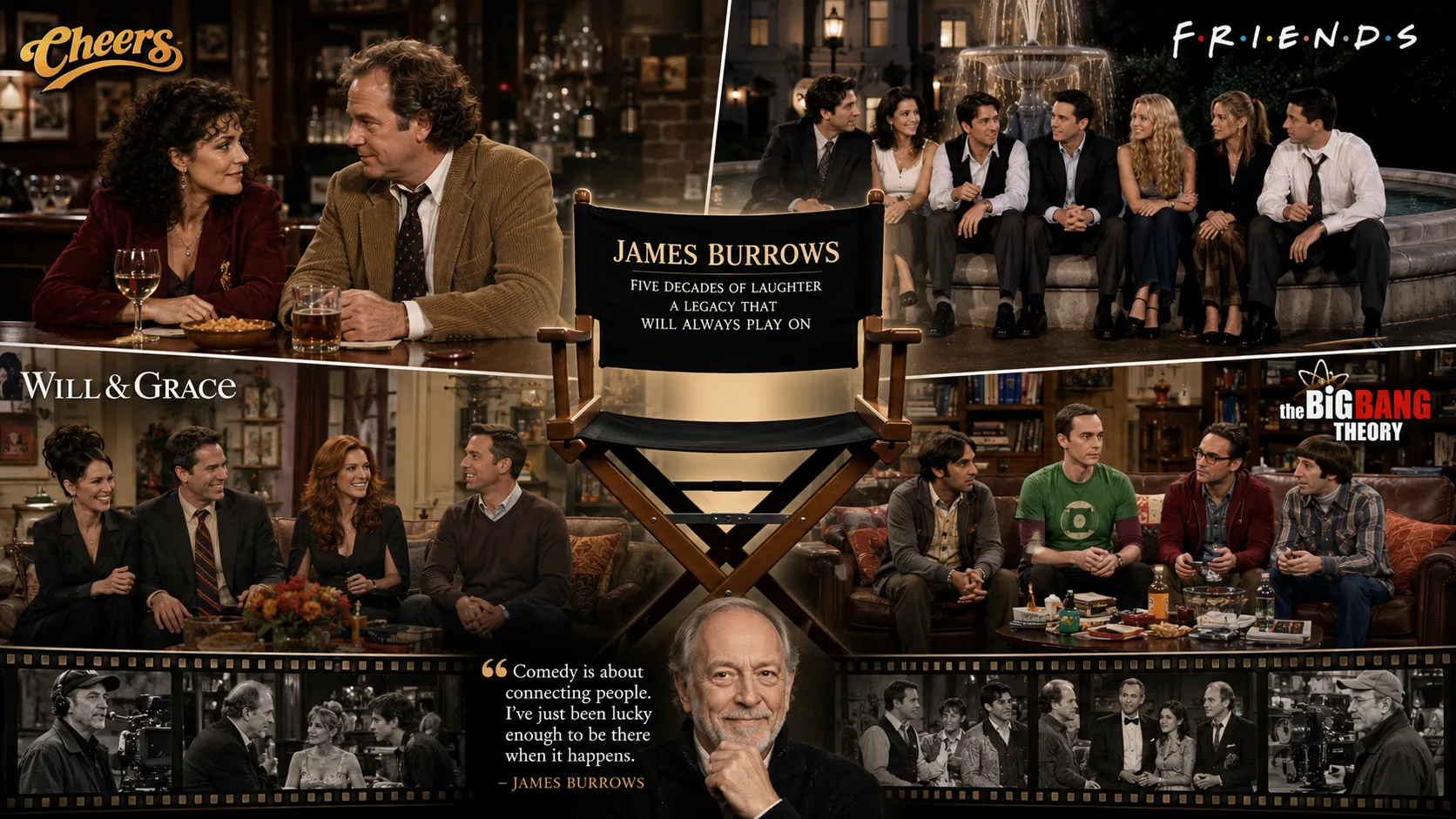
Burrows was also the go-to director for pilots. Studios knew that if they wanted a sitcom to succeed, they needed Burrows to direct the first episode. He helmed the pilots of Two and a Half Men and The Big Bang Theory. He directed episodes of Friends, Frasier, Mike & Molly, and 3rd Rock From the Sun.
The Friends pilot, which Burrows directed, is a masterclass in sitcom setup. In 22 minutes, he introduced six characters, established their relationships, and made the audience care about them. The show would go on to become one of the most beloved sitcoms in television history.
Burrows accepted a lifetime achievement award from the Directors Guild of America in 2015, celebrating his already decade-spanning career. By that time, he had already directed more than 1,000 episodes of television.
The Man Behind the Camera
For all his professional achievements, Burrows was remembered by those who knew him for something else: his kindness.
"Beyond his remarkable achievements, Burrows will be remembered for something even greater: his kindness, generosity, and unwavering belief in the people around him," his family said. "He possessed a rare ability to make everyone better and was known for remembering every person he met by name, making colleagues at every level feel seen, valued, and appreciated".
In an industry known for its egos and its ruthlessness, Burrows was a rare figure: a director who made everyone around him better. He mentored generations of writers, directors, and actors. He created an environment where people could do their best work. He made people laugh — not just on screen, but in life.
The Legacy: A Form That May Never Return
Burrows' death marks the end of an era. The multi-camera sitcom, filmed before a live studio audience, was the dominant form of television comedy for decades. It produced the shows that defined American culture: I Love Lucy, The Mary Tyler Moore Show, Cheers, Friends, Seinfeld, Will & Grace, The Big Bang Theory.
That form is now in decline. Streaming has changed the economics of television. Single-camera comedies, with their cinematic feel and lack of laugh tracks, have become the norm. The live studio audience, once the heartbeat of American comedy, is becoming a relic.
But Burrows' influence will endure. The lessons he taught — about timing, about chemistry, about the importance of humanity in comedy — are timeless. The shows he directed will be watched for generations. The laughter he created will continue to echo.
"What a beautiful ending for a man who spent his life shepherding stories to a beautiful ending," McCormack said.
James Burrows is survived by his wife Debbie Burrows, his four daughters, and seven grandchildren. He was previously married to Linda Solomon, with whom he had three children before their divorce in 1993.
He leaves behind a legacy that is measured not in awards, but in laughter. And that, in the end, is the only metric that matters.


