The Kerala Lab Where a 28-Year-Old Is Printing Human Corneas—and Could End the Global Blindness Waitlist
THIRUVANANTHAPURAM — May 24, 2026 — Dr. Asha Krishnan was not supposed to be a startup founder. She was a research scientist at Sree Chitra Tirunal Institute for Medical Sciences and Technology, one of India's most respected medical research institutions, working on biomaterials that could one day—perhaps, maybe, eventually—be used to 3D-print human tissue. The work was fascinating, important, and slow. The gap between a published paper and a patient who could see again was measured in decades. She was fine with that. She was a scientist. Patience was the job.
Then her grandmother went blind. The cause was corneal opacity—a clouding of the eye's outermost lens that is treatable with a transplant, but only if a donor cornea is available. In India, the waitlist for corneal transplants stretches into the hundreds of thousands, and the supply of donated tissue meets less than a quarter of the demand. Her grandmother's name was on the list. She waited two years. She died before a match was found.
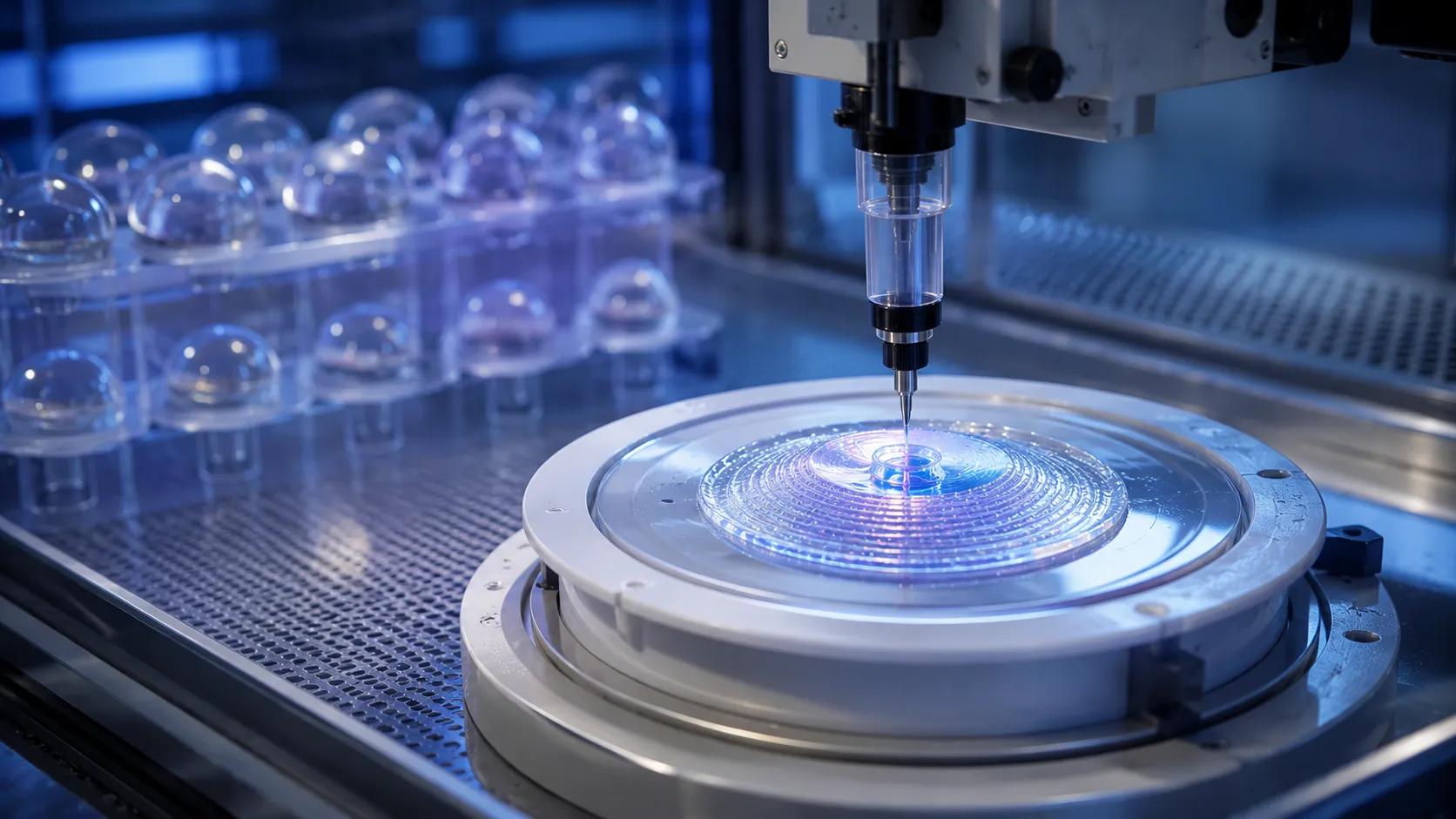
That was 2021. Today, Dr. Krishnan, 28, is the founder of BioPrint Vision, a Thiruvananthapuram-based biotechnology startup that has built a proprietary 3D bioprinter capable of printing functional human corneal tissue using stem cells and a custom bio-ink derived from marine collagen. The company has successfully printed over 200 corneal grafts and tested them in preclinical animal models. Results submitted to the Central Drugs Standard Control Organisation show that the printed corneas achieved transparency levels comparable to donor tissue, with no signs of immune rejection after six months in rabbit models. If clinical trials proceed as planned, BioPrint Vision could begin human implantation by 2028—making it one of the first companies in the world to bring a 3D-printed organ to market.
This week, the company closed a ₹42 crore ($5 million) Series A funding round led by HealthQuad and the Sree Chitra Tirunal Institute's technology transfer arm, with participation from angel investors including several ophthalmologists and a former Novartis executive. The capital will fund the transition from animal studies to Phase I human clinical trials, the expansion of the company's GMP-compliant manufacturing facility in Thiruvananthapuram, and the recruitment of a clinical team with experience in ophthalmic device regulation. The round values BioPrint Vision at approximately ₹280 crore—a modest figure by startup standards, but one that reflects the company's stage, its regulatory pathway, and the enormous addressable market it is targeting.
The Ink That Made It Possible
The single most important technological breakthrough at BioPrint Vision is not the printer. It is the ink.
For decades, the fundamental obstacle to 3D bioprinting human tissue has been the scaffold. Cells need a structure to grow on—a matrix that mimics the extracellular environment of natural tissue, providing mechanical support, biochemical signals, and the right porosity for nutrients to flow in and waste to flow out. Building that scaffold from synthetic polymers works, but synthetic materials are often rejected by the body, trigger inflammation, or degrade into toxic byproducts. Building it from human-derived collagen works better, but human collagen is expensive, scarce, and carries the same donor-dependency problem that makes corneal transplants so difficult in the first place.
Dr. Krishnan's breakthrough was to look for a scaffold material that was abundant, biocompatible, and structurally similar to human corneal tissue. She found it in an unlikely place: the Indian Ocean. Marine collagen, extracted from the skin and scales of fish, has a molecular structure that closely resembles human collagen, but with one crucial difference—it is available in virtually unlimited quantities. India's fishing industry generates thousands of tonnes of fish waste every year, most of which is discarded. BioPrint Vision sources its collagen from processing plants in Kerala and Tamil Nadu, paying a premium for high-quality raw material that would otherwise be landfill.
The marine collagen is processed into a hydrogel—a water-swollen polymer network that can be loaded with stem cells and extruded through a 3D printer nozzle with micron-level precision. The hydrogel is transparent, mechanically robust, and designed to degrade at exactly the rate that the cells replace it with their own extracellular matrix. By the time the graft is implanted, the scaffold has largely disappeared, leaving behind only the patient's own tissue. The approach has been tested in over 200 printed grafts, and the preclinical data submitted to CDSCO shows that the printed corneas achieved optical clarity scores of 92 percent compared to donor tissue, with less than 5 percent variation between grafts—a level of consistency that human-donated corneas, with their inherent biological variability, cannot match.
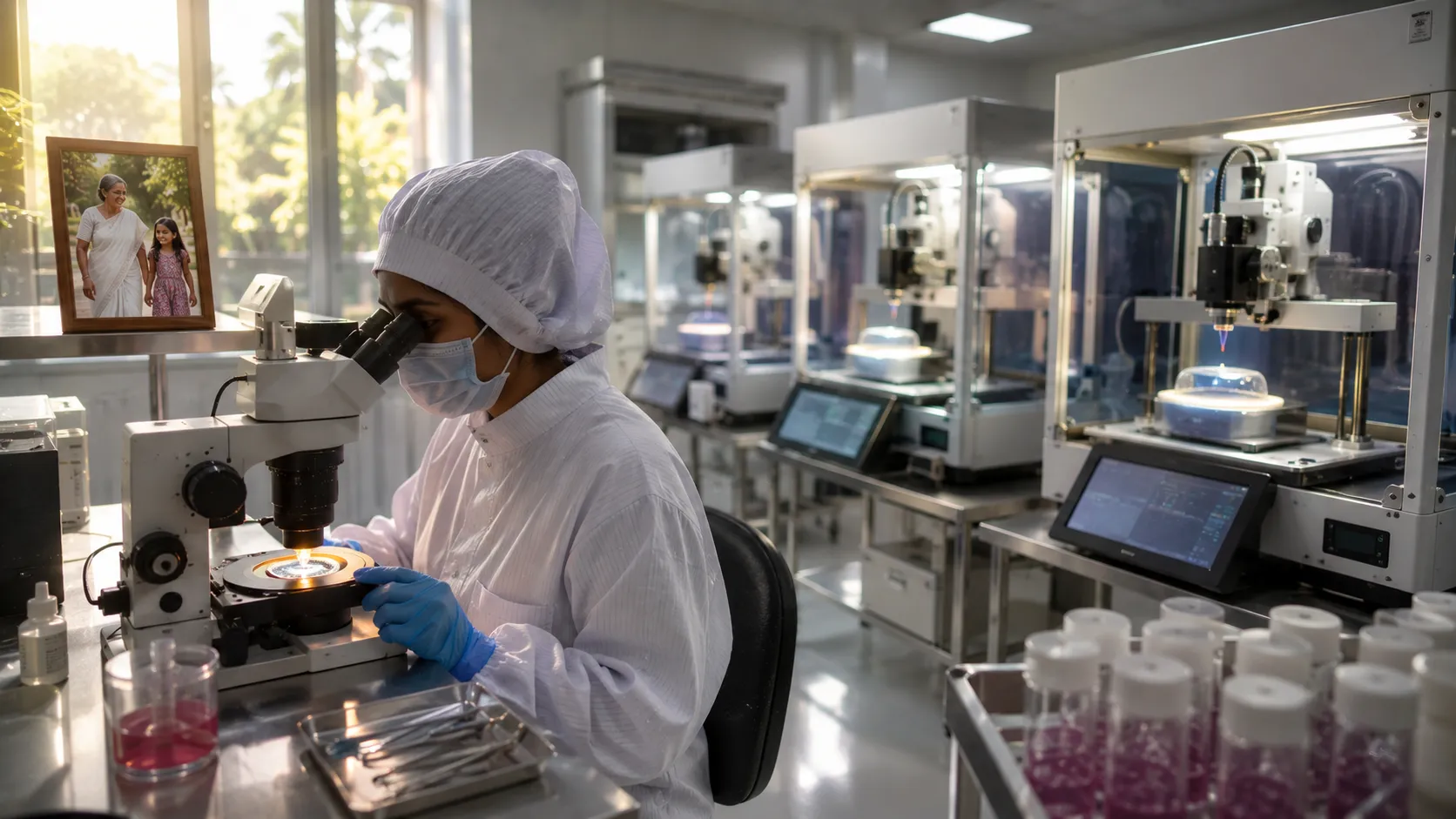
The stem cells used in the printing process are sourced from the limbus—the border region between the cornea and the white of the eye—where a population of adult stem cells continuously regenerates the corneal epithelium throughout life. A small biopsy from a patient's healthy eye provides enough limbal stem cells to print multiple corneal grafts. The cells are expanded in culture, suspended in the marine collagen hydrogel, and printed into the precise geometry of a human cornea. The entire process, from biopsy to finished graft, takes approximately two weeks. A conventional corneal transplant, by contrast, requires a donor, a waitlist, and a surgical procedure that depends entirely on the availability of human tissue.
The Grandmother Clause
The origin story of BioPrint Vision is the kind of narrative that venture capitalists usually dismiss as too personal, too emotional, too anecdotal to justify a multi-crore investment. Dr. Krishnan tells it anyway.
Her grandmother, Lakshmi, was a retired schoolteacher in Palakkad who began losing her vision in her early seventies. The diagnosis was corneal opacity—a condition in which the normally transparent cornea becomes scarred and cloudy, blocking light from reaching the retina. The treatment was a corneal transplant. The waitlist in Kerala, as in most of India, was measured in years. Lakshmi's name was added to the list in 2019. By 2021, she had gone completely blind in one eye and was rapidly losing vision in the other. The call from the transplant coordinator never came.
"When she died, I was angry," Dr. Krishnan said in an interview this week. "Not at anyone in particular. Just at the fact that we live in a world where we can print electronics, print food, print houses—and we cannot print a cornea. A piece of tissue the size of a contact lens. That's what stands between millions of people and the ability to see their grandchildren." The anger did not dissipate. It became a research programme. The biomaterials work she had been doing at Sree Chitra—the marine collagen scaffolds, the stem cell expansion protocols, the 3D printing techniques—had always been theoretical, aimed at journal publications and conference presentations. After Lakshmi's death, she asked herself a question that academic scientists rarely ask: what would it take to make this real?
The answer required leaving the institute, raising capital, building a team, and navigating a regulatory pathway that had no precedent in India. The first two years were spent on the core technology: optimising the bio-ink formulation, calibrating the printer, validating the optical properties of the printed corneas against donor tissue. The next two years were spent on preclinical testing: implanting the grafts in rabbit models, measuring transparency, screening for immune rejection, collecting the data that would eventually be submitted to CDSCO. The Series A funding, which closed this week, marks the end of the scientific phase and the beginning of the clinical one.
The Global Blindness Burden
The market that BioPrint Vision is targeting is among the largest and most underserved in global healthcare.
Corneal blindness affects an estimated 12.7 million people worldwide, according to the World Health Organisation. It is the fourth leading cause of blindness after cataracts, glaucoma, and age-related macular degeneration, but it is unique in one crucial respect: it is almost always treatable. A corneal transplant can restore vision in the vast majority of cases, with success rates exceeding 90 percent in uncomplicated patients. The problem is not the treatment. It is the supply of tissue.
Only about 1 in 70 of the people who need a corneal transplant will receive one in any given year. The shortage is most acute in low- and middle-income countries, where eye banks are rare, cultural and religious barriers to donation are significant, and the infrastructure required to harvest, store, and transport donor tissue is inadequate. India alone has an estimated 1.2 million people waiting for corneal transplants, with approximately 25,000 to 30,000 new cases added annually. The country's eye banks collect approximately 50,000 corneas per year—enough to meet less than a quarter of the demand, and substantially fewer than the number that are needed just to clear the existing backlog.
The economics of a 3D-printed cornea are fundamentally different from a donor transplant. A donor cornea, when available, costs the healthcare system approximately ₹50,000 to ₹1,00,000, depending on the eye bank, the processing, and the surgical fees. Much of that cost is borne by the patient or by charitable hospitals that subsidise transplants for the poor. A printed cornea, produced at scale, could cost less than ₹15,000 per graft—a fraction of the donor alternative. The raw materials are abundant: a single fish processing plant produces enough collagen for thousands of grafts per year. The manufacturing process is automated and scalable. The quality is consistent, eliminating the variability that makes donor tissue a lottery for patients and surgeons alike.
The global market for corneal transplants is estimated at approximately $3.5 billion annually, and it is growing as populations age and the incidence of corneal disease increases. The first company to bring a 3D-printed cornea to market will capture not just a share of that existing market, but an entirely new market—the millions of patients who are currently on waitlists, who have given up hope, and who will seek treatment the moment a reliable, affordable alternative becomes available.
The Clinical Pathway
The regulatory pathway from preclinical success to commercial approval is long, expensive, and littered with the wreckage of promising technologies that could not survive the transition from animal models to human trials.
BioPrint Vision has submitted its preclinical data to CDSCO, India's medical device regulator, and is awaiting approval to begin Phase I human clinical trials—the first time a 3D-printed cornea will be implanted in a human patient in India. The Phase I trial will enrol approximately 20 to 30 patients with corneal opacity who are not eligible for conventional transplants, either because they have already rejected a donor graft or because they are too old or too ill to withstand the immunosuppressive regimen that donor transplants require. The trial will measure safety—whether the printed cornea causes inflammation, infection, or immune rejection—as well as preliminary efficacy: improvements in visual acuity, corneal transparency, and patient-reported quality of life.
If Phase I succeeds, the company will progress to a larger Phase II/III trial with several hundred patients across multiple sites in India, comparing the printed cornea against conventional donor transplants in a randomised controlled design. The endpoint will be non-inferiority: the printed cornea must be at least as good as a donor cornea in terms of visual acuity at 12 months post-implantation. If that endpoint is met, the company can apply for full commercial approval from CDSCO and begin selling the product in India.
The company is also laying the groundwork for regulatory filings in other markets. The U.S. Food and Drug Administration has a Breakthrough Device designation for novel technologies that address unmet medical needs, and a 3D-printed cornea would almost certainly qualify. The European Medicines Agency has a similar pathway for advanced therapy medicinal products. The regulatory strategy is global because the market is global—and because the first company to secure approval in any major jurisdiction will have a head start that competitors will struggle to overcome.
Dr. Krishnan is clear-eyed about the timeline. "We are not going to rush," she said. "My grandmother waited two years for a cornea that never came. I am not going to put a product into a patient's eye until I am certain it is safe. But I am also not going to wait a day longer than necessary. Every day we spend in trials is a day that someone, somewhere, goes blind waiting for a donor."
The Competition
BioPrint Vision is not alone in the race to build a 3D-printed cornea. The field is global, competitive, and well-funded.
Precise Bio, a North Carolina-based startup founded by researchers from Wake Forest University, has developed a 3D bioprinting platform for ophthalmic tissues and has raised over $50 million in venture capital. The company has printed corneal tissue and tested it in animal models, but has not yet advanced to human clinical trials. Pandorum Technologies, a Bengaluru-based biotech startup, raised $18 million in February 2026 to advance its regenerative therapy for corneal blindness—a different approach that uses exosomes rather than printed tissue. Several academic groups in the United States, Europe, and Japan are developing competing technologies, though none has yet reached the clinical trial stage.
The competitive landscape is intensifying, but the addressable market is large enough to support multiple winners. The 12.7 million people waiting for corneal transplants are not going to be served by a single company. The winner in this race will not be the company that builds the best technology in the lab. It will be the company that navigates the regulatory pathway fastest, builds the manufacturing capacity to produce grafts at scale, and establishes the clinical evidence that convinces surgeons to adopt a product that is radically different from anything they have used before.
BioPrint Vision's advantages are structural. Its location in India gives it access to a patient population that is larger, more diverse, and more accessible for clinical trials than any in the world. Its use of marine collagen eliminates the donor-dependency problem that has bedevilled competing approaches. Its relationship with Sree Chitra Tirunal Institute—one of India's most respected medical research institutions—provides scientific credibility and access to the clinical infrastructure required for human trials. And its founder's motivation is not venture capital returns. It is personal.
The Deep-Tech Convergence
The BioPrint Vision story is not occurring in isolation. It is part of a broader structural shift in Indian biotechnology—a shift from generic drug manufacturing toward frontier innovation that has attracted capital, talent, and regulatory attention at a pace that has surprised even optimistic observers.
The same week that BioPrint Vision announced its Series A, the Technology Development Board approved 22 deeptech projects under the Research Development and Innovation Fund, including Eyestem Research—a Bengaluru-based regenerative medicine startup that is advancing a cell therapy for incurable retinal diseases and that recently secured regulatory approval for Phase 2 human trials. The alignment of policy, capital, and scientific talent is unmistakable: India's biotech ecosystem is moving from the margins of the global industry to the frontier.
HealthQuad, the lead investor in BioPrint Vision, has built a portfolio of Indian health-tech startups that are addressing the country's most intractable healthcare challenges. The firm's investment thesis is that India's disease burden, its large and diverse patient population, its growing pool of scientific talent, and its evolving regulatory framework create a unique environment for building health-tech companies that can compete globally. BioPrint Vision, with its 3D-printed cornea technology and its path to clinical trials, fits squarely within that thesis.
"BioPrint Vision represents everything that is changing about Indian biotechnology," said Dr. Amit Varma, managing partner at HealthQuad. "It is a company built on deep scientific research, addressing a global unmet need, using technology that has been developed entirely in India. The fact that a 28-year-old scientist in Thiruvananthapuram can build a 3D bioprinter that prints functional human corneas—and attract the capital to take it to clinical trials—is a measure of how far the Indian ecosystem has come."
What This Signals
The BioPrint Vision story is not primarily about a startup raising ₹42 crore. It is about the collision of three massive structural shifts—the global organ shortage, the maturing of 3D bioprinting technology, and the emergence of India as a credible centre of biotechnology innovation—and about the scientist who is building at the intersection of all three.
For decades, the global transplant system has been defined by scarcity. The supply of donor organs and tissues has never matched the demand, and the gap has been filled, inadequately, by waitlists, triage protocols, and the quiet tragedy of patients who die waiting for a match that never arrives. The 3D bioprinting revolution promises to end that scarcity—not for all organs, not yet, but for the ones that are structurally simple enough to be manufactured. The cornea, a transparent dome of collagen and cells with no blood supply and no complex internal architecture, is the ideal starting point.
Dr. Asha Krishnan is no longer the research scientist who published papers on biomaterials and hoped that someone, someday, would turn her work into a product. She is the founder of a company that has printed more than 200 functional human corneas, raised ₹42 crore to fund clinical trials, and set a timeline that could put a 3D-printed cornea into a human eye within two years. The grandmother who died waiting for a donor cornea is no longer just a memory. She is the reason the company exists—and the reason it will not stop until the waitlist is empty.
The printer is calibrated. The ink is ready. The trials are about to begin. The millions of people waiting for a cornea that will never come from a donor are about to learn that it might come from a printer instead—in a laboratory in Thiruvananthapuram, built by a 28-year-old who refused to accept that the technology that could have saved her grandmother did not yet exist. So she invented it.


