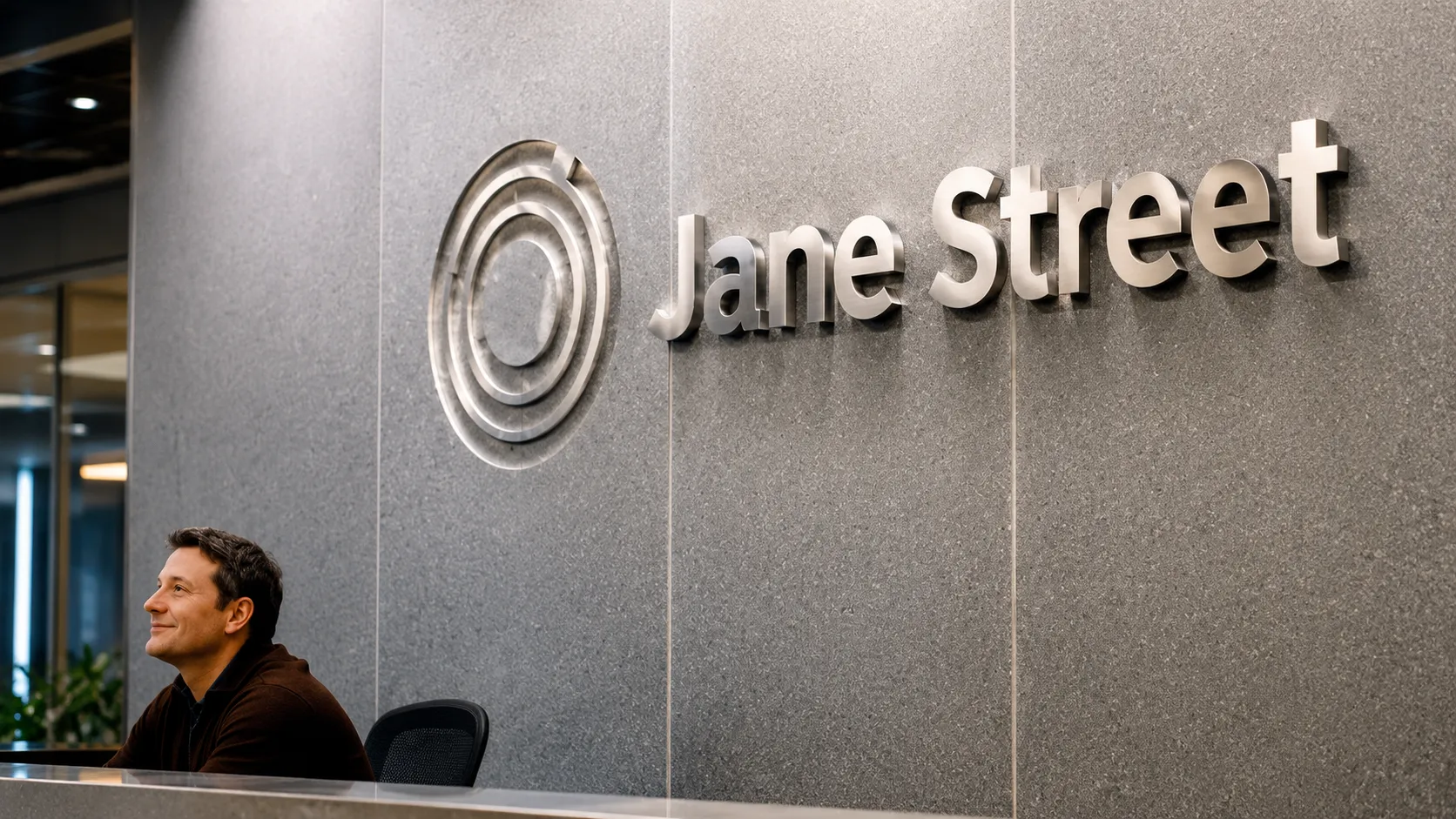
Some market controversies burn brightly for a news cycle and then fade quickly from investor memory once the immediate headlines pass. Others leave a longer shadow, quietly reshaping how market participants think about risk, regulation, and market structure long after the original story has stopped generating fresh headlines. The Jane Street controversy, which first rocked India's derivatives market months ago, has settled firmly into this second category — a story that, even now, continues to be cited as a contributing factor in the cautious, jittery mood affecting trading-related stocks and broader investor sentiment toward India's market structure.
For readers who may have only followed the story in passing, or who have seen it referenced repeatedly in market commentary without fully understanding why it continues to matter, it is worth revisiting both the substance of the original controversy and, more importantly, why its effects have proven considerably more persistent than many market observers initially expected.
WHAT THE JANE STREET EPISODE WAS ABOUT
Jane Street, a prominent US-based quantitative trading firm know

n globally for its sophisticated, technology-driven trading strategies across numerous asset classes and markets, became the subject of intense regulatory scrutiny in India after the Securities and Exchange Board of India examined allegations that the firm had engaged in trading strategies designed to manipulate prices around the expiry of index options contracts, particularly involving India's heavily traded Bank Nifty and Nifty index options markets — among the largest and most actively traded derivatives markets globally by contract volume.
The core allegation centred on what regulators characterised as a deliberate strategy of using large trades in the underlying index constituents or futures contracts to influence the index's closing level on expiry days, in a manner that would benefit the firm's much larger, offsetting positions in index options contracts that settle based on that same closing level — a strategy that, if proven, would represent a clear instance of market manipulation designed to profit from artificially influencing the very price benchmark used to settle other market participants' options positions.
Following its investigation, SEBI took significant regulatory action, including barring the firm from further access to Indian securities markets and moving to impound what regulators characterised as unlawfully gained profits from these trading strategies, a sum that ran into hundreds of millions of dollars — among the largest regulatory actions of this nature in the history of India's securities markets, reflecting both the scale of the alleged manipulation and the seriousness with which Indian regulators treated the integrity of the country's derivatives market structure.
WHY THIS EPISODE PROVED SO CONSEQUENTIAL
What elevated this controversy beyond a single firm-specific enforcement action into a broader, market-structure-defining episode was the fact that it struck directly at one of the most actively traded and economically significant segments of India's entire capital markets ecosystem: index options trading, which has grown explosively in popularity among India's retail trading community over recent years, driven by relatively low capital requirements for participation, the potential for significant leveraged returns, and aggressive marketing and platform accessibility from India's rapidly growing discount brokerage and trading app industry.
This explosive growth in retail participation in index options trading had, even before the Jane Street controversy, already drawn regulatory attention and concern, given mounting evidence that the vast majority of retail traders participating in this market segment were losing money over time — a pattern that regulators had already begun addressing through various measures aimed at improving retail investor risk disclosure and, in some cases, restricting certain types of high-risk options trading strategies for less sophisticated retail participants.
Against this backdrop, revelations that a sophisticated, well-resourced institutional trading firm may have been actively manipulating the very price benchmarks that these retail options traders' positions settled against added a considerably more troubling dimension to the existing retail options trading concern: the suggestion that at least some retail traders' losses may not have reflected simply the well-understood, inherent risk of options trading, but potentially the additional, less visible risk of trading in a market whose price discovery mechanism had, at least for a period, been subject to deliberate manipulation by a sophisticated market participant with the resources and technical capability to execute this kind of strategy at scale.
THE LINGERING TRUST DEFICIT
This distinction — between ordinary trading risk and manipulation-driven risk — helps explain why the Jane Street episode's effects have proven so much more persistent than a typical enforcement action's news cycle might suggest. Market participants, once they begin questioning whether the fundamental price discovery mechanism underlying a market segment can be trusted, tend to demand a considerably higher standard of reassurance before fully restoring their prior level of confidence and participation, compared to situations involving more straightforward, easily-quantified risks like company-specific earnings disappointments or macro-driven volatility.
For India's brokerage and trading platform industry, whose business models depend heavily on sustained retail trading volumes, particularly in the high-volume options trading segment that the Jane Street controversy directly implicated, this lingering trust deficit has translated into tangible, ongoing effects on trading-related stocks, as investors in these companies weigh the risk that continued regulatory scrutiny, potential new trading restrictions, or a more cautious retail trading community could weigh on transaction volumes and, by extension, the revenue and profitability of businesses whose economics depend heavily on trading activity levels.
REGULATORY RESPONSE AND ONGOING REFORM EFFORTS
In the aftermath of the Jane Street revelations, SEBI has continued examining broader market structure questions around index options trading, expiry-day price dynamics, and the adequacy of existing surveillance mechanisms for detecting similar manipulative strategies before they can cause significant market distortion or investor harm. This ongoing regulatory review process, while important for restoring long-term market integrity, has itself contributed to continued uncertainty for market participants and trading-related businesses, who must navigate the possibility of further regulatory changes to market structure, trading rules, or surveillance requirements before the full scope of the post-Jane Street regulatory response becomes clear.
Some of the specific reforms under consideration or already implemented in the aftermath of this episode have reportedly included enhanced surveillance mechanisms specifically designed to detect unusual trading patterns around index options expiry windows, tighter position limits or reporting requirements for large institutional traders in index derivatives, and broader reviews of the overall expiry-day settlement mechanism design to reduce the potential for the kind of manipulation strategy Jane Street was alleged to have employed.
HOW TRADING-RELATED STOCKS HAVE BEEN AFFECTED
For publicly listed companies whose business models are directly tied to India's trading and brokerage ecosystem — including stock exchanges themselves, discount brokerages, and other market infrastructure-adjacent businesses — the lingering effects of the Jane Street controversy have manifested in several observable ways. Investor concern about potential future regulatory restrictions on high-volume options trading, which represents a significant and highly profitable revenue stream for many of these businesses, has created a persistent overhang on valuations, even for companies with no direct connection to the Jane Street case itself.
Additionally, any signs of moderating retail options trading volumes — whether due to reduced retail trader confidence following the controversy, new regulatory restrictions, or simply the natural cooling of what had been an unusually rapid growth phase in retail options participation — have been closely scrutinised by analysts covering these trading-related stocks, given how directly transaction volume growth or decline flows through to these companies' revenue and profitability metrics.
WHETHER THIS SHADOW WILL EVENTUALLY LIFT
Market structure controversies of this nature typically do eventually fade in their day-to-day market impact, though the timeline for this kind of trust restoration can vary considerably depending on how convincingly regulators and market infrastructure providers are able to demonstrate that the underlying vulnerabilities have been genuinely addressed, rather than merely papered over with enforcement action against a single implicated firm without broader structural reform.
For India's markets, the ultimate resolution of this lingering Jane Street shadow will likely depend on the market's collective assessment of whether SEBI's ongoing regulatory review process produces meaningful, credible structural reforms to index options market design and surveillance capability, reforms robust enough to give both retail traders and institutional investors genuine confidence that the specific manipulation strategy at the heart of this controversy could not be readily replicated by other sophisticated market participants going forward.
Until that confidence is more fully restored, trading-related stocks and the broader sentiment around India's derivatives market structure appear likely to continue carrying at least some of the weight of this episode, even as it recedes further from the immediate news cycle and into the more settled, if still consequential, territory of a market structure controversy whose full resolution remains, for now, still very much a work in progress.
WHAT RETAIL TRADERS SHOULD TAKE FROM THIS EPISODE
For the millions of Indian retail traders who participate in index options markets, the practical lesson from the Jane Street episode extends beyond simply awaiting regulatory reform. Financial literacy advocates and market educators have increasingly used this controversy as a teaching moment about the fundamental risks embedded in derivatives trading more broadly — risks that exist independent of any manipulation concern, given how options trading strategies, particularly the kind of short-dated, high-leverage strategies popular among India's retail options trading community, carry inherently high probabilities of loss even in a perfectly fair, well-functioning market.
This distinction matters because it would be a mistake for retail traders to conclude that addressing the specific manipulation concerns raised by the Jane Street case would, on its own, meaningfully improve the odds for retail participants in index options trading more broadly. The data on retail options trading outcomes in India, gathered by SEBI and various research studies over recent years, has consistently shown that the substantial majority of retail traders in this segment lose money over time, a pattern driven primarily by the mathematically unfavourable structure of short-dated options trading strategies themselves, rather than by manipulation specifically. Addressing market manipulation is necessary for restoring trust in price discovery integrity, but it does not, on its own, change the fundamental risk-reward mathematics facing individual retail options traders.

THE BROADER LESSON FOR MARKET REGULATORS
Beyond India, the Jane Street episode has also drawn attention from securities regulators in other major markets, who have used the case as a reference point in their own ongoing discussions about surveillance capabilities for detecting sophisticated, technology-driven manipulation strategies in increasingly complex and fast-moving derivatives markets globally. As algorithmic and high-frequency trading strategies continue growing in sophistication and market share across global exchanges, regulators everywhere face the shared challenge of developing surveillance and enforcement capabilities that can keep pace with trading strategies that are often designed, quite deliberately, to operate within the technical letter of existing rules while nonetheless achieving market-distorting effects that those rules were originally intended to prevent.
For India specifically, this global regulatory attention carries an additional dimension of significance: as the country continues positioning itself as an increasingly important global financial market, capable of attracting sophisticated international trading firms and institutional capital, how effectively and credibly it resolves market structure controversies of this nature will likely factor into how global market participants assess the overall maturity, integrity, and trustworthiness of India's financial market infrastructure over the longer term — a reputational consideration that extends well beyond the specific trading-related stocks currently carrying the more immediate, near-term weight of this episode's lingering effects.
That broader reputational stake, more than any single quarter's trading volume figures, may ultimately prove to be what determines how long the Jane Street shadow continues to fall across India's markets — and how quickly investors are willing to stop mentioning it every time trading-related stocks have a rough week on Dalal Street. Until then, the episode remains a useful, if uncomfortable, reminder that in modern financial markets, trust — once shaken — is often the slowest thing of all to fully rebuild, no matter how quickly the enforcement paperwork itself gets settled and filed away in a regulator's archive somewhere in Mumbai.


