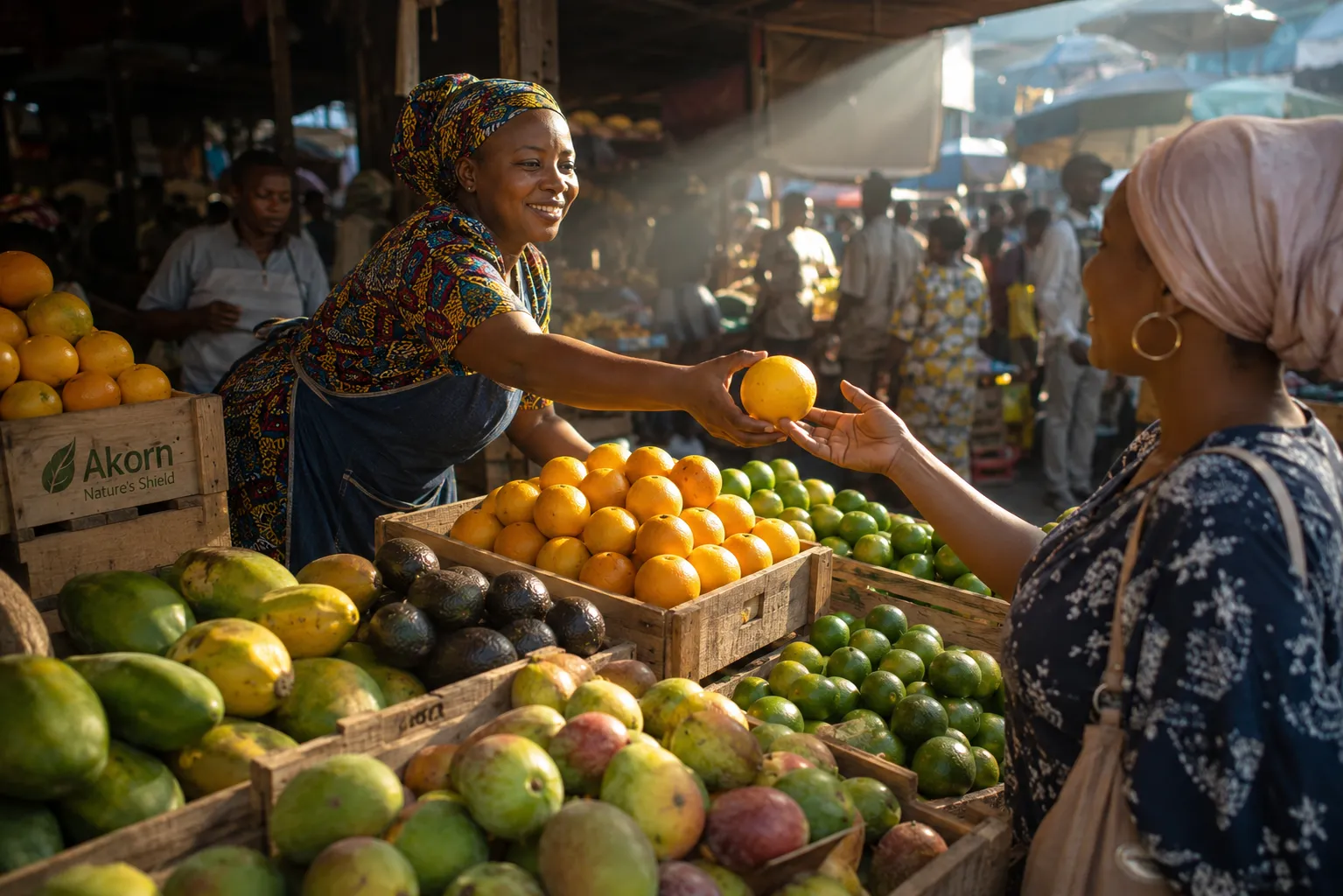
The Invisible Shield: How a Berkeley Startup's Edible Coating Is Winning the War on Food Waste
BERKELEY, CALIF. — May 2026 – The world wastes roughly 1.3 billion tons of food every year. An estimated 13% of food is lost between harvest and retail. Another 19% is discarded by consumers. The total economic cost approaches $1 trillion. The environmental cost—in water, land, fertilizer, and carbon—is incalculable. And a significant share of this waste has a single, preventable cause: fresh produce does not stay fresh long enough.
For decades, the produce industry has fought this problem with chemicals. Synthetic waxes. Petroleum-derived coatings. Fungicides that leave residues. The solutions work, after a fashion, but they carry environmental costs, consumer skepticism, and regulatory baggage. The industry has been waiting for an alternative that is effective, natural, and compatible with existing supply chains. In January 2026, that alternative won one of the most competitive food technology prizes in the world.
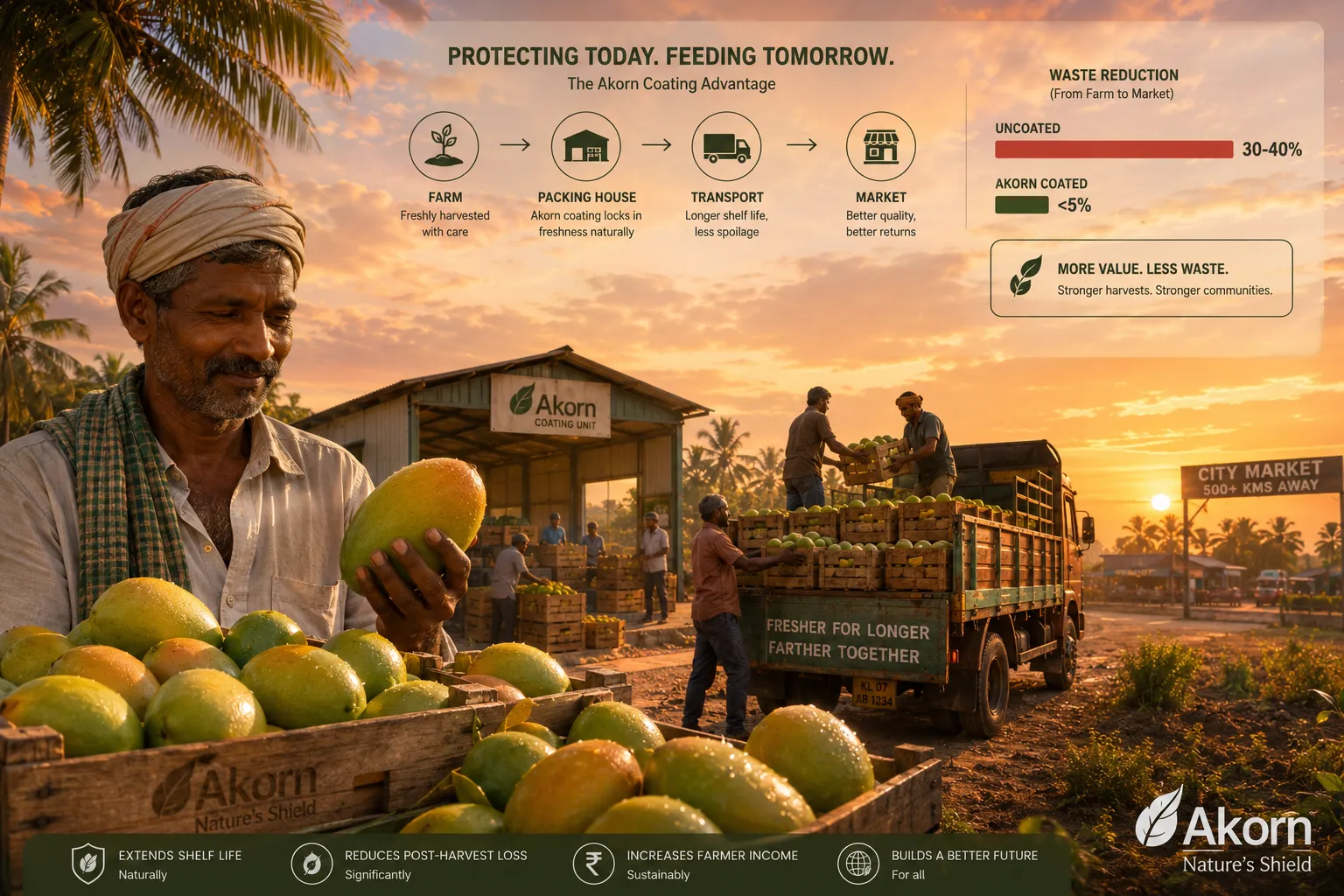
Akorn Technology, a Berkeley-based agritech startup, was named one of four winners of the UAE FoodTech Challenge, selected from over 1,200 entries across 113 countries. It became the first U.S. company to ever win the prize. The award came with a share of a $2 million prize pool, access to the UAE's innovation ecosystem, and a mandate to scale its solution globally. What Akorn had built was not a new pesticide or a better refrigeration system. It was an edible coating—invisible, tasteless, and made entirely from plants—that doubles the shelf life of fresh produce and reduces retail waste by up to 30%.
The Three-Part Solution
Akorn's coating is elegant in its simplicity. It uses three ingredients, all plant-derived, each performing a specific function. A vegetable protein slows the ripening process by reducing the fruit's respiration rate. A natural wax reduces moisture loss and dehydration, the primary causes of shriveling and weight loss during transport. A vegetable oil maintains vibrant color without altering taste, texture, or nutritional quality. The coating is applied using the same waxing lines already present in every commercial packing house. No new equipment. No workflow changes. No retraining. It drops into the existing postharvest infrastructure as seamlessly as the chemical coatings it is designed to replace.
The company has since developed a natural fungicidal coating that reduces green and blue mold on citrus by over 90%, again without synthetic chemicals. For retailers, the combined effect is a 20% to 30% reduction in shrink—the industry term for produce that is discarded before it can be sold. In an industry where margins are razor-thin and waste is the single largest cost, a 30% reduction in shrink is not a marginal improvement. It is a transformation of the unit economics.
The technology is already in commercial use in Egypt and Ghana, where postharvest losses are particularly severe due to limited cold-chain infrastructure and long transport distances. The UAE FoodTech Challenge win will accelerate deployment under the harsh climatic conditions of the Arabian Peninsula—a proving ground that, if successful, will demonstrate the coating's effectiveness in some of the most challenging environments on Earth.
The Global South Opportunity
What distinguishes Akorn's strategy from many agritech startups is its deliberate focus on the Global South. The company has stated that it plans to establish a research and production hub in the UAE within the next 12 to 18 months, using the region as a conduit to reach markets across Africa, South Asia, and Latin America. It is also exploring the use of date-based raw materials—abundant in the Gulf region—as active ingredients for future coating formulations, creating a circular economy link between local agriculture and global technology.
This geographic focus is strategically astute. The regions where postharvest losses are highest—sub-Saharan Africa, South Asia, Southeast Asia—are also the regions where cold-chain infrastructure is least developed. A coating that extends shelf life at ambient temperature is far more valuable in a market without reliable refrigeration than in a market where every truck is air-conditioned. Akorn is not selling a premium product to wealthy consumers who already have access to fresh produce. It is selling a resilience technology to markets where the difference between a coated and an uncoated mango is the difference between a farmer who makes a living and a farmer who watches a third of the harvest rot before it reaches a buyer.
The company has also received a Phase IIB Small Business Innovation Research grant from the National Science Foundation to advance its plant-based coatings, a validation from one of the most competitive non-dilutive funding programs in the United States. The NSF grant will support continued R&D on the fungicidal coating and the development of new formulations for additional crop categories.
What Every Entrepreneur Can Learn
Akorn's story offers lessons that are unusually clean and broadly applicable.
First, the best technology is often invisible. Akorn's coating does not announce itself. The consumer does not taste it, see it, or know it is there. The retailer does not need to change any process to use it. The grower does not need to invest in new equipment. The solution is designed to disappear into the existing system, solving the problem without creating new ones. This is the opposite of the "disruption" narrative that dominates startup culture—and it is, in many industries, the faster path to adoption. Don't ask your customer to change. Make your innovation a drop-in replacement for something they already use.
Second, non-dilutive funding is a strategic weapon. Akorn's NSF grant and its UAE FoodTech Challenge prize winnings provided capital, validation, and market access without diluting equity. For deep-tech and science-based startups, grant funding can bridge the gap between laboratory proof-of-concept and venture-scale readiness. The entrepreneurs who treat grant applications as a core competency, rather than a distraction from fundraising, often build more capital-efficient companies with stronger founder ownership.
Third, the biggest markets are often hiding in plain sight. Food waste is a trillion-dollar problem that affects every human on Earth, disproportionately harms the poorest populations, and has a solution that does not require inventing any new fundamental science. What it requires is a product that works, a distribution strategy that slots into existing infrastructure, and the patience to navigate the long sales cycles of the agricultural industry. Akorn's trajectory suggests that the size of the prize is commensurate with the scale of the problem.
The Road Ahead
Akorn's challenges are not technological. The coating works. The NSF grant, the UAE prize, and the commercial deployments in Egypt and Ghana have validated both the science and the market. The challenges are operational: scaling manufacturing, building distribution partnerships across fragmented agricultural markets, navigating diverse regulatory environments, and convincing risk-averse growers and retailers to switch from chemical coatings they have used for decades to a plant-based alternative they have never heard of.
But the tailwinds are powerful. Consumer demand for clean-label, chemical-free produce is growing in every major market. Regulatory pressure on synthetic fungicides and petroleum-based waxes is intensifying, particularly in the European Union. And the economics of food waste are becoming impossible to ignore as climate change makes agricultural production more expensive and less predictable. In a world where every calorie counts, the technology that preserves calories will become increasingly valuable.
Anthony Zografos, Akorn's founder and CEO, has said that the company's mission is to tackle the global challenge of food waste with sustainable, science-based solutions. The edible coating is the first product. The fungicidal coating is the second. The date-based formulations being explored in the UAE represent a third. Akorn is building a platform, not a product—a platform for natural, edible protection that could, over time, extend to every fruit, every vegetable, and every market where freshness is measured in days and waste is measured in billions.