The Indian Watch Brand That Sells Out Every Launch—And Just Took Aim at the Swiss
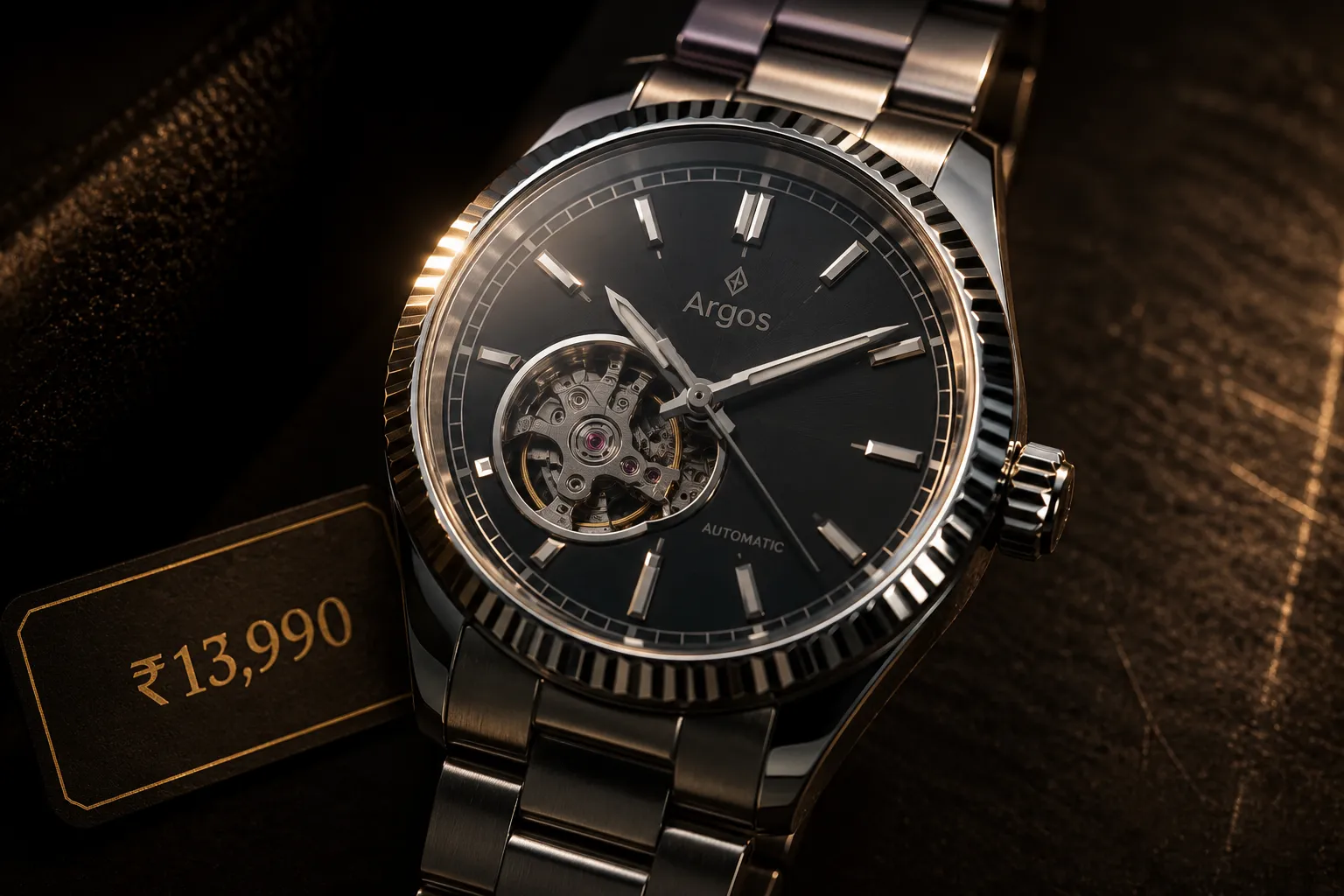
MUMBAI — May 22, 2026 — Somewhere in the backstreets of Mumbai's watch district, a brand that did not exist three years ago has been doing something that Swiss executives with six-figure marketing budgets and centuries of heritage cannot explain. Every time Argos Watches launches a new collection, the watches disappear. Olympus I sold out. Apollo III sold out. This week, the company launched Olympus II, its latest automatic watch line priced from ₹13,990—roughly $170—and more than 34,000 people had already signed up before the launch to be first in line. The collection features Japanese Miyota automatic movement, open-heart dials, sapphire crystal glass, and fluted detailing. The watches went live on Monday. By Wednesday, the website was displaying the three words that have become the brand's signature: "Sold Out Again."
Argos Watches is not a Swiss brand. It is not Japanese. It is an Indian luxury automatic watchmaker—homegrown, bootstrapped, and built in a country that the global watch industry has spent a century treating as a market to sell into, not a source of credible competition. "Olympus II is a reflection of what our community has consistently asked for—elevated finishing, stronger movements, and thoughtful design," the Argos team said at launch. "As a growing Indian watch brand, we want to continue creating products that feel premium, timeless, and globally relevant while remaining accessible to our audience." The statement is diplomatic. The subtext is not: an Indian brand is building automatic watches that compete on craftsmanship, design, and emotional connection with a generation of buyers who have been told their entire lives that quality comes from elsewhere.
The launch also marks Argos' entry into women's automatic watches, introducing a more compact design while retaining the signature detailing of the Olympus line—a sign that the brand sees its addressable market as substantially larger than the male collector community that powered its early growth.

The Community That Built the Brand
The most unconventional thing about Argos is not the watches. It is how the company decides what to build.
Argos does not have a traditional product development process. There is no market research firm conducting consumer surveys, no focus group evaluating design prototypes, no consultant advising on pricing strategy. Instead, the company has built a community—a digital following of watch enthusiasts, young professionals, and first-time luxury buyers who engage with the brand through social media, provide feedback on designs, and effectively vote on which products get made.
"Olympus II is a reflection of what our community has consistently asked for," the company said. The approach is borrowed from the direct-to-consumer playbook that built brands like Glossier and Warby Parker in the United States, but it is virtually unprecedented in the Indian watch market, which has historically been dominated by legacy retailers, multi-brand outlets, and foreign licensees. Argos does not sell through traditional watch stores. It sells direct to consumers through its own website, capturing the full margin and—more importantly—the direct relationship with the customer that allows it to iterate faster than any legacy competitor.
The community-driven model has produced a series of sold-out launches. Olympus I, the brand's first major collection, sold out within days. Apollo III, a subsequent release, followed the same pattern. Each launch has been larger than the last, and each has sold out faster. The 34,000 pre-launch sign-ups for Olympus II represent a demand signal that the brand is still struggling to match with supply—a problem that most Indian consumer startups would envy. "We are still figuring out how to scale production to meet demand," a company representative acknowledged. "Every launch, we think we've made enough. Every launch, we're wrong."
The ₹13,990 Question
The pricing of the Olympus II is a strategic decision that requires a moment of explanation. At ₹13,990—roughly $170—the watch sits in a category that the global watch industry has largely abandoned: the affordable automatic. Swiss automatic watches from heritage brands like Tissot, Hamilton, and Certina start at roughly ₹50,000 and climb rapidly from there. Japanese automatics from Seiko and Citizen occupy the ₹20,000 to ₹40,000 range. Below that, the market is dominated by quartz watches—battery-powered, mass-produced, and devoid of the mechanical soul that makes automatic movements compelling to enthusiasts.
Argos has positioned itself in the gap between ₹10,000 and ₹20,000—a price point where no credible automatic watch brand has established a foothold in India. The economics are challenging. Automatic movements are more expensive to manufacture than quartz alternatives. Sapphire crystal is more expensive than mineral glass. The fluted bezels and premium finishing that Argos invests in add cost that most brands at this price point avoid. The company is effectively selling a product with the features of a ₹40,000 watch at a ₹14,000 price.
The strategy is not to compete on cost with mass-market quartz watches. It is to create an entirely new category: the entry-level luxury automatic, priced for the Indian consumer who aspires to own a mechanical watch but cannot justify spending a month's salary on a Tissot. "The collection aims to bridge the gap between aspirational luxury and everyday sophistication," the company said. The gap is real. India's watch market has seen a growing shift toward mechanical and automatic watches, particularly among younger consumers who are "increasingly looking for craftsmanship, storytelling, and individuality in the products they invest in." The challenge is that the products they want have historically been priced beyond their reach. Argos is closing that gap—not by cutting corners, but by selling direct, building community, and capturing the margin that traditional retail would consume.
The Japanese Pilgrimage
One of the more revealing details in the Olympus II launch announcement was a small note about the brand's research and development process. "The Argos team travelled to Japan earlier this year as part of the research and development process behind Olympus II," the company said. The statement is significant because it signals that Argos is not content to be a brand that sources off-the-shelf components and assembles them into attractive packages. It is investing in the same kind of design research that established watch brands conduct—traveling to the world's premier watchmaking regions, studying manufacturing techniques, and building relationships with movement suppliers.
Japan is the natural destination for an affordable-luxury automatic brand. The Miyota movement that powers the Olympus II is manufactured by Citizen, one of Japan's largest watch companies, and is widely regarded as one of the most reliable automatic calibers in the entry-level segment. By sourcing Japanese movements and combining them with Indian design and direct-to-consumer distribution, Argos is assembling a supply chain that looks increasingly like the globalized model that built the Japanese auto industry in the 1970s and the Korean consumer electronics industry in the 1990s.
The Japan trip also signals something about the brand's ambitions. Argos is not positioning itself as an "Indian alternative"—a cheaper, locally-made version of a foreign product. It is positioning itself as a globally credible watch brand that happens to be based in India, drawing on the world's best manufacturing expertise to build products that compete on quality, design, and emotional connection. The distinction is subtle but significant. The former positioning has historically been a trap for Indian brands. The latter is a path to genuine global competitiveness.
What This Signals
The Argos Watches story is not primarily about watches. It is about the structural shift in how Indian brands are being built—and about the generation of consumers that is making those brands viable.
For decades, the Indian consumer market was defined by a single, crushing assumption: quality comes from elsewhere. The best watches were Swiss. The best electronics were Japanese. The best cars were German. Indian brands competed on price, not on quality, because the domestic manufacturing ecosystem could not match the craftsmanship of established global producers and because Indian consumers, conditioned by decades of import substitution, did not believe it could.
That assumption is collapsing—not all at once, but in categories where the manufacturing know-how is accessible, the design talent is abundant, and the consumer is young enough not to carry the baggage of the previous generation. The Indian watch market is one of those categories. The mechanical watch movement is a commodity, available from Japanese suppliers who will sell to any brand with a purchase order. The design talent—the ability to create a product that looks and feels premium—is increasingly available in India's growing pool of industrial designers. And the consumer, particularly the young, urban, digitally native consumer, does not share their parents' deference to foreign brands.
Argos is not the only Indian brand exploiting this gap. The same dynamic is playing out in apparel, in personal care, in home goods, in food and beverage. A generation of Indian entrepreneurs is building brands that are neither "Indian alternatives" to foreign products nor "premium imports" from abroad. They are something new: globally competitive Indian brands, built for Indian consumers, with the quality and design language to compete anywhere in the world.
The Olympus II collection is sold out. The 34,000 people on the waitlist will have to wait for the next production run. Argos is a small brand, still figuring out how to scale. But the signal it is sending—that an Indian watch can be beautiful, desirable, and worth waiting for—is larger than the brand itself. The Swiss do not need to worry yet. But they should probably pay attention.


