
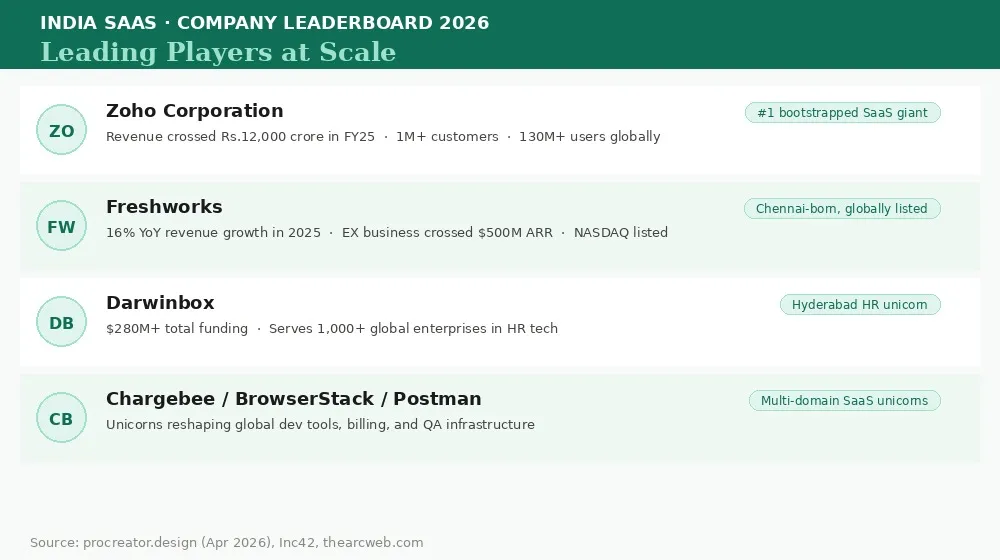
On a warm morning in Chennai, engineers at Zoho's campus are shipping code that will be used by over 130 million people across 150 countries. In Bengaluru, Freshworks is recording its 16th consecutive quarter of double-digit revenue growth. Meanwhile, a SaaS startup in Hyderabad is onboarding enterprise clients without venture capital funding. These examples illustrate the rise of India's SaaS ecosystem.
“India's SaaS industry is rapidly transitioning from a regional service hub to a global product powerhouse.”
— Expert Market Research, April 2026
A Market Built for Scale
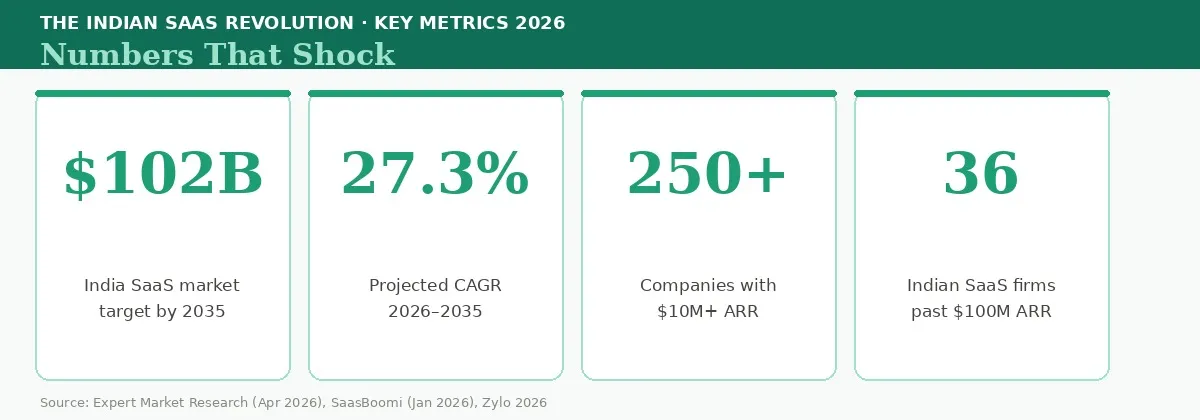
India's SaaS market was valued at approximately $9.14 billion in 2025 and is projected to reach $102 billion by 2035, representing a 27.3% CAGR according to Expert Market Research.
The sector has already achieved a 24% CAGR from FY2019 to FY2024, making it one of the fastest-growing technology segments in the Asia-Pacific region.
Private equity investment in Indian SaaS reached $1.38 billion in the first seven months of 2025, exceeding the $833 million invested during all of 2024.
The Company Leaderboard
India now has approximately 250 SaaS companies with more than $10 million in ARR, and 36 companies have surpassed $100 million ARR milestone — a figure that was essentially zero less than a decade ago.
Revenue Distribution: Who's Winning
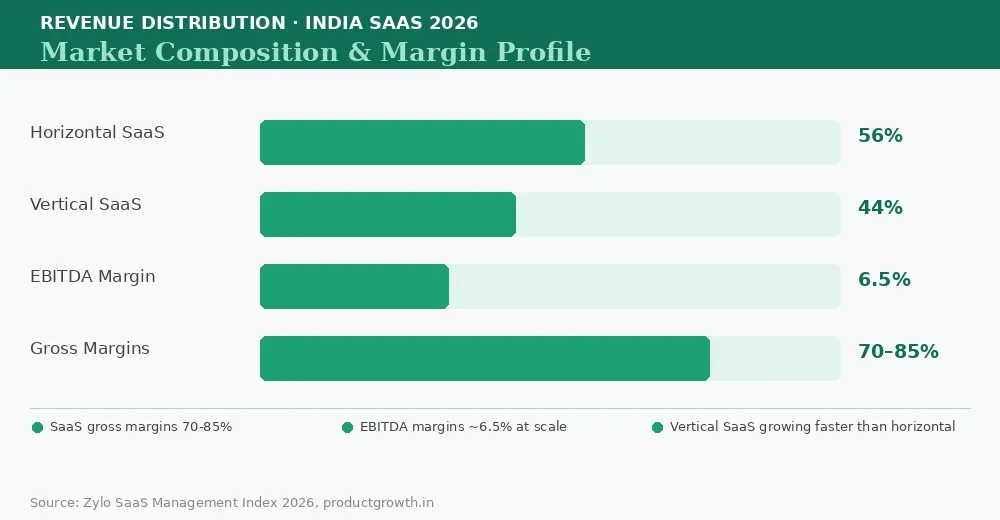
Horizontal SaaS — tools designed to serve any industry — still dominates revenue at 56% of totaL among India-based providers. But vertical SaaS, software built for a specific industry like healthcare, BFSI, or manufacturing, is growing faster from a smaller base and attracting the most investor attention in 2026.
The AI Multiplier
Artificial intelligence is not a future consideration for Indian SaaS — it is already table-stakes. Growing enterprise AI and cloud adoption is expected to contribute $35 billion of India's $100 billion SaaS market expansion alone, according to SaasBoomi's landmark January 2026 report.
The AI SaaS market globally is growing at a CAGR exceeding 37% from 2023 onwards. India's engineers, who built some of the world's most cost-effective software products, are now embedding AI capabilities at a pace that is restructuring global pricing assumptions.
India's IT spending is projected to exceed $176 billion in 2026, driven primarily by software and IT services growth — with SaaS at the heart of the expansion.
Why India's Edge Is Structural, Not Accidental
The conventional explanation — cheap labour — misses the point entirely. Indian SaaS companies have proven they can build enterprise-grade software with gross margins between 70% and 85%, matching or exceeding their Silicon Valley counterparts. The difference is cost of customer acquisition.
The median customer acquisition cost (CAC) for product-led growth SaaS companies in India now runs between Rs.500 and Rs.1,500 per customer — a fraction of the Rs.2,000-Rs.5,000 commanded by traditional sales-led models. This structural efficiency means Indian SaaS firms can reach profitability earlier and at smaller scale than their US peers.
Zoho — founded in Chennai in 1996 — is the most dramatic proof point. The company crossed $1 billion in annual revenue without taking a single dollar in venture capital and now serves over 700,000 businesses across 150 countries. In 2026, it surpassed one million customers.
What Comes Next
The SaaS firms that will define the next decade will be those that master what SaasBoomi calls 'localised solutions that scale globally.' The playbook is already being written: free tiers that convert to paid as SMB teams grow, AI features embedded at the product core rather than bolted on, and a relentless focus on capital efficiency over headline valuations.
With India's unicorn ecosystem collectively commanding a combined valuation exceeding $392 billion as of May 2026, and new unicorns being minted across SaaS, deep tech, and fintech, the revolution isn't coming. It's already here.
The numbers don't shock because they are large. They shock because they keep getting larger — and there is no credible scenario in which that stops.


