The House of 10,000 Kitchens: How a Former Swiggy Executive Built India's Most Capital-Efficient Food Empire — Without Owning a Single Stove
BENGALURU — May 18, 2026 — Arpita Aditi does not own a restaurant. She does not employ chefs. She does not run delivery fleets, manage dine-in operations, or spend sleepless nights worrying about table turnover rates. And yet, in roughly four years, the 30‑year‑old biotech engineer-turned-entrepreneur has built one of India's most quietly formidable food businesses — a virtual restaurant empire spanning 10 regional cuisine brands, more than 300 restaurant partners, six cities, and 340 pincodes, all without ever lighting a single stove herself.
Dil Foods — the name is a play on the Hindi word for "heart" — just closed a ₹72 crore (approximately $7.5 million) Series B funding round led by the Bikaji Foods Family Office, with participation from international funds and existing investors V3 Ventures, MJV Ventures, and Alteria Capital. The round brings the company's total funding to ₹113 crore (approximately $13.6 million) and sets the stage for an expansion that will take the platform from 340 to 600 pincodes by FY28, targeting an annualized revenue of ₹500 crore.
The numbers are impressive in their own right. But the more important number — the one that has drawn the quiet admiration of India's venture capital community and earned the company a spot on Shark Tank India — is 30X. When V3 Ventures first backed Dil Foods three years ago, the startup operated 30 locations. It has since scaled thirtyfold while maintaining what V3 founder Arjun Vaidya calls "probably the most capital-efficient business in the cloud kitchen QSR space in India." In a sector notorious for burning through venture dollars with little to show for it — kitchens that never break even, brands that vanish from Zomato listings as quickly as they appear — Dil Foods has built something rarer than a unicorn. It has built a real business.
The Woman Who Saw the Problem
Arpita Aditi did not come from the restaurant industry. She studied biotechnology at MIT, worked in pharmaceuticals at Himalayan Drugs, and spent time at Reliance Capital before landing at Swiggy, the Indian food delivery giant that, alongside Zomato, reshaped how hundreds of millions of Indians eat. It was inside Swiggy that she saw the problem Dil Foods was built to solve — and it was not the problem most food-tech founders were chasing.
The dominant narrative of the 2010s and early 2020s was that India needed more cloud kitchens: massive, centralized, technology-driven cooking facilities purpose-built for delivery. Rebel Foods, the category-defining giant, raised hundreds of millions to build and operate its own kitchens. EatClub and Curefoods followed a similar path. The prevailing logic was that the inefficiency in the food delivery system was a supply-side problem: if you could build bigger, smarter kitchens, you could serve more customers at lower cost.
Aditi saw a different inefficiency. India already had thousands of small, independently owned restaurants with fully functional kitchens, trained cooks, and spare capacity — particularly during off-peak hours. These restaurants were struggling because their fixed costs — rent, equipment, staff salaries — remained constant whether they served 50 orders a day or 150. The problem was not a lack of kitchen capacity. The problem was a lack of demand that the restaurants themselves could generate, because they lacked the brands, the technology, and the marketing muscle to compete on delivery platforms where visibility is everything.
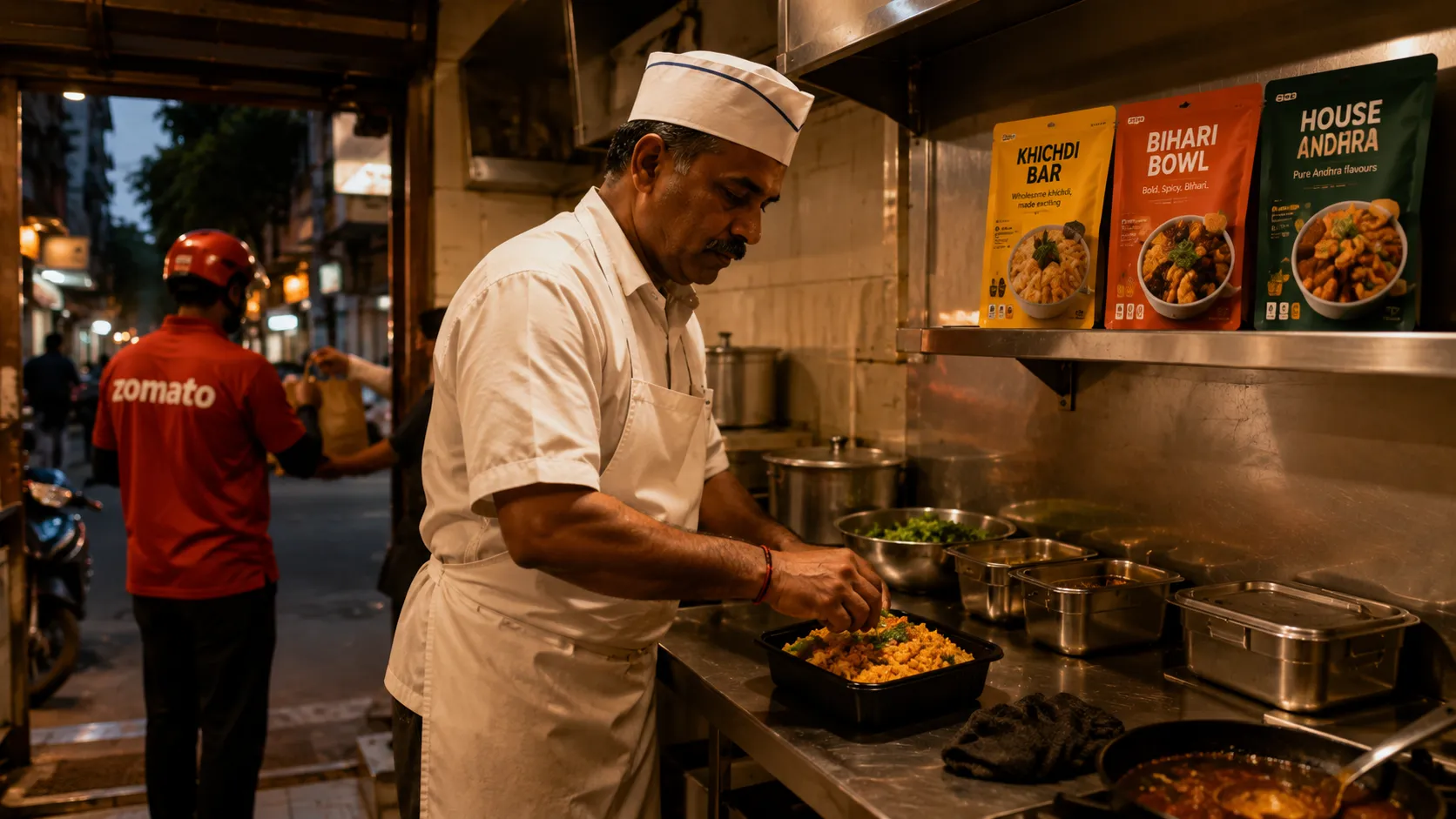
Dil Foods was Aditi's answer. Instead of building new kitchens, the company partners with existing restaurants that have underutilized capacity. It supplies them with ready-to-cook ingredients, standardized recipes, and a suite of branded virtual storefronts that appear on Swiggy and Zomato. The restaurant cooks and packages the food. Dil Foods handles the branding, the digital marketing, the delivery platform commissions, and the customer acquisition. The restaurant earns incremental revenue from kitchen hours that would otherwise have gone idle. Dil Foods earns revenue by capturing a share of the order value — a share that does not require it to pay rent, buy equipment, or employ chefs.
The Regional Flavor Bet
The second strategic insight embedded in Dil Foods is arguably more important than the first. While most cloud kitchen operators in India have focused on the mass-market categories — pizzas, burgers, biryanis, North Indian staples — Aditi built a portfolio of brands that are aggressively, unapologetically regional.
Khichdi Bar serves comfort-food khichdi across formats. Bihari Bowl offers litti chokha and other dishes from Bihar, one of India's most populous but culinarily underrepresented states. House of Andhra brings the fiery, tamarind-laced cuisine of coastal Andhra Pradesh to delivery platforms. Junglee Kitchen focuses on rustic, forest-inspired tribal recipes. Dil Punjabi Daily covers the North Indian classics. Bhole ke Chole is a single-dish brand built around the chickpea curry that is a staple across northern India. The Chaat Cult brings street-style chaat to delivery. Vegerama is the plant-based play. And Aahar rounds out the portfolio with simple, everyday vegetarian meals.
The insight is demographic. India is urbanizing at speed. Millions of young professionals are migrating from small towns in Bihar, Andhra Pradesh, Rajasthan, and Bengal to the major cities — Bengaluru, Hyderabad, Mumbai, Pune, Chennai, Ahmedabad — in search of work. They arrive with disposable incomes, delivery-app subscriptions, and a deep, abiding nostalgia for the food they grew up eating. They can find pizza and biryani anywhere. What they cannot find is their grandmother's litti chokha, their hometown's specific variant of chole, their mother's khichdi made the way it is made back home.
Dil Foods is betting that the next wave of food delivery growth will not come from more efficient ways to deliver generic food, but from a long-tail of regional specificity that the mass-market brands — Rebel Foods, EatClub, even direct-to-consumer giants like Domino's — are structurally unable to serve. As Deepak Agarwal, Managing Director of Bikaji Foods International, put it: "Having built Bikaji on the foundation of bringing authentic Indian flavours to people across the world, this investment in Dil Foods feels especially meaningful to us. We see in their journey a shared passion for regional cuisine and a deep understanding of how consumer preferences in India are evolving."
The Central Kitchen Moat
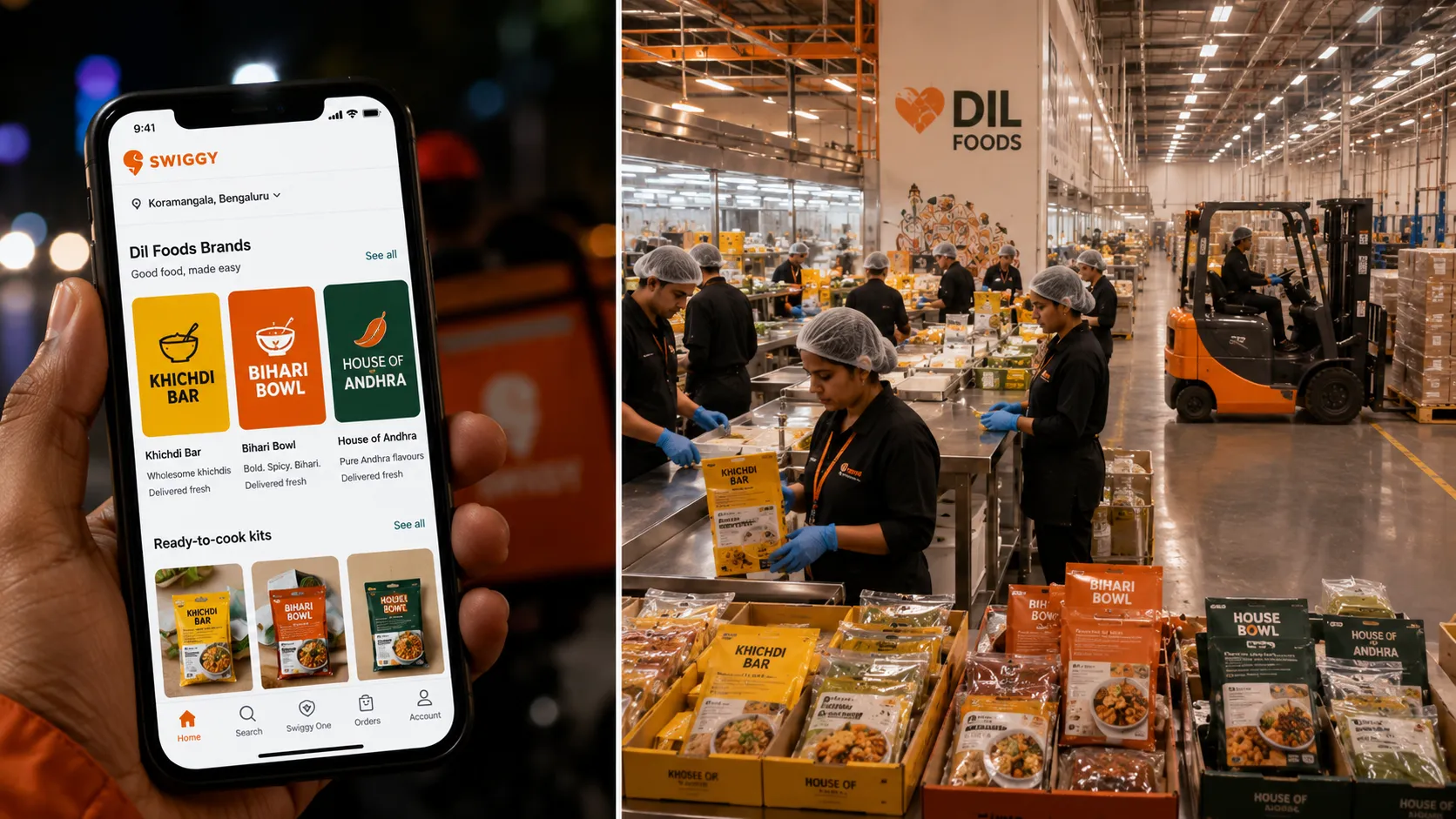
The most recent — and least understood — piece of Dil Foods' strategy is a 100,000-square-foot central kitchen in Bengaluru, completed in 2025 and described by Aditi as "just the beginning." The facility is not a restaurant. It does not cook food for delivery. It produces ready-to-cook kits — pre-portioned, standardized, quality-controlled ingredients that are shipped to partner restaurants across the city.
The economics of this approach are subtle but powerful. By centralizing ingredient sourcing, quality control, and initial preparation at the Bengaluru kitchen, Dil Foods removes the single largest source of variability in the virtual restaurant model: inconsistency. When a customer orders House of Andhra chicken curry from a partner restaurant in Whitefield and the same dish from a different partner restaurant in Jayanagar, the flavor, texture, and quality are identical — because the core ingredients came from the same central kitchen, prepared to the same specification, and the partner restaurant's job is simply to execute the final cooking step.
This is not a trivial operational achievement. It is the moat that separates Dil Foods from the hundreds of virtual restaurant startups that launch on Swiggy and Zomato every year, ride a wave of initial orders and promotional discounts, and then vanish when customers discover that the food tastes different depending on which kitchen made it. Standardization is the graveyard of most virtual restaurant plays. Dil Foods' central kitchen model is designed to solve it at the infrastructure level.
The central kitchen also changes the partner-restaurant proposition. Under the earlier model, a restaurant partner had to procure ingredients, prepare them according to Dil Foods' specifications, and hope for consistency. Under the central-kitchen model, the partner receives pre-portioned, ready-to-cook kits. The food preparation time drops to roughly two to three minutes — "it hardly takes two to three minutes to regenerate the food," Aditi told Inc42 — and the gas and LPG costs fall sharply. The partner's barrier to participation is lower, the economics are better, and the consistency risk is largely eliminated.
The Road to ₹500 Crore
Dil Foods' Series B round positions the company for an expansion that will take it from its current footprint — six cities, 340 pincodes, 300-plus restaurant partners — to 600 locations by FY28. The target annualized revenue: ₹500 crore, or roughly $60 million. That is a substantial number for a company that has raised only $13.6 million in total funding — a capital-efficiency ratio that would be the envy of most venture-backed startups in any sector.
The expansion strategy has two vectors. The first is geographic: deepen penetration in existing Tier-I markets like Bengaluru and Hyderabad while pushing into Tier-II and Tier-III cities where the demand for delivery-friendly regional cuisine is growing rapidly. The second is culinary: launch more regional cuisine brands that capture the specific food traditions of additional Indian states and communities. The portfolio logic is that each new brand unlocks a new set of consumers without requiring a new kitchen, because the brands are deployed across the same partner-restaurant network and supplied by the same central-kitchen infrastructure.
The competitive landscape is intensifying. Rebel Foods, the category giant, operates more than 45 brands across 70-plus cities and has raised over $600 million. EatClub, Curefoods, and a growing roster of smaller cloud-kitchen operators are competing for the same delivery-platform real estate. But Dil Foods' asset-light, capital-efficient model gives it a structural advantage that the kitchen-heavy competitors cannot easily replicate. It does not need to raise hundreds of millions to build kitchens. It needs to raise enough to build brands and supply chains. The kitchens are already there, spread across India, waiting for additional demand.
India's online food delivery market is projected to reach $59 billion by 2030, driven by rising disposable incomes, increasing internet penetration, quick-commerce integration, and a generational shift toward convenience-driven eating. Within that market, the regional cuisine segment — the long tail of specific, authentic, nostalgia-driven food experiences — is growing faster than the generic categories that dominated the first wave of delivery growth. Dil Foods is positioned at the intersection of the two trends: a technology platform that enables the distribution of regional food without owning the kitchens that produce it.
Arpita Aditi is not building the next Rebel Foods. She is building something that may, in the long run, prove more durable: a distributed, capital-light ecosystem that can scale across cuisines, cities, and consumption patterns without the burden of fixed assets that weighs down the competition. The company that began with a founder walking the corridors of Swiggy and wondering why small restaurants with spare capacity could not be turned into a network is now targeting half a billion rupees in annual revenue. It has done so by solving the problem no one else was solving — not building more kitchens, but making the kitchens that already existed more productive.
"Dil Foods has always been built on the idea of creating a sustainable ecosystem in the food industry," Aditi said. "This funding will help us double down on that belief and capture a larger share of the consumer's plate." The plate, if she is right, will be filled with litti chokha, Andhra chicken, and the kind of khichdi that tastes like home. And it will arrive not from a gleaming cloud kitchen owned by a unicorn, but from a neighborhood restaurant that was already there.


