The Helicopter Farmer: How a Banker Quit His Job, Bet Everything on Medicinal Herbs, and Built a Rs 70 Crore Empire in India's Most Dangerous Region
BASTAR, CHHATTISGARH — May 21, 2026 — In 1998, Rajaram Tripathi did something that made no sense to anyone who knew him. He was a probationary officer at the State Bank of India, a government job that came with a pension, respectability, and the quiet assurance of a middle-class life. He had degrees. He had security. He had a father who was a teacher and a grandfather who had spent seven decades coaxing crops from the soil of Bastar. Everyone in his orbit expected him to stay in banking, rise through the ranks, and retire with a gold watch. Instead, he walked into his branch manager's office and resigned.
The reason, he later explained, was something he had seen too many times during his years at the bank: farmers losing their land to auction because they could not repay loans. The agricultural system was broken, and he believed he could fix it — not from behind a desk, but from the fields themselves. "I saw farmers suffering," he said. "The weakest link was marketing. They grew crops but had no way to sell them at a fair price."
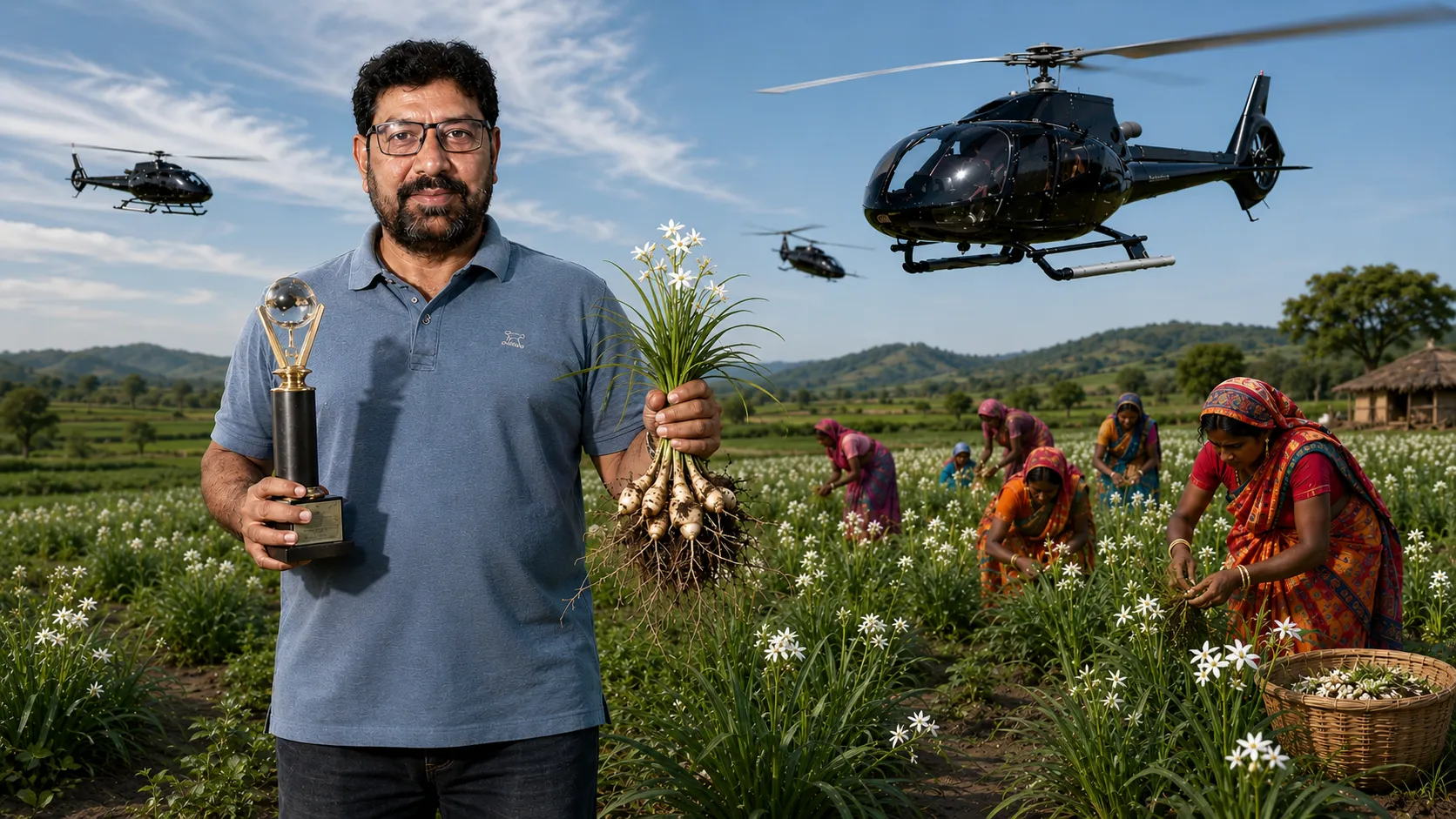
Nearly three decades later, the man who quit his bank job is the founder and CEO of Maa Danteshwari Herbal Group, an enterprise that cultivates more than 70 varieties of medicinal plants across approximately 1,200 acres, generates an annual turnover estimated between Rs 25 and Rs 70 crore, and exports black pepper to Europe and the United States. He has won the Best Farmer of India award four times. He owns a Robinson R-44 helicopter worth Rs 7 crore — the first Indian farmer ever to use one for agricultural spraying. He is now planning to buy an airplane. And he has done all of this in Bastar, a region known more for Naxalite insurgency than for agricultural innovation.
The Gamble on White Musli
The first years after quitting the bank were disastrous. Tripathi planted vegetables — tomatoes, cauliflower — and lost money on every harvest. The crops were perishable, the market prices volatile, and the middlemen ruthless. "I lost heavily," he admitted. The experience nearly sent him back to banking, tail between his legs.
Instead, he did something that revealed the analytical mind beneath the farmer's exterior. He researched. He traveled. He studied global commodity markets. What he discovered was that medicinal herbs — specifically white musli, a plant whose roots are prized in Ayurvedic medicine and fetch high prices on international markets — were in persistent short supply. The crop was non-perishable, unlike vegetables. It could be dried, stored, and sold when prices were favorable. And Bastar's climate — humid, warm, with rich forest soil — was ideal for growing it.
In late 1999, he planted his first crop of white musli. It sold. He planted more. He added black pepper, using an Australian trellis method that increased yield. He added stevia, the natural sweetener, and ashwagandha, the stress-reducing adaptogen that has become a global wellness phenomenon. By 2002, he had founded the Central Herbal Agro Marketing Federation of India, a cooperative network that eliminated middlemen and connected tribal farmers directly to export markets. By 2010, he was the largest producer of white musli and black pepper in Bastar.
The cooperative model became the engine of his social impact. Tripathi does not simply employ 400 tribal families; he provides them with seeds, free training, and guaranteed purchase prices. He has built women's self-help groups across the region. His foundation runs on a principle that he articulates with the unsentimental clarity of someone who has seen what happens when farming fails: profit must be shared, or the system collapses. "Farming cannot succeed in isolation," he told Krishi Jagran. "When the community rises, everyone rises."
The Helicopter and the Airplane
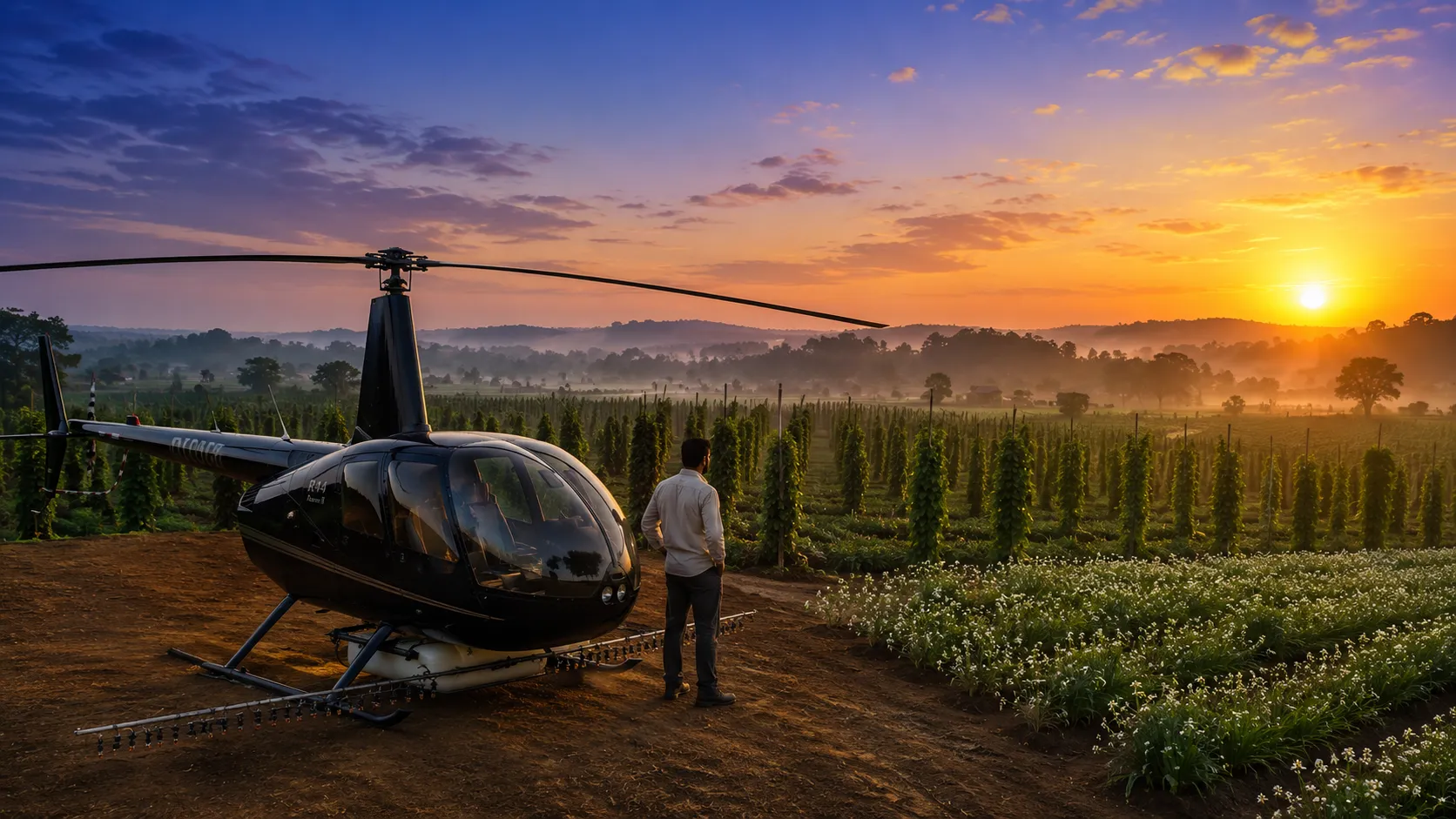
In 2023, Tripathi made international headlines for a purchase that seemed, at first glance, almost absurd. He bought a Robinson R-44 helicopter — a four-seater aircraft — and had it outfitted with specialized spraying equipment. The cost: Rs 7 crore. The purpose: aerial application of fertilizers and pesticides across his vast landholdings.
"I saw this in England and Germany," he explained, with the matter-of-fact tone of someone discussing a tractor purchase. "Manual spraying scatters the medicine unevenly and contributes to pest spread. A helicopter can spray precisely and cover far more ground." The helicopter, which arrived in Bastar in 2024 after a two-year wait, also serves neighboring farms — Tripathi makes it available to other farmers at no charge. His son, his younger brother, and he all trained at the Aviation Academy in Ujjain to pilot the machine.
The helicopter was not an extravagance. It was a calculated capital investment, the kind that farmers in the developed world make routinely but that remains almost unimaginable in Indian agriculture. Tripathi understood this. He also understood that the symbolism mattered. "I want other farmers to see what is possible," he said. The helicopter became a national news story, earning him the nickname "Helicopter Wale Kisan" — the farmer with a helicopter. But the message beneath the spectacle was more profound: Indian agriculture, if run with discipline, market intelligence, and the right technology, could generate the kind of returns that justified a helicopter.
Now he is planning to buy an airplane. The Robinson R-44 is useful for spraying, but its range is limited. An airplane would allow him to cover more ground, reach more remote fields, and expand the cooperative model beyond Bastar. The South African government has already signed a memorandum of understanding with him to replicate his model on 10,000 hectares. The "Herbal King of Bastar," as Krishi Jagran has called him, is going global.
The Larger Meaning
Rajaram Tripathi's story resists easy categorization. He is not a startup founder in the conventional sense — there is no venture capital, no term sheet, no exit. He is not a technologist — his innovations are agronomic, not digital. He is something rarer in the modern economy: a farmer who became an industrialist without losing his connection to the soil.
His enterprise now cultivates more than 70 varieties of medicinal plants across 1,200 acres. His cooperative network supports 400 tribal families and has been recognized nationally for its social impact. He has won the Richest Farmer of India award, the Millionaire Farmer of India award, and multiple national honors. He is, by any measure, one of the most successful agricultural entrepreneurs the country has produced. And he still lives in Bastar, still works the fields, still signs off on purchase orders for the cooperative, still takes calls from tribal farmers who need advice on pest management.
When Krishi Jagran named him the Richest Farmer of India in 2023, the award was presented by Union Minister Purushottam Rupala. Tripathi accepted it with the same quiet composure with which he had resigned from his bank job 25 years earlier. He was not leaving anything this time. He was arriving.
The banker who walked away from security to bet everything on medicinal herbs has been proven right — not just about white musli, but about something larger. Agriculture, he has spent his life demonstrating, is not a backward occupation to be escaped. It is a business to be mastered. The helicopter is not a toy. It is a tool. And the farmer who uses it is not a curiosity. He is the future.


