The Headphones That Read Your Mind: How Two Indian Women Built an AI-Powered Neurotech Wearable That Reduces Stress in Real Time
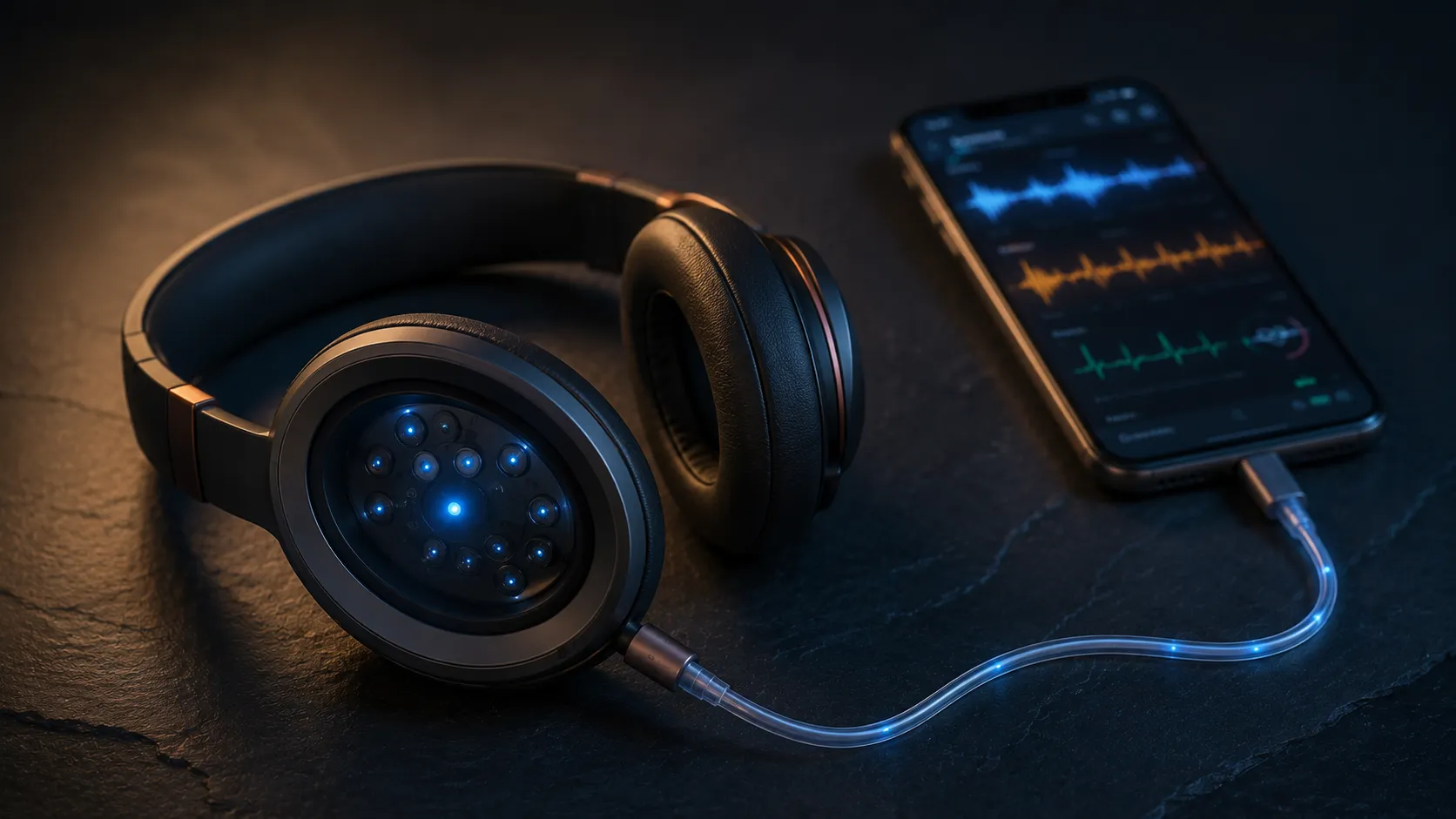
GURUGRAM — May 24, 2026 — The headphones look ordinary. They sit over the ears like any premium audio device, the kind worn by millions of commuters and office workers every day. But inside the ear cups, a system of sensors, electrodes, and adaptive artificial intelligence is doing something no consumer headphone has ever done. It is reading the wearer's brainwaves. It is tracking their heart rate variability in real time. It is detecting the subtle physiological shifts that signal rising stress, fading focus, or the onset of mental fatigue. And then, quietly, without the wearer ever pressing a button, it is responding—adjusting neurostimulation protocols, modulating binaural beats, delivering precisely calibrated transcranial direct current stimulation to guide the brain back toward a state of calm, or alertness, or deep concentration.
The device is called Sychedelic. It has been in development for more than two years, tested on over 100 early adopters over the past six months, and approved as a medical device by India's Central Drugs Standard Control Organisation. This week, the Gurugram and New York-based startup behind it closed a $3.5 million seed funding round led by TurboStart, Ideabaaz, and Praveek Ventures, with participation from angel investors across India, the UAE, and the non-resident Indian community. The capital will fund the company's global Kickstarter launch this month, scale its manufacturing operations, and expand its research pipeline. And it marks the arrival of something that has been promised for decades—a consumer neurotech wearable that actually works, backed by clinical data, regulatory approval, and the quiet conviction of two founders who believe the next great computing interface is not a screen. It is the human brain.
The Closed Loop
To understand what Sychedelic has built, one must first understand the architecture of a closed-loop neuromodulation system—and the decades of research that made it possible.
The consumer wearable market is saturated with devices that track. Smartwatches count steps, measure heart rate, estimate sleep quality. Fitness rings monitor blood oxygen and body temperature. The output is data—charts, scores, trend lines—that tells the user what their body has already experienced. A smartwatch can inform you that you slept poorly. It cannot help you sleep better. It can alert you that your stress levels are elevated. It cannot reduce them. The fundamental limitation of every consumer health wearable on the market is that it is an open-loop system: it senses, it reports, it does not intervene.
Sychedelic is built on a different principle. The device is a closed-loop system: it senses, it interprets, and it responds, all in real time, without the user needing to do anything. The headphone form factor is deliberate. The ear is one of the most data-rich locations on the human body. It sits close to the brain, allowing electroencephalography sensors embedded in the ear cups to detect cortical activity with clinical-grade precision. It contains a dense network of blood vessels that enable photoplethysmography sensors to track heart rate variability. It is stable during movement, making it suitable for all-day wear. And it is, crucially, a form factor that consumers already accept—unlike a headband, a cap, or a clinical EEG net.
Inside the ear cups, the system layers multiple technologies. Transcranial direct current stimulation, or tDCS, delivers a low-intensity electrical current—typically between 1 and 2 milliamps—through electrodes positioned over specific regions of the cortex. The current is imperceptible to the wearer, but it has been shown in hundreds of peer-reviewed studies to modulate neuronal excitability: increasing the likelihood that neurons will fire in regions associated with focus, or decreasing activity in regions associated with anxiety. Binaural beats—auditory illusions created by playing slightly different frequencies in each ear—are used to guide the brain toward specific oscillatory states: alpha waves for calm, beta waves for concentration, theta waves for creative flow. Heart rate variability biofeedback provides a real-time measure of autonomic nervous system function, allowing the AI to adjust stimulation parameters based on the body's actual physiological state.
The AI layer is what makes the system intelligent. The device continuously ingests EEG, HRV, and motion data, builds a dynamic model of the user's mental state, and adjusts the stimulation protocols in real time to guide the brain toward the desired outcome—whether that is focus during a work session, calm during a stressful commute, or sleep readiness at the end of the day. The algorithms have been trained and refined using data from more than 100 early adopters who used the device over six months, allowing the company to tune its hardware, stimulation protocols, and adaptive algorithms against real-world usage patterns. "More than 100 early adopters have used the device over the past six months, allowing the company to refine its hardware systems, stimulation protocols, and AI-driven adaptive algorithms using real-world usage data," the company stated at the funding announcement.
The regulatory milestone is significant. The Central Drugs Standard Control Organisation, India's equivalent of the U.S. Food and Drug Administration, has granted the product medical device status—a classification that requires demonstrated safety and efficacy. The company has also filed multiple global patent applications, currently under patent-pending status, covering its closed-loop neuromodulation architecture, its sensor-integrated headphone design, and its AI-driven stimulation algorithms. The intellectual property moat is being built alongside the product.
The Science That Made It Possible
The technologies that Sychedelic has integrated into a consumer headphone have, until recently, been available only in clinical settings. Transcranial direct current stimulation has been studied for decades in university laboratories and hospital neurology departments, where it has shown promise in treating depression, chronic pain, and cognitive decline. But the equipment has been expensive, cumbersome, and designed for use under professional supervision. The idea of putting tDCS into a consumer headphone—making it safe, effective, and invisible to the wearer—required solving a cascade of engineering problems that most startups have avoided.
The first problem was safety. tDCS involves passing electrical current through the brain, and while the currents involved are tiny—far below the threshold of perception—the long-term effects of daily, unsupervised use are not fully understood. Sychedelic's response was to build a system that operates well within established safety parameters, using electrode placement and current levels that have been validated in clinical literature. The medical device certification from CDSCO was not a formality. It required demonstrating that the device could deliver neurostimulation safely and consistently, across diverse users, without adverse effects.
The second problem was signal quality. EEG sensors in a consumer headphone must contend with motion artifacts, electrical noise, and the simple fact that the ear is not the optimal location for recording brain activity. Sychedelic's solution was a proprietary sensor array that combines dry-electrode EEG with advanced signal processing algorithms, extracting meaningful neural data from the noisy environment of everyday life. The system does not need clinical-grade precision—it needs enough signal to classify mental state and adjust stimulation accordingly.
The third problem was personalisation. The same neurostimulation protocol that calms one person might have no effect on another, or might even increase anxiety. The brain is not a uniform organ, and responses to tDCS and binaural beats vary significantly across individuals. Sychedelic's AI layer is designed to learn each user's unique neurophysiology over time, building a personalised model that improves its interventions with continued use. The early adopter programme was critical to this process, generating the data required to train the adaptive algorithms.
The global neurotech market is projected to grow from approximately $13 billion in 2025 to more than $38 billion by 2032, driven by rising mental health awareness, the destigmatisation of neurotechnology, and the convergence of AI with wearable sensor platforms. Sychedelic is positioning itself at the intersection of three of the largest consumer technology trends of the decade: the mental wellness boom, the wearable health revolution, and the AI-powered personalisation of everything from entertainment to medicine. The question is whether consumers, who have embraced devices that track their physical health, are ready for a device that actively modulates their mental state—and whether a startup with $3.5 million in seed funding can build a category that has defeated far larger companies.
The Global Ambition
The $3.5 million seed round is not structured like a conventional venture capital raise. The investor syndicate includes TurboStart, a platform that combines capital with go-to-market support; Ideabaaz and Praveek Ventures, early-stage firms with deep networks in the Indian and Gulf startup ecosystems; and angel investors from India, the UAE, and the NRI community. The round is designed not just to fund product development, but to build the global distribution channels that Sychedelic will need to scale.
The company operates across India and the United States, with teams in Gurugram and New York. The dual-market structure is deliberate. India provides access to engineering talent, a regulatory environment that has granted the product medical device status, and a large, cost-conscious consumer market that is increasingly open to mental wellness products. The United States provides access to the world's largest consumer electronics market, the deepest pool of early adopters, and the venture capital ecosystem that can fund the company's next phase of growth.
The Kickstarter launch scheduled for this month is a critical milestone. Crowdfunding is not a funding strategy for Sychedelic—the seed round already provides the capital the company needs. It is a market validation exercise. A successful Kickstarter campaign demonstrates consumer demand, generates press coverage, and builds a community of early adopters who will provide the feedback and word-of-mouth that drive adoption of a new product category. The neurotech wearable market is not yet established. The first company to build a brand around closed-loop neuromodulation will define the category. Sychedelic intends to be that company.
The competitive landscape is thin but intensifying. Muse, the Canadian neurotech company, has built a popular EEG headband for meditation, but its device is a passive sensor—it measures brain activity, it does not modulate it. Thync, a Silicon Valley startup that attempted to build a consumer neurostimulation device, shut down after failing to achieve product-market fit. The graveyard of consumer neurotech is littered with companies that built interesting technology that nobody wanted to wear. Sychedelic's bet is that the headphone form factor—familiar, socially acceptable, useful even when the neurotech features are turned off—solves the adoption problem that defeated its predecessors.

The Investment Thesis
The seed round was led by TurboStart, an investor that has backed a growing portfolio of deep-tech and health-tech startups. Cultadvisors LLP, Ideabaaz, and Praveek Ventures participated, alongside angel investors from India, the UAE, and the NRI community. The syndicate is unusual for a neurotech startup: it combines institutional capital with a geographically diverse network of angels who bring distribution connections across India, the Middle East, and North America.
The capital will be deployed across three priorities. First, marketing and the Kickstarter launch, which will serve as the company's primary customer acquisition channel in its first year. Second, scaling manufacturing operations from the pilot batch that served the early adopter programme to the volumes required for a global consumer launch. Third, expanding research activities, including additional clinical validation studies and the development of next-generation stimulation protocols for specific use cases: sleep, anxiety, focus, and cognitive performance.
The company has not disclosed its post-money valuation. But the seed round size—$3.5 million—is consistent with a valuation in the $15 million to $25 million range, typical for a hardware-enabled health-tech startup with regulatory approval and early adopter validation. The valuation will be reset by the Kickstarter performance and the commercial launch later this year. The investors who committed at the seed stage are betting that the market for consumer neurotech is about to cross a threshold—from niche curiosity to mainstream category—and that Sychedelic's closed-loop architecture, regulatory moat, and headphone form factor position it to lead the transition.
The global mental wellness market, valued at approximately $180 billion in 2025, has been growing at a compound annual rate that reflects a structural shift in how consumers think about mental health. Meditation apps, therapy platforms, and wellness wearables have proliferated. But the gap between tracking and intervention remains largely unaddressed. A device that can detect rising anxiety and actively reduce it—not through a notification, but through neurostimulation that the user does not even feel—is a fundamentally different value proposition than anything on the market. The $3.5 million seed round is a bet that the gap can be closed, and that a small team of engineers and neuroscientists in Gurugram can close it before anyone else.
What This Signals
The Sychedelic story is not primarily about a pair of headphones. It is about the arrival of consumer neurotechnology as a credible category—and about the structural shift that is making it possible.
For decades, neurotechnology was confined to hospitals and research laboratories. The devices were large, expensive, and operated by trained clinicians. The idea of putting brain-stimulation technology into a consumer product that anyone could buy was considered science fiction, or dangerous, or both. The regulatory barriers were high. The engineering challenges were immense. The consumer appetite was unproven.
Three things have changed. The first is miniaturisation. The sensors, electrodes, and processors required for EEG and tDCS can now be integrated into a headphone ear cup—something that was physically impossible even ten years ago. The second is artificial intelligence. The signal processing algorithms required to extract meaningful neural data from a noisy consumer environment have advanced to the point where they can run in real time on a device the size of a credit card. The third is cultural acceptance. The stigma around mental health is receding, particularly among younger consumers, and the willingness to use technology to manage mental states is growing.
Sychedelic is one of a growing number of startups—alongside companies like Muse, Neurosity, and Flow Neuroscience—that are building at the intersection of these three trends. The difference is the closed-loop architecture. A device that only tracks mental states is a wellness tracker. A device that actively modulates them is a wellness intervention. The regulatory classification as a medical device, the patent filings, and the early adopter data all suggest that Sychedelic is building the latter.
The headphones are not yet on the market. The Kickstarter campaign will be the first public test. The $3.5 million in seed funding will be consumed quickly by manufacturing, marketing, and continued R&D. The company has not yet proven that consumers will pay for a device that actively modulates their brain activity—a proposition that is both more compelling and more unsettling than anything the wearable market has offered before.
But the direction of travel is unmistakable. The boundary between tracking and intervention is dissolving. The devices we wear are moving from passive observers to active participants in our mental and physical health. The headphones that look ordinary but read your mind are not a prototype in a lab. They are a product, with regulatory approval, patent protection, and venture backing, preparing for a global launch. The future of consumer technology is not just on your wrist, counting your steps. It is in your ears, reading your thoughts—and quietly, imperceptibly, changing them.


