The Handheld Device That Paints New Skin: How a 2-Kilogram Bioprinter Could Make Burn Centers Obsolete
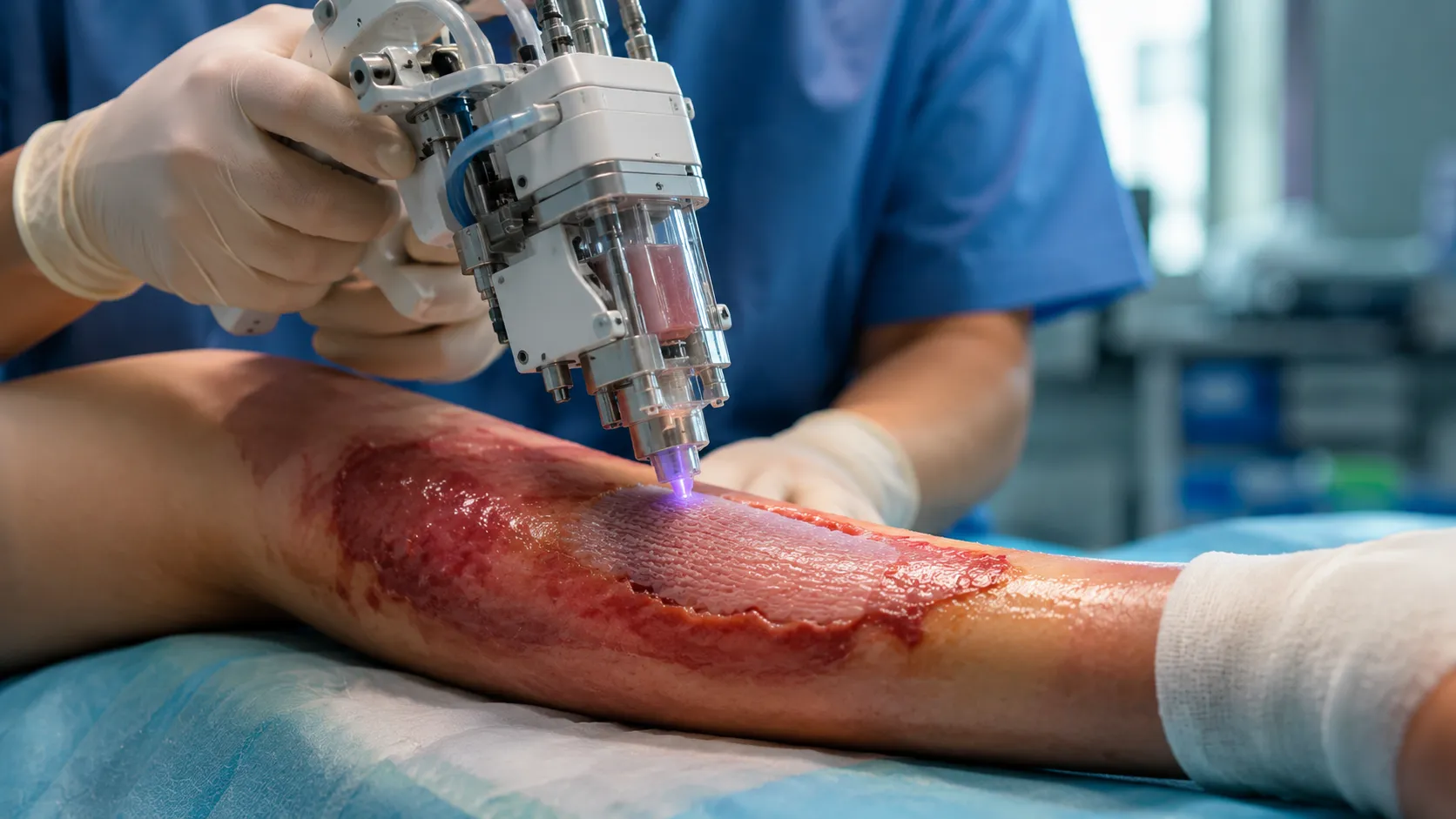
STANFORD, CALIF. — May 21, 2026 — On the third floor of the Stanford University School of Medicine, a team of bioengineers has built a machine that sounds like science fiction and looks like a hot glue gun. It weighs less than 2 kilograms. It fits in a paramedic's backpack. It uses living human cells—fibroblasts, keratinocytes, the building blocks of skin—as its ink. And it prints new skin directly onto wounds, layer by layer, without grafts, without donors, without the painful, scarring, months-long process that has been the standard of care for severe burns and deep wounds since the invention of the skin graft in the 19th century.
In preclinical trials on pigs—whose skin is anatomically and physiologically similar to human skin—the device reduced healing time by 60 percent. Wounds that would normally take months to close, requiring multiple surgeries and leaving permanent scars, healed in weeks with near-complete regeneration of the dermis and epidermis. The results, published in Science Translational Medicine in May 2026, have been described by independent experts as the most significant advance in wound care since the development of cultured epithelial autografts in the 1980s. The U.S. Food and Drug Administration has granted the technology Breakthrough Device designation, fast-tracking it for human clinical trials. If those trials succeed, the device could be in ambulances, battlefield medical kits, and rural clinics within three years.
The Problem with Burns
Severe burns and deep wounds are among the most devastating injuries the human body can sustain, and the treatments for them have remained stubbornly primitive. The gold standard—the autologous split-thickness skin graft—involves surgically removing a thin layer of healthy skin from an uninjured part of the patient's body, meshing it to expand its area, and grafting it onto the wound. The procedure is painful. It creates a second wound at the donor site. It requires weeks or months of healing, often with permanent scarring, contractures, and loss of sensation. And it is not always possible: patients with burns covering more than 50 percent of their body simply do not have enough healthy skin to serve as a donor.
Cultured epithelial autografts, developed in the 1980s, offered a partial solution. A small sample of a patient's skin cells could be grown in a laboratory into sheets of epidermis, which were then transplanted onto the wound. The technology saved lives, but it had severe limitations: the grafts were fragile, took weeks to grow, were vulnerable to infection, and often failed to regenerate the deeper dermal layer, leaving the healed skin thin, weak, and prone to breakdown. The dream of a technology that could regenerate full-thickness skin—epidermis and dermis, with hair follicles, sweat glands, and nerve endings—has remained just that: a dream.
The Stanford bioprinter is the closest anyone has come to realizing it. The device loads two types of bio-ink: one containing fibroblasts, the cells that form the dermis, and one containing keratinocytes, the cells that form the epidermis. The printer deposits the fibroblast layer first, building a three-dimensional scaffold that mimics the structure of natural dermis. Then it deposits the keratinocyte layer on top, forming a protective barrier. The cells are alive when they are printed, and they remain alive after—dividing, migrating, and organizing themselves into functional tissue.
How It Works
The Stanford bioprinter solves three problems that have defeated previous attempts at bioprinting skin.
The first is cell survival. Printing living cells requires keeping them alive through the printing process—a challenge that has plagued bioprinting since its inception. The Stanford team developed a proprietary hydrogel that protects the cells during extrusion from the printer nozzle and provides a nutrient-rich environment that supports their survival after deposition. The hydrogel is biodegradable, breaking down over several weeks as the cells produce their own extracellular matrix.
The second is structural integrity. Skin is not a random arrangement of cells; it is a highly organized tissue with distinct layers, cell types, and structural proteins. The bioprinter deposits cells in a precise three-dimensional pattern that mimics the architecture of natural skin. The fibroblasts are printed in a cross-hatched pattern that provides strength and flexibility. The keratinocytes are printed in a continuous sheet that forms a waterproof barrier. The result is a tissue that is not merely a collection of cells, but a functional organ.
The third is speed. Traditional cultured epithelial autografts require weeks to grow in a laboratory. The bioprinter prints skin directly onto the wound in minutes. For a burn covering 20 percent of a patient's body, a full treatment with the bioprinter would take less than an hour—a fraction of the time required for a traditional grafting procedure, and with no donor site morbidity.
The Path to Clinical Use
The preclinical pig trials demonstrated safety and efficacy in wounds that are anatomically and physiologically similar to human skin. The next step is human clinical trials, which the FDA has agreed to fast-track under its Breakthrough Device program—a designation reserved for technologies that offer significant advantages over existing treatments for life-threatening or irreversibly debilitating conditions.
The first human trial, expected to begin in 2027, will enroll patients with deep partial-thickness burns covering up to 30 percent of their body surface area. The primary endpoints will be wound closure time, scar formation, and restoration of skin function—sensation, elasticity, and barrier protection. If the results are positive, the device could receive FDA approval as early as 2029.
The commercial potential is substantial. The global market for advanced wound care is projected to exceed $25 billion by 2030, driven by rising rates of diabetes, an aging population, and the increasing incidence of burns in low- and middle-income countries. A handheld bioprinter that can be deployed in emergency rooms, burn centers, and eventually ambulances and battlefield hospitals would capture a significant share of that market.
But the humanitarian potential is even larger. Burns are among the most common injuries in armed conflict, and military medical services have been a major funder of bioprinting research. The Defense Advanced Research Projects Agency has invested in related technologies through its Bio-Inspired, Bio-Engineered Materials program. A portable bioprinter that can regenerate skin in the field would transform military medicine—and, by extension, civilian trauma care.
What This Signals
The Stanford bioprinter is not the first device to print living cells. Bioprinting has been a laboratory curiosity for two decades, producing small samples of tissue for research but never achieving the speed, reliability, or regulatory approval required for clinical use. The Stanford device is different. It is fast. It is portable. It has produced remarkable results in animals. And it has the FDA's attention.
The implications extend beyond burns. The same technology could be adapted to print other tissues—cartilage for joint repair, bone grafts for reconstructive surgery, vascular grafts for bypass procedures. The bioprinter is a platform, not a product, and the platform is built on a simple, powerful idea: that living cells can be deposited with the same precision as ink on paper, and that the resulting tissue can integrate with the body as if it had been there all along.
The device that fits in a paramedic's backpack is not yet approved for human use. The pig trials are promising, but pigs are not people. The human trials will be the true test. But for the first time in the long, painful history of wound care, a technology exists that could make the skin graft—the 19th-century procedure that has saved millions of lives at the cost of millions of scars—obsolete. The skin printer is not science fiction anymore. It is a handheld device in a laboratory at Stanford, waiting for the day when it can be carried into an ambulance, onto a battlefield, and into the lives of people who have been waiting for a better way to heal.


