The Gurugram Startup That Said Even Air Conditioners Deserve an Indian Engineering Upgrade
GURUGRAM — May 24, 2026 — Ashish Goel was not supposed to be a hardware entrepreneur. He had spent the better part of his career building software — the kind that makes e-commerce platforms run faster, that optimises supply chains, that sits invisibly inside the digital infrastructure of modern India. He was good at it. He was comfortable. And then, in the brutal summer of 2024, his air conditioner broke.
The temperature outside was 47 degrees Celsius. The technician who eventually arrived told him what every Indian who has ever owned an air conditioner already knows: the machine was not designed for this. The compressor was struggling. The heat exchanger was clogged. The refrigerant pressure was unstable. The unit, built by one of the world's largest electronics manufacturers, had been engineered for ambient temperatures that rarely exceed 40 degrees — the summer reality of Tokyo, Seoul, and Shanghai, where it was designed. It had not been engineered for the Indian summer, where 45 degrees is a normal Tuesday in May and 50 degrees is becoming disturbingly common. Goel paid the technician. The AC sputtered back to life. And then he did what any engineer with a broken appliance and a conviction does: he decided to build a better one.
This week, Optimist — the climate-tech startup Goel founded with Pranav Chopra in 2024 — launched its first product: a 1.4-ton, 5-star inverter split air conditioner engineered from the ground up for Indian conditions. It is rated to deliver stable cooling at outdoor temperatures of up to 50°C. It uses a microchannel heat exchanger — a technology borrowed from automotive and aerospace applications — instead of the conventional fin-and-tube design that dominates the consumer AC market. It carries an ISEER rating of 6.05, which the company positions as among the highest efficiency ratings in the Indian market. It is priced at ₹39,990 at launch, which the company says represents a 38 percent reduction from its MRP of ₹65,000. And it is backed by $12 million in funding and an 18-month research collaboration with IIT Delhi's thermal engineering department.
The AC That Was Never Designed for India
To understand what Optimist has built, one must first understand a quiet scandal hiding in plain sight across every Indian city. The air conditioner is the defining appliance of the Indian middle class — the machine that makes sleep possible in May, that makes offices habitable in June, that is now being installed in millions of homes every year as rising incomes and rising temperatures converge. And yet, for most of the history of the Indian AC market, the machines being installed were not designed for Indian conditions.
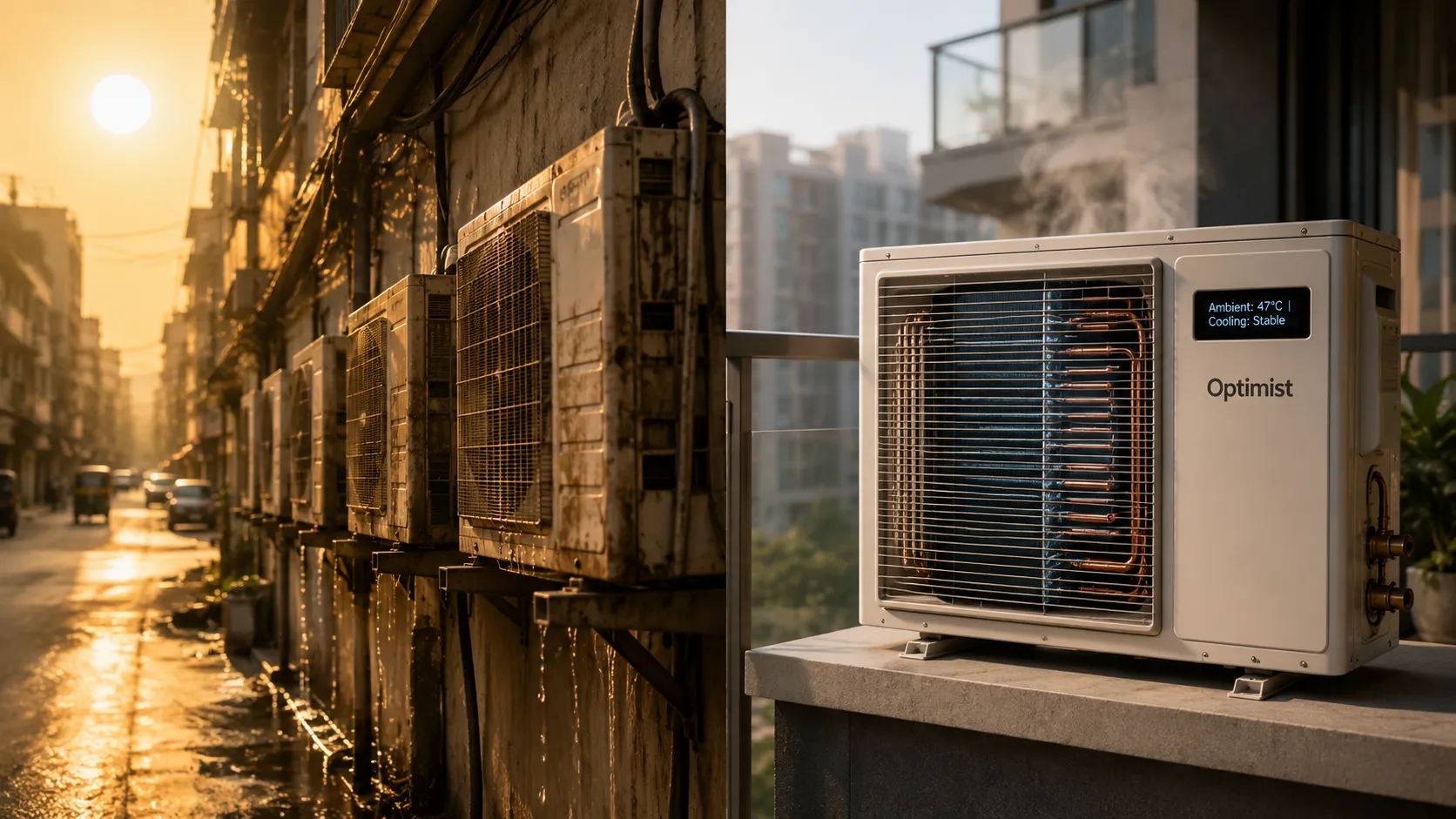
The global air conditioner industry is dominated by Japanese, Korean, and Chinese manufacturers — Daikin, Mitsubishi, LG, Samsung, Voltas (a Tata brand that sources its technology from global partners), and a growing roster of Chinese OEMs. These companies design their products for global markets, and their engineering decisions are shaped by the conditions of their largest and most profitable markets. The compressors are optimised for the moderate summers of East Asia and Europe. The heat exchangers — the component that transfers heat from the indoor air to the outdoor environment — use fin-and-tube designs that work well at 35 degrees but degrade rapidly at 45 degrees and above. The refrigerants are chosen for a balance of efficiency, cost, and environmental impact, without specific attention to the extreme temperature ranges that Indian summers demand.
The result is an appliance that works — mostly, sort of, well enough — but that is operating at the edge of its design envelope for weeks or months at a time. The compressor runs harder and fails sooner. The heat exchanger loses efficiency as the temperature gap narrows. The power consumption spikes as the unit struggles to maintain setpoint. The Indian consumer pays more for electricity, replaces the unit sooner, and spends the hottest months of the year in a state of low-grade thermal discomfort that they have been conditioned to accept as normal.
Optimist's thesis is that normal is not acceptable. The company's AC is built around a microchannel heat exchanger — a technology that replaces the traditional fin-and-tube design with a compact array of flat aluminium tubes and fins, similar to the radiators used in cars and aircraft. The microchannel design provides a larger surface area for heat transfer in a smaller volume, operates more efficiently at high temperature differentials, and is less prone to the dust fouling that plagues conventional heat exchangers in Indian conditions. The twin-rotary inverter compressor — a design that uses two compression chambers instead of one, balancing the load and reducing vibration — is rated to deliver stable cooling at ambient temperatures up to 50°C. A Turbo+ mode provides up to 1.9-ton cooling output from the 1.4-ton unit for faster cool-down — a feature designed for the Indian consumer who walks into a heat-soaked apartment at 7 p.m. and wants it cold now, not in an hour.
The energy efficiency numbers are central to the product's value proposition. The ISEER rating of 6.05 places the Optimist AC among the most efficient units in the Indian market — a market where the regulatory floor for a 5-star rating is 4.5, and where most units clustered between 5.0 and 5.5. The company claims the unit consumes 25 to 35 percent less electricity than standard 5-star units — a claim that, if validated by independent testing, would translate to annual savings of approximately ₹4,000 to ₹6,000 for the average Indian household, effectively paying back the price premium over a lower-rated unit within three to four years.
The IIT Delhi Partnership
The single most credible piece of validation behind the Optimist AC is not a funding round or a celebrity endorsement. It is an 18-month research collaboration with IIT Delhi's Department of Mechanical Engineering — specifically, its thermal engineering laboratory.
The collaboration, which the company describes as an intensive period of "thermal engineering and product validation," gave Optimist access to testing infrastructure and expertise that no startup could have built on its own. The IIT Delhi team worked with Optimist's engineers to model the thermodynamic performance of the microchannel heat exchanger under Indian ambient conditions, to test the compressor's reliability at sustained high-temperature operation, and to validate the overall system efficiency against the Indian Seasonal Energy Efficiency Ratio standard. The collaboration also extended to the product's smart features — the companion app that enables remote control, energy monitoring, filter health tracking, and predictive service alerts, all of which required software-hardware integration that the IIT team helped to design and test.
The IIT Delhi partnership is significant because it places Optimist within a broader trend of Indian deeptech startups that are leveraging the country's academic research infrastructure to build globally competitive hardware products. The model is well-established in the United States — where Stanford and MIT have incubated generations of hardware startups — but it is relatively new in India, where the gap between academic research and commercial product development has historically been wide. Optimist is part of a wave of startups — alongside companies like EndureAir Systems (IIT Kanpur), Mindgrove Technologies (IIT Madras), and BioPrint Vision (Sree Chitra Tirunal Institute) — that are building on the research capabilities of India's elite technical institutions to create products that compete with global incumbents.
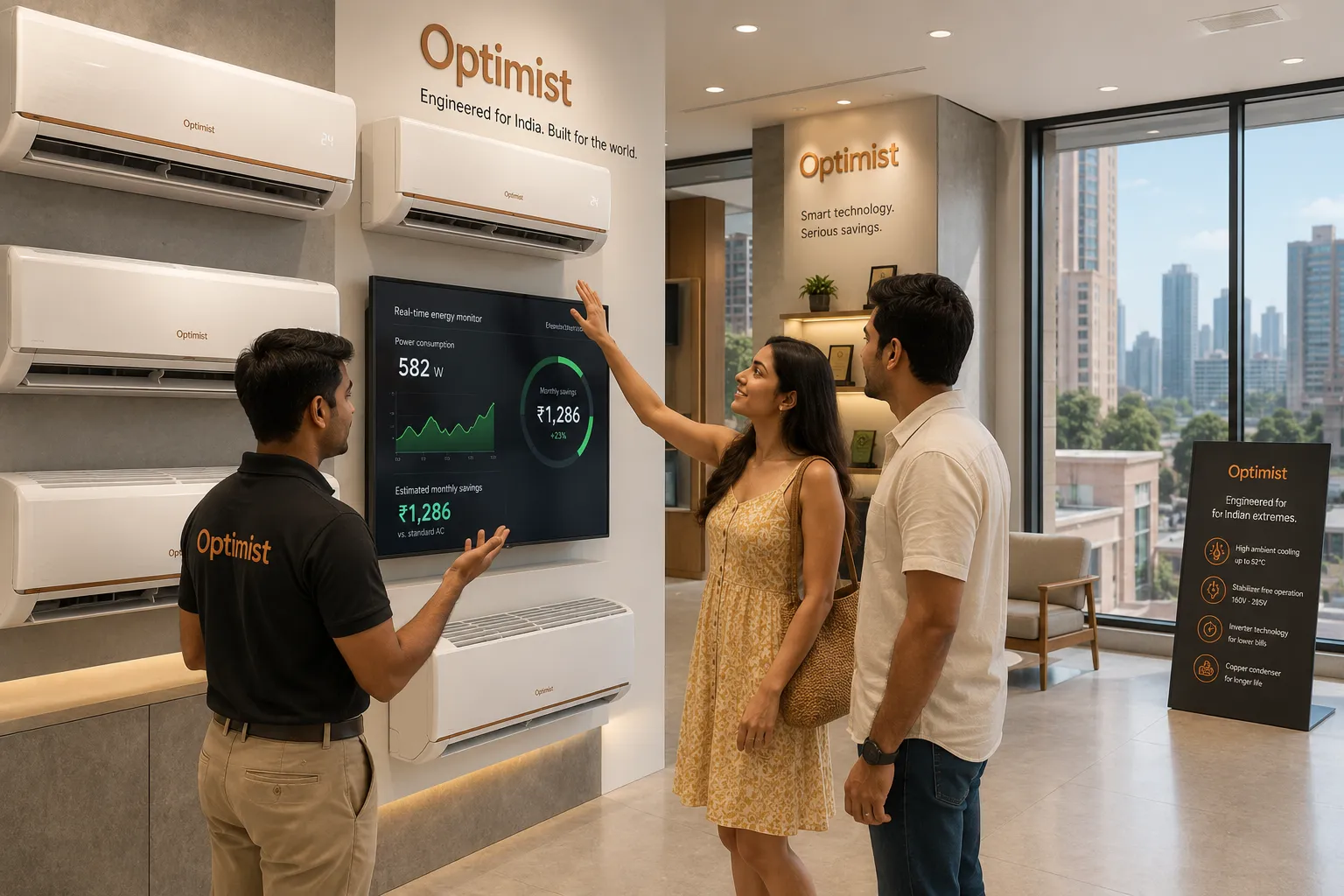
The $12 million in funding that Optimist has raised — the company has not disclosed its investors or the structure of the round — will be used to scale manufacturing, expand R&D, and build service infrastructure. The company has already opened its first experience store in Gurugram, with the initial rollout covering Delhi-NCR, Hyderabad, Bengaluru, and Jaipur. One-ton and two-ton variants are planned for later in the year. The company is also building its service network, which is essential in the AC market: a broken air conditioner in May is not a warranty claim, it is a domestic emergency, and the company's ability to respond to service requests within hours rather than days will determine whether it can build a brand that customers trust.
The ₹39,990 Question
The pricing of the Optimist AC is a strategic decision that requires a moment of analysis. At ₹39,990, the unit is positioned above the mass-market 1.5-ton inverter AC segment — where prices start at approximately ₹28,000 — and below the premium segment dominated by Daikin, Mitsubishi, and the top-end Voltas models, which range from ₹45,000 to ₹65,000. The company claims the launch price represents a 38 percent reduction from the MRP of ₹65,000 — a figure that serves as a reference point for the unit's positioning rather than a realistic transaction price.
The pricing strategy reflects the brand's ambition to be neither a budget alternative nor a luxury import, but something in between: a premium Indian brand that commands a premium price because it offers genuinely superior engineering for Indian conditions. The microchannel heat exchanger, the twin-rotary compressor, the ISEER 6.05 rating, and the 50°C operating envelope are features that no competitor at the ₹30,000 price point can match. The question is whether Indian consumers — who have been conditioned to treat air conditioners as commodities differentiated only by brand name and star rating — will pay a premium for features that are invisible until the temperature crosses 45 degrees.
The company's bet is that the consumer is changing. The same generation of Indian consumers that has embraced premium Indian brands in automobiles (Mahindra, Tata), in personal care (Mamaearth, The Derma Co.), and in eyewear (Lenskart) is increasingly willing to pay a premium for products that are designed in India, built for Indian conditions, and backed by Indian engineering credibility. The Optimist AC is not an import substitute. It is an argument — that the Indian summer is different enough to require a different kind of machine, and that the Indian consumer deserves a machine that was designed for their reality rather than adapted from someone else's.
The warranty reinforces the argument. Optimist offers a five-year comprehensive warranty covering key functional components and gas charging for covered failures, along with a 10-year compressor warranty — terms that are competitive with the best in the industry. The built-in gas-level indicator provides real-time refrigerant status, removing the guesswork around cooling performance dips. The companion app enables predictive service alerts — a feature that, if it works as advertised, could reduce the frequency of the emergency service calls that define the Indian AC ownership experience.
The Deeptech Consumer Wave
The Optimist story is not occurring in isolation. It is part of a broader structural shift in Indian consumer technology — a shift from services and software toward hardware products that are designed, engineered, and manufactured in India.
The same week that Optimist launched its first AC, HrdWyr — a Bengaluru-based fabless semiconductor startup — raised $13 million to build AI-native chips for edge devices, including the kind of smart appliances that Optimist is building. The convergence of hardware startups — in robotics, in semiconductors, in consumer electronics — signals something new in the Indian startup ecosystem: a generation of founders who are building physical products, not just digital platforms, and who are targeting global markets with engineering-led competitive advantages.
The Indian air conditioner market is among the largest and fastest-growing in the world, with annual sales projected to exceed 15 million units by 2030, driven by rising incomes, urbanisation, and the simple, brutal fact that Indian summers are becoming hotter and longer. The market is currently dominated by established brands — Voltas, LG, Samsung, Daikin, Blue Star, Hitachi — that have spent decades building distribution networks, brand equity, and service infrastructure. A two-year-old startup with a single product, a website, and a handful of experience stores is not a threat to those incumbents. But the thesis it represents — that the Indian consumer deserves products engineered for Indian reality, not adapted from global designs — is a threat to the assumption that the incumbents' dominance is permanent.
Ashish Goel is not the founder he was supposed to be. He was supposed to be a software entrepreneur — someone who built platforms and optimised supply chains and stayed within the comfortable boundaries of the digital economy. Instead, his air conditioner broke on a 47-degree day, and he decided to build a better one. The 1.4-ton unit that launched this week is the first expression of that decision. The IIT Delhi collaboration is the engineering credibility behind it. The $12 million in funding is the capital to scale it. The ₹39,990 price is the argument that Indian engineering deserves a premium. The summer is coming. The AC is ready. The question is whether the Indian consumer is ready for an Indian air conditioner that costs more — and cools better — than the ones they have been buying for decades.


