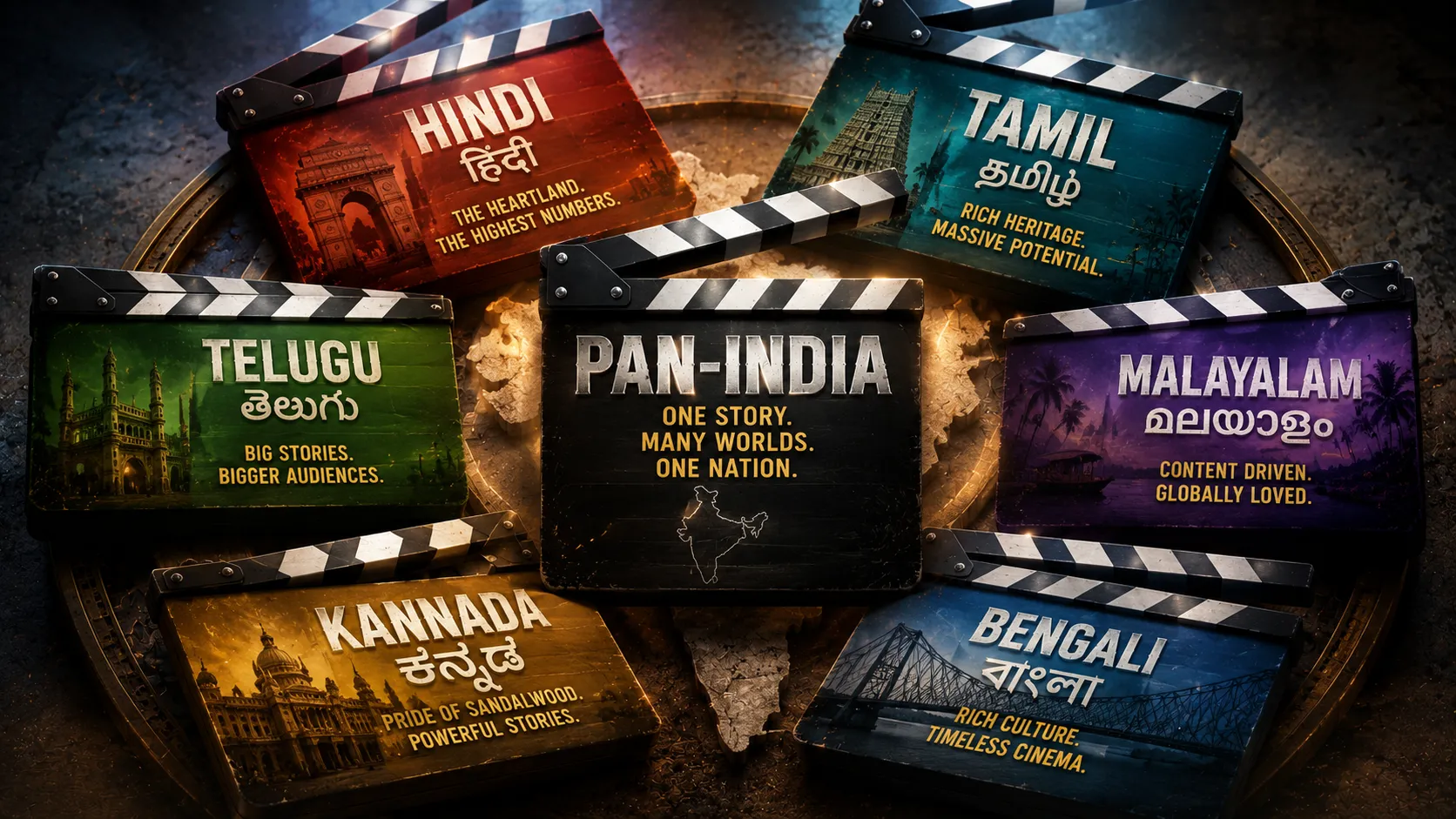
Pan-India hits like Dhurandhar are breaking records. But regional cinemas are stronger than ever. Hindi films are flopping in the South. Tamil blockbusters are ruling the North. And the only thing everyone agrees on is: no one-size-fits-all strategy works anymore.
The numbers were supposed to be a triumph. A Hindi film, made in Mumbai with Bollywood's biggest star, released across 5,000 screens nationwide. Its producers called it a "pan-India" release. The opening weekend was ₹75 crore. Then came the second weekend: ₹30 crore. Then the third: ₹12 crore. The film had bombed — but only in some places. In Delhi, UP, and Bihar, it was still running at 60% occupancy. In Tamil Nadu, Kerala, and Andhra, it had been pulled from most screens after week one. The "pan-India" hit was actually a patchwork of regional successes and failures. And that, more than any single blockbuster, is the story of Indian cinema in 2026.
The industry has spent the past five years chasing the "pan-India" dream. It started with Baahubali, continued with KGF, and reached its peak with RRR. The idea was simple: make a film that transcends language, release it in multiple versions, and capture the entire country. But the reality of 2026 is more complicated. While some films — the Dhurandhar franchise being the most prominent — have achieved genuine pan-India success, they are the exception, not the rule.

What's happening instead is a fragmentation of the market. Tamil films are performing brilliantly in Tamil Nadu, but their dubbed Hindi versions often struggle in the North. Telugu films dominate Andhra and Telangana but find mixed reception elsewhere. Malayalam cinema, long considered a niche, has grown its base in Kerala but remains a minority taste in the rest of the country. Hindi films, once the default national language of cinema, are losing ground in the South, where local content is stronger than ever.
The causes are multiple. First, streaming has exposed regional audiences to global content, raising expectations. A Tamil audience member who can watch a Korean thriller or a Spanish drama on Netflix is no longer satisfied with a poorly dubbed Hindi film. Second, regional producers have invested heavily in quality. Tamil and Telugu films now have budgets that rival Bollywood, with production values, VFX, and talent that match anything made in Mumbai. Third, language loyalty is real. Audiences prefer to watch films in their mother tongue, and when the quality is comparable, they choose local over imported.
The pan-India strategy also ignores the diversity of India's cinema-going habits. A film that works in the multiplexes of South Delhi may fail in the single-screens of Bihar. A comedy that lands in Bengaluru may fall flat in Mumbai. The "one film for all" approach requires a level of cultural universality that very few films can achieve.
So where does that leave producers? In a difficult but not impossible place. The smart ones have abandoned the pan-India fantasy and are focusing on what they know. Hindi producers are making films for Hindi audiences, with occasional releases in dubbed versions in the South — but without the expectation of national dominance. Tamil producers are focusing on the Tamil market, with careful, targeted releases in other regions. Telugu producers are doing the same.
The result is a more fragmented but also more sustainable market. Regional cinemas are thriving because they understand their audiences. Bollywood is finding its footing again by focusing on quality rather than geography. And the occasional pan-India hit — like Dhurandhar — is celebrated as an event, not expected as a norm.
The business caution is palpable. Studios are no longer betting ₹200 crore on a single pan-India release. They are spreading their risk across multiple mid-budget films, each targeting a specific region. They are partnering with regional producers rather than trying to replace them. They are learning that in a country as diverse as India, there is no single audience — there are many audiences.
For the independent filmmaker, this fragmentation is both a challenge and an opportunity. A film that might have been lost in a pan-India strategy can find its audience if targeted correctly. A Tamil film with a niche subject can succeed in its home state without needing to conquer the North. A Hindi film with a specific cultural reference can thrive in the Hindi belt without dumbing itself down for a national audience.
The industry is learning. The early 2020s obsession with "pan-India" is giving way to a more mature, segmented approach. Producers are making better decisions. Audiences are getting better content. And the Indian film industry, in all its fragmented glory, is healthier than it has been in years.
The paradox is this: the dream of a single, unified Indian audience was always a fantasy. The reality is a patchwork of regional audiences, each with its own tastes, languages, and expectations. The industry that learns to serve those audiences — without trying to force them into a single mould — will be the industry that thrives.