The God-Hero, The Comedian-Director, and The ₹260 Crore Resurrection
How Suriya Shattered a 13-Year-Old Record, Ended a Decade-Long Drought, and Proved That the Tamil Mass Hero Is Not Dead—He Was Just Waiting for the Right Myth
CHENNAI — May 28, 2026 — For more than ten years, Suriya Sivakumar has been the most confounding figure in Tamil cinema. He is, by any measure, one of the finest actors of his generation—a performer who has oscillated between the raw intensity of Kaakha Kaakha and the quiet dignity of Soorarai Pottru, who has carried films on his shoulders with a conviction that few of his contemporaries can match, and who has built a body of work that any actor in any language would be proud to claim. And yet, for more than a decade, the one thing that had eluded him was the thing that the industry measures most obsessively: a blockbuster.
Between 2013, when Singam 2 became his highest-grossing film with approximately ₹122 crore worldwide, and the spring of 2026, Suriya appeared in fourteen films. Some were critically acclaimed. Some were commercially successful. None of them surpassed the record set by a cop drama released when Manmohan Singh was still Prime Minister. The drought was not for lack of effort. Suriya worked constantly, across genres, with directors ranging from the experimental (Venky Atluri, Karthik Subbaraj) to the mainstream (Siruthai Siva, Pandiraj). The audiences came, sometimes. They stayed away, often. The actor who had once been spoken of in the same breath as Vijay and Ajith was now spoken of as a cautionary tale—a star whose ambition exceeded his commercial reach, whose film choices were too eclectic for the mass audience, and whose window for delivering a genuine blockbuster was narrowing with every passing year.
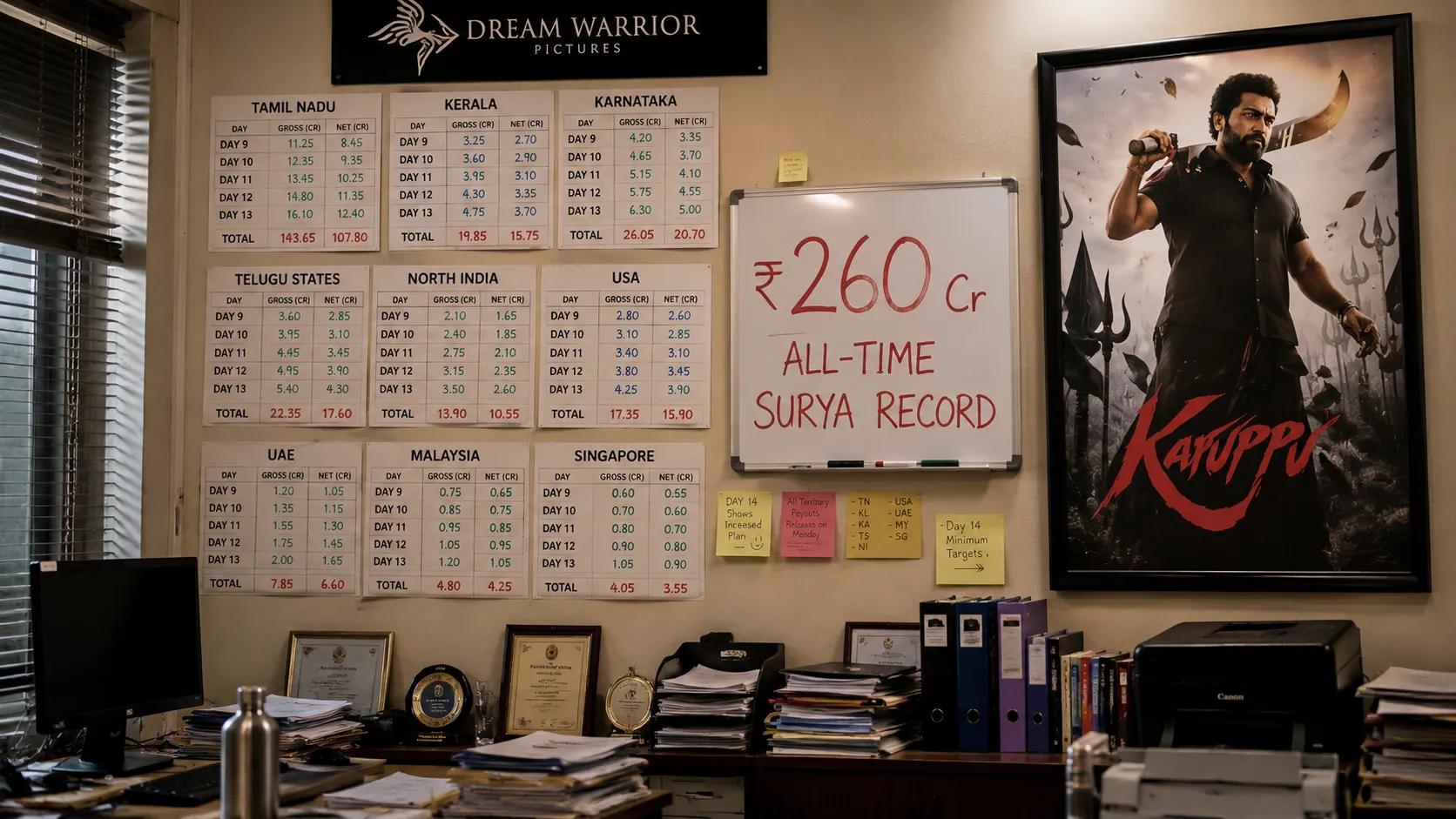
On May 15, 2026, Karuppu—a fantasy action drama directed by RJ Balaji, the radio jockey turned filmmaker who had never directed a film of this scale—was released on approximately 6,000 screens worldwide. In the thirteen days since, it has earned over ₹260 crore in worldwide gross, crossed ₹163 crore in India net collections, and become the highest-grossing Tamil film of 2026. It has surpassed Singam 2 to become the biggest hit of Suriya's career—a record that had stood for thirteen years. It has become the first Tamil film in nine months to cross the ₹100 crore mark in Tamil Nadu alone. It is, by the time you read this, approaching the ₹300 crore global milestone that would place it among the ten highest-grossing Tamil films in history. And it was directed by a man whose previous directorial credits were a social comedy and a horror thriller, and whose primary claim to fame, until now, was his voice.
The Decade in the Wilderness
To understand the magnitude of what Karuppu has achieved, one must first understand the depth of the drought that preceded it. Suriya's last clean box-office success, by the unforgiving standards of the Tamil trade, was Singam 2 in 2013. The films that followed—Anjaan, Massu Engira Masilamani, 24, S 3, Thaanaa Serndha Koottam, NGK, Kaappaan, Soorarai Pottru (which skipped theatres entirely during the pandemic), Jai Bhim, Etharkkum Thunindhavan, Retro—were a mixture of critical successes, pandemic-era experiments, OTT releases, and theatrical disappointments. Some, like Soorarai Pottru and Jai Bhim, earned national acclaim and awards. Others, like ET and Retro, struggled to recover their costs. None of them crossed the ₹122 crore mark that Singam 2 had set. The actor who had once been the most bankable star in Tamil cinema—the man who could open a film on his name alone—had become a proposition that distributors approached with caution.
The drought was not merely a commercial problem. It was a structural one. The Tamil film industry, like every other regional industry in India, was being reshaped by the same forces that were transforming Bollywood: the rise of OTT platforms, the fragmentation of the theatrical audience, the escalating cost of production, and the growing dominance of pan-Indian spectacles that could cross linguistic boundaries. The mass hero—the larger-than-life star whose mere presence on screen could guarantee a ₹100 crore opening—was supposed to be a relic of a bygone era. Vijay had already announced his departure from cinema to pursue politics. Rajinikanth was in his seventies. Ajith had scaled back his output dramatically, with a growing interest in motorsport. The Tamil film industry, which had been built on the shoulders of its male stars for half a century, was facing a succession crisis. And Suriya, the most versatile actor of his generation, was supposed to be part of the past, not the future.
Karuppu has changed that calculus. The film's worldwide gross, now past ₹260 crore, places it among the highest-grossing Tamil films of all time—a list dominated by Rajinikanth's Jailer and Coolie, Vijay's Leo and The GOAT, and the Baahubali and KGF franchises. It has surpassed three Vijay films—Master, Mersal, and Sarkar—in global collections. It has become the first Tamil film in nine months to cross the ₹100 crore mark in Tamil Nadu alone, ending a drought that had persisted since Rajinikanth's Coolie in August 2025. And it has done all of this without the benefit of a major holiday weekend, without the presence of a superstar director, and without the kind of pan-Indian marketing campaign that has become standard for the largest South Indian releases. Karuppu is not a spectacle designed to appeal across linguistic boundaries. It is a Tamil film, rooted in Tamil mythology, made for a Tamil audience—and that audience has shown up in numbers that the industry had forgotten were possible.
The RJ Balaji Gamble
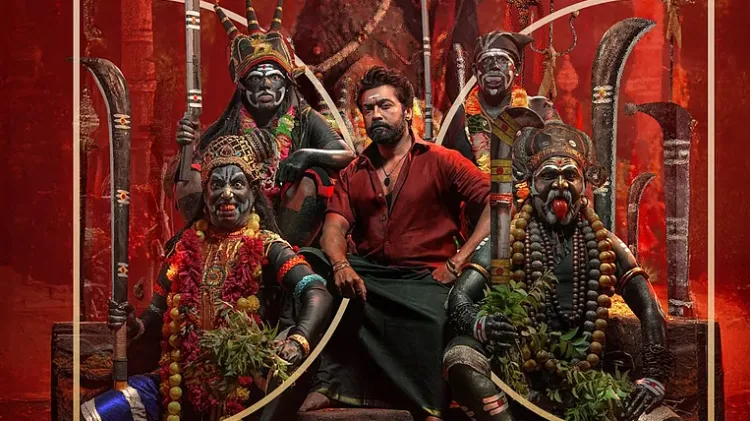
The most audacious dimension of Karuppu is not its budget or its box-office performance. It is the identity of its director. RJ Balaji is, in the taxonomy of Tamil cinema, an unlikely candidate to direct a ₹100 crore superhero fantasy. He built his career as a radio jockey, became known for his voice and his comic timing, and transitioned into cinema with a series of supporting roles in comedies. His directorial debut, LKG (2019), was a political satire. His second film, Mookuthi Amman (2020), was a devotional comedy. Neither film suggested that its director was capable of mounting a large-scale fantasy action drama with complex visual effects, mythological resonance, and the emotional stakes required to carry a Suriya vehicle. The decision to entrust him with Karuppu was, depending on whom you asked, either an act of creative faith or an act of commercial folly.
The decision was Suriya's. The actor, who has spent his career making unconventional choices—working with first-time directors, backing films that other stars would have rejected, and prioritising creative conviction over commercial calculation—saw something in Balaji's pitch that the rest of the industry did not. The story was rooted in the mythology of Karuppusamy, a Tamil folk deity associated with protection, justice, and the fierce defence of the vulnerable. The genre was superhero fantasy—a category that is almost entirely absent from Tamil cinema, which has historically preferred its heroes grounded in social reality or historical grandeur. The combination—a folk deity reimagined as a modern superhero, directed by a radio jockey turned comedian—was either inspired or insane. "The combination of Suriya, who is known for his versatile performances, and RJ Balaji, who has a knack for blending social messages with entertainment, has created a significant amount of curiosity," noted Sacnilk in its pre-release analysis. The curiosity was justified. The execution was transformative.
Balaji, for his part, has been vocal about the challenges of directing a film of this scale. The visual effects required to render the deity Karuppusamy—the fiery aura, the supernatural powers, the visual grammar of divine intervention—were complex and time-consuming. The film was originally scheduled for a Diwali 2025 release, but was pushed back repeatedly as the CGI work consumed more time than anticipated. Subsequent slots—Pongal 2026, March 2026, April 2026—were bypassed to navigate technical hurdles, digital rights negotiations, and the Tamil Nadu Legislative Assembly elections. Balaji defended the delays publicly, explaining that the extra time was essential to perfect the visual effects and that the mid-May window was strategically chosen to capture family audiences during the summer holidays, away from political noise.
The release itself was not without drama. On May 14, the scheduled opening day, a technical failure delayed the film's rollout. Producers issued a public statement decrying the "unauthorized and illegal activation of KDMs" (key delivery messages, the digital keys that unlock encrypted cinema files) and asserted that the film was "illegally shown" in parts of North India without final authorization. The controversy generated a flurry of negative headlines, but it also generated attention. When the film finally opened properly on May 15, the audience was primed, the advance bookings had surged, and the box office responded accordingly. The opening day net of ₹15.50 crore—respectable but not record-breaking—was followed by a Saturday surge and a Sunday explosion that pushed the three-day worldwide total past ₹122 crore, matching the entire lifetime collection of Singam 2 in a single weekend.
The critical response was mixed—fantasy action dramas rarely please critics—but the audience response was emphatically positive. The film's BookMyShow ticket sales set a new all-time Day 2 record of 690,000 tickets, narrowly beating Rajinikanth's Coolie (689,000) and Vijay's Leo (646,000). The Telugu version, VeeraBhadrudu, hit a peak booking speed of 43,000 tickets per hour—a career-high for Suriya in that market. The film's momentum was sustained not by the front-loaded opening weekend that characterises most Indian blockbusters, but by the steady accumulation of family audiences, repeat viewers, and the devotional fervour that surrounds any film rooted in Tamil folk religion. The deity on screen was not just a character. He was an object of veneration, and the audience responded accordingly.
The Pre-Release Economics
The most instructive dimension of the Karuppu business story is not the box-office collections. It is the pre-release economics that de-risked the film before a single ticket was sold. Reports indicate that the producers, Dream Warrior Pictures, locked in over ₹110 crore in pre-release business through non-theatrical avenues—digital streaming rights, satellite rights, and music rights—before the film reached theatres. The theatrical rights for Tamil Nadu alone were reportedly sold for approximately ₹40 to ₹42 crore. The satellite rights were acquired by Zee Tamil. The digital rights, according to industry speculation, have been secured by Netflix for post-theatrical streaming, though neither the platform nor the producers have confirmed the deal.
The pre-release revenue fundamentally altered the risk profile of the project. Produced on a budget of approximately ₹90 to ₹100 crore—with some estimates placing the figure as high as ₹130 crore—Karuppu had recovered the vast majority of its production cost before its opening day. The theatrical run, regardless of its outcome, would determine whether the film was merely profitable or genuinely transformative for its investors. The fact that the theatrical run has been extraordinary—the India net crossed ₹125 crore in the first week alone, and the theatrical share from India is now approaching ₹100 crore—means that Karuppu is not just a hit. It is a financial windfall for everyone involved.
The pre-sale economics also reflect a broader shift in how Tamil cinema finances its largest productions. The era in which a star vehicle was funded entirely by the producer, who then hoped to recoup the investment through theatrical revenue alone, is over. The successful Tamil blockbuster of 2026 is a multi-revenue-stream enterprise: digital rights sold to an OTT platform, satellite rights sold to a television network, music rights sold to a label, theatrical rights pre-sold to distributors in each territory. The producer's risk is diversified across multiple buyers, each of whom is betting on a different window of the film's commercial life. The model works when the film is good. It collapses when the film is not, because the buyers who overpaid for rights to a flop will not return for the next one. Karuppu, by delivering on its pre-release promise, has strengthened the model for every Tamil film that follows it.
The distributor Sakthivelan, who acquired the Tamil Nadu theatrical rights, called the ₹100 crore Tamil Nadu gross milestone "a historic moment in my career." The sentiment is shared across the value chain. The exhibitors who screened the film to packed houses for two consecutive weeks, the distributors who pre-bought territorial rights and watched their investments multiply, and the producers who backed a director with no experience at this scale—all of them have been vindicated by the numbers. The ₹110 crore in pre-release business was a safety net. The ₹260 crore in worldwide gross is a celebration.
The Overseas Surge and the Tamil Diaspora Engine
The most quietly impressive dimension of Karuppu's performance has been its overseas run. The film has collected approximately $7 million (₹67 crore) from international markets in its first ten days—a figure that places it among the strongest Tamil performers of the post-pandemic era. The Middle East, traditionally the most reliable overseas market for Tamil cinema, contributed approximately $2.5 million to $2.8 million (₹21 to ₹23.5 crore), making it Suriya's biggest grosser in the GCC. Malaysia, where the Tamil diaspora is large and deeply connected to the home industry, contributed $2.1 million—among the highest second-weekend holds of all time for a Tamil film in the territory. North America delivered over $1.1 million in the opening week alone, shattering Suriya's previous records in the region. The United Kingdom grossed £235,080 in three days, surpassing his previous film Retro.
The breadth of the overseas performance—from the Gulf to Southeast Asia to North America to Europe—reflects a fundamental truth about the Tamil film market that is often obscured by the industry's obsession with domestic box-office records: the Tamil diaspora is among the most loyal, most passionate, and most commercially valuable audiences in world cinema. The Suriya brand, which had been damaged by a decade of inconsistent domestic performance, remained strong overseas—stronger, in some markets, than it was at home. The audience that had grown up watching Kaakha Kaakha and Ghajini and Singam in theatres in Chennai and Madurai had carried those memories with them to Dubai, Singapore, Toronto, and London. When Karuppu arrived—a film that returned Suriya to the mass-hero mode that had defined his early career, but filtered through the devotional intensity of Tamil folk mythology—the diaspora responded with an enthusiasm that the domestic trade had not anticipated.
The overseas performance also highlights a structural advantage that Tamil cinema enjoys over Bollywood in international markets. The Hindi film industry's overseas revenue is concentrated in a handful of territories—the Gulf, North America, the United Kingdom—and is dependent on the tastes of a diaspora that is linguistically unified but culturally diverse. The Tamil diaspora, by contrast, is linguistically and culturally cohesive: a Tamil speaker in Toronto is watching the same films, listening to the same music, and participating in the same cultural conversation as a Tamil speaker in Madurai. The result is an overseas market that behaves less like a collection of foreign territories and more like an extension of the domestic market—an audience that is smaller than the Hindi diaspora in absolute numbers, but that is more engaged, more passionate, and more willing to turn out for the right film. Karuppu was the right film, and the overseas numbers are the evidence.
The breakdown tells the story: USA $925,000, Canada $250,000, Australia-New Zealand $300,000, Middle East $1.45 million, Malaysia $2.1 million, Singapore $450,000, Sri Lanka $225,000, United Kingdom $520,000, France $275,000, Germany $150,000, Rest of Europe $300,000. The film earned more in Malaysia than in North America—a reminder that the geography of Tamil cinema's commercial power is not the geography that the English-language entertainment press assumes. The centre of gravity is not Los Angeles. It is Kuala Lumpur, Dubai, Singapore, and the thousand towns of Tamil Nadu where a Suriya film is not just a film, but an event.
The BookMyShow Phenomenon
The most granular evidence of Karuppu's cultural penetration comes not from the trade figures but from the ticketing data. BookMyShow, the dominant online ticketing platform in India, recorded 700,000 ticket sales for Karuppu on its opening day—the fourth-highest Day 1 in Kollywood history, behind only Jailer, Leo, and Coolie. On Day 2, the platform recorded 690,000 sales—a new all-time Day 2 record, narrowly beating Coolie (689,000) and Leo (646,000). By the end of the second weekend, total BookMyShow ticket sales had climbed to 36.62 lakh (3.66 million). By Day 13, the figure had reached 39.24 lakh (3.92 million), with the Bakrid holiday expected to push it past the 4 million mark.
These are not merely large numbers. They are numbers that place Karuppu in the same commercial league as the biggest Tamil blockbusters of the past decade—films that starred Rajinikanth and Vijay at the peak of their box-office powers. For Suriya, who had not been part of this conversation for more than a decade, the ticketing data is a validation of a kind that no critical review can provide. The audience has voted, and it has voted in numbers that the trade had stopped associating with his name.
The booking patterns tell a story of sustained demand rather than front-loaded frenzy. The film's second-weekday holds—₹3.65 crore net on Day 12 (Tuesday), ₹4.00 crore net on Day 13 (Wednesday)—are comparable to the holds of Jailer, the Rajinikanth blockbuster that became the highest-grossing Tamil film of 2023. The occupancy rate on Day 13, at approximately 25 percent across 3,141 shows, would be unremarkable for an opening weekend but is exceptional for a film in its second week. The Bakrid holiday on Day 14 is expected to generate a significant spike, and the absence of major competing releases in the coming weeks means that Karuppu will have a clear run through its third weekend and beyond. The ₹300 crore global milestone, which once seemed like a distant aspiration, is now a near-certainty.
The BookMyShow data also reveals something about the audience that is not visible in the trade figures. The film's appeal is broad—family audiences, young couples, repeat viewers—and its cultural resonance extends beyond the urban multiplexes. The single-screen theatres of Tamil Nadu, which are often the last to benefit from a blockbuster run, have been reporting full houses for two consecutive weeks. The devotional element of the film—its grounding in the mythology of Karuppusamy, a deity with deep roots in Tamil folk religion—has given it a cultural significance that a conventional action film could not achieve. The audience is not just watching a movie. It is participating in a ritual, and the ritual has translated into commercial returns that the industry will be studying for years.
The Star Who Chose the Unlikely Director
The most powerful dimension of the Karuppu story is not the box-office figures. It is the creative partnership at the centre of it—the decision by one of Tamil cinema's most accomplished actors to entrust his commercial future to a radio jockey who had never directed a film of this scale. Suriya's career has been defined by exactly this kind of choice: the willingness to work with first-time directors, to back projects that other stars would reject, to prioritise creative conviction over commercial calculation. The choices have not always worked. NGK, directed by the acclaimed Selvaraghavan, was a critical and commercial disappointment. 24, a time-travel thriller directed by Vikram Kumar, was admired but not profitable. ET, directed by Pandiraj, was widely panned. The same instinct that produced Soorarai Pottru—one of the most celebrated Tamil films of the streaming era—also produced a decade of theatrical underperformance. The instinct was not wrong. It was simply ahead of the market.
Karuppu represents the moment when the market caught up. RJ Balaji's direction—his fusion of folk mythology with superhero spectacle, his instinct for the emotional beats that resonate with family audiences, his understanding of the devotional intensity that the figure of Karuppusamy commands in Tamil Nadu—was exactly what the audience had been waiting for. The film is not a departure from Suriya's creative philosophy. It is the fullest expression of it—a star vehicle that is also a director's vision, a commercial blockbuster that is also a cultural event, a mass entertainer that is also, in its own way, a deeply personal film about the relationship between a community and the deity that protects it.
The trade had been warning for years that Suriya needed to "play to the gallery"—to make the kind of mass-hero film that Vijay and Ajith had built their careers on, rather than the eclectic, director-driven projects that had defined his post-Singam 2 filmography. The warning was well-intentioned, but it misunderstood what Suriya was doing. He was not refusing to play to the gallery. He was waiting for the right gallery. The audience that had rejected ET and Retro and NGK was not the audience that would eventually embrace Karuppu. The difference was not the star. It was the material—a story that connected Suriya's screen persona to something larger than himself, to a mythology that predated cinema and that would outlast it. The actor who had spent a decade making films that the market did not want was now making a film that the market had been waiting for without knowing it.
The ₹45 crore fee that Suriya reportedly commanded for Karuppu—by far the largest upfront payment of his career—is a reflection of the commercial confidence that the project inspired even before its release. The fee was a bet, and the bet has paid off. Suriya's next film, already in pre-production, is expected to command an even larger fee, and the actor is now being discussed in the same commercial terms as Vijay and Rajinikanth—a conversation that had been closed to him for more than a decade. The thirteen-year drought is over. The god-hero has returned. The comedian-director who made it happen is no longer a radio jockey who dabbles in cinema. He is the director of the biggest Tamil hit of 2026, and his phone has not stopped ringing since May 15.
The Madras High Court and the Contempt Petition
The most unusual dimension of the Karuppu release was not the box-office performance. It was the legal challenge. On May 27, the Madras High Court ruled that the film did not attract the provisions of the Contempt of Courts Act, 1971, dismissing a petition that had sought to ban the movie on the grounds that it portrayed a presiding officer of an imaginary court as corrupt. The court held that the film's fictional setting—a supernatural fantasy involving a folk deity—was sufficiently removed from the reality of the judicial system that no reasonable person would interpret it as contempt of a real court.
The ruling was significant not just for Karuppu, but for the broader principle it established. Tamil cinema has a long history of legal challenges—films have been threatened with bans for depicting police brutality, political corruption, and caste violence—and the courts have generally been reluctant to suppress creative expression on the grounds that a fictional work might offend the dignity of a real institution. The Karuppu ruling reinforces that reluctance. The film's fictional court, presided over by a corrupt judge who is ultimately brought to justice by the deity Karuppusamy, is a work of imagination. The audience understands this. The law, the High Court ruled, understands it too.
The contempt petition was the final obstacle in a release that had been delayed by technical failures, KDM disputes, and the lingering uncertainty of the Tamil Nadu political calendar. Its dismissal removes the last shadow over the film's commercial run and clears the path for the sustained theatrical engagement that the trade now expects to carry Karuppu past the ₹300 crore mark. The legal victory, like the box-office victory, is a validation of the creative choices that Suriya and Balaji made—choices that were, at the time they were made, considered commercially risky and creatively unproven. The risk has been rewarded. The unproven has been proved. The god-hero has been vindicated, not just by the audience, but by the law.
What This Signals
The Karuppu story is not primarily about a fantasy action drama. It is about the structural recovery of a film star's commercial viability—and about the industrial lessons embedded in that recovery.
For more than a decade, Suriya was the most confounding figure in Tamil cinema: an actor of undeniable talent whose commercial instincts seemed perpetually out of sync with the market. The films he chose were too eclectic, the directors he backed were too unconventional, and the audiences he courted were too fragmented to generate the kind of blockbuster numbers that the trade uses to measure success. The criticism was not entirely unfounded. Fourteen films in thirteen years, and none of them had surpassed the record set by a cop drama released when Manmohan Singh was still Prime Minister. The drought was real, and the questions it raised—about Suriya's commercial judgment, about his understanding of the mass audience, about his willingness to subordinate creative ambition to box-office necessity—were legitimate.
Karuppu has answered those questions in the most emphatic way possible. The film is not a departure from Suriya's creative philosophy. It is the fullest expression of it. It is a mass-hero spectacle rooted in Tamil folk mythology, directed by a first-time large-scale filmmaker, produced by a banner known for backing unconventional projects, and released during a non-holiday window against a backdrop of industry-wide anxiety about the future of the Tamil mass hero. It has earned more than any Suriya film in history. It has surpassed three Vijay films in global collections. It has become the first Tamil film in nine months to cross the ₹100 crore mark in its home state. It has been validated by the audience, by the trade, and—in its contempt-of-court ruling—by the law. The actor who was told to play to the gallery has finally found the right gallery, and the gallery has responded with a fervour that the industry had forgotten was possible.
Suriya is no longer the star who could not buy a hit. He is the star who has delivered the biggest Tamil blockbuster of 2026, whose thirteen-year-old record has been shattered, and whose commercial future is now being discussed in the same breath as Rajinikanth and Vijay. The radio jockey who directed the film is no longer a curiosity. He is the filmmaker who cracked the code of the Tamil superhero genre, who understood that the most powerful special effect in Indian cinema is not CGI but devotion, and who has become, in the space of two weeks, one of the most sought-after directors in the country. The deity on screen was Karuppusamy. The resurrection was Suriya's. The decade in the wilderness is over.


