The Gene Scissors: How a Coimbatore Biotech Startup Is Rewriting the DNA of India's Crops—And the Farmers Who Are Betting Their Harvest on It
COIMBATORE — May 31, 2026 — In a modest greenhouse on the outskirts of Coimbatore, beneath rows of LED lights that mimic the spectrum of the Tamil Nadu sun, a crop of rice is growing that is unlike any rice that has ever been grown on the subcontinent. Its leaves are a deeper green, its stalks are thicker, and its roots—visible through a transparent panel in the soil bed—are longer and denser than those of the conventional variety that farmers in the Cauvery delta have been planting for generations. The difference is not the result of traditional cross‑breeding, which takes a decade or more to produce a new variety, nor of transgenic modification, which involves inserting foreign genes into the plant's genome and which has been effectively banned in India for food crops for over a decade. The difference is the result of CRISPR, the gene‑editing technology that allows scientists to make precise, targeted changes to a plant's own DNA—switching off the genes that make it vulnerable to drought, for instance, or enhancing the ones that allow it to absorb nutrients more efficiently—without introducing any foreign genetic material. The rice growing in the Coimbatore greenhouse has been edited, not modified, and the distinction is the foundation of a regulatory revolution that is transforming Indian agriculture.
The startup behind the rice is GeneCrop Biosciences, a company that was founded in 2021 by Dr. Lakshmi Narayanan, a plant molecular biologist who had spent a decade at the International Rice Research Institute in the Philippines, and Karthik Subramanian, an agritech entrepreneur who had previously built and sold a farm‑data analytics company. The company's first product, a drought‑tolerant rice variety called GC‑DR1, completed its field trials in February 2026 and received commercial approval from the Genetic Engineering Appraisal Committee—the same regulatory body that had, for decades, been the bottleneck that prevented genetically modified food crops from reaching Indian farmers—in a process that took just 14 months. The speed of the approval was not a bureaucratic anomaly. It was the result of a deliberate policy decision by the Indian government, which in 2022 had exempted gene‑edited crops that contain no foreign DNA from the stringent regulatory framework that governs transgenic GMOs, and which had since been encouraging the development of a domestic gene‑editing industry. GeneCrop Biosciences, which has raised approximately $65 million from a consortium of investors led by Omnivore and the IFC, is one of a growing number of Indian biotech startups that are using CRISPR to develop crops that are more resilient, more nutritious, and more productive—and the farmers who are adopting them are betting their harvests on the promise that the technology works.
"The Indian farmer has been waiting for a technology like this for a generation. The Green Revolution gave us high‑yielding varieties, but those varieties depend on water, fertiliser, and pesticides that are becoming scarcer and more expensive. CRISPR gives us varieties that can thrive without them—varieties that are designed for the climate of the future, not the climate of the past." — Dr. Lakshmi Narayanan, Co‑founder and CEO, GeneCrop Biosciences
The Regulatory Breakthrough
The single most important variable in the CRISPR crop revolution is not the science—the technology for gene‑editing plants has been available for over a decade, and the tools for applying it to crops have been steadily improving. It is the regulation. The Indian regulatory framework for genetically modified organisms, which was established in the 1980s and which has been administered since then by the Genetic Engineering Appraisal Committee under the Ministry of Environment, Forest and Climate Change, was designed for an era when the only way to alter a plant's genome was to insert a foreign gene—a gene from a bacterium, for instance, that made the plant resistant to a particular insect pest, or a gene from another plant species that improved its tolerance to a particular herbicide. The regulatory framework treated all genetically altered organisms as essentially equivalent, regardless of the method by which the alteration had been made, and it subjected them to a set of requirements—multi‑year field trials, environmental‑impact assessments, food‑safety evaluations—that were so demanding, so expensive, and so uncertain that they effectively prohibited the commercialisation of genetically modified food crops in India.
The 2022 exemption, which was issued by the Ministry of Environment, Forest and Climate Change after years of deliberation, changed that calculus. The exemption applies to gene‑edited plants that contain no foreign DNA—plants that have been altered using CRISPR or a similar technology to make changes that could, in theory, have occurred through natural mutation or conventional breeding, but that have been made more precisely and more quickly. The exemption means that a gene‑edited crop like GC‑DR1, which has had a handful of its own genes switched off to improve its drought tolerance, is regulated not as a GMO but as a conventionally bred plant—subject to the same registration and quality‑control requirements as any other new crop variety, but not to the additional, GMO‑specific requirements that had previously made commercialisation impossible. The exemption, which was modelled on similar regulatory frameworks in the United States, Japan, and several other countries, was the signal that the Indian biotech industry had been waiting for—and the startups that had been developing gene‑edited crops in anticipation of the exemption, including GeneCrop Biosciences, moved quickly to bring their products to market.
The Drought‑Tolerance Mechanism
The drought‑tolerance mechanism that GeneCrop has engineered into GC‑DR1 is, in its molecular details, a story of extraordinary precision. The rice plant, like all plants, has a set of genes that regulate its response to water stress—genes that control the opening and closing of the stomata, the tiny pores on the surface of the leaves through which the plant exchanges gases with the atmosphere, and genes that regulate the growth of the roots, which the plant extends deeper into the soil in search of moisture when the surface layers dry out. The conventional rice varieties that Indian farmers have been growing for decades have a drought‑response system that is, in a sense, too conservative—the plant shuts down its stomata too quickly, reducing photosynthesis and stunting growth, and it invests too little energy in root growth, limiting its access to the deeper soil moisture. The GC‑DR1 variety has had two specific genes edited: one that slows the stomatal closure response, allowing the plant to continue photosynthesising for longer during a dry spell, and another that enhances the root‑growth response, allowing the plant to reach deeper into the soil for water. The two edits together produce a plant that can survive a drought that would destroy a conventional variety—and that can produce a harvest, albeit a reduced one, in conditions that would reduce the conventional variety to a total loss.
The editing was performed using the CRISPR‑Cas9 system—the same technology that has been used to edit human cells for medical research, and that has become, over the past decade, the standard tool for genetic engineering across the life sciences. The Cas9 protein, which functions as a pair of molecular scissors, was programmed to cut the rice genome at the two specific locations where the target genes reside, and the plant's own DNA‑repair machinery was then allowed to re‑join the cut ends—a process that, in most cases, introduces a small deletion or insertion that disables the gene. The editing process took approximately six months from the initial design to the first edited plants, and the subsequent breeding and selection process—the cross‑breeding of the edited plants with the best existing rice varieties to produce a commercial product—took approximately three years. The result, after four years of laboratory and greenhouse work, was a rice variety that is, in every respect other than the two edited genes, identical to the conventional varieties that farmers have been growing for generations—and that is, in the one respect that matters most to the farmers of the drought‑prone Cauvery delta, fundamentally different.
The Farmer Adoption
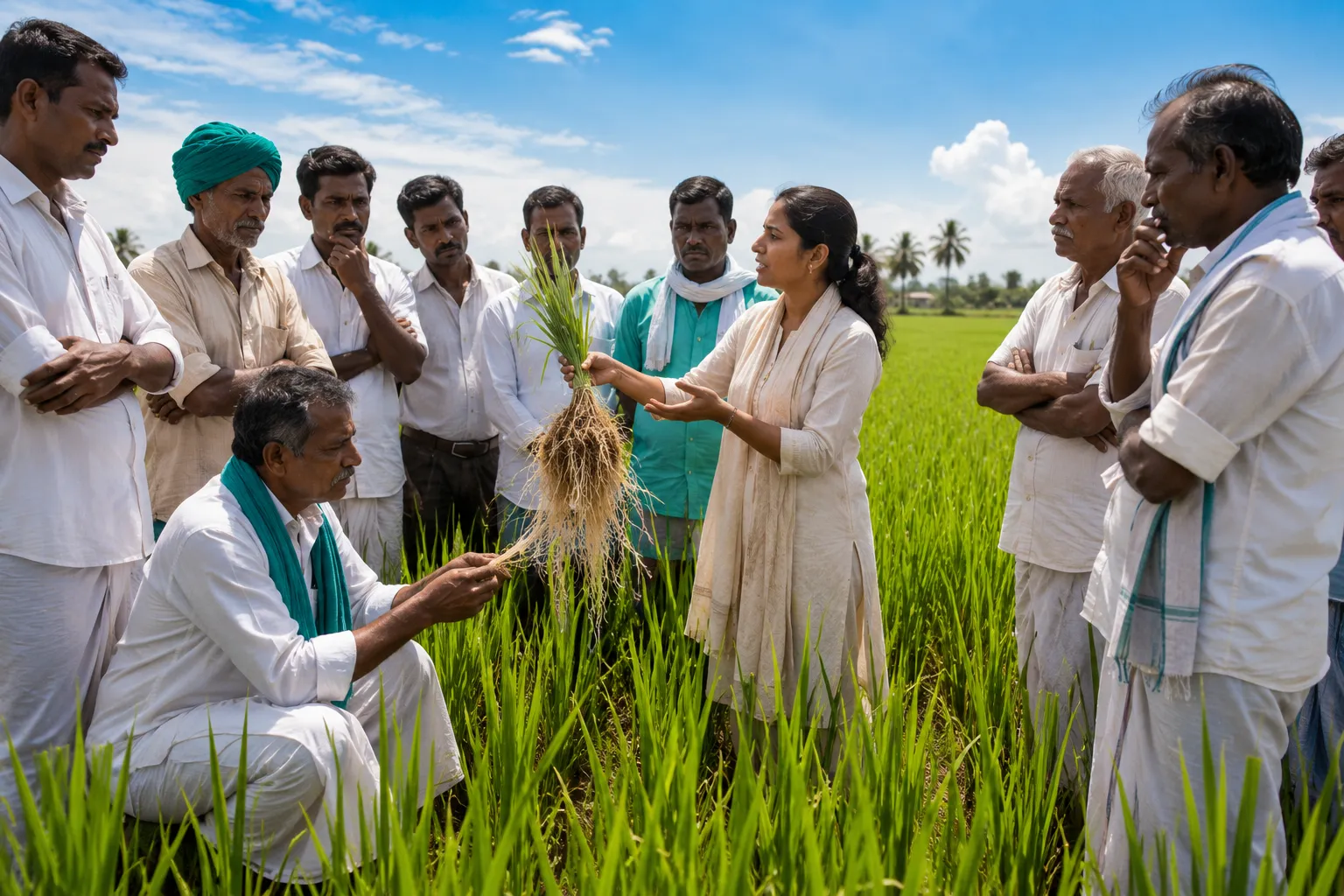
The most important test of any agricultural technology is not the laboratory or the greenhouse. It is the field, and the farmer who works it. The GC‑DR1 variety was tested in field trials across 12 locations in Tamil Nadu, Karnataka, and Andhra Pradesh during the 2025 growing season, and the results were, by the standards of agricultural field trials, unambiguous. The gene‑edited variety produced an average yield that was approximately 22 percent higher than the conventional variety under normal rainfall conditions, and approximately 45 percent higher under drought conditions—conditions that were, in the 2025 season, the result of a delayed monsoon rather than a deliberate experimental manipulation. The yield advantage was most pronounced in the rain‑fed areas, where farmers do not have access to irrigation and are entirely dependent on the monsoon—the areas, in other words, where the need for a drought‑tolerant variety is greatest.
The farmer adoption that has followed the commercial approval has been, by the cautious standards of Indian agriculture, rapid. GeneCrop has sold approximately 800 tonnes of GC‑DR1 seed to approximately 12,000 farmers for the 2026 planting season, a figure that represents approximately 0.5 percent of the total rice‑growing area in the three states where the variety has been approved, and that is expected to grow substantially in the 2027 season as the seed supply expands and the word‑of‑mouth from the early adopters spreads. The company's distribution model is a hybrid of the traditional and the digital: it sells seed through a network of local agricultural‑input dealers, the same dealers who sell fertilisers and pesticides to the same farmers, and it provides agronomic advice through a mobile app that the farmers can use to report problems, receive recommendations, and track the performance of their crops. The distribution model is designed to meet the farmers where they are, rather than to force them to adopt a new way of buying seed—and it is working.
The economics of the GC‑DR1 seed are, for the farmer, compelling. The seed costs approximately 30 percent more than the conventional variety—a premium that reflects the company's investment in the technology and the regulatory process—but the yield advantage, even in a normal year, more than compensates for the higher seed cost. The farmer who plants GC‑DR1 can expect to earn approximately ₹6,000 to ₹8,000 more per acre than the farmer who plants the conventional variety, a return on the incremental investment that is substantially higher than the returns that the farmer can expect from any other input—fertiliser, pesticide, irrigation. The economics are the engine of the adoption, and the engine is powerful enough to overcome the farmer's natural caution about a new technology from a startup they had never heard of.
The Competitive Landscape
GeneCrop Biosciences is not alone in the CRISPR crop market. Several other Indian biotech startups are developing gene‑edited crops—mustard with higher oil content, wheat with improved heat tolerance, bananas with resistance to a devastating fungal disease, and pulses with enhanced protein quality—and the multinational agribusiness giants, including Bayer and Corteva, are developing their own gene‑edited varieties for the Indian market. The competitive landscape is intensifying, and the market is large enough to support multiple players. India has over 150 million farmers, who plant approximately 120 million hectares of crops each year, and the vast majority of those farmers are still using seed varieties that were developed decades ago and that are increasingly unsuited to the changing climate. The CRISPR crop market is, in effect, a replacement market—the new varieties will replace the old ones, over time, as the farmers discover the benefits and as the seed supply expands—and the replacement cycle will take decades to complete. The companies that are building their seed businesses today are competing for a share of a market that will be worth tens of billions of dollars when the transition is complete.
The regulatory environment is also evolving. The Indian government's 2022 exemption applies only to gene‑edited crops that contain no foreign DNA, and it does not apply to transgenic crops—crops that contain genes from other species—which remain subject to the full GMO regulatory framework. The distinction between gene‑edited and transgenic is scientifically meaningful but politically contentious, and the anti‑GMO movement that has blocked the commercialisation of transgenic food crops in India for decades is now turning its attention to gene‑edited crops, arguing that the exemption is a loophole that will allow multinational corporations to introduce "GMOs by another name." The regulatory environment is stable, for now, but it is not guaranteed to remain so, and the CRISPR crop startups are watching the political landscape as carefully as they are watching the scientific one.
What This Signals
The GeneCrop Biosciences story is not primarily about a single crop or a single startup. It is a story about the structural transformation of Indian agriculture—a shift from a model that was defined by the technologies of the Green Revolution, which were based on chemistry and breeding, to a model that is increasingly defined by the technologies of the Gene Revolution, which are based on molecular biology and data, and from a regulatory framework that treated all genetic technologies as equivalent to a framework that distinguishes between the methods and regulates them accordingly. The Indian farmer, who was largely excluded from the first generation of agricultural biotechnology—the GMO revolution that transformed the farms of the Americas and Asia but that bypassed India's food crops—is now being given access to the second generation, and the startups that are providing that access are building businesses that will define the agricultural economy for the next generation. The gene scissors are in the field, and the farmers are watching.


