The Galaxy That Shouldn't Exist: How a Team of Indian Astronomers Using the World's Most Powerful Telescope Just Rewrote the History of the Universe
PUNE — May 26, 2026 — For more than two decades, the dominant theory of how galaxies form has been built on a simple, elegant premise: in the early universe, galaxies were chaotic. They were small, irregular, clumpy agglomerations of gas and stars, colliding and merging in a violent cosmic dance that took billions of years to settle into the graceful spiral structures we see today. The Milky Way—our own galaxy, with its sweeping arms and its calm, orderly rotation—was supposed to be a product of middle age, a structure that could only emerge after eons of cosmic evolution had smoothed out the turbulence of youth. The early universe, the theory held, was too hot, too dense, and too violent to produce anything so refined. The James Webb Space Telescope, the most powerful astronomical observatory ever built, has just proven that theory wrong—and the team that made the discovery was led by Indian astronomers.
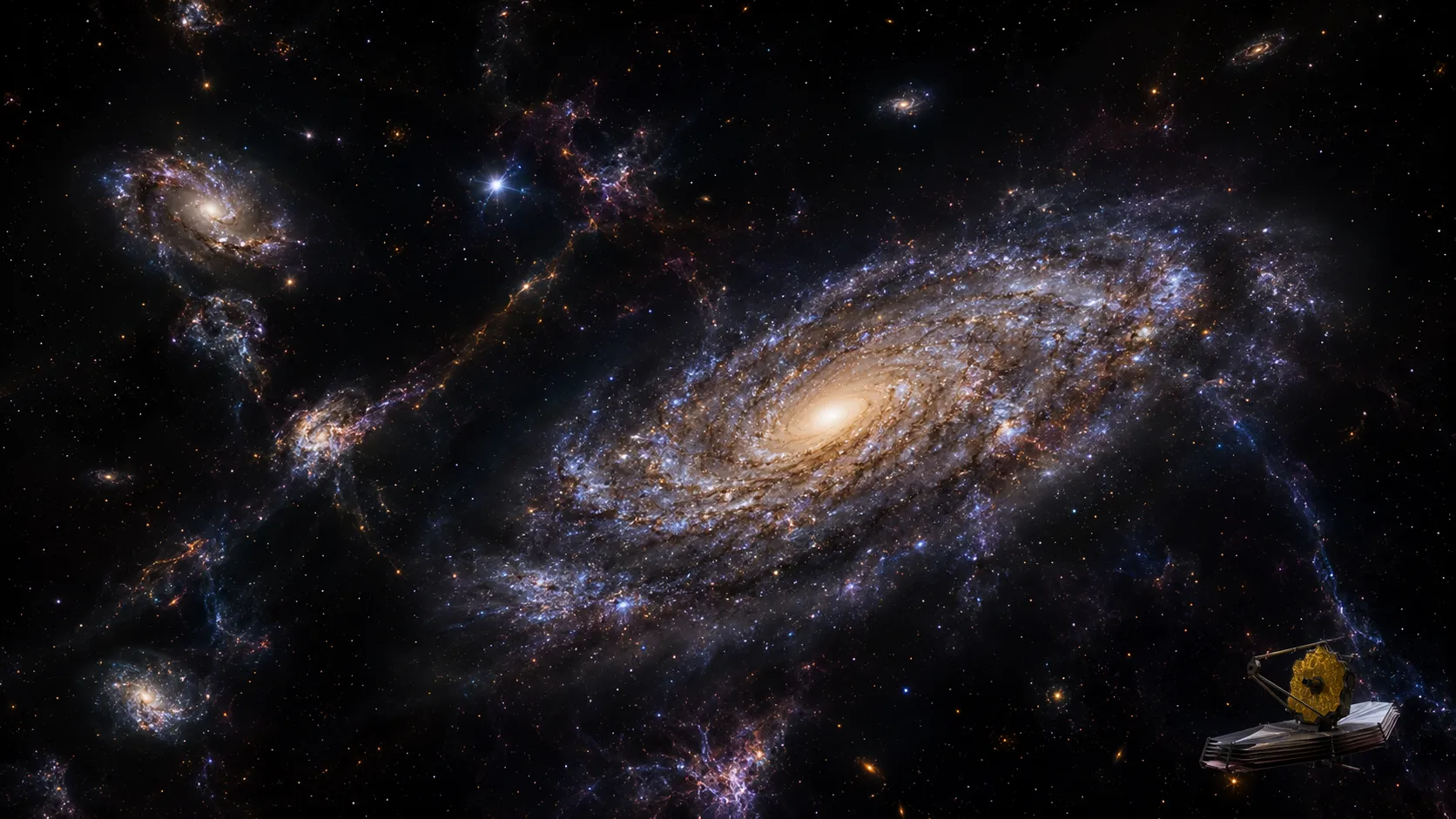
In a study published this month in the Monthly Notices of the Royal Astronomical Society, researchers from the Inter-University Centre for Astronomy and Astrophysics in Pune announced the discovery of a Milky Way-like galaxy that existed when the universe was barely 1.5 billion years old—less than 11 percent of its current age. The galaxy, catalogued as JADES-GS-z14-0, exhibits a well-defined spiral structure with a central bulge and a rotating disk—features that, according to the prevailing models of galaxy formation, should not have been possible for at least another five billion years. The discovery was made using data from JWST, which is operated by NASA, the European Space Agency, and the Canadian Space Agency, and which has been producing a steady stream of revelations about the early universe since its launch in 2021. But this particular revelation is among the most significant yet—because it challenges not just a detail of the standard model, but one of its foundational assumptions.
"It is a surprising find," said Dr. Piyush Sharda, an astrophysicist at IUCAA and the lead author of the study. "We are seeing a galaxy that looks remarkably like our own Milky Way, but at a time when the universe was still in its infancy. This suggests that the processes that create ordered, spiral galaxies can operate much faster than we thought—or that there are processes at work that we do not yet understand." The statement, delivered with the careful understatement of a scientist whose work has just overturned a generation of theoretical models, captures the central tension of modern cosmology: the more we see of the early universe, the less it conforms to our expectations.
The Telescope That Sees the Beginning
To understand what the IUCAA team has found, one must first understand the instrument that made the discovery possible—and the peculiar way it sees the universe.
The James Webb Space Telescope is not a camera in the conventional sense. It does not take pictures of distant objects by capturing the light they emit in the visible spectrum. It sees in the infrared—the region of the electromagnetic spectrum where the most ancient and most distant objects in the universe reveal themselves. This is because the universe is expanding, and as light travels across the expanding fabric of space-time, its wavelength stretches. The visible light emitted by a galaxy 13 billion years ago has been stretched, over the course of its journey to Earth, into the infrared. To see the first galaxies, you must look not at the light they emitted, but at the ghost of that light—the redshifted afterglow that has been travelling toward us for most of the history of the universe.
JWST was designed specifically for this purpose. Its 6.5-metre primary mirror—a tessellated golden honeycomb of 18 hexagonal segments—is the largest ever launched into space. Its instruments are sensitive enough to detect the heat signature of a bumblebee on the Moon. Its location, at the L2 Lagrange point a million miles from Earth, shields it from the infrared glare of our own planet and allows it to stare, uninterrupted, into the deepest reaches of cosmic time. Since its first scientific images were released in July 2022, the telescope has been producing a cascade of discoveries that have challenged the standard model of cosmology at almost every turn: galaxies that are too massive, too early; black holes that are too large, too soon; structures that should not have had time to form and that are nevertheless, unmistakably, there.
The JADES (JWST Advanced Deep Extragalactic Survey) programme, under which the IUCAA team made their discovery, is one of the telescope's flagship projects—a systematic survey of the deepest, oldest regions of the sky, designed to find and characterise the first galaxies that formed after the Big Bang. The programme has already produced a catalogue of hundreds of early-universe galaxies, each one a window into an era that was, until recently, completely invisible to human science. The galaxy JADES-GS-z14-0 is one of the most remarkable objects in that catalogue—not because it is the most distant or the most massive, but because it is the most ordered. It looks like a galaxy that belongs in the present-day universe, and it has been found in a universe that was barely out of its cradle.
The Indian Team That Made the Discovery
The most significant dimension of this discovery, for Indian science, is not the finding itself. It is the fact that the team that led the analysis was based in India. The Inter-University Centre for Astronomy and Astrophysics in Pune is one of the country's premier research institutions, and its scientists have been involved in JWST science from the earliest stages of the telescope's planning. But the discovery of a Milky Way-like galaxy in the early universe—a finding that challenges one of the fundamental assumptions of galaxy formation theory—is among the most high-profile results to emerge from an Indian-led JWST analysis.
The team was led by Dr. Piyush Sharda, an astrophysicist whose research focuses on the formation and evolution of galaxies. He was supported by colleagues at IUCAA and by collaborators at institutions in the United States, the United Kingdom, and Europe. The analysis used data from JWST's NIRCam (Near Infrared Camera) and NIRSpec (Near Infrared Spectrograph) instruments, which together provide both the imaging resolution to resolve the galaxy's spiral structure and the spectroscopic data to confirm its redshift and thus its age. The galaxy's light has been travelling toward Earth for approximately 13.1 billion years, and the spiral arms that JWST has resolved in that ancient light are essentially identical in structure to the arms of the Milky Way.
The significance of the discovery for Indian astronomy extends beyond the scientific result itself. India has been a partner in some of the world's largest astronomical observatories—the Giant Metrewave Radio Telescope near Pune, the Thirty Metre Telescope in Hawaii, the LIGO gravitational-wave detector—but the country's astronomers have historically been underrepresented in the highest-impact science that emerges from flagship space telescopes like Hubble and JWST. The IUCAA discovery is part of a broader trend of Indian researchers claiming a larger share of the scientific output from the world's most powerful observatories. In the same month that the JADES result was published, Indian astronomers using JWST data published separate findings on the chemical composition of early-universe galaxies, the formation of the first supermassive black holes, and the distribution of dark matter in galaxy clusters. The country's astrophysics community is producing science at a level that is beginning to match its growing investment in astronomical infrastructure.
The discovery also highlights the importance of international collaboration in modern astronomy. JWST is a NASA-led mission, with significant contributions from the European and Canadian space agencies. The data it produces is available to scientists around the world through a competitive proposal process, and the IUCAA team won their observing time through exactly that process—competing against the best astronomers on Earth for access to the most powerful telescope ever built. The fact that a team based in Pune won that competition, and used that time to make a discovery of this significance, is a measure of how far Indian astronomy has come.
The Theoretical Earthquake
The discovery of a Milky Way-like galaxy at a redshift corresponding to 1.5 billion years after the Big Bang is not merely a curiosity. It is a theoretical earthquake—a finding that challenges the standard model of galaxy formation at one of its most fundamental levels.
The standard model, known as Lambda-CDM (Lambda Cold Dark Matter), describes a universe in which structure forms hierarchically. Small clumps of dark matter coalesce first. Gas falls into these clumps, forming the first stars and the first small, irregular galaxies. Over billions of years, these small galaxies merge, collide, and gradually build larger structures. The process is violent and chaotic, and the model predicts that it takes a long time—at least several billion years—for the turbulence of these early mergers to settle into the orderly, rotating disks that characterise spiral galaxies like the Milky Way. The discovery of a well-formed spiral galaxy at a cosmic age of 1.5 billion years suggests either that the hierarchical model is incomplete, or that the timescales it predicts are wrong.
There are several possible explanations. One is that the galaxy formed through a process of "cold accretion"—the smooth, orderly infall of gas from the intergalactic medium, rather than the chaotic mergers that dominate the standard model. Cold accretion can, in theory, build disk galaxies much faster than the merger-driven model, and the existence of JADES-GS-z14-0 may be evidence that this process was more common in the early universe than previously believed. Another possibility is that the galaxy's spiral structure is not primordial, but was imposed more recently by a gravitational interaction with a neighbouring galaxy—a process that can transform an irregular galaxy into a spiral in a few hundred million years. A third possibility is that the standard model itself needs revision—that the role of magnetic fields, cosmic rays, or feedback from supermassive black holes in shaping early galaxies has been underestimated.
"Whatever the explanation," Dr. Sharda said, "this galaxy is telling us that our models of the early universe are too simple. We need to account for processes that can create order out of chaos much faster than we thought possible." The statement captures the central challenge of modern cosmology: the universe, as observed by JWST, is more complex, more varied, and more surprising than the models that were built to explain it. The telescope is producing discoveries faster than theorists can absorb them, and the models that have guided the field for a generation are being revised, almost in real time, in response to the data.
The discovery also has implications for the search for life beyond Earth. Spiral galaxies like the Milky Way are the most likely hosts for habitable planets, because their orderly structure provides stable environments in which planetary systems can form and evolve over billions of years without being disrupted by the gravitational chaos of galaxy mergers. If spiral galaxies can form much earlier in cosmic history than previously believed, then the window for the emergence of life in the universe may be much wider than previously estimated—and the number of potentially habitable worlds may be correspondingly larger.
The Golden Age of Indian Astronomy
The IUCAA discovery is not occurring in isolation. It is part of a broader golden age for Indian astronomy—a period in which the country's researchers are participating in, and increasingly leading, the most important scientific discoveries of the era.
India's astronomical ambitions have expanded dramatically over the past decade. The country is a partner in the Thirty Metre Telescope, one of the largest ground-based observatories ever conceived, which will provide imaging resolution ten times sharper than the Hubble Space Telescope when it is completed. India's AstroSat, the country's first dedicated multi-wavelength space observatory, has been producing science since its launch in 2015. The LIGO-India gravitational-wave detector, now under construction, will join the global network of observatories that have opened an entirely new window onto the universe. And Indian astronomers are increasingly competitive in winning observing time on the world's most powerful telescopes, including JWST, ALMA (the Atacama Large Millimetre/submillimetre Array), and the Very Large Telescope in Chile.
The IUCAA discovery is a product of that expanding capability. It also highlights the importance of India's investment in fundamental research—an investment that has historically been modest by comparison with the country's spending on applied science and technology. The Department of Science and Technology, which funds IUCAA, has been increasing its support for astronomy and astrophysics, and the results are beginning to show. The country that once produced Nobel laureates like C.V. Raman and Subrahmanyan Chandrasekhar is now producing a new generation of scientists who are competing at the highest levels of global research—and they are doing so from institutions in Pune, Bengaluru, and Mumbai, rather than from Cambridge, Princeton, or Caltech.
The broader context is a global scientific landscape in which the centre of gravity is shifting. The United States and Europe remain the dominant powers in astronomy, but China, India, and other nations are rapidly expanding their capabilities. The next generation of astronomical observatories—the Extremely Large Telescope in Chile, the Square Kilometre Array in South Africa and Australia, the Nancy Grace Roman Space Telescope—will be built and operated by international consortia that include Indian scientists and Indian funding. The discoveries that emerge from these observatories will, increasingly, bear Indian names. The galaxy JADES-GS-z14-0, and the team in Pune that found it, are a preview of that future.
What This Signals
The discovery of JADES-GS-z14-0 is not primarily about a single galaxy. It is about the transformation of our understanding of the universe—and about the role that Indian science is playing in that transformation.
For decades, the standard model of cosmology has been a triumph of human reason. It has explained the distribution of galaxies, the afterglow of the Big Bang, and the large-scale structure of the universe with extraordinary precision. But it has always been a model—a simplified representation of a reality that is more complex, more varied, and more surprising than any model can capture. The JWST era is exposing the limitations of that model, and the scientists who are leading the revision are based not only in the traditional centres of astronomical research, but in Pune, in Bengaluru, and in other cities that were once on the periphery of the global scientific enterprise.
The galaxy that shouldn't exist has been found. It is 13.1 billion light-years away, and its light has been travelling toward us for almost the entire history of the universe. The spiral arms that JWST has resolved in that ancient light are a message from the dawn of time—a message that says, in the language of physics, that the universe is more creative, more efficient, and more surprising than we imagined. The Indian astronomers who received that message and decoded its meaning have written their names into the history of science. The universe, as observed, is more beautiful than the models that described it. The models will now be revised. The telescope will keep observing. The galaxies will keep forming, in ways we are only beginning to understand. And the team in Pune, and the country they represent, will be part of the revision.


